Category Archives: advocating civic education

the first “civic ed” bill: 1642

The Massachusetts legislature is considering S. 2306, a bill to enhance civic education. I’m for this legislation. Questions about whether the Commonwealth should require civics–or, indeed, any subject–led me to wonder when civics was first mandated in Massachusetts. I think the answer is 1642:

Forasmuch as the good education of children is of singular behoof and benefit to any Common-wealth; and whereas many parents & masters are too indulgent and negligent of their duty in that kind. It is therfore ordered that the Select men of every town, in the severall precincts and quarters where they dwell, shall have a vigilant eye over their brethren & neighbours, to see, first that none of them shall suffer so much barbarism in any of their families as not to indeavour to teach by themselves or others, their children & apprentices so much learning as may enable them perfectly to read the English tongue, & knowledge of the Capital Lawes: upon penaltie of twentie shillings for each neglect therin.

There was a high-stakes test. All “children or apprentices” had to learn “some short orthodox catechism without book, that they may be able to answer unto the questions that shall be propounded to them out of such catechism by their parents or masters or any of the Select men when they shall call them to a tryall of what they have learned of this kind.”

And there were accountability mechanisms. In addition to the “twentie shilling” fine for local leaders who failed to ensure successful educational outcomes for all their communities’ youth, there was also a plan to be followed when “children and servants bec[a]me rude, stubborn & unruly.” First, the responsible selectmen would be admonished. Next, “the said Select men with the help of two Magistrates, or the next County court for that Shire, shall take such children or apprentices from them & place them with some masters for years (boyes till they come to twenty one, and girls eighteen years of age compleat) which will more strictly look unto, and force them to submit unto government according to the rules of this order, if by fair means and former instructions they will not be drawn into it.”

The 1642 act required religious as well as civil instruction, which we wouldn’t endorse under the US Constitution. It included a large dose of what we might call character education, career preparation, and/or social-emotional development, under the heading of preparation for “some honest lawful calling, labour or employment, either in husbandry, or some other trade profitable for themselves.”

I’m not saying that the Massachusetts School Law of 1642 is what we need today. It’s wise to innovate. But there is certainly precedent for requiring civics: 375 years of precedent, in fact.

new Civic Studies major at Tufts

Yesterday, the Tufts Faculty of Arts & Sciences approved our proposal for a new major in Civic Studies, the first in the world. It will begin next fall, and I’ll co-teach the new introductory course with my colleagues Erin Kelly (Philosophy) and Yannis Evrigenis (Political Science). Here are the relevant portions of the proposal that passed yesterday:

Curriculum Proposal: Civic Studies

“We see before us an emerging civic politics, along with an emerging intellectual community, a field, and a discipline. Its work is to understand and strengthen civic politics, civic initiatives, civic capacity, civic society and civic culture.…and to contribute to an emerging global movement of civic renewal.” — Harry Boyte, Stephen Elkin, Peter Levine, Jane Mansbridge, Elinor Ostrom, Karol So?tan, and Rogers Smith, “Framing Statement for Civic Studies,” 2007

Civic Studies is an interdisciplinary field of study that focuses on critical reflection, ethical thinking, and action for social change, within and between societies. People who think and act together to improve society must address problems of collective action (how to get members to work together) and deliberation (how to reason together about contested values). They must understand how power is organized and how it operates within and between societies. They must grapple with social conflict, violence, and other obstacles to peaceful cooperation. They will consider questions of justice and fairness when social tensions arise, and they must confront questions about appropriate relationships to outsiders of all types. This includes examining alternative ethical, political, and theological frameworks to encourage comparative reflection about different ways in which people live together in society.

The focus on civil society contrasts with state-centric approaches. It includes the study of collective action in social spheres that, while organized, may not be institutionalized or otherwise sanctioned by the state, and it highlights the perspective of individual and group agents.  Thus civic studies considers phenomena that are central to other disciplines—governments, law, markets, societies, cultures, and networks—but from the distinctive perspective of civic agents, that is, individuals and groups who think together and act cooperatively. It includes principles and vantage points civic agents may use to evaluate existing social norms, institutions, governments, and ideologies. In these and other ways, Civic Studies brings critical scrutiny to status quo norms of social order.

Civic Studies is more than citizenship studies. Civic agents include citizens, disenfranchised or colonized groups, temporary residents, undocumented migrants, refugees, and members of other societies acting across borders. Civic Studies engages with the importance of a society’s criteria of membership, as well as the logic and dynamics of inclusion and exclusion, hierarchy and subordination, across social groups. It subjects social dynamics to empirical study and normative evaluation, with the aim of understanding how to challenge unjust inequalities and to enhance just forms of social inclusion.

Normative reflection, ethical analysis, empirical understanding, historical perspective, and the development of practical skills are all important to the study of social and political conflict, and for developing cooperative strategies to enable positive social change. Civic Studies brings those modes of learning together to deepen our understanding of social criticism and action for social change as well as the circumstances that give rise to a need for it. The major’s classroom and experiential learning requirements would enable students to explore the theory and practice of critical reflection and just social change.

A Peace and Justice Studies track within the Civic Studies major provides a special focus within Civic Studies for learning about the causes and effects of violence, and for developing nonviolent strategies for conflict resolution and just social transformation. A minor in Peace and Justice Studies is also available to students who are particularly interested in studying violence and alternatives to it.

In sum, a major in Civic Studies [will] continue from the Tufts Peace and Justice Studies major the following core commitments: a combination of classroom-based and experiential learning; normative analysis and critical scrutiny of claims about justice; an explicit focus on conflict and possibilities for resolving it, and the development of skills useful in nonprofits, governments, community groups, and social movements. We believe the intellectual content of Civic Studies is exciting and the curriculum distinctive, highlighting strengths of Tufts University.

The proposed requirements for the Civic Studies major are 11 courses distributed as follows:

  1. CVS 0010—Introduction to Civic Studies
  2. Thinking about Justice: two courses in political theory, philosophy, or social theory devoted to normative questions about the nature and content of justice. Courses must be selected from an approved list. [Examples are listed in the proposal. E.g., PS 41: Western Political Thought I and II; REL 43: Asian Religions; HIST 129: Black Political Thought in the 20th century]
  3. Social Conflict and Violence: Two courses to enhance an empirical understanding of the historical, political, and social origins of conflict and violence. Courses must be selected from an approved list. [Among others: SOC 94: Sociology of Violence; PS 138-01: Political Violence in State and Society; PSY 136: Stereotypes, Prejudice, and Discrimination]
  4. Civic Action and Social Movements: Two courses dealing with the historical, ethical, and social origins of organized movements for social change. Courses must be selected from an approved list. [Among others: CH 109: Community Action and Social Movements in Public Health; ANTH 0146: Global Feminisms]
  5. Civic Skills: two courses that focus on civic skills or civic practices, e.g., dialogue and deliberation, ethical reasoning, emotional intelligence, conflict-mediation and peacemaking, community-based research, communication and media-making, public art, community organizing, evaluating nonprofits, or financing social enterprises. [Among others: UEP 194: Technology, Media, and the City; ELS 193: Social Entrepreneurship, Policy, and Systems Change; VISC 145/AMER 94, which is a course taught in state prison]
  6. CVS 099: A required internship. This includes a weekly 2.5 hour class with graded assignments and a final project. (3 SHUs)
  7. CVS 190: A capstone seminar taught by a CVS affiliated faculty member.(3 SHUs)

Total: 11 courses

my exchange with Beth Rubin about policy for civics

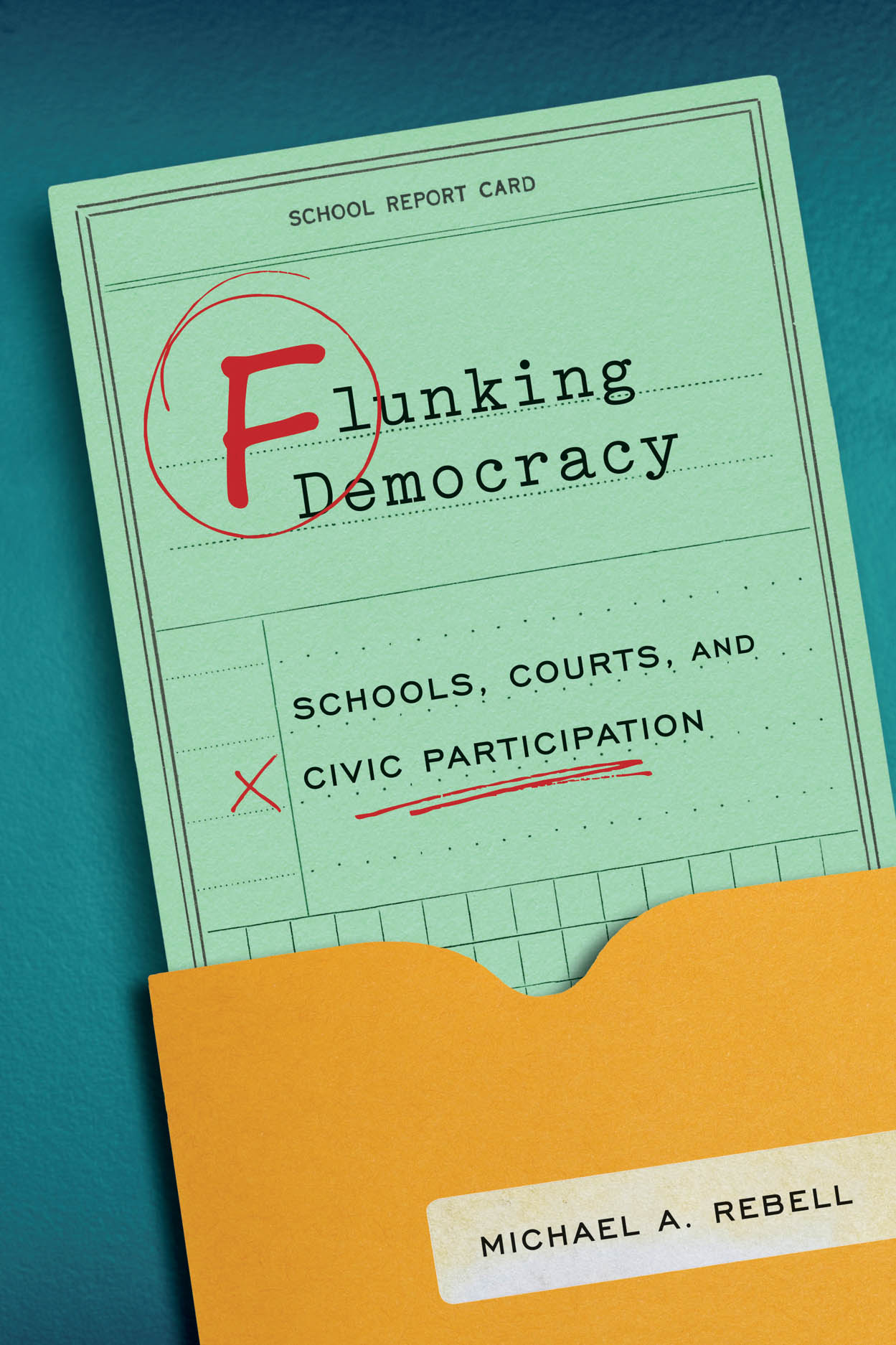
Paul G. Fitchett and Kevin W. Meuwissen have published Social Studies in the New Education Policy Era: Conversations on Purposes, Perspectives, and Practices. This edited volume is devoted to exchanges between pairs of scholars. My assigned debating partner is Prof. Beth Rubin from Rutgers, whose work I admire and who has influenced me a lot. There isn’t a whole lot of room between Beth and me, but we manage to disagree mildly in ways that might be illuminating.

I begin by arguing that the policies adopted so far by states and districts for civic education matter, but not as much as how such policies are implemented. Support for things like professional development makes policies either work or fail. I also note that the policy debate reflects disagreements about what should be taught. Given such disagreements, no one can expect to get the curriculum that she or he prefers enacted into law in all 50 states. I propose a division of labor: public schools should teach relatively uncontroversial, relatively basic civics, and community-based groups should add more politically charged content that reflects their diverse perspectives.

Beth understandably worries that the mainstream curriculum mandated by governments will, in fact, be biased. She argues that governments should make schools good places for learning, leaving civics curricula mostly unconstrained by policy. That would imply skepticism about policies like standards and tests, because they centralize decisions about the curriculum. I counter by offering a state policy agenda that includes standards, professional development, reforms of school discipline, and tests–if they are well done. This package is fairly minimalist, intended to create a baseline for all kids while leaving space for diversity. Beth ends the exchange with some concerns about whether the “baseline of knowledge” that I want to see in state standards can really be good for all of our kids.

The rest of the book is entirely devoted to similar debates, and it looks good throughout.

talking about teens and the 2018 election

While traveling to Orlando to talk about civic education, I’ll post two recent links.

First is today’s episode of “On Point” from NPR. The guests are three teenagers who are running for governor in Kansas (which imposes no age limit on candidates)–and me. I celebrate the young politicians but try to broaden the conversation to other forms of civic engagement that can involve a lot more kids.

And here is a piece by me on civic education in America and specifically in Connecticut “PERSPECTIVE: Republic Still at Risk; Connecticut Edges Forward.”

22 million new voters by 2020

With The LAMP, a New York City nonprofit that works on media and digital literacy skills, my colleagues at CIRCLE are launching the 22×20 Campaign, which has the tagline “22 million new voters by the year 2020.”

For the night of the State of the Union, 22×20 helped organize Action Parties in “New York City, Washington D.C., Austin, Chicago, Boston and San Francisco with partners such as Austin Public Library, Mikva Challenge, DoSomething.org, KQED, OZY, Sony, and YVote.” Students were encouraged to discuss, analyze, and share their reactions. More information about how to organize such events is here.

The campaign also provides educational resources. For example, you can find lesson plans on media literacy and tutorials on how to create videos using news clips. I thought the guide entitled “Ten Easy Steps to Fact-Checking” was a perfect resource for viewers of the State of the Union.

More events are coming up. Follow the campaign on Twitter (@22millionVotes) or by using the hastag #22×20CIRCLE also has an explanatory blog post on “Teens and Elections” with valuable background data.