Category Archives: Trump

why political science dismissed Trump and political theory predicted him, revisited

I’m not sure what’s driving the traffic, but since yesterday, more than 2,500 people have visited my March 3, 2016 post entitled “why political science dismissed Trump and political theory predicted him.” I probably should revisit the topic now that the election is over (especially since I subsequently used standard empirical methods to predict a Clinton victory, thus acting like a political scientist instead of a political theorist).

Last March, I argued that mainstream–empirical or positivist–political science research on “American government” (as the specialty is called) has a vulnerability. Aiming to be a science, it uses data that can be amalgamated to produce models and predictions, such as data from modern US elections. The main method of prediction is to run trend lines from the past into the near future. Although normative assessment is always marginal in positivist social science, most of this research has an implied value-stance: our system works, it follows rules and norms, it’s fairly durable, the players are reasonably competent professionals who support the regime, and you should understand and respect it even you want to reform it. Any reform proposals should be informed by empirical evidence, because otherwise the reforms will have unintended consequences that are likely to be bad. As the great Theodore Lowi wrote, “Realistic political science is a rationalization of the present. The political scientist is not necessarily a defender of the status quo, but the result is too often the same, because those who are trying to describe reality tend to reaffirm it.”

In contrast, political theorists spend their time reading critical reflections on politics written in highly diverse and often tragic circumstances. Hannah Arendt’s writings from Nazi Europe and Frantz Fanon’s analysis of colonial Algeria are just two examples. Political theorists are quick to see that regimes can change, that they can be very bad, that they have debatable normative foundations, and that ideas can be revolutionary.

This means that when Trump arrived on the national scene, positivist political scientists were prone to think that he couldn’t get anywhere in our system–because no one like him had–and political theorists were ready to think that he might take over, because they spend their time considering tyrants, fragile regimes, and the power of xenophobia and authoritarianism. Although there were exceptions in both camps, I think these are reasonable generalizations.

What should we conclude now that Trump is president-elect? It’s tempting to say that the theorists were right. But there’s actually a mainstream positivist account of what just happened. Presidential elections in two-party systems tend to settle at a point where each party has a 50% chance of winning. Given the way nominees are selected in multi-candidate primaries, a smallish faction can capture either party. Its nominee will still have very close to a 50% chance of winning: that’s why Trump got about half the votes, and because of the Electoral College, he won. Furthermore, given the constraints built into the regime as a whole, Trump is likely to govern as a Chamber of Commerce Republican rather than an authoritarian. And if he pushes too far, his party will lose the Congress in two years.

The trouble with political theory is that its predictions can be unmoored from empirical reality. Some political theorists have been predicting catastrophe or revolution throughout my lifetime. The fact that regimes sometimes change does not mean that ours is always about to. I think the odds are still against our regime changing fundamentally in the immediate future.

On the other hand, our political economy is problematic in ways that are not immediately evident from empirical data about the recent past. The Constitution does not fit the present society. The document has fundamental flaws, and the society is evolving toward oligarchy. Although empirical evidence is relevant to those claims, one needs a broader, deeper, and more evaluative stance on the regime as a whole to grasp a crisis such as our present one.
time for civil courage

Post-War Germany teaches the ideal of Zivilcourage, civil courage. The acid test is whether you would stand up to a tyrant rather than standing by as he takes over. Even when a literal tyranny is not imminent, civil courage means holding sacred ground.

It’s what we need today. And that means, please, no jokes about moving to Canada. No thoughts about giving up on the nation you belong to, even if its majority and its institutions anger you. No opting out. You may have suffered grievous injustices at the hands of the United States: many have. In that case, you owe no gratitude or service to the republic. But you have more leverage over the US government than the billions who live beyond our borders and yet face the consequences of our policies. You owe it to them to stand up: here, now.

It may seem that the large, official institutions of the United States are remote and unresponsive to our actions, yours and mine. But the fundamental premise of my whole career is that our formal institutions reflect the ways that we talk and work together in everyday life. My first job out of graduate school was at Common Cause, helping to lobby Congress for institutional reform. But while I worked there (1991-3), the organization’s membership rolls were in steep and prolonged decline. Common Cause evolved from a grassroots movement for good government (solely dependent on 250,000 members in local and state chapters) into a nonprofit organization that employs talented experts and relies heavily on grants and large gifts. As such, it has lost political influence. I began to think that we can’t have decent political institutions without a base of active, responsible, organized citizens. Robert Putnam’s 1995 “Bowling Alone” article struck a chord for that reason, and everything I’ve worked on since then has been in the service of civic renewal.

This means that you are showing civil courage if you are working to strengthen the associations and networks that connect us as fellow citizens. This theory is also a source of optimism. Despite some deterioration, we have a far better civil society than Italy had in 1922, or Germany in 1932. For just that reason, actual tyranny is highly unlikely here. (Radical Paul Ryanesque neoliberalism is much more of a threat.) But our associations and networks are only as robust as we make them.

By the way, the networks and associations that we build must include Trump voters. This is not a matter of showing empathy to them or trying to achieve reconciliation. Instead, a cold, hard look at the situation tells me that Trump voters are unrepresented by accountable organizations, and that makes them dangerous. If they had organizations, I’d be on the opposite side from them on most issues, but we could negotiate. Absent a functioning civil society, they have opted for a celebrity who will give them nothing, even as he harms others.

Speaking of cold, hard analysis: we should be critical, but avoid anger. There’s plenty of blame to go around, and it’s fine to apportion responsibility if that helps to improve the situation. We can critically assess Clinton and her campaign, the Democratic establishment and its ideology, consultants and pollsters, the media, the FBI, Ted Cruz, Bernie Sanders, white voters, old voters, rural voters, men, and anyone else you like. But not in anger, because anger clouds judgment and promotes error. The situation is complex; nothing but a clear-headed, subtle, multifaceted analysis will suffice.

Joseph Schumpeter and the 2016 election

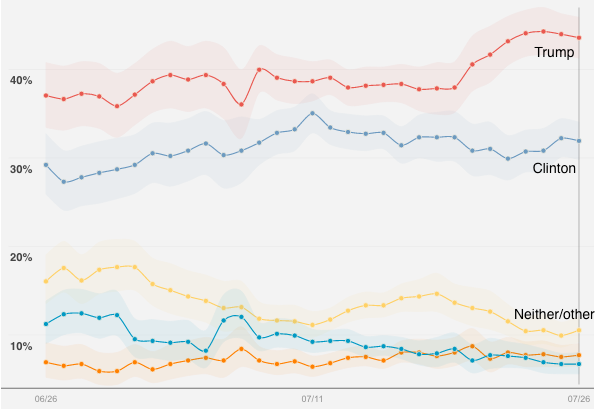
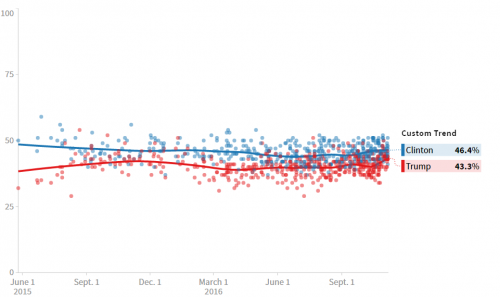
The graph below depicts the 2016 campaign as I see it. When all the polls are displayed on a graph with a y-axis from 0-100% and a fairly strong “smoothing” algorithm is applied, it becomes evident that hardly anything has changed for 18 months. Hillary Clinton has been ahead of Donald Trump by about 4-5 points nationally all along, and she leads by a mean of exactly four points in the major final polls released by this point on the last Monday. The ups and downs revealed by zooming in are best understood as temporary responses to news that may influence who participates in surveys–or who feels enthusiastic on a given day–but very few people have actually changed their minds; and most of those switches have been random and have canceled each other out.

2016-2

I think this means that Clinton is likely to win the national popular vote by about 4 points, although GOTV operations could change result that (in either direction).

It’s hard to know whether different nominees would have performed differently. A reasonable guess is that if both parties had nominated politicians with typical levels of popularity who used typical methods of campaigning, the Republican would have an edge. That implies that Trump v. Clinton costs the GOP maybe 4-6 points, net–but that is not much more than a guess.

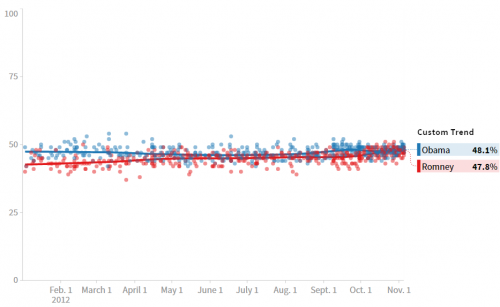
By the way, 2012 looks about the same, except Romney ran closer to Obama all the way along.

2012

But 2008 was different: McCain was ahead at first but slipped behind Obama to lose pretty badly.

For me, the interesting question is what this means about our civic culture and the purpose of campaigns and elections. The presidential candidates have raised about $1.3 billion so far and spent most of that on such activities as advertising, canvassing, and events. The press has spent untold billions on campaign coverage and commentary. All kinds of remarkable events have occurred. As all that has played out, citizens have been exhorted to pay attention and to change their opinions in response to arguments and information. But it looks as if almost everyone already had enough data 18 months ago to make up their minds. That includes me: nothing has transpired since June 2015 that has altered the probability of my voting for Clinton versus Trump by even one thousandth of a percentage point.

I used to subscribe to the view that the actions of candidates and campaigns matter, but they usually cancel each other out because all presidential nominees of major parties are effective campaigners. This year, we have one truly incompetent candidate, yet the trend remains flat. Unless you think that Clinton’s weaknesses cancel out Trump’s incompetence, it looks as if campaigns hardly matter at all. Once citizens know the candidates’ party labels, demographics, and basic facts about their biographies, they are ready to vote.

Perhaps Joseph Schumpeter was right, at least about presidential politics. It’s all about rendering a verdict on the status quo and choosing either the incumbent elites or an outsider. Schumpeter adds:

The reduced sense of responsibility and the absence of effective volition in turn explain the ordinary citizen’s ignorance and lack of judgment in matters of domestic and foreign policy which are if anything more shocking in the case of educated people and of people who are successfully active in non-political walks of life than it is with uneducated people in humble stations. Information is plentiful and readily available. But this does not seem to make any difference. Nor should we wonder at it. … Without the initiative that comes from immediate responsibility, ignorance will persist in the face of masses of information however complete and correct. It persists even in the face of the meritorious efforts that are being made to go beyond presenting information and to teach the use of it by means of lectures, classes, discussion groups. Results are not zero. But they are small. People cannot be carried up the ladder. …

Thus the typical citizen drops down to a lower level of mental performance as soon as he enters the political field. He argues and analyzes in a way which he would readily recognize as infantile within the sphere of his real interests. He becomes a primitive again. His thinking becomes associative and affective.

Since Schumpeter’s view of democracy is unattractive, we must either reform presidential politics or (if that seems impossible) write it off and focus on other aspects of our political system, where more people can show more “immediate responsibility” for collective decisions.

social class does predict Trump support

Some say that Trump has captured the support of working-class Whites who are economically stressed or anxious. Others reply that Trump voters are relatively upscale but motivated by racial resentment alone. The former premise suggests that Democrats must do more to empower the working class, including Whites. The latter suggests that White nationalism is our fundamental problem today. Although I see truth in both positions, I’ve argued for addressing the economic and political vulnerability of the White working class. I present that as a strategy for countering Trumpism, but it’s a misguided strategy for that purpose if Trump voters are relatively affluent.

The raw story is that White people with lower incomes are Trump’s strongest backers.

Presidential Candidate Preference for Whites with Family Income <75K (Reuters)

Presidential Candidate Preference for Whites with Family Income <$75K (Reuters)

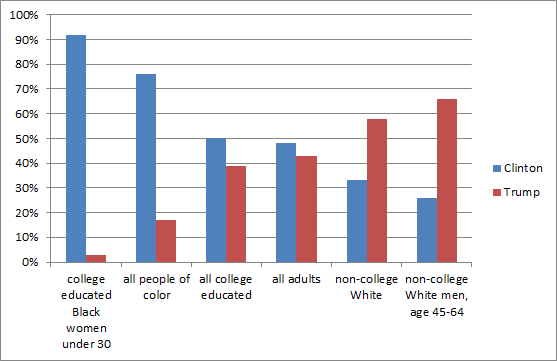
But it’s not just about income and race. Education levels, age, and gender are also strongly related to voters’ preferences in this election, as I illustrate with data from YouGov:

yougov

The question is what to make of those middle-aged White men without college degrees, who are preferring Trump over Clinton by more than two-to-one in the YouGov polls (and by 59%-25% in Reuters). Is it economic anxiety, racial identity, or what?

One of the most widely cited pieces of evidence against the economic-anxiety explanation is Jonathan Rothwell’s paper, “Explaining nationalist political views: The case of Donald Trump.” Rothwell, who works for Gallup, conducted a regression analysis of almost 100,000 Gallup survey responses collected over the year that ended in July (i.e., mostly during the primary season). I have no quarrel with the paper, but I would note that it does not debunk a class analysis of the Trump vote.

Rothwell finds that holding a favorable view of Trump correlates with higher, not lower, income. Nate Silver is also widely cited for his finding that Trump voters during the primary season had higher median incomes than Clinton and Sanders voters (but the same as Cruz voters and lower than Kasich voters).

However, Rothwell also looks at whether household income remains a significant predictor of Trump support once you consider the fact that Trump voters are disproportionately White, male, and older. Using one measure of income, it remains a significant predictor; with a different measure, it ceases to predict Trump support.

At the same time, Rothwell’s model shows that you are more likely, to a statistically significant degree, to favor Trump if you: (1) hold a blue-collar job; (2) did not attend college; and (3) live in a community with high White mortality rates. Those relationships appear in the whole sample but are especially strong when the model is restricted to non-Hispanic Whites. Further, “more subtle measures at the commuting zone level provide evidence that social well-being, measured by longevity and intergenerational mobility, is significantly lower among in the communities of Trump supporters.”

If social class means income, then class is not a strong predictor of Trump support in Rothwell’s model. At least during the primary season, Trump voters were actually wealthier than the mean American voter. But if class means social status, and status involves occupation and education, then Trump voters tend to be downscale Whites in downscale White areas.

Rothwell’s paper uses a binary outcome of Trump support versus non-Trump support. The non-supporters include Republicans who were still favoring Cruz, Rubio, and others, plus Democrats for Sanders. That makes the analysis a bit dated now that we’re down to Clinton v. Trump. Reuters data suggests that Trump widened his lead among working class White men once he won the nomination.

Presidential Candidate Preference, White Men Without College Degrees (Reuters)

Presidential Candidate Preference, White Men Without College Degrees (Reuters)

Meanwhile, Clinton is now doing very well among the top 1 percent of the income distribution.

In sum, the relationship between working class status (measured by education) and Trump support seems strikingly strong for the White population. This doesn’t mean that class is the only issue. Race/ethnicity and gender are obviously very significant. But it means that there is some truth to the class analysis.

See also why the white working class must organize and it’s hard to talk about tough issues if no organization represents you.

what people mean when they say that Trump or Clinton is honest

It flabbergasts many people to learn that more Americans view Trump rather than Clinton as “honest and trustworthy” (35% versus 33%), even though we can read in The New York Times, “A Week of Whoppers from Donald Trump”; in The Washington Post, “Trump’s Week Reveals Bleak View, Dubious Statements in ‘Alternative Universe‘”; and in The Los Angeles Times, “Scope of Trump’s Falsehoods Unprecedented for a Modern Presidential Candidate.”

In philosophy school, you learn to make distinctions, and I think two distinctions may be useful for interpreting the public’s response. First, “truthfulness” can mean:

  1. Saying what is true. Because they envision truths as claims consistent with evidence, many fact-checkers compare candidates’ assertions to government data and public records or to academic research. For instance, Donald Trump has said that Lester Holt, the debate moderator, is a Democrat, but official records show that Holt is a registered Republican. The Times calls that a “whopper.” I am confident that Hillary Clinton’s claims are far more often verifiable than Donald Trump’s, and in that sense, she is more truthful and trustworthy.
  2. Investing skill and effort in finding the truth. If truth is correspondence to some independently verifiable reality, then a person could say something true–or false–by accident. We can also err when we fact-check. But some people truly strive for truth. They are careful not to opine on matters for which they lack evidence, they listen to alternative views, they complicate their positions when they encounter contrary evidence, they may even seek contrary evidence, and they select appropriate methods for answering empirical questions. They can still be wrong, but they have a respectful attitude to truth. I am confident that Hillary Clinton is a much more dedicated and skillful truth-seeker than Donald Trump is, although one could raise serious criticisms of her truth-seeking in episodes like her vote to authorize the Iraq War (when she had privileged access to intelligence) or her endorsement of the “super-predator” theory of crime.
  3. Speaking what is in your mind. For many people, honesty and truthfulness mean candor, sincerity, or forthrightness. Provoked by tricky Odysseus, guileless Achilles exclaims, “I hate like the Gates of Hell a man who says one thing and thinks another in his mind!” A candid straight-shooter can say lots of things that are false, either by accident or because he’s not a good truth-seeker. If he really, truly thinks that taxes are higher in the US than any other country, he looks you in the eyes and says so. Judged by that third standard, I am not sure whether Trump is “honest.” Although he may be guileful, it’s at least plausible that he blurts out what he really thinks, reflecting an ideological/normative worldview that he genuinely holds. Sometimes he even says things that cost him tactically because they make him look dumb or alienate a specific voting bloc that might have preferred him. And just for that reason, lots of people think he’s “honest.” As for Hillary Clinton, I perceive that she thinks many things in her mind and puts them through a very careful screen before she speaks aloud. Voters are sensitive to that kind of processing. They take slip-ups, like her “deplorables” comment, to be glimpses of a hidden stratum of sincere beliefs. This is what some have in mind when they call Trump more honest than Clinton.

“He tells it like it is”

My own view would be something like this: Truth-seeking is an important virtue for political leaders. It raises the odds that leaders will know the actual truth, although I’d forgive any human being for making errors if she demonstrates both commitment and skill in her truth-seeking.

Politicians should also demonstrate some candor. To struggle to know the truth and then to say something less than, or different from, the truth in public is not very democratic. On the other hand, politics isn’t a seminar room, a lab, or a witness stand in a court of law. Other political virtues may conflict with candor, such as tact, diplomacy, privacy, national or global security, and sheer effectiveness. A political leader must strive to enact and change policies, and it can undermine her effectiveness if she says everything she believes. I am pretty sure that’s why Clinton talks as she does, but because many people equate truthfulness with candor, she pays a price.

It’s also worth distinguishing between …

  1. the immediate empirical truth of statements (e.g., “Lester Holt is a Democrat,” which is false), and
  2. the truth or validity of broad ideological positions (e.g., “The media is biased against regular folks”).

I believe that Hillary Clinton’s center/left ideology is much more defensible than Trump’s authoritarian ethno-nationalism, but that requires arguments rather than empirical data; and other positions are more defensible still than Clinton’s.

I am also inclined to think that Trump is pretty candid about his own ideological position, although he fails to acknowledge its implications (which is a fault of his truth-seeking). I am not sure how candid Clinton is about her ideology; that is hard to assess from afar. I’d argue that center-left American politicians exhibit a general lack of ideological candor because they presume that many beneficial policies are unpopular. For instance, it would be wise to borrow and spend on infrastructure, but you can’t say that because the American people don’t trust government. It would be desirable to standardize curricula and tests because in lots of communities, parents are creationists or otherwise misguided, but you’d better not say that because those people vote. I’d posit that Clinton struggles to attract trust in part because she belongs to a whole ideological bloc that has struggled since the 1970s to present itself candidly to the electorate.

See also: Bernard Williams on truth as a virtue of the humanitieswhy Hillary Clinton appears untrustworthy; and Hillary Clinton on spending for infrastructure.