Category Archives: Trump

White racial resentment and the 2016 election

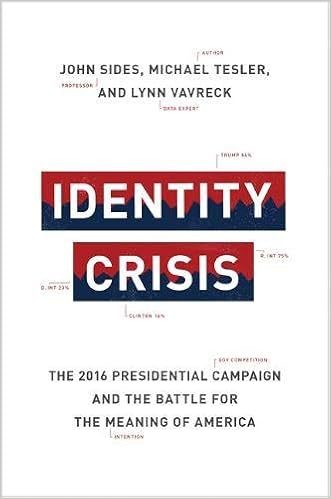
Yesterday, I got to hear Michael Tesler present about his forthcoming book with John Sides and Lynn Vavreck: Identity Crisis: The 2016 Presidential Campaign and the Battle for the Meaning of America. I don’t want to give away the content based on yesterday’s presentation; the book is due early next year. But promotional materials already say: “Identity Crisis reveals how Trump’s victory was foreshadowed by changes in the Democratic and Republican coalitions that were driven by people’s racial and ethnic identities. The campaign then reinforced and exacerbated those cleavages as it focused on issues related to race, immigration, and religion.”

The 2016 election can’t have a single cause, but this book adds weight to the thesis that White racial identity played a major role–more so in 2016 than at any point since 1968. Tesler made me think of an argument by Manuel Pastor, who has noted that White identity peaked in California when Whites saw their majority control nearing its end. In 1994, Californians passed Prop. 187 to block undocumented people from getting state services and to establish a “citizenship screening system.” Governor Pete Wilson made support for Prop. 187 his hallmark issue and used it to win reelection. Incumbent Democratic Senator Diane Feinstein tried to position herself as a critic of immigration as well.

California is no utopia today, but defensive White identity seems to have passed its peak there. I suspect that facing the prospect of losing majority status triggered a sense of threat. Once Whites actually became a minority in California, the sky didn’t fall, and the sense of threat passed. Whites retain their social and economic advantages despite representing just 48% of the votes cast in the 2016 election. I would contrast Texas, where a White-majority coalition still dominates the electorate but the demographic trends are against them. In 2016, 57% of Texas voters were still White (and they preferred Trump by 43 points), but they must know their electoral control won’t last.

It would be valuable to look in more detail at major cities where Whites lost majority control after 1970. Often, White racial identity peaked around the point when the first Black mayor was elected, which marked a threat to White control. The next mayor was sometimes propelled by White backlash, but then a racially diverse coalition came to dominate, and most Whites adjusted to it.

Earlier this year, Pastor told the New York Times, “The United States just went through its Prop. 187 moment.” That period in California was ugly and lasted a while. Pastor asked, “Why go through all of our pain? That was no fun, and it dashed a lot of people’s lives. We underinvested in education. We over-imprisoned, so we got a lot of people locked out of the labor market. We broke apart a lot of families because of anti-immigrant sentiments. We did a lot of stupid things to ourselves.” The good news is that if the country follows California’s trajectory, we will ultimately reach a better place, but we need to get there much faster and with less damage.

the remarkable budget deal

Many have been rightly alarmed by the Trump Administration’s commitments to terminate programs related to scholarship and science, aspects of k-16 education, environmental and climate research, and national and community service. The critical response from citizens has been appropriate and welcome. But it’s also valuable to recognize the limits on any administration’s ability to change federal priorities, the degree to which valuable programs enjoy bipartisan support in Congress, and the extraordinarily inept record of the Trump team so far.

All of those factors are evident in the Consolidated Appropriations Act of 2017. The bill is 1,665 pages long, and it is written as a set of dollar figures plus instructions (“riders”). Because these aren’t presented as changes compared to last year, it is hard to see what Congress has done. But as far as I can tell, most of the changes have been in the direction of more funding for education, culture, science, and even climate science.

The National Institutes of Health, National Endowment for the Humanities, and National Endowment for the Arts all see increases (source). NEH’s research funding is modestly cut, while support for the State Humanities Councils goes up. (My friend Elizabeth Lynn has explained how the State Councils are responsible for the NEH’s political fortunes since the 1970s.) The Corporation for Public Broadcasting is fully funded (source).

EPA faces a one percent overall cut. The Department of Energy’s research budget and the National Science Foundation see increases. Climate research within DoE is boosted. “The Bureau of Land Management, National Park Service and Fish and Wildlife Service all would see more money under the bill, which included few policy riders for the agencies” (source). NOAA receives an increase, and the Climate Program Office within NOAA is held flat. The National Environmental Information Office and Regional Climate Centers have flat budgets.

Education as a whole is cut by 0.1%. Within Education, Title I funding rises; support for education research is trimmed.

The bill “restores year-round Pell Grant funding, a longtime priority sought by student aid groups since its elimination as a cost-saving measure in 2011. The deal also … provides modest increases to college readiness programs TRIO and GEAR UP, which were reduced significantly in the proposed White House 2018 budget plan” (source).

Normally, the president proposes and Congress disposes. In this case, the president has alienated enough potential allies, failed to fill enough key positions, and played his hand so badly that after he proposed, Congress just developed an entirely different budget on a fairly bipartisan basis. To be sure, next year could be worse; and some of the people responsible for implementing these programs will do their best to sabotage them. Still, the new budget deal ought to be an antidote to defeatism.

(See also “mixed feelings on the DeVos nomination battle,” in which I argued that the new Education Secretary will have very limited impact on policy.)

the impact of post 9/11 war on our politics

(San Antonio, TX) Any effort to understand the current political situation must take seriously the fact that we have been war since 2001. Although it’s problematic to assess wars as won or lost, that’s a hard framework to avoid; and in those terms, we’ve lost. Neither Afghanistan nor Iraq—let alone Libya or Syria—is in a state that any proponent of these wars would have remotely advocated before we invaded.

Nations typically respond poorly to the experience of losing wars. The post-9/11 conflicts have been somewhat unusual. Even though we failed in our objectives, the vast majority of the human price was borne by people who are remote from US voters in both space and culture—Iraqis and Afghans. We lost no territory and very few lives at home after 9/11. Meanwhile, a small proportion of US citizens have actually been deployed in those zones. Military personnel are far from representative of the US population. Instead, they are concentrated in certain communities and families. It’s easy for some of us to forget that we have been at war; impossible for those who have served in a war zone or have sent close relatives there.

I think that for many Americans, the experience of having fought and lost is very salient. For others, it’s hardly a thought. To be critical of George W. Bush for launching an unjust war (as I am) is very different from feeling the trauma of having personally served and suffered for no apparent reason. Across history, that type of experience has often produced very ugly political results.

Certainly, voters will blame leaders who were responsible for launching and then managing these conflicts. George W. Bush left office deeply unpopular. Hillary Clinton voted (with very few fellow Democrats) for the Iraq War and then, as Secretary of State, took partial responsibility for managing the conflicts (from Libya to Pakistan) when they weren’t going well. I think the political cost of that record has been under appreciated. It didn’t help that she prospered personally and sought even higher office while others paid for decisions that she had supported. Barack Obama got a partial pass because he—like Donald Trump—was out of office when the war began. However, one of several reasons that President Obama was a polarizing figure is that some Americans blamed him for losing the wars he had inherited, some thought he disappointingly continued the Bush policies, and others thought he managed these wars skillfully.

Trump lied that he opposed the war at first, but presumably many people believed him because they never saw the counter-evidence. More importantly, Trump acknowledged the experience of having lost wars and proposed a response: from now on, we will win, because we’ll spend much more money and ignore any moral and diplomatic constraints.

Veterans and people who live in communities with heavy military presence were far more likely to vote for Trump in November. Maybe I have missed it, but I don’t recall hearing a plausible message to those communities from politicians and movements that oppose these kinds of wars. I respect a genuinely pacifist (or anti-imperialist) stance, but it has a long way to go to capture majority support, and it faces valid questions as a policy position. (Should we really not intervene militarily against ISIS?) Any viable message must acknowledge the experience of trauma without patronizing those who have served. And it must recognize the desire for the nation to succeed without being bellicose.

three views of the Democratic Party when democracy is at risk

View #1: The same two parties have alternated power since 1854 and will continue to do so for the foreseeable future. Today, the most serious threat to small-d democratic norms and institutions comes from the Trump Administration, and the Democratic opposition is an essential counterweight. A Democratic House in 2018 could begin serious investigations; a Democratic president in 2010 2020 would end the Trump era. You may or may not agree with the platform of the Party, but it’s a big tent, and you have your choice of intraparty factions to back, from Sen. Manchin to Sen. Warren. Moreover, any Democrat would endorse positions on some issues that are preferable to those of the Trump Administration. The Party is accountable to communities most threatened by Trump: for instance, half the voting delegates at the Democratic National Convention were people of color. That fact pushes the Party to defend basic rights for all. The Democratic Party is a bulwark of democracy; it must win the elections of 2018 and 2020.

View #2: At the root of our problems is partisanship. Most of us (including me) use partisan labels as heuristics for assessing policies, candidates, news sources, and opinions. As a result, we are prone to misunderstanding the situation and demonizing half of our fellow Americans. “Partisanship is a helluva drug.” What we need is less reliance on party labels and more cross-partisan or non-partisan dialogue. Maybe it would be better if more Democrats won elections, but that is up to the Party apparatus and should not be our focus as concerned citizens.

View #3: The party duopoly stands in the way of progress, for reasons specific to our moment. Once industrial unions declined and working-class whites migrated to the GOP, we were left with two parties controlled by economic elites. Main Street business interests and extractive industries like coal and oil control the GOP, drawing votes from working-class whites who are not likely to see their interests served. Highly educated coastal elites control the Democratic Party, with votes from people of color who have no better choice. The result is hard-wired neoliberalism, with modest distinctions between the parties on civil rights and environmental regulation. Democracy (in the sense of government that responds to mass economic needs) requires a major reorientation of the whole duopoly. Trump actually enables that in a way that Hillary Clinton could not, in part because of his potential to blow up his own party.

For those keeping score, these three views are most consistent with the first, sixth, and second boxes in my flowchart (below). They can be posed as stark alternatives, demanding a debate. But it’s possible that they all contain truths and that we need people working on all three.

would Americans be better off if they used ideology as a heuristic?

(Washington DC) News stories abound these days about Trump voters who are surprised that the president and his party may cut their benefits. For instance, Mae Bilodeau says she voted for Trump “precisely because she thought he would help the poor people of America who need services like [the local Legal Advice and Referral Center]. ‘He seems to be taking away from them more than helping them at this point,’ Bilodeau said.”

A good number of Trump voters even spontaneously announce a preference for a Canadian-style single payer system.

I learned a long time ago to think of US politics on a left/right continuum: pro-state on the left, anti-state on the right. Using that framework, I regarded Obamacare as a modest shift leftward. I assumed that President Obama would wish to move further left but had compromised (wisely, I think; others would say unnecessarily) by enacting the ACA. If I were enrolled in an Obamacare exchange, I would expect a Democrat to reduce my premiums or increase my benefits, simply by spending more money on the program. I would expect a Republican president to do the opposite: defund or repeal the law. My opinion of their positions would depend on my view of the government and the market.

But the Trump supporters quoted in these recent news reports do not use the left/right continuum as a heuristic. And that shouldn’t surprise us.  “Despite the centrality of philosophical concepts like liberalism and conservatism to mainstream political discourse, modern public opinion research has generally concluded that most citizens are unable to effectively use these concepts when making political judgments” (Frederico & Hunt 2013). Instead, at least some of Trump’s voters simply see him as standing on their side, and liberals as their enemies. I overheard two working-class white New England guys recently. One said, “The problem with liberals is they just hate people.” The other laughed. Many seem to have assumed that Trump would lower their premiums or improve their benefits. If Obama wasn’t doing either, that showed that he was a people-hating liberal, or perhaps just less competent than business-wizard Donald J. Trump would be.

This post could end with me tsk-tsking my fellow citizens for not using the ideological heuristic that I learned long ago to decide for whom to vote. And in fact, I believe Americans would be better off (overall) if they at least understood how to think in pro-state versus pro-market terms. That would certainly be far preferable to using race as a heuristic, as some may do.

Yet they may also be right to downplay the left/right spectrum. Consider the Kentuckian whom Sarak Kliff interviewed last December. She is reliant on the ACA, yet she had voted for Trump. She explained, “I guess I thought that, you know, he would not do this, he would not take health insurance away knowing it would affect so many peoples lives. … I mean, what are you to do then if you cannot pay for insurance?”

At the time, I tsk-tsked. But, to my surprise, it now looks fairly unlikely that the Republicans will repeal the ACA. This voter was right, and I was wrong. She saw herself as part of a coalition that won the election and would serve her interests. Ultimately, I believe that heuristic misled her, because she threw her support to anti-government conservatives who want to cut her benefits for ideological reasons, and she joined a coalition dominated by wealthy people who mainly want their taxes cut. But again, I am the one who was surprised to see ACA repeal in such trouble; her prediction was more accurate than mine.

Republicans tend to think that they have an anti-government or pro-market movement behind them. They are likely wrong. (CIRCLE’s research reveals a substantial shift of young white men who define themselves as “moderates,” not “conservatives,” to Trump in 2016.) The Alt-Right believes there’s a majority that is pro-welfare and also white-supremacist. I doubt that constituency is huge. But liberals should also doubt that they can win votes mainly by finding the right point on the left/right spectrum. Their main challenge is trust. As for voters, they may use a range of heuristics to assess candidates, but they would be wise not to ignore left/right ideology completely, because it explains why the GOP is trying to cut their benefits.