Category Archives: Trump

considering censure

The question of the moment should not be what decision to reach in re Donald Trump. Justice is always best served by a process that generates evidence and permits a defense before any decision is reached. A process conducted by Congress cannot avoid being political, but it can be structured so that all sides get heard and the conclusions are open rather than foreordained. This is important for fairness and legitimacy.

Not to hold any kind of process at all would itself be a decision. It would be a clear statement that presidents enjoy impunity when their party controls at least one house of Congress. That would be another step in the degeneration of our system. I think this degeneration reflects fairly deep flaws built into the Constitution. But that is no excuse for non-action.

An impeachment process would require public hearings and debates, which would be valuable for the American people to see and to assess. It would count as a “judicial proceeding,” thus justifying the release of key documents, including those involved in grand jury proceedings. It would also justify sending the president written questions, and if he refused to answer, that refusal would be material to the decision. It would force all members of the House to take a position; all Senators, too, if the House voted to impeach.

On the other hand, impeachment is not much of a sanction if it doesn’t lead to conviction in the Senate. A split result might further cheapen the constitutional remedy of impeachment.

Although Jeffrey Isaac is right that members of the House and presidential candidates can address other issues while an impeachment process unfolds, their attention and the public’s focus are finite resources. Impeachment would dominate politics. If that helped Trump by keeping him in the spotlight or by obscuring a truly substantive debate about policy and philosophy within the Democratic primary, it would not serve the public interest.

Senators should be forced to take positions on Trump’s alleged obstruction, but an impeachment vote could be more politically costly for Democratic incumbents than for Republicans. The Post is reporting that the public is currently against impeachment, 56%-37%. Opinions certainly could shift as a result of the process, but you have to assume that attitudes toward Donald Trump are now pretty durable. It doesn’t make sense to punish a president by subjecting his opposition to a tough political battle.

The considerations against impeachment make me wonder about censure. Like impeachment, censure would not be a foreordained decision but a choice for each house of Congress to consider after due investigation and public debate. The practical consequences of censure are the same as those of impeachment if we assume that the Senate would fail to convict. The civic advantages of the debate and public vote are the same. I suppose nobody knows whether censure counts as a “judicial process,” but the House would certainly argue so when demanding sealed grand jury documents. The public might be more receptive to censure than impeachment, and it could be done quicker.

The main disadvantage is that a process to determine whether to censure the president forecloses the possibility of removing him from office. It says that Trump will finish his term unless something else arises that necessitates impeachment. That implication is hard to swallow but might make the best sense overall.
on playing hardball with the shutdown

On the one hand … The recent shutdown and the threat of a second one result from the Democrats’ choices as well as Donald Trump’s. Nancy Pelosi could reflect that she previously supported legislation that expanded walls on the Southern border, that $6 billion is a mere 0.16 percent of the federal budget, and that closing the government to thwart the president’s desire for a wall causes real people real pain–above all the low-income contract workers who will never be repaid for missed work. These might be reasons for her to compromise. I might add that the shutdown gives me the satisfaction of a successful political brawl without costing me anything. (I wasn’t even inconvenienced at the various TSA inspections I crossed while the TSA workers weren’t being paid.) And there is a long, very ugly tradition of sacrificing other people’s immediate interests for political purposes, sometimes justified on the ground that you can’t make omelets without breaking eggs or that the revolution is more likely to begin if the government gets worse. This is a path to evil paved with dubious intentions.

On the other hand … The president was elected with (although not necessarily because of) racist and factually false claims: migration from the south is hurting “us,” a wall would stop it, and the republic to our south can be forced to pay for it. In a world of partisan polarization and weaponized disinformation, there are scant consequences for making such claims. A shutdown forces Trump to pay a price. For the American people and the political elites who watch the public’s reactions, it sharply clarifies what is at stake. It has reminded many voters of the value of civil servants’ work. It deters similar behavior by Trump and by his allies. Along with a few more such conflicts, it may prevent him from being reelected.

In the end, I favor playing hardball. I think the last shutdown was a good moment, and it is worth risking a second one by negotiating hard with the president.

We must be constantly attentive to the dangers of forcing conflicts when other people bear the costs, and we must resist the narcotic attractions of partisan victory. I’ve been reading a lot of Gandhi lately and can imagine him fasting or doing something self-sacrificial after having heightened tensions in this way–for the good of his soul and as a method of preventing hubris.

But he and other nonviolent political leaders do intentionally heighten tensions. When the openly racist Public Safety Commissioner of Birmingham, “Bull” Connor, was defeated by a White moderate candidate, the Civil Rights Movement rushed to take advantage of his lame duck months in office. They knew that he would turn firehoses and dogs on the children and teenagers in their movement. His reaction was an opportunity for victory that they didn’t want to squander.

Just because the end does not justify the means, it doesn’t follow that you can’t strategize with goals in mind. We must not forget the contract workers who go without pay in a shutdown. Neither can we overlook the long, slow, and vast injustices of our immigration and criminal justice policies. A shutdown forces those issues onto the agenda and may increase the odds of a new coalition governing the country.

If public deliberation is a value (as I think it is), then there would be better ways to reason together about public policy. We wouldn’t have to force vulnerable people to sacrifice in the interest of clarity. But the reality is a system of unaccountable government plus partisan polarization and hypercharged misinformatibon. Under those circumstances, nothing cuts through the fog and illuminates citizens’ choices as well as a crisis. Wise leaders must be ready to force crises if they think they can win.

See also: should Democrats play constitutional hardball in 2019-20?; game theory and the shutdown; moderation, civility, and bipartisanship are not the same; Brag, Cave and Crow: a contribution to game theory; and Gandhi on the primacy of means over ends.

Brag, Cave and Crow: a contribution to game theory

Game theory models interactions by presenting the “players” as people (or organizations) who face choices, and the outcome as the result of how they each choose. In conflictual circumstances, the players can choose between the option that their opponent would prefer (cooperate) or the one that their opponent would not prefer (defect). In certain unpleasant circumstances, such as the Prisoner’s Dilemma, every player is better off defecting even though that outcome is worst for all.

Donald Trump has faced a set of conflictual games as president, with North Korea, Mexico and Canada, China, and Chuck & Nancy (among others) on the opposite side of the table. He has frequently applied the novel strategy of Brag, Cave, and Crow (Trump, DJ et al. 2019). It works like this: First declare very loudly that you will defect and the other side will be forced to cooperate, then cooperate, and then declare very loudly that the other side was the one that cooperated.

This is not as dumb as it sounds.

First, assume that you can convince yourself that you did win. Payers seek to achieve their own preferences or maximize their own satisfaction. If you talk yourself into the idea that you won even though someone might see you as having folded, your subjective feelings are fine. That’s a win. Meanwhile, the conflict is gone and does you no more damage.

Second, if you are Donald Trump, you are always more interested in another game, a popularity contest. You are appealing to an audience of consumers or voters. Insofar as you can persuade them that you won even though you folded, you do win what you wanted most. And in a world of echo chambers and partisan heuristics, often this is exactly what happens. For instance, settle for the substance of NAFTA with minor tweaks, but rename it with an acronym that has “US … A” in it, and you can Brag, Cave, and Crow (BCC) for the win.

In the immediate circumstances, it’s good that BCC pays off for Donald Trump. It’s much better that he should brag about having solved the North Korean nuclear standoff than convince himself that he must actually force North Korea to denuclearize. Likewise, if he can claim he built a wall on the southern border when he didn’t, that will save us all some money, preserve the Constitution, offend Mexico less than a physical wall would, and leave nature and landowners alone.

At this juncture, Trump’s choice is either to Crow or to go back to the Brag stage. In other words, he can declare that he won or else threaten to win in the future with a veto or a declaration of emergency. I don’t think he can both Brag and Crow at the same moment about the same thing, although the echo chamber may be hermetic enough to allow that to work to some degree.

Alas, the incentive to BCC is yet another blow to responsible and accountable governance and public deliberation.

See also game theory and the shutdown; the emperor’s new wall; and why learn game theory?

game theory and the shutdown

In game theory, you model a real-world situation by simplifying it to depict a finite group of “players” who are defined by preferences and choices. You predict outcomes based on how these players will choose. The structure of the choice matters, e.g., Will they decide simultaneously or in turn? Once, or several times? (Here’s my argument that game theory is useful.)

In the case of the current shutdown, it seems that at least the following six players are relevant:

  • Donald Trump: He can choose at any time between the status quo (threatening to veto a continuing resolution, or CR, unless it includes money for a wall) or folding (saying that he would sign such a resolution). His decision-making process is simple: he does what he wants to do. He could, however, renege on a promise to sign a “clean” CR. He presumably wants: 1) the wall, 2) the ability to claim a victory, 3) higher instead of lower popularity, 4) strong support among Republican voters, to head off a primary, 5) economic growth, and 6) an outcome that will satisfy the actual opponents of immigration (who know that a wall won’t really help their cause). NB: these are not in order, because I am not sure how to rank them.
  • Chuck and Nancy: They can choose at any time between the status quo (supporting only a “clean” CR) or else folding (agreeing to fund the wall). Their decision-making process is complex since they are elected by caucuses full of diverse interests and values. They presumably want: 1) no wall, 2) a victory over Trump that is popular on the center-left, 3) Trump’s popularity to fall, 4) the Republican congressional caucuses to fracture, 5) federal workers to be paid, and 6) other policies, such as DACA, to pass. Again, these are not in order–maybe they want 6) most of all.
  • Mitch McConnell: He can choose at any time to propose a “clean” CR or some kind of win/win agreement, such as the wall plus DACA. He presumably wants: 1) this whole thing to go away, 2) conservatives in Kentucky to like him, 3) Republican Senators in diverse circumstances all to be reelected in 2020, and 4) his caucus to hang together.
  • Federal workers: They can choose at any time between the status quo (showing up to work without being paid) or some kind of civil resistance: massive absenteeism, a wildcat strike. Their decision-making is very complex. For instance, the National Border Patrol Council (a union) is right behind Trump, but perhaps its members aren’t. In general, federal workers presumably want: 1) to get paid. Their other interests–such as harming or else supporting Trump–vary.
  • Right-wing personalities and organizations: They can choose to put pressure on Trump or back off. They like the wall but differ in how much they like it. Many know that it wouldn’t actually reduce immigration and are dead-set against giving up a punitive immigration law in return for a wall that doesn’t work. But their opinions on that matter vary. They need not speak in unison, and perhaps it’s necessary to model them as several players. They presumably want: 1) less immigration, 2) symbolic manifestations of white nationalism, 3) Democrats and liberals to look bad, 4) their own audiences to stay loyal.
  • The people who are sampled in opinion polls: They can each say whether they blame Trump or the Democrats. Their decision-making process is individual choice followed by a pollster’s statistical aggregation. They want lots of things, but current polls suggest that the largest group wants: 1) no wall, 2) the government to reopen, and 3) the politicians to move onto other things. This is what they say, but the partisan heuristics with which they’d assess any specific outcome cannot be discounted.

I tend to think that Tyler Cowan is right that the federal workers will end this. Of course, their ability to act is much constrained by labor law, but they still have a range of tactics available to them. Mitch McConnell is the other player with a lot of clout–but bad options, which is why he isn’t playing so far.

The time dimension is crucial, since the status quo could be interrupted unpredictably by a disaster that needs a federal response, an economic crisis, a serious decline in Trump’s popularity, an erosion of public support for the Democrats, or a major distraction, such as a certain Special Council’s final report. Smart players must decide how to choose based on deep uncertainty about what happens next.

churchgoing and Trump

The Democracy Fund’s Voter Study Group has released an important new paper by Emily Ekins entitled, “Religious Trump Voters: How Faith Moderates Attitudes about Immigration, Race, and Identity.”

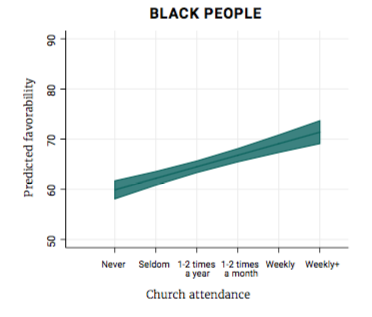
Ekins notes that Trump performed best in the 2016 GOP primaries among Republican voters who never attend church (getting 69% of their vote). Examining Trump voters during 2018, she finds correlations between regularity of church attendance and positive attitudes toward racial and religious minorities, acceptance of diversity, approval of immigration (and opposition to the border wall), and concern about poverty.

Here I illustrate that pattern with attitudes toward Black people as the dependent variable. The trend line controls for race, gender, income, education, and age. All the data come from Trump voters. Because the correlation between church attendance and racial attitudes among Trump voters holds with these controls, Ekins suggests that it is causal.

This might not be a case of cause-and-effect. A third factor might underlie both tolerance and church attendance. However, I posited a similar causal hypothesis early in 2017, after I’d met with a conservative Southern pastor who despised Trump’s leadership style and attitudes. This pastor blamed Trump’s support on coach-potato “Christians,” those for whom Christianity is an identity rather than an actual faith, those who get their ideas from Fox News or Breitbart, not from fellow congregants.

Some colleagues and I tried to test this hypothesis using survey data and failed to find it, which is a null result worth noting. Still, I’d like to think that Ekins is right—perhaps more so in 2018 than in 2016.

Why would this pattern hold?

First, Ekins shows that church-attending Trump supporters volunteer and trust other people much more than Trump supporters who rarely or never attend Church. It may be that people who help others and feel they can rely on others are less likely to despise and fear strangers. In turn, church-attendance may promote volunteering and trust, or it may manifest a broader form of social capital that explains both tolerance and church-attendance.

Robert Putnam introduced a distinction between “bridging” and “bonding” social capital. The bridging kind connects people who are diverse in some respects; the bonding kind may increase solidarity in opposition to outsiders. One could imagine that churches enhance bonding social capital. America is said to be most segregated on Sunday mornings, and churches distinguish insiders from outsiders. But volunteering and trusting generic others are measures of bridging, not bonding, social capital. Insofar as churches encourage volunteering, they are trying to create bridging social capital.

Another mechanism could be leadership. Real churches have leaders, both clergy and laypeople. Church leaders are expected to be responsive and responsible and to hold the group together. In contrast, Trump just says whatever comes into his mind, usually makes no effort to deliver what he promises, and is happy to divide. I have hypothesized that people who are familiar with real leadership in local voluntary associations would despise Trump’s style. Although we were unable to show that pattern using survey data, Ekins’ new results may suggest that it holds.

A third mechanism could be the content of the faith. I happen not to be religious, and I could criticize the specific content of many sermons and texts on ethical grounds. I am aware that there are mega-churches that show huge audiences jingoistic videos of American military might; there are clerics who praise Trump or cite Romans 13 to defend the administration’s policies. In my opinion, these examples are idolatrous as well as unjust, but my argument does not depend on romanticizing the content of religious expression.

I would argue, instead, that real faith is demanding. You can find passages and examples that reinforce bigotry, but you will also encounter texts that challenge you. Faith may be consistent with almost any policy position—as we can see from the enormous range of political opinions among clergy—yet participation in a deep and complex religious community is inconsistent with all simplistic attitudes about other people. Cable news and propagandistic websites reinforce what their audiences want to hear, but scripture is strange and demanding. Since religious texts are very hard to figure out by oneself, they require discussion and debate. In turn, the people in any given discussion usually turn out to have idiosyncratic and incompatible interpretations. This is why Martin Luther, despite his break with The Church, believed that we all need a church to keep us honest. Even if the content of preaching and liturgy doesn’t turn us into people who understand and care for others, the decision to attend a service may reflect a desire to become such a person.

In short, religion as a pure identity: bad. Religion as a community of people who struggle to address issues of moral and existential importance: good. Voters who actually attend church are more likely to experience the good form of religion, compared to those who identify as Christians without showing up on Sunday.

See also: the prospects for an evangelical turn against Trumpthe Hollowing Out of US Democracywhy Trump fans aren’t holding him accountable (yet); and why Trump fans aren’t holding him accountable (yet)