Category Archives: 2016 election

the pantomime of the Democratic primary, or the choices that actually confront the next president

The first question in Sunday’s Democratic primary debate was: “President Obama came to office determined to swing for the fences on health care reform. Voters want to know how you would define your presidency? How would you think big? So complete this sentence: in my first 100 days in office, my top three priorities will be — fill in the blank.”

All three candidates answered as they had been encouraged to, by describing grand changes in society that would require legislation to accomplish. None mentioned that conservatives have almost a 100% chance of controlling the House, the judiciary, and most states.

I wouldn’t criticize their approach to answering the question. If they had stuck to politically realistic answers, they would have allowed the other party to narrow the scope of discussion and debate. Also, it was illuminating to understand the differences that emerged when the candidates discussed legislation. For instance, are the Affordable Care Act and Dodd-Frank hard-won and fragile victories to be protected with strongly affirmative rhetoric (Clinton), or mere promissory notes demanding to be redeemed with better laws (Sanders)? Are almost all political dysfunctions traceable to campaign money (Sanders), or could skillful leadership within the current system improve things (Clinton)? Finally, it would have been defeatist for these candidates to offer realistic plans for their first 100 days. That would have undercut progressives’ efforts to win down-ballot races and would have converted a prediction into a self-fulfilling prophesy. In other words, it would have been bad leadership.

And yet, as someone deciding which candidate to choose, I am interested in what each candidate would actually do in office (as well as the more pressing question: Who has a better chance of beating the Republican nominee?). At least in the first two years, they would be able to do virtually none of the things they proposed in the debate. Any of them would veto assaults on the Affordable Care Act and negotiate a budget deal that retains most of the status quo. But some choices would confront them:

What unilateral foreign policy decisions to make. This is the area where Congress has–perhaps unfortunately–the least scope, although the national security apparatus has a great deal of say, and it’s not clear that the president really does decide. Dovish progressives have a hard choice in ’16, because Clinton has a hawkish record and Sanders has no experience managing the military and security agencies.

What legislation to propose to Congress first. Three options to send to the Hill are: 1) Widely popular but small-bore bills that can pass and establish a record of accomplishment. 2) Wedge issues: bills designed to catch the House Republicans between their constituents’ opinions and their party orthodoxy. Or 3) grand visions of alternative health or justice systems. These would fail but could possibly alter the terms of public debate. It’s a hard choice.

What executive orders to issue. Note that President Obama seems intent on using that authority to its full in his final year, and he may not leave a lot of attractive options for his successor.

Whom to nominate for a wide range of offices. Within many domains of policy, a Democrat has genuine choices. For instance, she or he could nominate an education reformer enamored of metrics, accountability, and competition (continuing the status quo) or switch to someone who prefers to give teachers autonomy and resources. There is plenty of room within the legislative framework of the Elementary and Secondary Education Act to push in either direction. In the economic agencies, there is a choice between mollifying Wall Street and the markets or regulating them aggressively.

In making appointments, the president also gets to choose leaders with a range of personal profiles. Any Democratic president will look for racial and gender diversity, but how to weigh ideological, religious, generational, and regional diversity? Should most cabinet secretaries have extensive experience as CEOs of large bureaucracies so that they can run things smoothly, or should they be thinkers and advocates?

I enjoy the debate about long-term directions for progressive politics and the nation, but we should probably ask the candidates how they will resolve the decisions that they will actually face.
if you’ve voted, it’s been noted

(Washington) In Hacking the Electorate: How Campaigns Perceive Voters, Eitan Hersh shows that candidates and campaigns obtain their knowledge of us, the citizenry, by analyzing voter files. They don’t know the truth about us; they know what the voter files say about us.

That means that getting on the voting rolls is a source of power. Once you’re on, the political class becomes interested in you. They measure and model and predict your preferences and behaviors. Your vote may not make a marginal difference in the electoral outcome. After all, most elections are lopsided victories. But even if you are part of a large majority or a small minority, the candidates will pay attention to you if you’re in the voter files, and they won’t even see you if you aren’t.

This is an argument for registering and voting that may not be easy to convey, but it has the advantage of being right.

Don’t campaigns learn what the whole population thinks from polls? The answer is: sometimes. Polls are mainly conducted for high profile races. It’s a pop-culture myth (see “The Good Wife”) that ordinary candidates do any significant polling. Besides, we are in the midst of a data revolution in which companies, governments, and politicians are shifting away from random samples to datasets that track all of the relevant behavior–every purchase on Amazon, every Web search, or every vote. These datasets are far more powerful than surveys for predicting and influencing people. In particular, voting files are powerful because: (1) public policy requires the collection of more data on voters than is strictly necessary to run an election, (2) voter files can be merged with commercial records, and (3) analysis of such data is becoming both more sophisticated and more user-friendly. (I take all of this from Hersh.)

Don’t campaigns learn about the public by talking to people? They used to rely on skillful, experienced neighborhood-level volunteers to provide information about the electorate. That whole infrastructure has been hollowed out by money and technology. Of course, there are still volunteers. But they come forward to work on particular campaigns. Few have deep and accumulated knowledge of local voters. The best way to harvest what they learn during a campaign is to require them to upload their observations about specific citizens to the voter files. Meanwhile, the candidates spend their time talking to donors. The voter file is how the campaign learns who you are–which means that you should make sure you’re on it by voting.

the Koch brothers network and the state of American parties

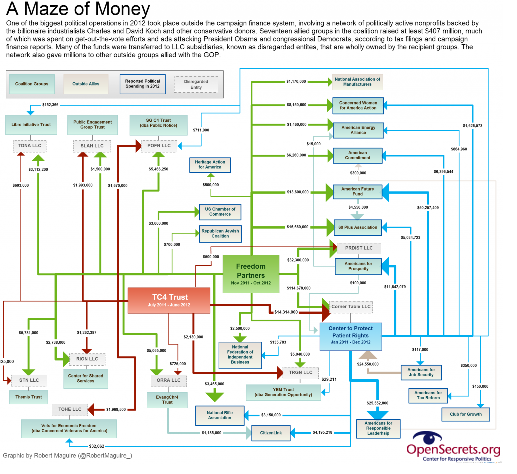
Kenneth Vogel reported recently in Politico that “[Charles] Koch and his brother David Koch have quietly assembled, piece by piece, a privatized political and policy advocacy operation like no other in American history that today includes hundreds of donors and employs 1,200 full-time, year-round staffers in 107 offices nationwide. That’s about 3½ times as many employees as the Republican National Committee and its congressional campaign arms had on their main payrolls last month.” Vogel adds that the Koch network will spend more than twice what the RNC spent in 2012, that it has more staff and funding in some key states than the state’s Republican party has, and that it is the leading provider of voter data and political training/coaching on the right today, supplanting the GOP.

Vogel and some of his quoted sources emphasize that this network is unprecedented in US history, which seems true. I would add that it appears unique in the world. The Varieties of Democracy (V-Dem) Project offers free data on the political systems of 173 countries. They ask so many questions about each country that the dataset includes 15 million data points. (I am one of many coders for the USA.) The V-Dem project asks about all kinds of ways in which political parties may be strong or weak; autonomous or co-opted; free, regulated or banned–but it doesn’t even pose questions about entities that perform the traditional functions of parties without being parties. That seems to be a novel contribution of the US since 2000.

The Koch network stands for an ideology and policies that I mostly disagree with, but that’s not the only reason to worry about this development–which could be replicated on the left. These are the main reasons:

  1. A standard political party is at least somewhat accountable, representative, and deliberative. Here are the extensive Rules of the Republican Party, which are mostly about intra-party elections, offices, procedures, and powers. They create a system in which each grassroots Republican has an independent voice and influence. To be sure, some parties have boasted of their authoritarian internal structures, but they have never been important in the US. More common are parties that fail to live up to their claims of responsiveness. In fact, Robert Michels’ “Iron Law of Oligarchy” (1911) was about the rigid tendency of even social-democratic parties to become internal oligarchies. That is a real worry, but there are limits to it. In competitive systems, parties that present themselves as democratic yet act oligarchically lose members and elections. Party elites are disciplined by voters–imperfectly but inevitably. There is no such mechanism within the Koch brothers’ network. It is officially and thoroughly oligarchical. The 1,200 paid staffers work for the people who pay them, not for voters or members.
  2. A party is also accountable to all the voters because it can obtain power and actually govern, and then the electorate can decide what they think of the results. But the Koch network doesn’t directly govern; it just influences some of the people who do. If the politicians they support turn out to be unpopular, the Koch network can pick new candidates for the next round. It cannot itself be voted out.
  3. A standard political party must be transparent if it seeks to attract and retain members. That’s why the GOP has published rules, leaders, and a platform. I am fully aware of the secrecy in US politics, but secrecy is checked by the need to compete for public support. As far as I can tell, the Koch network doesn’t even have an official name, let alone a set of binding rules that an outsider can assess, let alone a public budget.
  4. A standard political party includes both activists and interest groups and actual office-holders. The office-holders are responsible for performance in government and can’t just spout rhetoric. The activists, on the other hand, have some freedom to speak truth to power. The result is a healthy tension between aspirations and reality. But the Koch network is run by activists/interests groups who influence office-holders. It has no incentive to compromise or to support compromise.
  5. Power within the Koch network is proportional to money and is extraordinarily unequal. Michels taught that all parties are inequitable, even those most passionately committed to equality. Still, parties need citizens to vote and volunteer, and the capacity to do so is pretty evenly distributed across the population. The Koch network is purely and simply driven by money.

Below is the Koch network as depicted by my friends at the Center for Responsive Politics. It does not belong in a civics textbook, although a realistic textbook today should probably include it.

.Koch network


come work with us

(Washington, DC) Tisch College is advertising two positions:

A Program Administrator for the National Study of Learning, Voting, and Engagement, who will manage essential responsibilities associated with NSLVE including recruiting campuses to join the study, distributing data to campuses in the form of reports, and working to develop resources for all campuses to access through the website. The Program Administrator will also be responsible for supporting communications including but not limited to managing the process for the newsletter, updating the website, and collaborating with the team on other publications.

A Coordinator for our Voting Initiative: This individual will coordinate efforts to increase voter participation among Tufts students in the 2016 presidential election through initiatives supported by faculty and staff at all Tufts campuses. Responsibilities will include: working with student groups to sponsor forums on campaign issues of interest; implementing a plan for comprehensive voter registration opportunities; administering a fund for student-driven initiatives (etc.)

is Trumpism akin to the European right?

On the whole, I’m inclined to think that Donald Trump’s large lead in the Republican race is a passing phenomenon, similar to several candidates’ surges during 2011-12, and driven mostly by media attention and name-recognition at a time when most people are not yet following the campaign closely. In Die Hard III, which is 20 years old, Trump and Hillary Clinton are already two prominent references. The Donald has a level of celebrity that may give him disproportionate attention early in a multi-candidate campaign but that won’t win him the nomination.

However, there is an interesting substantive discussion of his candidacy. It’s not about whether he will win but rather whether he and his followers are like the right-wing parties in Europe. That constituency might outlast his presidential run.

Trump’s positions are not consistent with American conservative doctrine. He is fanatically anti-immigrant and lobs verbal grenades at various countries every day, but he also says, “I’m not going to cut Social Security like every other Republican and I’m not going to cut Medicare or Medicaid. … Every other Republican is going to cut, and even if they wouldn’t, they don’t know what to do because they don’t know where the money is.” Apparently, Trump would also raise taxes on unearned income.

The combination of grievances against foreign countries and immigrants plus enthusiasm for state intervention in the domestic economy is a position that tends to be called “populism” in Europe. I resist that terminology for the US because we have a very worthy political tradition officially known as Populism (on which Laura Grattan‘s forthcoming book is excellent). Another term could be “far-right.” As Mathew Yglesias writes, “several of [the European parties] have institutional roots in old fascist political movements.” That would indeed make them far-right. But, as Yglesias adds, “their current ideological positioning is generally much more complicated than that, and some of them have no such institutional roots.” They typically combine extreme positions against immigration with economic policies that would be left-of-center in the US. So perhaps the most accurate term is “economic nationalist.” It can then come in varieties that range from truly chauvinistic to plausibly mainstream.

Similar views make a popular combination in the US as well. As Lee Drutman shows, if you screen for people who favor expanding Social Security and decreasing immigration, you get 24% of the electorate. They may or may not be chauvinists, since their views on immigration could be moderate. But they are out of step with the Republican Party on Social Security and could accurately be called “economic nationalists.” Meanwhile, those who would expand Social Security and keep immigration at least at current levels constitute 26.5%. This second group is in sync with the Democratic Party’s leadership. The strong conservative position (trim or privatize Social Security and restrict immigration) draws just 2.4% of voters, one tenth as many.

Trump is aligned with the 24% who are economic nationalists. If we use Social Security and immigration as the two proxies for that view, then Trump’s constituency is comparable in size to liberals and much larger than conservatives. A third measure would be attitudes toward policing, on which Trump takes an aggressive position that may also be fairly popular (with similar people).

It’s common for a combination of views not to be represented in a two-party system. Antiabortion progressives, for instance, have nowhere to turn in presidential politics in the US. But economic nationalists represent a big enough bloc to possibly destabilize the political system. Antiabortion progressives are typically Democrats who are badly outvoted within their own party on that issue. Economic nationalists, in contrast, seem to be Republicans who represent a large force in their party but are at odds with its elites.

While Trump’s support (about 30% of Republican voters right now) may be boosted by his attention-grabbing style during the silly season of the campaign, it is conceivable that someone with similar views and a less rebarbative and risible style might actually perform better in the long term. Republican elites disagree with half of economic nationalism and will have to figure out how to keep it at bay even after Donald Trump no longer threatens the nomination.