Category Archives: 2016 election

CIRCLE briefing on Donald Trump and the Youth Vote

Medford/Somerville, MA – Young people have turned out in record numbers for the 2016 GOP primaries and caucuses. Now that Donald Trump is the presumptive Republican nominee, researchers at the Center for Information and Research on Civic Learning & Engagement (CIRCLE) – the preeminent, non-partisan research center on youth engagement at Tufts University’s Jonathan M. Tisch College of Civic Life – today released an analysis of his level of support from young people during this primary election cycle. This briefing examines how Mr. Trump’s support from young voters stacks up with previous Republican nominees, as well as implications for the general election.

The briefing offers findings in response to several key questions:

How did Donald Trump do among young people who voted in the primaries?

  • Generally, Donald Trump has received a lower level of support from youth, ages 17-29, than from older voters, particularly those over 45: averaging roughly one-third of the youth vote vs. 43 percent of older voters.
  • In the first 21 states for which youth data are available, Mr. Trump won 17 overall and received a plurality of youth votes in just 11.
  • As the Republican field narrowed, young people who identified as or with Republicans showed greater levels of support for Mr. Trump in states like Pennsylvania and Indiana.

How does Trump’s youth support compare to that of previous Republican nominees?

  • Mr. Trump has received a slightly larger proportion of estimated youth votes in the primary season than previous Republican nominees Senator John McCain (2008) and Governor Mitt Romney (2012).
  • In 2016, both parties’ nominating contests remained competitive for many months, which may have driven youth turnout.
  • While Republican youth have been underrepresented in recent primary and general elections, this year youth participation in the Democratic and Republican contests has been rather evenly split. Currently, in the states for which data are available for both parties, 55% of young primary participants have voted in Democratic contests, while 45% have voted in GOP contests.

How do young people overall view Donald Trump?

  • As a whole, young people view Mr. Trump unfavorably, with young women and non-white youth, who together make up roughly 70 percent of the youth electorate, viewing him even more unfavorably; young people with less formal education have shown greater levels of support in the primaries.
  • Our analysis shows that among “solid Republican” youth, 8 out of 10 are non-Hispanic Whites; and this group skews slightly male.
  • Among all young eligible voters, 78% do not have a four-year college degree—whether because they have no college experience or because they are in college but have not yet graduated.
  • Mr. Trump also performs well with young people who are disillusioned with the overall state of the country.

What are the potential implications for the general election?

  • Two major factors may affect Donald Trump’s performance with young voters in November: education and ideology/party affiliation.
  • Young people without a four-year college degree—one of Mr. Trump’s strongest constituencies among youth—tend to vote at higher rates in general elections than in primaries. However, their overall turnout is still fairly low. This could inform Mr. Trump’s campaign outreach strategy and suggests a need to mobilize a great deal of non-college youth to move the overall youth electorate in his favor.
  • Consistent with the political polarization of the general electorate, about two-thirds of young people who participated in the Republican primaries identified as conservatives rather than moderates.  However, like many young voters today, young Republican primary participants were less likely than older voters to identify with the Republican Party.

For CIRCLE’s full briefing, please see hereCIRCLE’s 2016 Election Center will continue to offer new data products and analyses providing a comprehensive picture of the youth vote, including a forthcoming analysis of the presumptive Democratic nominee Secretary Hillary Clinton. CIRCLE researchers also will provide insight into key states where young people have the potential to shape the 2016 general election, as rated in CIRCLE’s Youth Electoral Significance Index.
why Hillary Clinton appears untrustworthy

Philippe Boulet-Gercourt has a long article in the French magazine L’Obs (formerly Le Nouvel Observateur) entitled “The Ten Sins of Hillary.” He quotes me saying, “I see her as someone very sensitive to what is possible and what is not, you watch her thinking in real-time, seeking the right answer that takes all the constraints into account. … Her answers can be complex because she attempts to answer honestly. [She’s] a political junkie and, in a way, it is a mark of sincerity!” (I was interviewed in English, my words were translated into French, and here I translate back.)

I am open to objections to what I said. First, it could be that the center-left in the US imposes these constraints on itself unnecessarily, to its detriment. For instance, if you’re a “serious” politician, you never say that we should float bonds to pay for infrastructure. That is what economists would recommend, but you don’t say it because it’s supposed to be politically impossible to advocate borrowing and spending. By censoring yourself, you narrow the range of what actually is possible, and you come across as pervasively dishonest because it’s clear that you’re for things that you won’t defend. Arguably, HRC is Exhibit One of that phenomenon. Second, one could assemble a list of specific prevarications or evasions from her long career. Third, maybe people don’t trust her because of her gender.

But I still think that genuine efforts to be realistic can look dishonest, especially in contrast to passionate statements that pay no heed to constraints. In January 2003, I posted on this blog about my day’s work with a class of kids who were conducting an oral history project on the desegregation of Prince George’s County (MD) schools. They were all students of color, and they were exploring (with me) how their school had been de jure white until Brown v Board of Education, was then integrated for a time, and is now diverse but minus a substantial white population.

One interviewee [had been] the first African American student at the school. (He was still the only one when he graduated three years later). He said: “Initially I was actually hoping that it wouldn’t work. My parents had said that if there was a lot of violence, we would back up. … Instead of violence, there were three years of hostility.” His main motivation was to be “part of something bigger,” the Civil Rights Movement. He later became a successful chemical engineer. I found him enormously appealing—and easily understood what he meant in his understated way, but the kids took his reticence about his own emotions as evasiveness.

He wouldn’t say much about how he personally felt about integrating the school. Our next speaker was a current member of the County Council, a white man who was formerly a civil rights lawyer and who spoke very passionately about his commitment to integration. I was mildly suspicious of him; the kids loved him. Our reactions were different, probably not because of age or other demographics characteristic but just because assessments of character are subjective. But I do think it’s possible that I was right to trust the speaker who was guarded and private more than the guy who said exactly what his audience wanted to hear. The question is whether HRC faces the same problem.

the most educated Americans are liberal but not egalitarian (2)

On Friday, I argued that the most educated Americans may be the most “liberal,” but liberalism is being defined by a whole set of opinions that cover cultural and international issues as well as economic policies. The most educated Americans are the people with the greatest economic advantages, and they are less economically egalitarian than other people, not more so.

This means that we do not have a “What’s the Matter with Kansas”-style situation, in which the least advantaged have forgotten their own interests, nor a situation in which tenured radicals are turning bourgeois students into socialists. Rather, we have a very standard situation in which the most advantaged people are the least enthusiastic about equality. They just qualify as “liberal” because of opinions on other matters.

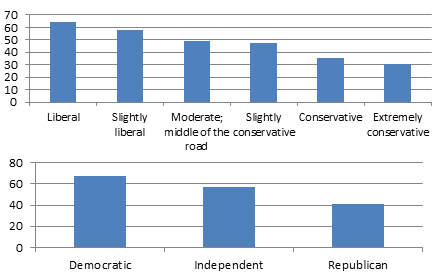
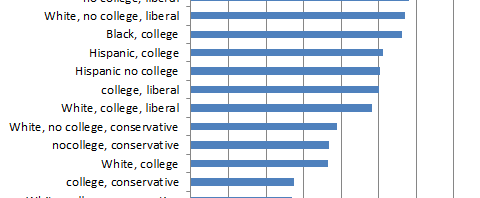
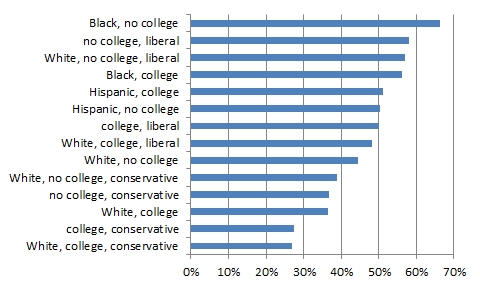
Here is an additional graph using 2012 American National Election Study data. The question is “Do you agree strongly that society should make sure everyone has equal opportunity?” I show all the breakdowns for education, race, and ideology that have sufficient samples, in descending order of egalitarianism.
inequality3
The general pattern is that you’re less likely to support equal opportunity if you’re White, college-educated, or conservative. Individuals in all three categories are the least supportive of all. But note than less than half of liberals who are White and have college degrees strongly favor equality of opportunity.

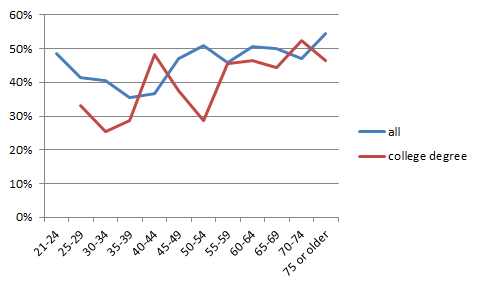
I also looked at the pattern by age, prompted in part by the phenomenon of young White college students who feel the Bern. But it’s important not to confuse 2 million young Sanders voters with their whole generation. Below are the percentages of all Americans–and Americans who hold college degrees–who strongly favor equality of opportunity, by age. The sample sizes for each point are between 38 and 96 (i.e., smallish), so I wouldn’t pay attention to the specific zigs and zags. The overall pattern is that young adults are more enthusiastic about equality than those in their 20s and 30s, but college grads are less so than their contemporaries, and their elders (50+) are more concerned than they are.
inequality4

the most educated Americans are liberal but not egalitarian

Pew reports: “Highly educated adults – particularly those who have attended graduate school – are far more likely than those with less education to take predominantly liberal positions across a range of political values. And these differences have increased over the past two decades.” Indeed, “more than half of those with postgraduate experience (54%) have either consistently liberal political values (31%) or mostly liberal values (23%).”

Based on that finding, one might assume that the most educated Americans stand the furthest left on our political spectrum. And, based on that premise, one might conclude that …

  • The people who would benefit most from left-of-center policies don’t support those policies, and the people who do support those policies don’t benefit from them–which is a paradox. OR …
  • Liberal programs are special-interest subsidies for people with advanced educations (like lawyers, physicians, and teachers), and that is why they vote for them.
  • Progressives tend to be smug or condescending because we tend to be highly educated and convinced that we support policies that are better for other people–and this is an unattractive attitude that loses votes.
  • Colleges and graduate schools are moving people left (either because they have ideological agendas or because “reality has a liberal bias”).

I’d actually propose a different view from any of the above. Pew does not find that highly educated people are the furthest left. Rather, people with the most schooling consistently give answers that are labeled liberal on a set of 10 items that range over economic, foreign, and social policies. None of the survey questions offers a radical opinion as an option. So Pew is measuring consistency, not radicalism.

Ideological consistency is correlated with education, but not necessarily for a good reason. More book-learning makes you more aware of the partisan implications of adopting a stance on any particular issue. So, for instance, conservatives are more likely to disbelieve in global warming if they have more education–because their education helps them (as it helps everyone) to see the ideological valence of this issue.

Many of the most educated Americans endorse a certain basket of political ideas that are associated with the mainstream Democratic Party. They have learned to recognize these policies as the best ones, and the policies are designed to appeal to them. All of the positions are labeled “liberal,” so the most educated are deemed liberals. Yet the most educated are not the most committed to equality. Instead, they are quite comfortable with their advantages, even as they endorse positions that Pew calls liberal.

To test that hypothesis, I wanted to look at a survey question about equality that has been asked over a long time period with large samples. The best I found was this American National Election Study question: Do you agree that society should make sure everyone has equal opportunity? This is not an ideal measure, because support for equal opportunity is not the most egalitarian possible position. If you are very committed to equality, you may prefer equal outcomes. Still, the question provides useful comparative data.

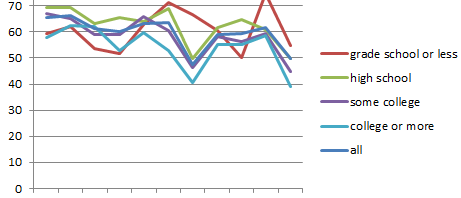
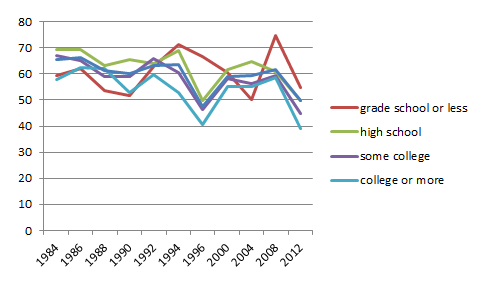
In 2012, the more education you had, the less likely you were to favor equality of opportunity. The whole population was less supportive than they’d been in 2008 and less supportive than at any time in the 1980s. But the least educated were the least supportive of equality during the Reagan years, and now they are the most concerned about it.inequality2

As of 2012, the most educated Americans are the least egalitarian, even though they are consistently “liberal.” Less than half of them strongly favored equality of opportunity.

It’s true that Democrats and liberals are (as of 2012) more likely to support equal opportunity than Republicans and conservatives are–and that the highly educated are the most liberal. However, the correlations between egalitarianism and partisanship or ideology are not tight. Forty percent of Republicans strongly agree that society should make sure everyone has equal opportunity, as do 30 percent of extreme conservatives. This is partly because conservatives also have an equal opportunity agenda, and partly because the liberal-to-conservative scale is defined by a whole basket of issues. It’s quite possible to be a strong liberal and yet not believe strongly in equality. And I think that is a common view among the most educated Americans–who are also the most advantaged.

inequality

setback in North Carolina

Federal Judge Judge Thomas D. Schroeder has upheld a whole series of voting laws in North Carolina that, in my view, create barriers to participation. The plaintiffs included the NAACP, the League of Women Voters, and the United States Department of Justice. My colleague Kei Kawashima-Ginsberg and I submitted expert testimony about the impact of the laws on youth. We were both deposed in the case, and I testified in federal court last summer. I don’t have an informed comment on the judge’s decision, much of which concerns matters of constitutional interpretation on which I do not claim any expertise. It’s a disappointing result, but the struggle for equitable and accessible voting continues.