Category Archives: epistemic networks

the advantages and drawbacks of precision in ethics

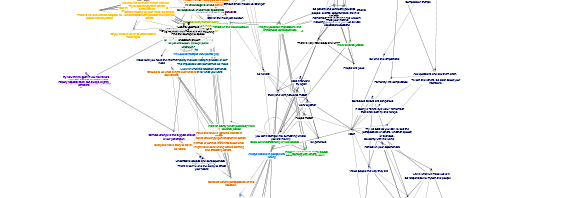
subject3I like to ask people to state their own beliefs that are relevant to ethics and then draw connections among those ideas to create networks that represent their moral worldviews. I put people (students and others) in dialogue with each other, invite them to explain their networks to peers, and watch connections form.

Usually the ideas that people propose are not precise. In explaining what we believe, we don’t employ many terms that we could define with necessary and sufficient conditions, nor do we often use quantifiers like “all” or “exactly one.” The connections we detect among our ideas are rarely logical inferences. They are looser links: resemblances, rough implications, empirical generalizations.

One impulse is to strive for as much precision as possible. That is a fundamental goal of analytic moral philosophy and it has significant merit. If someone proposed, “We should strive to improve everyone’s lives,” I would join mainstream analytic philosophers in requesting more clarity. Does that mean maximizing net human welfare? Does “welfare” mean happiness, satisfaction, or objective well-being? Does it trade off against freedom and autonomy? Does “everyone” mean all currently living human beings? (What about future generations?) Does “strive” mean actually maximize net welfare, or have a generally beneficent attitude toward others? These are valid and hard questions.

On the other hand, if the goal is descriptive moral psychology, it is a mistake to ask for that level of precision. We all hold–and are motivated by–rougher moral ideas and looser connections than could pass muster with an analytical philosopher. If you want to know what people believe, you must model those ideas and relationships as well as the clear ones. If you encourage people to map out many of their ideas and relationships, they will produce complex and elaborate networks that are useful for representing their mentalities and for provoking reflection.

That still leaves the normative question: how much precision should each of us strive for? I would say some but not too much. One of my favorite quotes is from Bernard Williams, in Ethics and the Limits of Philosophy (1985, p. 117):Theory typically uses the assumption that we probably have too many ethical ideas, some of which may well turn out to be mere prejudices. Our major problem now is actually that we have not too many but too few, and we need to cherish as many as we can.”

I’d expand that remark as follows: Through direct and vicarious experience, we build up collections of moral ideas that give our lives meaning and restrain our basest instincts. We also connect our ideas; we say that we believe A because it seems somehow related to B. If we must pass all these ideas and connections through a screen for clarity, precision, and inferential rigor, most will have to go. That will leave us with less meaning and less constraint against mere inclination and will.

Seeking clarity can illuminate. It can, for instance, force us to disaggregate a vague idea into a set of related ideas that are worth seeing on their own. Or it can reveal gaps and tradeoffs that deserve consideration. Formal philosophy is also useful for developing specific ideas that are clear and precise and that relate to one another logically.

However, it is a false dream that we can convert our entire networks of moral ideas into structures of clearly defined concepts and implications. Even the best moral arguments carry just a short distance–from a premise to a conclusion, or maybe as far as another conclusion or two, but not all the way across the domain of the moral. It is good to have a dense, complex, and expansive network of ideas that draws on experience and demands constant reflection and reevaluation, even if its components are a bit vague and the links are hard to articulate. Better that than a crystalline chain of reasons that connects just a few ideas and leaves us otherwise free to be selfish or fanatical.

Selim Berker on moral coherence

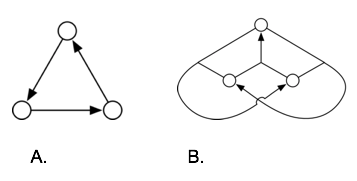
In “Coherentism via Graphs,”[i] Selim Berker begins to work out a theory of the coherence of a person’s beliefs in terms of its network properties. Consider these two diagrams (A and B) borrowed from his article, both of which depict the beliefs that an individual holds at a given time. If one beliefs supports another, they are linked with an arrow.

Screen Shot 2016-02-07 at 12.47.04 PM

Both diagrams show an individual holding three connected and mutually consistent beliefs. Thus traditional methods of measuring coherence can’t differentiate between these two structures. However, Graph A is pretty obviously problematic. It involves an infinite regress—or what has been called, since ancient times, “circular reasoning.” Graph B is far more persuasive. If someone holds beliefs that are connected as in B, the result looks like a meaningfully coherent view. If you find coherence relevant to justification, then you will have a reason to think that the beliefs in B are justified—a reason that is absent in A.

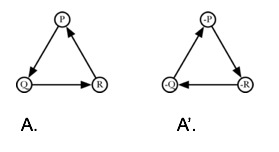
Berker also proposes a subtler but more decisive reason that B is better than A. Below I show A again, now with the component beliefs labeled as P, Q, and R. If the law of contraposition holds, than A implies another graph, A’, that is its exact opposite. A’  includes beliefs -P, -Q, and -R, and the arrows point in the reverse direction.

Screen Shot 2016-02-07 at 12.48.37 PM

But that means that if belief P is justified because it is part of a coherent system of beliefs, then the same must be true of -P, which is absurd.[ii]

The overall point is that coherence is a property of the network structure of beliefs. That should be interesting to coherentists, who argue that what justifies any given belief just is its place in a coherent system. But it should also be interesting to foundationalists, who believe that some beliefs are justified independently of their relations to other ideas. Foundationalists still recognize that many, if not most, of our beliefs are justified by how they are connected to other beliefs. Thus, even though they believe in foundations, they still need an account of what makes a worldview coherent.

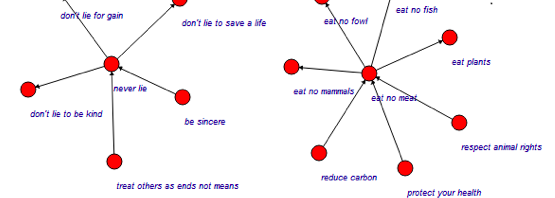
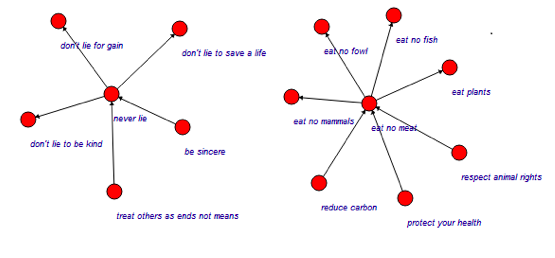
I have been developing a similar view, with a narrower application to moral thought (and without Berker’s deep grasp of current epistemology). I am motivated, first, by the sense that what makes a moral worldview impressively coherent cannot be seen without diagramming its whole structure. Imagine, for instance, a person who holds two major moral beliefs: “Never lie” and “Do not eat meat.” Assume that this person has not found or seen any particular connection between these two main ideas.

Screen Shot 2016-02-07 at 12.50.10 PM

His or her set of maxims is perfectly consistent: there is no contradiction between any two nodes. And every idea has a connection to another. But if we wanted to judge the coherence of this worldview, we would not be satisfied with knowing the proportion of the components that were consistent and directly connected. It would matter that the person holds two separate clusters of ideas—two hubs with spokes. This person’s network is fairly coherent insofar as it is organized into clusters rather than being completely scattered; but it would be more coherent if the two clusters interconnected via large integrating ideas. You can’t see the problem without diagramming the structure.

I also have another motivation for wanting to explore moral worldviews and political ideologies as networks of beliefs. In moral philosophy and political theory, constructed systems are very prominent. Although diverse in many respects, such systems share the feature that they could be diagrammed neatly and parsimoniously. In utilitarianism, the principle of utility is the hub, and every valid moral judgment is a spoke. That theory is so simple that to diagram it would be trivial. Kantianism centers on several connected principles, and Aristotelian, Thomist, and Marxist views are perhaps more complicated still. But in every case, a network diagram of the theory would be organized and regular enough that the whole could be conveyed concisely in words.

In contrast, my own moral worldview has accumulated over nearly half century as I have taken aboard various moral ideas that I’ve found intuitive (or even compelling) and have noticed connections among them. My network is now very large and not terribly well organized. A narrative description of it would have to be lengthy and rambling. Many of my moral beliefs are nowhere near each other in a network that sprawls widely and clusters around many centers.

I suspect this condition is fairly typical. No doubt, individuals differ in how large, how complex, and how organized their moral worldviews have become, but a truly organized structure is rare. (I have asked a total of about 60 students and colleagues to diagram their own views, and only one of the 60 gave me a network that could be concisely summarized.) That means that such constructed systems as Kantianism and utilitarianism are remote from most people’s moral psychology.

Further, I think that having a loosely organized but large and connected network is a sign of moral maturity. It is a Good Thing. That is obviously a substantive moral judgment, not a self-evident proposition. It arises from a certain view of liberalism that would take me more than a blog post to elucidate. But the essential principle is that we ought to be responsive to other people’s moral experiences.

Berker includes experiences as well as beliefs in his network-diagrams of people’s worldviews.[iii] In science, it should not matter who has the experience. An experience of a natural phenomenon is supposed to be replicable; you, too, can climb the Leaning Tower and repeat Galileo’s experiment. But in the moral domain, experience is not replicable or subject-neutral in the same way. Since I am a man, I cannot experience having been a woman my whole life so far. Thus vicarious experiences are essential to moral development.

If we are responsive, we will accumulate sprawling and random-looking networks of moral beliefs as we interact with diverse other people. These networks can be usefully analyzed with the techniques developed for analyzing large biological and social networks. It will be illuminating to look for clusters and gaps and for nodes that are more central than average in the structure as a whole. The coherence of such a network is not a matter of the proportion of the beliefs that are consistent with each other. Its coherence can better be evaluated with the kinds of metrics we use to assess the size, connectedness, density, centralization, and clustering of the complex networks that accumulate in nature.

On the other hand, if someone adopts a moral view that could be diagrammed as a simple, organized structure, he has not been responsive to others so far and he will be hard pressed to incorporate their experiences in the future. At the extreme, his simple graph is a sign of fanaticism.

See also: envisioning morality as a network; it’s not just what you think, but how your thoughts are organized; Stanley Cavell: morality as one way of living well; and ethical reasoning as a scale-free network (my first thoughts along these lines, from 2009).

Notes

[i] Berker, S. (2015), Coherentism via Graphs. Philosophical Issues, 25: 322–352. doi: 10.1111/phis.12052

[ii] “Coherence, we have been assuming, is a matter of the structure of support among a subject’s beliefs, experiences, and other justificatorily-relevant mental states at a given time.” But we can use directed hypergraphs (in mathematics, networks in which any of the nodes can be connected to any number of the other nodes by means of arrows) to represent all of those support relations. That is, we use directed hypergraphs to represent all of the relations that have a bearing on coherence. It follows that coherence is itself expressible as a graph-theoretic property of our directed hypergraphs (p. 339).

[iii] “Many theorists hold that a subject’s perceptual experiences are justificatorily relevant (in these sense that they either partially or entirely make it the case that the subject is justified in believing something).”

network dynamics in conversation

(Dayton, OH) It is in conversations–face-to-face or virtual, oral or written, small or massive, formal or informal–that we form our views of public issues, hold ourselves accountable for our reasons and actions, check our assumptions, expand our horizons, gain the satisfaction of being recognized, display eloquence, and develop enough will to act together.

Some conversations are better than others, and we need to understand more about the differences. I think that mapping conversations as evolving networks is a promising strategy. At least three relevant phenomena can be modeled in network terms:

  1. As we discuss, we collaboratively construct networks of ideas. I say that I favor marriage equality because adults who love and commit to each other should have the protection of law, and because people should be treated equally regardless of sexual orientation. In those sentences, I have put several ideas together into a structure. You can add to my structure by posing other ideas, whether they connect to mine or conflict with mine. The group’s epistemic network expands and changes as we talk.
  2. We also form and change social networks during a discussion. The nodes in a social network are people, and the links between pairs of people can be characterized by knowledge, trust, respect, affection, etc (or their opposites). People who converse may already belong to the same social networks. Their discussions may develop and alter their social networks.
  3. We make “meta” comments about the conversation. For instance, I might ask you to clarify what you meant when you said P. Or I might say I agree with you, or withdraw my comment, or propose that the truth lies between what I said and that you said. These are interesting moments because they are about both the epistemic and the social network that already exists, and they can affect those networks. In an important 1983 article, Berkowitz and Gibbs called them “transacts” and found they led to learning when children used them.

Consider some subtle cases and how they might be modeled in network terms.

  1. Person A only cares about influencing her boss, B, who sits at the head of the table, but she chooses to turn toward everyone else in a meeting and address them. In social network terms, her talk is literally directed at a whole set of peers, but there is a more significant network connection between her and just one other person.
  2. A says P, and B pays no attention because B thinks that A is a fool. C says P, and B agrees with it because B thinks that C is smart. In this case, the social network affects the epistemic network.
  3. A wants B to like her, so she withdraws point P that she had made earlier because B objected to it. With that concession, the social network changes in one way, the epistemic network in a different way. B says, “I appreciate your flexibility, but really, you should insist on what you believe.” B’s meta-comment puts P back on the epistemic map and affects the social network.

In technical terms, I’d measure the epistemic network by representing transcripts of discussions as ideas and links (the links being arguments of various kinds) and probably locating the nodes on a two-dimensional plane that reflect key dimensions of disagreement in the conversation. I’d watch the network change as the participants talk.

I’d measure social networks by asking people to characterize the ties between them and each of the other participants, before and after the discussion.

Finally, I might model the relevant personal beliefs of each participant before and after a discussion as a network of ideas and links, which I would derive from a private interview or short essay. I would be interested in how much of the private network ends up in public and how much the public discussion affects the private network.

The point of all this measurement is to provide data that is useful for evaluative judgment. So the normative questions (“What makes a good discussion?” “How should you participate in discussions?”) are central. I think they deserve more exploration than we have had so far, although philosophers have certainly contributed criteria.

For instance, Jurgen Habermas wrote that in an ideal discussion, “no force except that of the better argument is exercised” (Habermas 1975, p. 108). He would want an epistemic network composed of objectively defensible ideas and links to influence the participants, completely independent of their places in a social network. Just because everyone knows and admires A but dislikes B, it doesn’t mean that people should absorb A’s ideas and ignore B’s ideas.

Another example: Olivia Newman argues that a good discussion in a liberal democracy won’t produce a single hierarchical framework of ideas, but will rather encompass numerous clusters of ideas that are only loosely connected. That shape reflects value pluralism while still allowing mutual learning. Thus a group’s epistemic network should be clustered but not overly centralized.

We might add that good discussants should continue to add new nodes and connections as long as the conversation continues (not repeat points already made); that

See also a method for mapping discussions as networks and assessing a discussion.

on philosophy as a way of life

(San Antonio, TX) Here I briefly introduce schools of thought–Indian and European–that have combined introspective mental exercises with reasoning about moral principles and critical analysis of social systems. I contrast their integrated approach to forms of philosophy that construct comprehensive models of ethics by using reasons alone. This essay will be the introduction to a book on mapping moral networks, which is a new introspective exercise.

–“I should have given that man some change. He looked hungry.”
–“He would have used it for drugs or alcohol.”
–“Maybe he has that right—it’s his life!”
–“If you’re going to try to help the homeless, you should donate to the Downtown Shelter. They spend the money on real needs. Plus, it’s tax-deductible.”
–“That’s not realistic advice. While I am talking to a homeless person, I have homelessness on my mind. Once I get back home, the thought is gone. I’d never remember to mail off a check.”
–“Perhaps we should set aside some time every day to practice compassion and remember people who are suffering.”
–“Yes, I guess I’m for compassion—but handing someone money seems to create the wrong kind of relationship. What did Emerson write? ‘Though I confess with shame I sometimes succumb and give the dollar, it is a wicked dollar which by and by I shall have the manhood to withhold.’”
–“Maybe we should think about why some people are homeless in the first place and what policies would end that situation.”

This little dialog shows a pair of human beings doing several valuable things. They display emotions, some expressed with enthusiasm and some with regret. They exchange reasons. But they know that their reasons may not actually influence them deeply because they have habits that they would have to counteract by altering their regular routines. They cite rules—such as the tax deduction for charity and the shelter’s ban on alcohol—that are meant to improve and regulate people’s behavior. Finally, one speaker (perhaps showing off) cites an influential thinker from the past whose argument seems relevant.

Each of these modes of thought can be practiced at a high level. Instead of quickly asserting moral beliefs, we can develop whole arguments: chains of reasons that carry from a premise to a conclusion. If the argument persuades, it joins the list of things you believe, and you have been changed. Anyone who is serious about being a good person must struggle to get the reasons right and then act according to the conclusions.

But because our wills are weak, we also need enforced rules that guide or constrain us. And just as we can reason about our own choices (“Should I give a dollar to this homeless person?”), so we can reason about laws, regulations, social norms, and institutions. We can ask whether the rules that are in place are acceptable and, if not, how they should change. As Alexander Hamilton wrote on the first page of the Federalist Papers, laws are meant to arise from “reflection and choice” rather than “accident and force.” Political thinkers have often offered elaborate arguments about how institutions should be designed to improve people’s behavior.

Meanwhile, we can learn reflective practices such as confession, memorization, visualization, meditation, autobiographical reflection, and prayer. These methods are more personal than arguments, for they work directly on an individual’s beliefs, emotions, and habits. They are less coercive but more individualized than rules and laws, for we enforce these practices on ourselves. They tend to require practice and repetition to achieve their goals. You can read an argument once in order to evaluate it, but you must repeat a mental exercise for it to affect your psychology. In the 1500s, Michel de Montaigne observed, “Even when we apply our minds willingly to reason and instruction, they are rarely powerful enough to carry us all the way to action, unless we also exercise and train the soul by experience for the path on which we would send it” (II.6). But self-discipline without reason is blind, potentially turning us into worse rather than better people. Think of terrorists who have overcome their habits of peacefulness and tolerance to make themselves into killers; their fault is not a lack of discipline but a poor choice of means and (often) ends.

Finally, we can take the interpretation of other people’s thoughts to high levels of sophistication and rigor. Instead of just quoting a snippet of Emerson, we can make a full study of his ideas in their context. Cultural critique and intellectual history help us understand where we come from and what influences us. After all, we believe what we do in large measure because other people have formed and shaped our thoughts. No one invents her whole worldview from scratch. Since we begin with the traditions that have developed so far, it is important to understand them. Reasoning or self-discipline requires a critical understanding of the materials with which we construct our thoughts, which are ideas that our predecessors have invented.

It makes sense to put these modes together because we are reasonable creatures (capable of offering and sharing reasons for what we do), but we are also emotional and habitual creatures (requiring either external rules or mental discipline and practice to improve ourselves), political creatures (living in communities structured by laws and norms that people make and change), and historical creatures (shaped by the heritage of past thought).

In some periods, it has been common to combine argumentation about personal choices and social institutions, mental exercises, and the critical study of past thinkers. In other times–including our own–these elements have come apart. Here I will offer a very short and suggestive review of that history to support the thesis that now is a time to put the pieces back together. Continue reading

assessing a discussion

We discuss in order to address public problems together. We also develop morally through discussion–which, by the way, I would define very broadly to encompass a conversation with your neighbor over the backyard fence, with Leopold Bloom in the pages of Ulysses, with Angela Merkel through the New York Times, with Jesus in prayer, or with your late parent through memories and imagination.

I posit that the quality of discussion is a function of the skills, attitudes, and beliefs of the participants; the nature of the question under consideration; and the format. An individual’s contribution to a good discussion must be understood in context, because a given discursive act (such as making a concession or repeating a claim) can either be helpful or harmful, depending on the situation.

The tool I would use to assess discussion is a network map, where the nodes are the assertions made by the participants, and the links are explicitly asserted connections, such as “P implies Q” or “P is an example of Q” or “P is just like Q.” The network grows as the conversation proceeds–except when people stop adding new ideas and links–and each contribution can be assessed in terms of how it changes the network. A person’s statement can (for example) make a network larger, richer, denser, or more coherent.

As an illustration, I’ve mapped a 2005 Pew Research Center debate on the right to die (prompted by the then-recent Terry Schiavo case) that involved Daniel W. Brock (a medical ethicist), R. Alta Charo (a law professor), Robert P. George (a political theoriss), and Carlos Gómez (a hospice physician). The transcript is here and my map can be explored here:

This topic (end-of-life decisions) has certain features: it raises fundamental metaphysical questions rather than empirical questions that could be settled with data. It poses absolute and irrevocable decisions, unlike questions about the distribution of scare resources, which can be negotiated. As for the format, it involved relatively long prepared statements by just four experts, in contrast to a free-for-all among a larger group, which would have a different structure. And the speakers, although diverse in perspectives, were all accustomed to a certain style of argument (relatively abstract and organized). It would be interesting to contrast this transcript to, for instance, a New England town meeting about a budget.

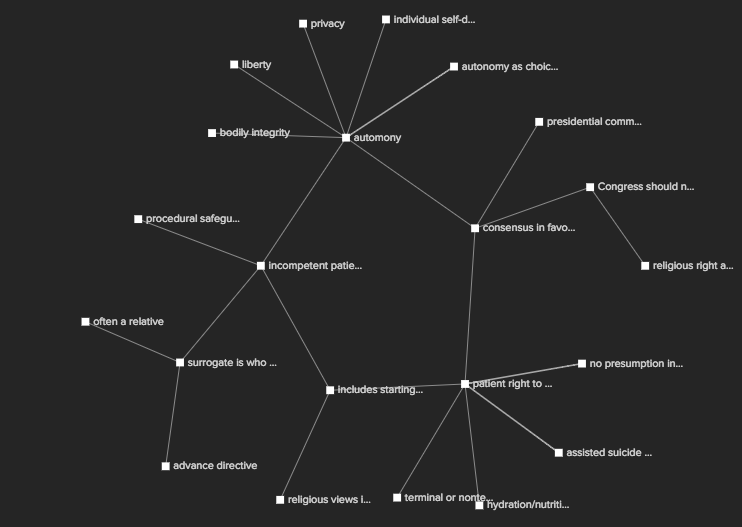
Dan Brock goes first and has a chance to lay out a position in favor of allowing a patient or her surrogate to end life support. His position is neatly organized, with the principle of autonomy at the center. He names that principle as the underlying rationale for a series of professional reports and court decisions that represent what he calls the current consensus. He connects autonomy to several related concepts: bodily integrity, privacy, self-determination, and choice. He draws the explicit implication that an autonomous patient must be able to choose or refuse any treatment. He adds the idea that when a person is incapable of exercising autonomy and has not made an advance directive, the best course is to empower a surrogate to choose. And he denies that the patient’s or surrogate’s choice should be constrained by supposed distinctions between starting versus stopping care, hydration/nutrition versus medical treatment, or a terminal versus a stable condition. Below is his position, isolated from the rest of the network.
Screen Shot 2015-05-09 at 5.56.20 PM

Brock’s position is consistent (no nodes contradict each other), coherent (all nodes are connected), and centralized around the concept of autonomy. I would attribute those features of his position to: 1) the format (he gives prepared remarks that come first in a debate), 2) the professional style of the speaker (a professional philosopher), 3) the nature of the topic (bioethics), and 4) Brock’s position as a liberal who strongly favors autonomy. Indeed, Robert P George, the conservative theorist, says later in the debate: “liberals have to come up with a justification for placing autonomy in the central position in the first place, and that requires the defense of a moral proposition.” Note George’s use of a network metaphor to characterize Brock’s view.

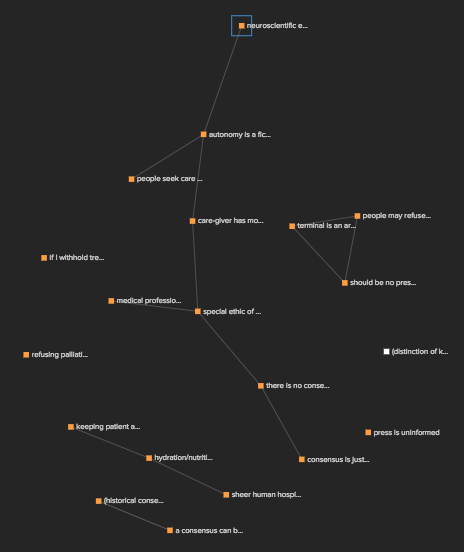
Dr. Carlos Gomez speaks second. Unlike Dan Brock, he doesn’t produce a single, organized argument with explicit connections than link all of his ideas. I count nine different clusters of points in his remarks. Gomez’ points–isolated from the rest of the network–are shown below.
Screen Shot 2015-05-10 at 1.11.34 PM

An important claim for Gomez only becomes evident to me (although this might be my own limitation as an interpreter) during the following exchange from the Q&A:

MODERATOR: Actually, before we go to the next question, when you said autonomy misses something essential in this sort of doctor-patient relationship, would you elaborate a little bit more on what that means in the real world?

MR. GOMEZ: Yeah, I’ve never had a patient knock on my office door, come in, sit down, and say, “I’m here to exercise my autonomy.” Now I may be a little too glib there, but what I’m suggesting is that one of the reasons that they are coming to me is precisely by nature of what I profess as a physician, by nature of what I know in terms of my skills, and also by nature – and on this I think Robby is dead on – by nature of the fact that there is a moral construct to what it means to be a physician or a nurse, or any other professionals that professes publicly what they’re going to do.

I think what Carlos Gomez has been implying all along is that nurses and doctors are required to show care for a patient, and an ethic of care is inconsistent with ending the patient’s life. Further, caregivers should have a strong voice in the debate about bioethics. Unlike Dan Brock, however, Gomez does not present that position as an organized argument but alludes to it with relatively scattered claims about how, for instance, there is actually no consensus about end-of-life treatment and the press is uninformed about hospice care. If I were to evaluate Gomez’ participation, I would say that he is less rhetorically effective than he might have been because he never states a claim that actually is central for him. The moderator assists not only Gomez but also the group by drawing out one central node that had not been clear before. On the other hand, Gomez clearly contributes ideas to the conversation and connects many of them to points already introduced by Dan Brock; so he broadens and enriches the discussion.

Alta Charo, a law professor, speaks third. She makes a cluster of points about how people mistake biological patterns for moral imperatives, and a related cluster of points about how sometimes the law appropriately creates “fictions” that are not based on biology, such as the idea of adoptive parenthood. She also makes at least nine other points that don’t explicitly connect to these two clusters. Her view is about as coherent as Carlos Gomez’. However, she is in a different position from him. She generally holds the same liberal position as Dan Brock, who has already spoken. It would not contribute to the conversation for her to repeat Brock’s argument for the centrality of autonomy, although she does state that choices about life must be personal and free. Instead, she builds ideas around the structure than Dan Brock has already laid out.

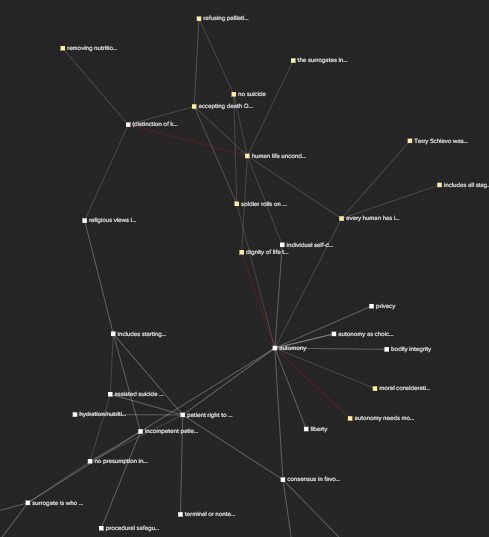
George follows Charo, and he lays out an alternative view to Brock’s, in which autonomy is explicitly not the central idea. Instead, “human life, even in developing or severely mentally disabled conditions, [is] inherently and unconditionally valuable.” His structure is about as consistent, coherent, and centralized as Brock’s, but it has a different center. Below is shown a network consisting only of the ideas proposed by Brock and George. “Human life is unconditionally valuable” is a central node in the top third of the picture; autonomy is a different center about two-thirds down.
Screen Shot 2015-05-10 at 1.30.00 PM

The two networks touch at multiple points, either because George contradicts Brock (I show explicit disagreements with darker lines) or because he acknowledges specific areas of agreement.

Later, in the Q&A, George makes a discursive move that can sometimes be helpful to a group. He says, “As much as I love disagreement and dissent, I think that on one point on which Carlos and Dan thought they were arguing, there’s not actually a disagreement.” This is an example of tying together two points that have already been made in order to increase the coherence of the network. It is a helpful move–unless the two points are not actually alike.

By the time the session ends, the whole network is fairly connected. But certainly, no agreement has been reached, and two nodes remain central for different people but mutually inconsistent. That may be an inevitable feature of debates about the ends of life, or it may be a function of the way these speakers reason about such questions. Although they are speaking lightly at this juncture, Brock and Gomez imply a serious point about the impasse between them:

Dan Brock: Well Carlos and I first met on a PBS show about assisted suicide I guess 15 years ago, was it, Carlos? And we disagreed then roughly the way we do now, so –

MR. GOMEZ: I’m unteachable.

MR. BROCK: So am I.

I would hope that more mutual learning can occur when issues are either more empirical or more negotiable than this one is.