Category Archives: notes on poems

Seamus Heaney, The Republic of Conscience (questions for a discussion)

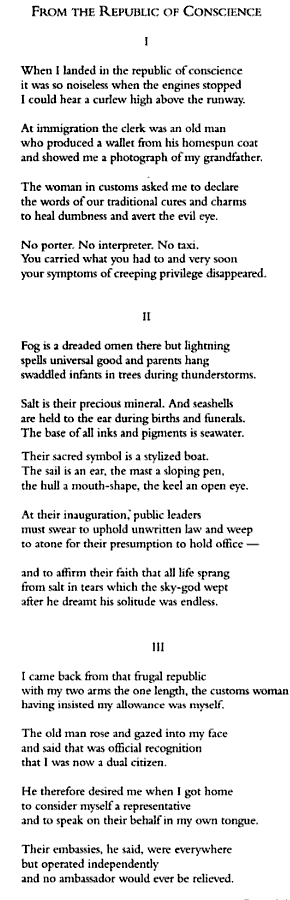
Below is the text of Seamus Heaney, “From the Republic of Conscience,” which was commissioned by Amnesty International and published on Human Rights Day, 1985. The text is from David Pierce (ed.), Irish Writing in the Twentieth Century: A Reader (Cork University Press, 2000), p. 1033. It makes an excellent stimulus for reflecting on your relationship to the political world, ideally in conversation with peers.

Seamus Heaney, The Republic of Conscience
Questions:

What literally happens in the poem? What is the plot?

Why do the immigration authorities show the narrator a picture of his grandfather and ask him for his traditional cures and charms?

What would it be like to have citizenship only in the Republic of Conscience?

Where do the salt and seawater that they hold sacred (and use for writing) in the Republic of Conscience come from originally?

Why is lightning good and fog, bad?

What shows that the Republic is “frugal,” and why is it so?

Why were the visitor’s arms different lengths when he arrived?

What is the significance of the Republic’s “sacred symbol,” the boat?

I think the language of the poem is beautiful, and it describes beautiful things. What is the relationship between aesthetics and conscience? Can you have a conscience and not appreciate beauty or express yourself beautifully? (Does it matter that this statement is a poem?)

What does the visitor think about power? Is the Republic of Conscience actually an anarchy?

What does it mean that the ambassadors are never “relieved”? Is that a good thing for them, or a bad thing? (or both?)

Are you a dual citizen of the Republic of Conscience?

(One final note about this poem, which is generally free of specialized vocabulary. Apparently, curlews are impressively migratory birds, traveling across continents and oceans. The Call of the Curlew is also the title of a novel, which I do not know, by Taha Hussein.)

A.R. Ammons: Corsons Inlet

A.R. Ammons’ long poem “Corsons Inlet” reports a morning’s walk near a beach in New Jersey. It begins matter-of-factly, “I went for a walk over the dunes again this morning,” and the first stanza summarizes the itinerary. Although it reads like a diary entry, the poem is also a manifesto for a particular kind of free verse in which there will be:

… no forcing of image, plan,
or thought:
no propaganda, no humbling of reality to  precept.

The American city, with its rectangular blocks and buildings, represents thought as organized, articulated, and linear. In the city, nature has been humbled to design. Similarly, in a sonnet or a villanelle, language has been forced into a form. But Ammons reports that on the Jersey shore,

I was released from forms,
from the perpendiculars,
      straight lines, blocks, boxes, binds
of thought
into the hues, shadings, rises, flowing bends and blends
               of sight:


The narrator offers precise observations about changes that occur gradually. For instance, a dune is really different from a creek, but there is no point where one turns to the other. The “transition is clear / as any sharpness: but ‘sharpness’ spread out … ”

The poem’s layout–with its ragged margins and sudden blank lines–resembles the shapes of nature on a sandy coastline on a muggy, hazy day. On the dunes, and elsewhere “in nature there are few sharp lines.”

If the poem were all about vagueness, it would be dull. And if nature were truly formless, it could not be captured in words, no matter how loose and free. But Ammons detects tight order at small scales. The order turns blurry only from further away–a model for his own poetic form.

in the smaller view, order tight with shape:
blue tiny flowers on a leafless weed: carapace of crab:
snail shell:
            pulsations of order
            in the bellies of minnows: orders swallowed,
broken down, transferred through membranes
to strengthen larger orders: but in the large view, no
lines or changeless shapes: the working in and out, together
            and against, of millions of events: this,
                         so that I make
                         no form of
                         formlessness:


“Carapace of crab” is a fragment of tightly observed, onomatopoeic, self-conscious verse, but it is adrift in a larger poem whose form is loose and impressionistic.

I have cited examples of vagueness in space. Ammons is also interested in  vagueness over time.

thousands of tree swallows
               gathering for flight:
               an order held
               in constant change: a congregation
rich with entropy: nevertheless, separable, noticeable
          as one event,
                      not chaos: preparations for
flight from winter, …


As someone who once wrote a whole long poem about entropy, I am especially interested in this passage. I had treated disorder as problematic, both morally and aesthetically. For Ammons’ narrator, receptivity to vagueness and resistance to distinctions are not just valid aesthetic choices, but also moral imperatives. He identifies structure with “propaganda” and even “terror” (political words) but reports his acceptance of nature:

I have reached no conclusions, have erected no boundaries,
shutting out and shutting in, separating inside
          from outside: I have
          drawn no lines:
 …
so I am willing to go along, to accept
the becoming

thought

Elizabeth Bishop, At the Fishhouses

The Poetry Foundation provides the text of Bishop’s masterpiece “At the Fishhouses” (1948) along with a recording of the author reading it (not necessarily as well as it could be read).

She introduces the color silver early and returns to it often. In fact:

    All is silver: the heavy surface of the sea,
    swelling slowly as if considering spilling over …

But nothing in the poem is actually silver. That is just an appearance, a misleading feature of the surface of things. For instance, “the silver of the benches … is of an apparent translucence …” The wheelbarrows look beautifully silver because of the “small iridescent flies crawling on them.”

The opposite of false silver is the profound and true depth of the sea. “Cold dark deep and absolutely clear” is the comma-free phrase that Bishop strikingly repeats. The temptation in the poem is to plunge through silvery appearances to the real “element bearable to no mortal,” the ocean water that would kill by freezing or drowning. It is a temptation that Bishop suggests early and then repeatedly defers or avoids. Immediately after first invoking the “cold dark deep,” she digresses:

    … One seal particularly
    I have seen here evening after evening.
    He was curious about me. He was interested in music;
    like me a believer in total immersion,
    so I used to sing him Baptist hymns.

Singing Baptist hymns to a seal is amusing. Even if you don’t happen to find it funny (as I do), I think you will agree that it has the form of a joke, meant to deflect the question of how to relate to the “clear gray icy water” that would ache your bones and burn your hand if you entered it. Buried in the joke is the serious idea of “total immersion.” Plunging into the ocean at Nova Scotia would be like facing the ultimate truth that we try to defer. Of that water, Bishop writes,

    It is like what we imagine knowledge to be:
    dark, salt, clear, moving, utterly free …

If silvery surfaces and deadly depths are two crucial ideas in the poem, a third is the human observer. The poem begins with apparently objective and scientifically precise description. But then the narrator comes in:

    The old man accepts a Lucky Strike.
    He was a friend of my grandfather.
    We talk of the decline in the population
    and of codfish and herring. …

The narrator, like all mortal beings, inhabits a world of change. All the things she observes have developed and will cease, like the wheelbarrows that have come to be “plastered / with creamy iridescent coats of mail” or the cod that will disappear from overfishing. The last line of the poem says explicitly that “our knowledge is historical, flowing, and flown.” You cannot truly experience the freezing depths without dying in them: a metaphor for the unbearableness of truth. The poem is about flinching.

Bishop’s mentor Marianne Moore had written “A Graveyard” about a similar view of the ocean. In that poem, an unnamed man stands in the way of the sea, annoyingly blocking the view. But Moore tries to forgive him because it is natural to want to immerse oneself:

    it is human nature to stand in the middle of a thing
    but you cannot stand in the middle of this:
    the sea has nothing to give but a well excavated grave.

In Bishop’s poem, the ocean seems to come from a living source, even a human one:

    drawn from the cold hard mouth
    of the world, derived from the rocky breasts
    forever, flowing and drawn …

I would normally resist a biographical interpretation, but Bishop inserts herself in the poem (“he was a friend of my grandfather”) and reminds us that human knowledge is temporal and personal. So it is relevant that Elizabeth Bishop had to move to her grandparents’ home in Nova Scotia at age five, after her father had died and her mother was institutionalized with mental illness. In this poem, the frigid, salty water flows from breasts that should feed a daughter warm, sweet, sustaining milk. The metaphor (stated in a line of iambic pentameter) is agonizingly lonely. But Bishop’s seal friend, her grandfather’s dwindling connections, her love of surfaces–“beautiful herring scales”–, her subtle homage to Marianne Moore, and the writing of the poem itself show how we can digress and postpone what we know that we know.

Robert Lowell at the Indian Killer’s Grave

King Philip’s War was a struggle between the New England Puritan settlers and Native Americans. Fought in 1675-6, it caused the deaths of about 800 colonists and 3,000 Native Americans and a catastrophe for the Native peoples of New England. King Philip (Metacomet, in his own language) was shot to death, his wife and child sold as slaves in Bermuda, his head displayed on a pike for decades.

Traditionally, King Philip’s War was described as a dangerous attack on the colonists, not a genocidal campaign by them against the Wampanoags. Robert Lowell (1917-77) early grasped his region’s original sin. His direct ancestor John Winslow had been a rich Boston merchant during King Philip’s War; another relative had been Josiah Winslow, the governor who led Massachusetts in that war. Out of his struggles with his own ancestry, the Catholic-leaning, pacifist Lowell made poems of permanent value.

In 1946, he published “At the Indian Killer’s Grave” in his collection entitled Lord Weary’s Castle. The setting is King’s Chapel Burying Ground in Boston, where John Winslow was buried with his wife Mary. I recently visited the Burying Ground with a copy of Lowell’s poem in hand and found that he had described the setting precisely and had incorporated relatively obscure historical information. My annotations follow, interspersed with the entire text in italics. The whole poem is reprinted together here.

King's Chapel and Burial Ground

Title: “At the Indian Killer’s Grave”

The singular noun is interesting, since there are many graves in the Burial Ground that could be connected to King Philip’s War. Perhaps the grave of Joseph Tapping or of John Winslow is the specific reference (see below), or perhaps, as Frank Bidart writes in his notes to the Selected Poems, “The Indian Killer … is essentially generic, a collective figure ….”

Epigraph:

“Here, also, are the veterans of King Philip’s War, who burned villages and slaughtered young and old, with pious fierceness, while the godly souls throughout the land were helping them with prayer.”

Quoted from Hawthorne’s story “The Gray Champion,” which concerns the colonists’ resistance to James II (the king of King’s Chapel) and mentions their slaughter of Native Americans briefly and ironically. The story concludes: “still may the Gray Champion come, for he is the type of New England’s hereditary spirit; and his shadowy march, on the eve of danger, must ever be the pledge, that New England’s sons will vindicate their ancestry.” (Vindicating his ancestors is pretty much the opposite of what Lowell accomplishes in this poem.)

Behind King’s Chapel what the earth has kept

Whole from the jerking noose of time extends

Its dark enigma to Jehoshaphat;

These are regular iambic pentameter lines, as are most (but not quite all) of the lines of the poem. Most of the poem rhymes, but in a complex and irregular scheme. (Note friends/bends/ends, well/compel, root/foot, etc.) The very first line has no rhyme.

“Behind King’s Chapel”: The small plot of ancient stones is hemmed by some of the city’s tallest and most modern commercial buildings. America’s first subway line runs very close below, the quaint cover of its ventilation shaft interrupting the graves. Crowds of tourists file down the narrow lanes.

The Burying Ground is historically separate from King’s Chapel. The former was a cemetery for Puritans, strenuous critics of the official Anglican Church. Because no settler would sell to King James II land on which to build an Anglican church in New England, James seized some of the Burying Ground to build the chapel, presumably disrupting many Puritan tombs. The present structure of the chapel is a sober neoclassical building, erected in 1754, that overshadows the cemetery. The modern congregation is Unitarian, the Anglicans having been chased away as Tories in the Revolution. Lowell uses the phrase “King’s Chapel” to locate the poem and does not mention the Burying Ground itself. The buried Puritans would be angry that their resting place is so described. Lowell’s own theology would be closer to James’ than to the Puritans’.

“What the earth has kept whole …” Does this refer to bodies in the burial ground, ones that have not been broken up by centuries of building? Maybe not, because the subject of the sentence is singular: it “extends / Its dark enigma to Jehoshaphat.” One possible reading: there is a crime, a mysterious sin, that is hidden from the time when the corpses were buried until the Day of Judgment.

“Jerking noose” alludes to the mass hanging of the Wampanoag Indians in King Philip’s war, part of the crime that is the dark enigma. This also suggests a concrete image: something in the earth is partly broken by a rope which, like time itself, shakes things to pieces.

Jehoshaphat: this could refer to the King of the Israelites. He might be associated with the Puritans because he struggled against idolatry and defeated a large army of Moabites (comparable to Wampanoags) when the Lord made them quarrel amongst themselves. But more likely Lowell means not the king but the Valley of Jehoshaphat, where the Resurrection and Judgment Day is expected: thus, a vast graveyard. Cf. “In the great ash-pit of Jehoshaphat,” a phrase from Lowell’s “The Quaker Graveyard of Nantucket.”

Or will King Philip plait

The just man’s scalp in the wailing valley! Friends,

Blacker than these black stones the subway bends

About the dirty elm roots and the well

For the unchristened infants in the waste

Of the great garden rotten to its root;

“Or will King Philip plait …”: The word “or” suggests two possibilities. Either the enigma remains hidden until Judgment Day or King Philip braids the hair on the scalp of the “just man” in the valley of Jehosophat. The phrase “just man” could be ironic and refer to the kind of men whom the real Philip scalped: Puritans. “Plaiting” seems gentle and cosmetic, although perhaps King Philip celebrates the ultimate demise of the men who killed him and his people. Although they won the war, they all died in the end.

“Friends!”: Who could that be? We the readers? Imaginary companions visiting the Burying Ground with Lowell? A congregation addressed by a preacher? King Philip’s friends (for he clearly speaks later in the poem)?

“Blacker than these black stones …” The headstones are gray now, as they must have been when first cut. In Lowell’s time, pollution had blackened them (see the “off-scourings” mentioned in line 2.6). The air was polluted by the heavy industry that his ancestors brought to New England after 1790 and that supported all the office buildings around King’s Chapel.

“… the subway bends …”. It does bend–the Green Line of the Boston “T”–and as it moves it makes extraordinary creaking and whining sounds immediately below the cemetery, as if the dead were rising. The construction of the “T,” like the building of King’s Chapel, disturbed the sober Puritans in their graves and jumbled their bones together promiscuously.

“About the dirty elm roots and the well”: The “well” is actually the cover of the subway airshaft, a remarkable structure that I would call quaint, but I can see how it might look diabolical.

“For the unchristened infants in the waste”: In 1833, a charnel house (a vault for bones) was constructed under the Burying Ground to hold dead orphans. Once again, the dead Puritans must have been shifted. They would not be upset by the idea of unchristened burials. They considered baptism unnecessary for salvation and conducted no baptisms in the New World until about 1628. For the Catholic Lowell, unchristened babies would evoke Limbo.

Of the great garden rotten to its root: The garden may be the cemetery, where the bones are like roots. “Great” is surprising and worth some consideration, because I would have described the Burying Ground as small and quaint. Perhaps the cemetery is metonymy for something truly “great,” such as Boston or America.

Continue reading

W.S. Merwin, “The Drunk in the Furnace”

On the occasion of Merwin’s being named Poet Laureate, it’s worth taking a look at a 1960 poem that marked his move from formal and referential to vernacular. He also started telling short stories in poems.

The opening phrase, “For a good decade,” is casual, American slang: it means, “For a decade at least.” But the word “good” also poses a question. Was there a good period after the construction and abandonment of the furnace (which may have poisoned the creek and stripped the valley) and before its occupation by “someone”? Was the furnace better empty than turned into a “bad castle”? I think its re-use is “bad” only from the perspective of the Reverend and his flock of haters, but the question floats.

This poem is no allegory–it resists decoding–but we are entitled to explore associations between things in the text and objects outside. For example, what if the gully is our natural world and the furnace is our industrial exploitation of it? Or what if the abandoned landscape is poetry and the person inside the furnace is managing to get some “twists of smoke” out of the old sounds and forms? (He seems to be comfortable in there, and enjoying himself.)

There are three sets of characters on stage: the person “cosily bolted behind the eye-holed iron / door”; the observers who start in ignorance, become astonished, speak (I think) in the third stanza, and “hate trespassers”; and finally, their “witless offspring” who, at the end “Stand in a row and learn.” The guy inside is surely the hero–in fact, there is a vague air of disciples and sermons on mounts. His “spirits” aren’t necessarily alcoholic, despite the title. If it’s a self-portrait, it’s modest but also very bold. When all the old forms have crumbled, it takes brains and hard work to create regular, seven-line stanzas that can make the young “stand agape.” At 82, Merwin is still hammering and anvilling away.