Category Archives: civic theory

basic theories of civic development

I am spending these two weeks co-teaching the Summer Institute of Civic Studies. We will cover 18 separate topics, and I will blog about roughly half of them.

Yesterday afternoon’s discussion focused on children and youth, civic education, and human development, more generally. We had assigned the following readings on those topics:

  • David Elkind, “Erik Erikson’s Eight Ages of Man.” (NY Times article from 1970)
  • Karl Mannheim, “The Problem of Generations” (excerpt)
  • Joel Westheimer and Joseph E. Kahne, “Educating the ‘Good Citizen’: Political Choices and Pedagogical Goals”
  • Hugh McIntosh and James Youniss, “Toward a Political Theory of Political Socialization of Youth.”

Why does youth and education require attention in a course that is about how citizens can improve the world? I would say we need to give special attention to youth because:

  1. What it means to be a “good citizen” depends on how old you are—the answer is different if you are 8 or 80.
  2. People don’t automatically learn to be good citizens; that has to be taught, which raises difficult issues. (Who has a right to decide that they should learn? How should the state relate to parents if they have different goals?)
  3. A fundamental fact about any society is that people are always entering (without memories, skills, and experience), and also exiting when they have reached the maximum of human experience. So designing a good society that engages its people in governance must take into account the life cycle.

In 1999, the great political scientist Sir Bernard Crick lamented that “there is no political Piaget.” He meant that there was no major theorist who provided a framework for understanding children’s development into citizens. Such a theory would help institutions to educate children civically, which, in turn, would strengthen democracy.

Although we don’t have a “political Piaget,” several major thinkers offer valuable theoretical frameworks. Before we turn to a few of those thinkers, I’d like to introduce a distinction that is often used when interpreting data on youth engagement:

  • An historical effect is the consequence of experiencing an event, regardless of your age at the time. For example, we are all experiencing the 2012 presidential campaign right now.
  • An age effect (or life cycle effect) is the result of being at a certain point in one’s life. For example, people who are eight years old at any given moment in history are less interested in sex than people who are 21 at the same moment.
  • A cohort effect (or generation effect) is the lasting consequence of going through an event when one was young. For example, people who experienced World War II have differed from other generations all their lives.

When we observe that only 24% of eligible young people voted in 2o10, we can ask whether that is an historical effect, an age effect, or a cohort effect. The answer will make a lot of difference to how we respond.

For our purposes today, we are not interested in historical effects. For age effects, a classical theorist is the Freudian psychologist Erik Erikson (1902-1994). Generational effects were invented and explored by the sociologist Karl Mannheim (1893-1947).
Continue reading

the Summer Institute of Civic Studies

For the next two weeks, I will be spending six hours of every day co-teaching the Summer Institute of Civic Studies (syllabus here). We will cover roughly 18 separate topics, and I will blog about just a few of those.

Near the beginning of the first session, I always read this quote:

“Never doubt that a small group of thoughtful, committed citizens can change the world. Indeed, it’s the only thing that ever has.”

  • Who recognizes that quote?
  • Who wrote it?
  • Do you have it printed out over your laser printer?

Was Margaret Mead right?

  • Yes, to inspire people to work together
  • Yes, to think about the scale of human action where the minuscule powers of an individual obtain enough leverage to count but are not lost entirely in the mass. Civil society is the world of “we,” but not such a huge or abstract “we” that “I” no longer matters. It is politics at the human scale.
  • But no to suggest that small group action is always successful or always good. It often fails. Sometimes it is bad. Mussolini led a small group of thoughtful and committed citizens.

A cynic might counter: “Never doubt the capacity of large groups of ignorant and selfish people to squelch good ideas and make the world worse.”

We need to ask …

  1. When can “a small group of thoughtful, committed citizens” change the world? Also, how can we get people like that?
  2. How can they be most effective?
  3. What are good means and good ends for these groups?

Citizens need a combination of facts, strategies, and values relevant to their own discretionary action. This combination is rare because …

Continue reading

Elinor Ostrom, 1933-2012

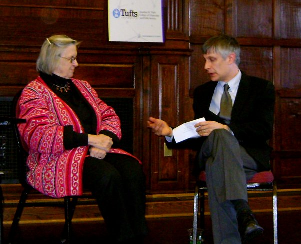
I was very sad to read this morning that Elinor Ostrom has died. Lin ran the Workshop in Political Theory and Policy Analysis at Indiana University, where she was also Distinguished Professor and Arthur F. Bentley Professor of Political Science in the College of Arts and Sciences and professor in the School of Public and Environmental Affairs.

Lin won the 2009, Nobel Prize in Economic Sciences and was chosen in 2012 for Time magazine’s annual list of the 100 most influential people in the world. She was a MacArthur “Genius” award winner, former president of the American Political Science Association, and recipient of our own Tisch College research prize, which she is receiving here:

I find I have blogged about her or her work 23 times already. For example:

Lin started as a graduate student of Vincent Ostrom, who survives her. She was a woman, an untenured “trailing spouse” in the one-college town of Bloomington, and she studied unfashionable topics, like local governance. Her perspective ran counter to dominant trends in modernity, especially the idea that centralization brings efficiency. She had profound respect for ordinary people’s wisdom, but that didn’t turn into pious enthusiasm. Instead, she tested hypotheses about collective action with the utmost rigor, using laboratory experiments, data from field work on several continents, and rational-choice models. The result was a glorious achievement that will long outlive her–but we’ll miss the warm and and kind human being.

Good Society special issue on Elinor Ostrom

The Good Society has published a special symposium issue on the work of Elinor Ostrom and the Bloomington School, which includes Lin’s husband Vincent Ostrom and their many colleagues and students. All study common property regimes, institutional design, the conditions under which voluntary collaboration occurs, and polycentric governance (governance understood as occurring at many levels and in many contexts). I contribute the first article, “Seeing Like a Citizen: The Contributions of Elinor Ostrom to ‘Civic Studies.'” My good friends Harry Boyte and Karol Soltan also have pieces in the issue (“Public Work and the Politics of the Commons” and “A Civic Science”).

on religion in public debates and specifically in middle school classrooms

Harvard Ed. School professor Meira Levinson visited the Summer Institute of Civic Studies yesterday and led us in a discussion of a case that raises two fundamental issues. Students were required to choose and implement a civic action project. An Orthodox Jewish 8th-grader chose as his project arguing against the Massachusetts gay marriage law on religious grounds, taking as a premise that homosexuality is immoral and citing scripture as evidence. The chief issues are: 1) the legitimacy of any religious arguments in public forums, such as deliberations in public school classrooms; and 2) the potential effects on any students who might be gay–in other words, the effects on inclusion and equity.

I am inclined to say the following. First, the school and its teacher should not be neutral about homosexuality. Gay students have a right to be included and fully respected in the classroom. The teacher should strongly communicate that anti-gay rhetoric is disallowed.

But there are several reasons to allow the religious student to argue against gay marriage on reasons of faith: 1) Gay marriage is actually a live debate in the legislature and the press, and students should learn to follow such debates. 2) Although a student does not have a constitutional right to say whatever he wants in class, it is good pedagogy to create free speech zones within social studies classrooms. 3) Other students will learn something about orthodox Jewish thought if he can speak candidly. 4) The student in question may learn from other students’ responses, and it is better that he bring his values into the classroom than to feel that he was censored there and continue to hold them privately.

I think that religiously-based arguments should be permitted in a classroom (or a legislature) and not rejected on the ground that they are religious. At the same time, I think anyone who brings religious arguments into the public domain can be required to defend them. If the religious student states, “God says homosexuality is sinful,” other people may reply that God does not say that, or that God does not exist, or that God’s word should not determine human laws. He cannot be permitted to close the debate by claiming that his identity generates his opinions, and therefore a critique of his opinions constitutes an unfair attack on his identity. He is entitled to have his identity as a Jew respected and to be fully included in the classroom, but he is not entitled to have his opinion about homosexuality respected by other people in the classroom. He should expect that it will be challenged.

I am proposing an asymmetry here. Being gay is an identity that must be accepted in a public school classroom; hence the teacher must be against homophobia and must favor inclusion and respect. Holding religiously-based, anti-gay opinions is not an identity but a position, and it can be challenged. (Yet being Jewish is an identity.) I recognize the problem: what counts as an “identity” and an “opinion” is contested and changes over time. But I’m sticking to my position. …