Category Archives: civic theory

what should we do?

You are a citizen of a group (regardless of your legal status) if you seriously ask: “What should we do?”

The question is what we should do because the point is not merely to talk but to change the world. Thinking is intrinsically connected to action. We don’t think in focused and disciplined ways about the social world unless we are planning to act; and we don’t think well unless we learn from our experience.

The question is what we should do, not what should be done. It’s easy enough to say what should be done (enact a global tax on carbon, for instance). The tough question is what we can actually achieve. That requires not only taking action but obtaining leverage over larger systems. Since our tools for leverage are mostly institutions, this question requires careful thought about real and possible institutional forms. It is also, by the way, not the question “What should I do?” Of course, that is also important, but I cannot achieve much alone and–worse–I cannot know on my own what I ought to aim for. I must collaborate in order to learn enough about what to do.

The question is what should we do, so it is intrinsically about values and principles. We are not asking “What do we want to do?” or “What biases and preferences do we bring to the topic?” Should implies a struggle to figure out what is right, quite apart from what we may prefer. It is about the best ends or goals and also the best means and strategies. (Or if not the best, at least acceptable ones.)

Finally, the question is what we should do, which implies an understanding of the options, their probabilities of happening, and their likely costs and consequences. These are complex empirical matters, matters of fact and evidence.

Academia generally does not pose the question “What should we do?” The what part is assigned to science and social science, but those disciplines don’t have much to say about the should or the we. Indeed, the scientific method intentionally suppresses the should. In general, philosophy and political theory ask “What should be done?” not “What should we do?” Many professional disciplines ask what specific kinds of professionals should do. But the we must be broader than any professional group.

Civic Studies” is a nascent effort to pose the citizen’s question again. We have an emerging canon of authors, which is merely exemplary and not complete. They are all recent or current thinkers and each offers a distinctive method for combining normative, empirical, strategic, and institutional analysis in the service of action.

I don’t offer my own method but merely some eclectic principles. I think:

Our methods should be interactive and deliberative. I will not decide what we should do; we will. Yet procedures will not suffice. It is not enough to say that a diverse mix of affected people should sit together and decide what to do. If I am seated at that table, I must decide what to advocate and how to weigh other people’s ideas. A deliberative process creates the framework for our discussion, but we still need methods to guide our thinking.

Our methods should be conscious of intellectual limitations. This is what I take from conservative thought: a serious doubt that we will come up with a better plan than what our predecessors devised, what the community in question already does, or what emerges from uncoordinated individual action. That doubt can be overcome by excellent thought; but we must be reasonably cautious and humble about ourselves.

We should not pay excessive attention to ultimate ends, to a theory of the good (let alone the ideal) society. First, the path toward the ideal is probably not direct, so knowing where you ultimately want to go may send you in the opposite direction from where you should set out. Second, we should be just as concerned about avoiding evil as achieving good. Third, our concept of the ideal will evolve, and we should have the humility to recognize that we do not believe what are successors will. And fourth, we are a group that has value– the group may even give our lives the value they have. It is just as important to hold the group together as to move it forward rapidly toward the ideal state.

We should not look for “root causes.” That is a misleading metaphor. Social issues are intertwined and replete with feedback loops and reciprocal causality. There is no root. Sometimes it is better to address an aspect of a problem that seems relatively superficial, rather than attack a more fundamental aspect without success.

Our critique should be “immanent,” in the jargon of the Frankfurt School. That is, we should try to improve the implicit norms of a community rather than imagine that we can import a view from nowhere. However, I would alter the idea of immanent critique in two ways. First, we should not only look for contradictions and hypocrisies. Holding contradictory ideas is a sign of maturity and complexity, not an embarrassment. And if you look for contradictions in order to advance your own view, then you are not actually practicing immanent critique. You’re hoping to score debating points in favor of a position external to the community. The immanent critique I recommend is subtler and more respectful than that. Second, it is not always directed at communities, whether geospatial, ethnic, or political. Sometimes it is directed at practices and fields. In fact, I see special value in intellectual engagement with fields of practice whose expressed aims are appealing but which need help with the details.

Finally, we should pay attention to whether our substantive beliefs are structured so as to permit interaction and learning. The question is not (only) whether you believe in equality or liberty, in God or science. The question is how you use those ideas in your overall thinking. If, for instance, you immediately return to a few core principles, that frustrates deliberation, collaboration, and learning. It is equally damaging to drop ideas quickly in order to avoid conflict. The ideal is genuine intellectual engagement with other people, through both talk and action.
defining civic engagement, democracy, civic renewal, and related terms

My post entitled “What is the definition of civic engagement?” gets lots of traffic. It does not actually present my definition but a compendium of alternative versions. I have volunteered to draft some new definitions for a particular purpose. This is what I am thinking:

Active citizenship: Working to improve a nation or other community, independent of whether you have legal status as a member of that community. (“You were an excellent active citizen in Massachusetts while you visited here from South Africa.”)

Civil society: The array of nongovernmental organizations and networks that address public issues. Sometimes the definition introduces a qualitative dimension, so that civil society is an array of associations and networks marked by peacefulness, mutual respect, trust, and other virtues. Civil society may include for-profit enterprises as well as nonprofits. (“The government worked with civil society groups to help victims of the storm.”)

Civic education: Any process that strengthens people’s capacity for civic engagement and political participation, at any age and in any setting. (“Newspapers traditionally provided some of the best civic education in America.”)

Civic engagement: Any act intended to improve or influence a community. Often, the phrase has positive connotations, so that engagement is viewed as “civic” to the extent that it meets such criteria as responsibility, thoughtfulness, respect for evidence, and concern for other people and the environment. (“Informed voting is an example of civic engagement.”)

Civic health: The degree to which a whole community involves its people and organizations in addressing its problems. (“Minneapolis/St Paul has the best civic health of large American cities, thanks to a long tradition of strong civic organizations and responsive local government.”)

Civic institutions: The organizations and associated norms and rules that people use for civic engagement. (“Political parties and volunteer groups are two examples of civic institutions.”)

Civic life: For an individual, a life in which civic engagement has an important place. For a community, all the acts of civic engagement and associated norms and values of its members. (“A service experience prepared her for civic life.” “The civic life of Somerville, MA is vibrant.”)

Civic renewal: Efforts to increase the prevalence, equity, quality, and impact of civic engagement. (“Attending a public meeting is civic engagement, but making such meetings work better for the whole community is civic renewal.”)

Democracy: Any system for making decisions in which all the members of the community or group have roughly equal influence, whether they exercise it directly or through representatives. Voting is common in democracies but is not definitive of it. Other means–such as reaching consensus or choosing representatives by lot–can also be democratic; and voting requires other elements to be satisfactory, such as free expression and civil peace. (“An elementary school is not a democracy, but it helps prepare students for democratic participation.”)

Democratic participation: Civic engagement that involves democratic political institutions. (“Petitioning Congress is a form of democratic participation.”)

Politics: Broadly, the means and processes by which people govern themselves and others, using power and influence. One important setting of politics is government, but politics also occurs in other institutions. Politics is not necessarily contentious or zero-sum. (“The Marshall Plan was politics at its finest.”)

Political engagement or political participation: Civic engagement that emphasizes governmental institutions and/or power. (“Voting is a touchstone of political participation in the United States.”)

the kind of organization we need

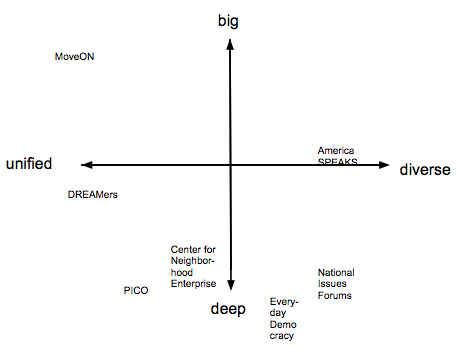
Our important civic organizations can be arrayed from “big” to “deep,” where the big ones touch lots of members, and the deep ones engage relatively small numbers in intensive ways. Meanwhile, the groups can be arrayed from “unified” to “diverse,” where the former organize people who share some common trait–such as an ideology or a social disadvantage–and the latter specialize in convening people who are different from each other. Here are some illustrative examples (with apologies to my friends who are shown below, if you think you should be a placed a little differently).
Screen Shot 2014-05-09 at 3.00.46 PM
The top right quadrant (big and diverse) is empty. Charles Tilly said that all social movements needed WUNC: “worthiness,” “unity,” “numbers,” and “commitment.” If your group is demographically or ideologically homogeneous, you can achieve unity along with numbers pretty easily–you just need the mass membership to demonstrate worthiness and commitment. And if your group is small, you can make it unified by bringing everyone into close relationships with each other.  But if you want all the people in a diverse nation to engage with each other, that requires numbers, commitment, worthiness, and unity in the face of diversity. The nation-state is supposed to achieve that, but it is not working well. It is no surprise that we lack mass, committed organizations capable of generating unity out of diversity–it is a tall order. But we have done better in the past, and we suffer from the lack today.

is society an artifact or an ecosystem? (and what that means for citizens)

A fundamental question for anyone who wants to improve the world is which aspects of society are (1) natural and fixed, (2) artifacts that we make, or (3) elements of an ecosystem or social fabric that holds together. This question came into view ca. 1800 and is now inescapable.

Let’s call a society “traditional” to the degree that members view it as natural, permanent, and perhaps of divine origin. For a very long time, some people have been partially non-traditional. They have seen particular aspects of society as artifacts: as things we plan, create, and can change. For instance, the very first Greek historian, Herodotus, collected the varied burial customs of his time. The Egyptians’ “fashions of mourning and of burial are these,” he wrote: “Whenever any household has lost a man who is of any regard amongst them, the whole number of women of that house forthwith plaster over their heads or even their faces with mud. Then leaving the corpse within the house they go themselves to and fro about the city and beat themselves, with their garments bound up by a girdle and their breasts exposed …” Herodotus implied that the Egyptians had somehow made these customs and could switch them for different ones. Yet for him, most aspects of a society were natural and permanent, as were the differences between civilized people (who knew how a society should be run) and barbarians (who got it wrong).

Let’s say that “modernism” is the view that most aspects of society are artifacts. In modernity, people not only understand some aspects of society as artifacts, but they posit that society is generally something we invent and construct; everything human is  artifactual. They believe this not only of objects and actions (such as works of art or laws) but of their underlying principles. Perhaps we have made–not discovered–our concepts and criteria of things like beauty and justice.

Modernity, in this sense, may have arisen at several times in the past. Velcheru Narayana Rao claims that “a form of awareness that can be characterized as modern emerged naturally and organically in the Telugu- and Tamil-speaking parts of the [Indian] subcontinent toward the end of the fifteenth century.” That could well be the case. But the modernism that arose in Europe around 1800 has special significance today because it spread with European power around the world and has never receded.

Two interesting authors hold opposite perspectives on the question of modernism, and I think it’s valuable for citizens to consider both.

Roberto Mangabeira Unger is an ultra-modernist, a “modernist visionary,” as he calls himself (False Necessity: Anti-Necessitarian Social Theory in the Service of Radical Democracy, p. 9). He takes “to its ultimate conclusion” the thesis “that society is an artifact” (p. 2). All our institutions, mores, habits, and incentives are things that we imagine and make. We can change each of these things, “if not all at once, then piece by piece” (p. 4). Unger “carries to extremes the idea that everything in society is politics, mere politics”–in the sense of collective action and creation (p. 1)

Unger argues that that we have not yet taken the modernist project all the way. Even radical modernists have assumed that some things are natural although we can actually change them. Importantly, they have assumed that the relations between one domain and another are given. For instance, for Marxists, the economy is fundamental and it always determines politics. Unger thinks we can change any part of that picture. He wants to get rid of all “superstitious inhibitions.”

Unger fears that the status quo retains an arbitrary advantage. To disrupt it, he proposes a whole range of social reforms that would constantly stir things up: a steep inheritance tax that funds a social endowment, mandatory membership in independent unions that can compete for members, and a “reconstructive branch” of government that can take over institutions for short periods and reform them before leaving. These are ways of creating “a framework that is permanently more hospitable to the reconstructive freedom of the people who work within its limits” (p. 34). The task is to “combine realism, practicality, and detail with visionary fire” (p. 14)

James C. Scott is a critic of radical modernism, especially under conditions when the state is strong and civil society is weak–colonialism and war being particularly dangerous. In Seeing Like a State: How Certain Schemes to Improve the Human Condition Have Failed, Scott describes high-modernist ideology as “a strong, one might even say muscle-bound, version of … self-confidence about … the rational design of social order.”

The modernist’s orientation, as Scott notes, is purely toward the future: what will improve the world going forward? Since that is an intellectual question, the smartest people can basically decide. Existing structures are arbitrary and open to review. Any artifact that works in one place can and should be adopted elsewhere.

High modernism implies a truly radical break with history and tradition. …. All human practices … would have to be reexamined and redesigned. … The structures of the past were typically products of myth, superstition, and religious prejudice. … Society became an object that the state might manage and transform with an eye toward perfecting it (Scott, pp. 92-3).

High modernism forgets humility and the value of local knowledge, the wisdom embodied in traditional practices and any obligations we may owe to the past, the intrinsic limits of human reason and virtue, and the delicate ways that aspects of society interrelate. As Scott shows, high modernist schemes of social improvement can make things much worse. On the other hand, Unger rightly points to the arbitrary advantages of the status quo and our tendency to treat terrible injustice and waste as necessary even when we could change them.

Note that this debate does not map neatly onto the conventional ideological spectrum of left to right. Unger is a radical leftist because he is strongly egalitarian and enthusiastic about state power. He is also an ultra-modernist. But Margaret Thatcher was another kind of ultra-modernist, embracing the creative destruction of capitalism and denying that there was any such thing as “society.”

Meanwhile, the most avid defenders of holistic thinking, local norms, and the precautionary principle are environmentalists (generally placed on the left). European social democrats and US liberals are quick to defend traditional institutions like welfare agencies, schools, and universities against radical reforms. Unger writes (p. 275): “Anyone who accepts the established institutional framework as the horizon within which interests and ideals –including egalitarian ideals — must be pursued is not a progressive. The European social-democratic parties are not progressive.” This is a quarrel within the left. On the right, as well, there can be a debate about the degree to which aspects of a society are artifactual. You can place yourself anywhere on the spectrum from egalitarian to libertarian and separately choose any place on a spectrum from modernist to anti-modernist.

See also Roberto Unger against root causes, the visionary fire of Roberto Mangabeira Unger, Edmund Burke would vote Democratic, and what defines conservatism?


the political advantages of organized religion

A piece of mine entitled “If Millennials Leave Religion, then What?” was published by the Religion News Service and picked up by the Washington Post yesterday. In it, I acknowledge the drawbacks of religion (viewed from a secular, political perspective), but I also catalog its advantages and argue that we don’t yet have a secular alternative that fills the traditional civic and political functions of churches and other religious congregations.

The piece had to be cut for length, which is fine (and I was able to select the cuts). But here, I would like to share one section that was deleted for length. In the published version, I alluded to the “depth” of religion. This is what I meant:

Mark Warren’s wonderful book about faith-based organizing, Dry Bones Rattling, begins with a vignette of Father Al Jost reading from the Book of Ezekiel to a group of Latina parishioners from poor neighborhoods in San Antonio. He chooses the version by African-American songwriter James Weldon Johnson: “Ezekiel connected dem dry bones.” Those lyrics derive from the Shakespearean poetry of the King James Version: “Again he said unto me, Prophesy upon these bones, and say unto them, O ye dry bones, hear the word of the Lord.” Father Jost’s listeners might hear those resonances, or some might recall the Spanish (“¡Huesos secos!”) or the Latin of the Church in which they were raised.

In any case, the effects are palpable. The women are nervous before Father Jost speaks, but they respond “with a resounding ‘Amen’ and [stride] onto the stage to the sounds of a mariachi band … exuding confidence and collective determination.”

I propose that the original quality and the long history of Ezekiel’s poetry explain its political power. Secular equivalents must match this depth of resonance.