Category Archives: civic theory

from soft skills to agency

I’m very pleased to see a blog post by Andy Calkins, Deputy Director of the Next Generation Learning Challenge, entitled “It’s Time to Trash the Terms ‘Non-Cogs’ and ‘Soft Skills.'”

Partly in response to the hegemony of standardized testing, some organizations and individuals have been pushing for “non-cognitive” or “soft” skills (e.g., collaboration, grit, participation) as important measures and goals of education. Theirs is a valid goal, but I agree with Calkins’ critique of the terminology. The kinds of skills that have been named “non-cognitive” actually require advanced cognition; the skills that have been labeled “soft” are, in every sense, quite hard.

But it’s not his critique of terminology that makes me recommend Calkins’ post. Rather, it’s the alternative master term that he recommends to replace “non-cog” and “soft.” Calkins chooses “agency,” which is indeed an apt word for the individual student outcomes that have been overlooked in the era of narrow assessments. Agency comprises an individual’s ability and motivation to interpret and change the world. But it is not an only individual matter. Agency has to be political (in the broadest sense), because individuals are truly effective as agents when they work together.

Thus we can say that citizens have agency; and people who exhibit agency in public contexts are citizens. Doris Sommers, who visited Tisch College earlier this week, would argue that citizenship is “cultural agency”: intentionally shaping the common world together. And Harry Boyte and Blase Scarnati write, “Agency can be understood as a form of empowerment that has conscious political dimensions, or as effective and intentional action that is conducted in diverse and open settings in order to shape the world around us.”

In We Are the Ones We Have Been Waiting For (pp. 27-8), I write:

A master question for social theory during the twentieth century was structure versus agency: whether people’s voluntary choices made any difference in politics, or whether underlying “structures” determined everything. This question divided, for example, French existentialists (who preached the value of intentional political acts) from French structuralists (who thought that political events, including major elections and revolutions, were superficial perturbations on the permanent structures below). But the question for the twenty-first century should be different: not how much impact agency has, but how that impact can be expanded. The reason to expand it is not that agency is intrinsically good. Hitler was an effective political agent. Rather, deliberate and effective human action is one necessary condition of a worthwhile human life. If there is no agency, life can have no point.

In the context of education, “agency” moves us from a purely individualistic framework to a recognition of collaboration, social capital, networks, public discourse, and other outcomes for groups and communities.

This argument is important coming from the Next Generation Learning Challenge, which is influential, hard-nosed about measures and methods, and involved with enhancing students’ success as currently measured. (For full disclosure, the NGLC funded us for a randomized experimental test of iCivics’ Drafting Board module, which we found to be effective.) It would be easy and unremarkable for me–a civics and democracy guy–to endorse agency. For the NGLC to choose it as a master term is much more valuable.

See also: “from the achievement gap to empowerment“
a different approach to human problems

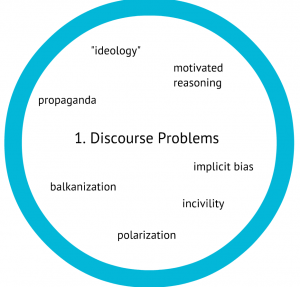
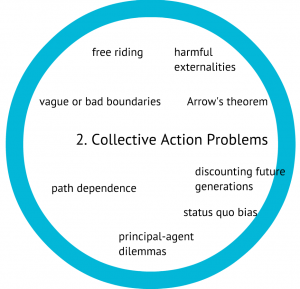
Crime, poverty, tyranny, racial injustice, and environmental degradation may be among the chief issues at a given time. But beneath such specific challenges are general forms of problems. To reprise a diagram from a previous post, we face problems of discourse (when we think or want the wrong things) and problems of collective action (when we can’t get what we want).

discourseAcademics certainly study these problems. Google Scholar finds more than 77,000 books or articles on free-riding, which is one variety of a collective action problem. It finds more than 9,000 citations of implicit bias, which I would categorize as a discourse problem. There is no shortage of material to read, and much of it is useful.
But the study of human problems and their solutions suffers from three general collective actionlimitations that we should address:

  1. Too little attention is paid to what we (you and I and the people we can influence) are able to do. For instance, pumping carbon into the air is a classic harmful externality. It’s serious enough that it threatens our survival. Economics offers a solution: tax the carbon. The tax might not even have to be very high, and other tax cuts could offset it. That sounds like the answer, but it isn’t something that we (you and I and our friends and colleagues) can implement. We lack the power to set taxes. Even if we formed the body of the US Congress, we couldn’t tax carbon in China. So the proposal to tax carbon is not the solution; it just poses new problems that we must define, analyze, and address in ways that guide our actions. (By the way, several of the most common proposed solutions are inadequate. For instance, we cannot vote for candidates who would tax carbon unless such candidates actually run, have a chance of winning, and hold a whole platform of ideas that we endorse. Also, we cannot just voluntarily cut our own carbon emissions and hope that others do as well. So what should we do?)
  2. The moral question (what is right and good?) is too often sidelined. Although the diagrams shown above list “problems,” these phenomena are not necessarily bad. For instance, when we promote competition among firms by preventing them from coordinating their prices, we are putting them in a Prisoner’s Dilemma. That is desirable because it’s better for profits and prices to be low. But when nonprofits compete instead of collaborating on the common good, that is damaging. So I say–but clearly, I owe an argument for those judgments. An underlying theory of justice must determine which Prisoner’s Dilemmas are good and bad. Some of the prevalent methods for deciding what constitutes a problem–or a solution–are morally indefensible. For example, neither false consciousness as a methodological tool on the left nor Pareto optimality on the right will reliably distinguish right from wrong. So what is right for us to do?
  3. Theory is insufficiently exploited as a resource. Sometimes people teach and investigate social problems in highly experiential ways, by rolling up their sleeves and tackling issues like homelessness or habitat loss in specific programs, classes, or other projects. Much can be learned from experience, which is why I am a lifelong advocate of civic engagement in k-12 schools and colleges. And yet, if you invite a group of people to choose, define, and address a problem from scratch, you are asking them to reinvent the whole history of thought. You may inspire them by telling them, “Never doubt that a small group of thoughtful, committed citizens can change the world.” But when they fail to improve the world, as they almost always will, their sense of self-confidence will fall–as seen consistently across a wide range of programs. It is hard enough to make noticeable progress on entrenched challenges without taking full advantage of the accumulated and organized analysis of other people. So what is smart for us to do?

The nascent Civic Studies movement proposes to ask “What should we do?” and then take very seriously the various generic forms of human problems–along with explicit moral argumentation. Three benefits should follow. We should unify our understanding of the various genera of problems–which are now distributed across the social sciences and humanities–by viewing them from a single perspective, that of a reflective small group of citizens. We should enhance human agency and satisfaction by making ourselves the cause of solutions, not just the objects of other people’s actions. Above all, we should actually improve the world by identifying solutions that we (you and I and our friends) can accomplish.

To give a little more concreteness to the list of problems, I will briefly discuss some of the key ones. This is a radically incomplete list; and the discussion of each one below is highly preliminary. The point is to indicate the agenda of Civic Studies.

  1. Discourse Problems
    1. Ideology: This word can be defined in various ways, but I have in mind a systematic distortion of one’s beliefs and preferences due to an overall theory that is wrong. For instance, some people believe that the United States was once a welfare state with a social safety net that has been badly frayed because of neoliberalism. And other people believe that the United States was once a society of free, self-reliant entrepreneurs that is now becoming socialist. They cannot both be right. If either belief or (as I happen to think) both beliefs are wrong, then we have a problem of ideology, because these ideas are prevalent and influential.
    2. Implicit Bias: In experiments using fictional resumes, “White-sounding names (e.g., Emily, Greg, Sarah, Todd) received 50 percent more callbacks for interviews than resumes with African American-sounding names (e.g., Lakisha, Jamal, Latoya, Tyrone) (Bertrand & Mullainathan, 2004). Putting this in perspective, ‘a White name yields as many more callbacks as an additional eight years of experience on a resume’ (Bertrand & Mullainathan, 2004, p. 992).” That is evidence of a bias that is pervasive and damaging even if it is unconscious and unintended. Implicit bias is not limited to matters of race and seems to be extraordinarily common.
    3. Motivated Reasoning: We are good at selecting and emphasizing facts that support our pre-determined ideas, and equally good at marginalizing or debunking facts that complicate or challenge those ideas. For example, as people obtain more education, their opinion about climate change correlates more with their political ideology. Conservatives become less likely to believe in it, and liberals more so, the more education they have. Why? Because well-educated conservatives are sophisticated enough to recognize that accepting evidence of climate change would challenge their economic views, so they use mental techniques (also exhibited by liberals on other topics) to debunk or marginalize the evidence. Many studies find that deliberate efforts to debunk myths actually reinforce the same myths because people hear the information selectively.
    4. Polarization: Numerous studies have found that groups on one general side of an issue will migrate toward more radical opinions as a result of interacting. Groups that span a wide spectrum of opinion will often polarize into relatively radical opposing subgroups. One of several reasons is that individuals want to be accepted into a group of like-minded peers.
  2. Collective Action Problems
    1. Principal-agent problems: An “agent” is someone whom a “principal” employs to take care of her interests. For instance, I employ my dentist to take care of my teeth. But my dentist’s interests may diverge from mine: for instance, if expensive surgery is an option. The same divergence can occur in political contexts. Almost all Americans believe that money has too much influence in politics and should be curtailed. Yet for decades before the Supreme Court got in the way, Congress did very little to restrain private money in politics, even when the Democrats (who were rhetorically opposed to it) controlled both branches of government. Why? Because politicians are agents of citizens, and as agents who have been elected in a system of unrestricted private money, they have different interests from their principals.
    2. Free riders: It is often tempting to let other people carry the burden for a public good, in which case the good may not be provided even if everyone wants it. Examples range from a failure to clean the dishes in a group house to the failure of nations to limit their carbon emissions.
    3. Path dependence: We might all be better off if, a century ago, cars had been developed to use electricity instead of gasoline. By the 21st century, electric cars would be fantastically fuel-efficient and convenient. But the petroleum path was chosen, and now to shift to electricity is very expensive and difficult–so much so that it might even be unwise.
    4. Arrow’s Impossibility Theorem: It has been logically proven that no system for turning votes into decisions can simultaneously meet several obvious criteria. In practical terms, the main implication is that we must choose between voting systems that force a two-sided choice (like referenda or two-party elections) or voting systems that allow many to win small shares of power (as in Israeli elections). The former systems disadvantage anyone who is dissatisfied with the forced choice. The latter can lead to stalemate or unpopular minority rule.

A subset of these problems will typically confront any concrete group of human beings who aim to improve their world. In many circumstances, the various problems will closely interrelate, causing webs or cycles of challenges. For instance, ideology may prevail over good evidence (a discourse problem) because the effort to become truly informed about public issues is not worthwhile for each party (a collective action problem).

Yet–and this is a crucial point–groups of people do solve human problems. They do build institutions and norms that make life better. Every decent and functioning government, association, neighborhood, and network is a triumph of reasonable hope over chastened experience. The master theorists of Civic Studies are people like Elinor Ostrom and Jürgen Habermas (a student, respectively, of collective-action problems and of discourse problems), who seek to understand in order to defend, improve, and spread such cases of human success.

See also Ostrom plus Habermas is nearly all we need; my piece on Civic Studies in Philosophy & Public Policy Quarterly; the book Civic Studies: Approaches to the Emerging Field; and The Good Society symposium on Civic Studies.

Peter Railton on why meetings are essential

The American Philosophical Association’s John Dewey lectures are autobiographical remarks by senior philosophers who draw lessons from their whole lives as scholars and people–much in the spirit of Dewey. University of Michigan Professor Peter Railton exemplifies the genre with his 2015 lecture, Innocent Abroad: Rupture, Liberation, and Solidarity, which is a wonderful reflection on a life of thought integrated with action.

What I want to quote is his defense of “meetings,” which is strikingly similar to the arguments I offer in We Are the Ones We Have Been Waiting For. Railton writes:

Oscar Wilde is still right—because the cost of building a society where the people have more say in how their lives are run is still many, many meetings. What is a meeting, after all, but people deliberating together with a capacity to act as a group that is more than just a sum of individual actions, and this sort of informed joint action is a precondition for significant social change. Come together, decide together, act together, and bear the consequences together. We must own our institutions or they will surely own us. As Aristotle told us, one becomes a citizen not by belonging to a polity or having a vote, but by shouldering the tasks of joint deliberation and civic governance. And there is no civic or faculty governance, no oversight of discrimination in hiring and promotion, no regulation of pollutants, no organization of faculty or students to initiate curricular reform, no mobilization by professional associations to protect their most vulnerable members or to promote greater diversity, no increased humaneness in the treatment of animals and human subjects, no chance to offset arbitrariness and bullying within offices and departments, no oversight of progress and revision of plans in response to changing circumstances, without actual people who care spending long hours in the work of planning, meeting, and making things happens. The alternative is for all these decisions to be made at the discretion of those on high—or not at all. …

Of course, I am using ‘committees’ and ‘meetings’ as stand-ins for countless forms of joint deliberation and action. It needn’t fill the streets with banners or occupy buildings—sustainable activism is the work of a lifetime, not just of youthful bravado. What most impresses me about the activism of today’s youth is that it persists, indeed, flourishes, in countless ways that are more integrated with the ways of working of the world. As I look around me from the vantage point of Philosophy, I see colleagues and students investing countless hours trying to enhance the inclusion of women and other under-represented groups, or to build collective bargaining for graduate student instructors and term lecturers, or to reach out beyond the university to promote equitable trade, or to support humane and ecological practices in agriculture, or to bring new resources to under-served communities. These efforts involve personal sacrifice, and often made by those within the academy whose positions are the least secure. Moreover, they are making these sacrifices without a movement at their backs, or a Zeitgeist to buoy them from below. So it behooves those of us who are more secure to revive our spirit of activism. To lend a hand, and to use whatever leverage we might have to provide badly-needed support.

I agree with every word above. I’d only add that opportunities to talk, listen, and work with fellow citizens have weakened. The proportions of Americans who said that they attended community meetings, worked with neighbors to address problems, and belonged to organizations fell between 1975 and 2005.

These trends were not accidental but reflected intentional moves to sideline citizens. For instance, jury trials were replaced with plea-bargaining. The proportion of Americans who served on public boards declined by about 75 percent during the second half of the twentieth century, due to consolidation of local governments and the replacement of lay bodies with professional managers. The decline of unions meant many fewer union meetings and collective bargaining sessions; it also meant that labor was no longer a force that could demand public discussion of issues.

It follows that democracy not only takes a lot of evenings. It also requires a fight for the right to use our evenings to govern ourselves–against people who would rather govern us.

apply for the 2015 Summer Institute of Civic Studies

The seventh annual Summer Institute of Civic Studies will be an intensive, two-week, interdisciplinary seminar bringing together faculty, advanced graduate students, and practitioners from many countries and diverse fields of study.

Organized by Peter Levine of Tufts University’s Tisch College and Karol Soltan of the University of Maryland, the Summer Institute will engage participants in challenging discussions of such topics as:

  • What kinds of citizens (if any) do good regimes need?
  • What should such citizens know, believe, and do?
  • What practices and institutional structures promote the right kinds of citizenship
  • What ought to be the relationships among empirical evidence, ethics, and strategy?

The syllabus for the sixth annual seminar (in 2014) is here. The 2015 syllabus will be modified but will largely follow this outline. You can read more about the motivation for the Institute in the Framing Statement by Harry Boyte, University of Minnesota; Stephen Elkin, University of Maryland; Peter Levine, Tufts; Jane Mansbridge, Harvard; Elinor Ostrom, Indiana University; Karol Soltan, University of Maryland; and Rogers Smith, University of Pennsylvania.

Practicalities

The daily sessions will take place from June 15-25, 2015, at the Tufts campus in Medford, MA. The seminar will be followed (from June 24, evening, until June 27) by a public conference–“Frontiers of Democracy 2015”–in downtown Boston. Participants in the institute are expected to stay for the public conference. See information on the 2014 conference here.

Tuition for the Institute is free, but students are responsible for their own housing and transportation. A Tufts University dormitory room can be rented for $230-$280/week. Credit is not automatically offered, but special arrangements for graduate credit may be possible.

To apply: please email your resume, an electronic copy of your graduate transcript (if applicable), and a cover email about your interests to Peter Levine at Peter.Levine@Tufts.edu. For best consideration, apply no later than March 15, 2012. You may also sign up for occasional announcements even if you are not sure that you wish to apply.

The Sister Seminar in Ukraine

In 2015, there will also be a parallel Summer Institute at Chernivitsi University in Ukraine. It is co-organized by Dr. Tetyana Kloubert (University of Augsburg) with Karol Soltan and Peter Levine and funded by the German government through the DAAD. Participants from Ukraine, Belarus, Poland, and Germany are eligible. More information here.

Please feel free to share this announcement.

the Women’s Studies/Civic Studies analogy

In introducing Civic Studies, I am increasingly using an analogy to Women’s Studies. This is how it goes:

In the 1960s, a political movement–known retrospectively as Second-Wave Feminism–developed, with the goals of liberating women and achieving gender equality. That movement had intellectual leaders, including academics and independent writers. They shared political goals with the movement but they also had intellectual objectives: to challenge the invisibility of women in all fields of study (from cancer research to classical history), to explore issues related to gender, and to develop novel theories and methodologies that emerged from thinking as and about women. One strategy for accomplishing those goals was to create women’s studies as a discipline, with all that entailed: journals, conferences, and courses. Apparently, the first women’s studies course was taught at Cornell in 1969, and the first two degree programs were launched in 1970. The courses could be pedagogically innovative, but what really defined them was their subject matter and the developing canon of assigned writers. Of course, participants did not hold uniform ideas but engaged in a rich debate. They have built up a new discipline, developed several generations of scholars, challenged and altered virtually all the other disciplines, and offered insights and information to political and social movements.

Likewise …

Since the late 1980s, there has been a movement to restore the role of active, responsible, collaborating citizens in the creation and the governance of communities. It has arisen to counter trends–centralization, marketization, consumerism, crony capitalism, and positivism–that marginalize citizens. Perhaps it does not deserve comparison to Second Wave Feminism, although if we take a global perspective, it has had striking successes (see this World Bank volume, village democracy in India, or the many cases described in Participedia). This civic renewal movement has an intellectual component led by prominent academics along with some independent writers (e.g., Parker Palmer, Frances Moore Lappé). They too have confronted a problem of invisibility within the academy. Too much research across the social and behavioral sciences, the humanities, and the professional disciplines ignores what I would call “citizens”: people who combine facts, strategies, and values to define and address social issues in common with peers. Citizens are invisible because of artificial distinctions between facts and values and because of research methods that miss human agency. In response, the intellectuals involved in Civic Studies are beginning to build up courses, journals, conferences, and allied efforts (e.g., Civic Science). Again, the pedagogy may be innovative, but this is not an educational reform movement. Our goals are rather to develop a new discipline, to alter the other disciplines, to derive new insights by thinking about and as citizens, and to inform political and social movements that renew civic life.