Category Archives: civic theory

apply for the 2015 Summer Institute of Civic Studies

The seventh annual Summer Institute of Civic Studies will be an intensive, two-week, interdisciplinary seminar bringing together faculty, advanced graduate students, and practitioners from many countries and diverse fields of study.

Organized by Peter Levine of Tufts University’s Tisch College and Karol Soltan of the University of Maryland, the Summer Institute will engage participants in challenging discussions of such topics as:

  • What kinds of citizens (if any) do good regimes need?
  • What should such citizens know, believe, and do?
  • What practices and institutional structures promote the right kinds of citizenship
  • What ought to be the relationships among empirical evidence, ethics, and strategy?

The syllabus for the sixth annual seminar (in 2014) is here. The 2015 syllabus will be modified but will largely follow this outline. You can read more about the motivation for the Institute in the Framing Statement by Harry Boyte, University of Minnesota; Stephen Elkin, University of Maryland; Peter Levine, Tufts; Jane Mansbridge, Harvard; Elinor Ostrom, Indiana University; Karol Soltan, University of Maryland; and Rogers Smith, University of Pennsylvania.

Practicalities

The daily sessions will take place from June 15-25, 2015, at the Tufts campus in Medford, MA. The seminar will be followed (from June 24, evening, until June 27) by a public conference–“Frontiers of Democracy 2015”–in downtown Boston. Participants in the institute are expected to stay for the public conference. See information on the 2014 conference here.

Tuition for the Institute is free, but students are responsible for their own housing and transportation. A Tufts University dormitory room can be rented for $230-$280/week. Credit is not automatically offered, but special arrangements for graduate credit may be possible.

To apply: please email your resume, an electronic copy of your graduate transcript (if applicable), and a cover email about your interests to Peter Levine at Peter.Levine@Tufts.edu. For best consideration, apply no later than March 15, 2012. You may also sign up for occasional announcements even if you are not sure that you wish to apply.

The Sister Seminar in Ukraine

In 2015, there will also be a parallel Summer Institute at Chernivitsi University in Ukraine. It is co-organized by Dr. Tetyana Kloubert (University of Augsburg) with Karol Soltan and Peter Levine and funded by the German government through the DAAD. Participants from Ukraine, Belarus, Poland, and Germany are eligible. More information here.

Please feel free to share this announcement.

the Women’s Studies/Civic Studies analogy

In introducing Civic Studies, I am increasingly using an analogy to Women’s Studies. This is how it goes:

In the 1960s, a political movement–known retrospectively as Second-Wave Feminism–developed, with the goals of liberating women and achieving gender equality. That movement had intellectual leaders, including academics and independent writers. They shared political goals with the movement but they also had intellectual objectives: to challenge the invisibility of women in all fields of study (from cancer research to classical history), to explore issues related to gender, and to develop novel theories and methodologies that emerged from thinking as and about women. One strategy for accomplishing those goals was to create women’s studies as a discipline, with all that entailed: journals, conferences, and courses. Apparently, the first women’s studies course was taught at Cornell in 1969, and the first two degree programs were launched in 1970. The courses could be pedagogically innovative, but what really defined them was their subject matter and the developing canon of assigned writers. Of course, participants did not hold uniform ideas but engaged in a rich debate. They have built up a new discipline, developed several generations of scholars, challenged and altered virtually all the other disciplines, and offered insights and information to political and social movements.

Likewise …

Since the late 1980s, there has been a movement to restore the role of active, responsible, collaborating citizens in the creation and the governance of communities. It has arisen to counter trends–centralization, marketization, consumerism, crony capitalism, and positivism–that marginalize citizens. Perhaps it does not deserve comparison to Second Wave Feminism, although if we take a global perspective, it has had striking successes (see this World Bank volume, village democracy in India, or the many cases described in Participedia). This civic renewal movement has an intellectual component led by prominent academics along with some independent writers (e.g., Parker Palmer, Frances Moore Lappé). They too have confronted a problem of invisibility within the academy. Too much research across the social and behavioral sciences, the humanities, and the professional disciplines ignores what I would call “citizens”: people who combine facts, strategies, and values to define and address social issues in common with peers. Citizens are invisible because of artificial distinctions between facts and values and because of research methods that miss human agency. In response, the intellectuals involved in Civic Studies are beginning to build up courses, journals, conferences, and allied efforts (e.g., Civic Science). Again, the pedagogy may be innovative, but this is not an educational reform movement. Our goals are rather to develop a new discipline, to alter the other disciplines, to derive new insights by thinking about and as citizens, and to inform political and social movements that renew civic life.

the two basic categories of problems

Human beings face two fundamental categories of problems: problems of discourse and problems of collective action.

Problems of discourse make our conversations go badly, so that we believe or desire the wrong things. They include, for example, our unconscious biases in favor of members of our members of our own groups and our strong tendency to “motivated reasoning,” or picking facts and theories because they yield the results we want. A different example is ideology, defined (in this context) as holding a distorted view of reality that preserves the advantages of the privileged.

Meanwhile, problems of collective action cause us to get results that we do not desire, even when we agree about goals and values. An example is the temptation to “free ride” on other people’s contributions, or the extreme cost of changing a system once it has been chosen and developed (“path dependence”).
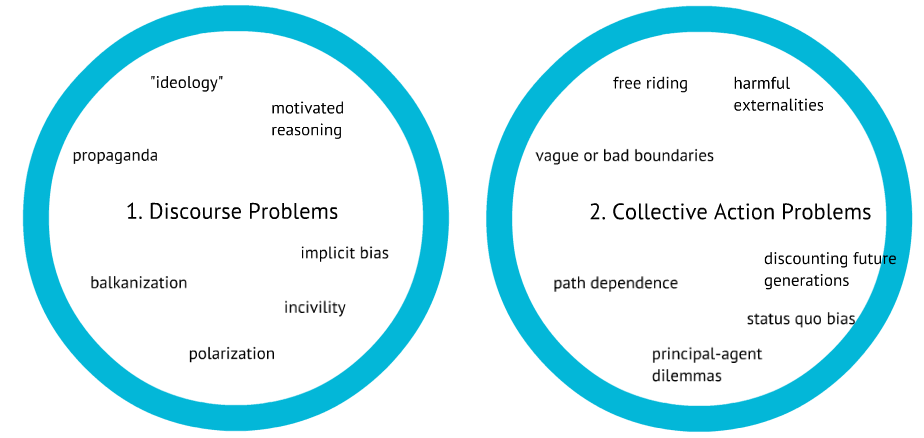
Screen Shot 2015-02-10 at 10.20.04 AM

How can I justify the claim that these are the two fundamental categories of problems? My claim is subjective, but it does arise from 20 years of thinking about social problems, during which I have constantly found myself drawn to two quite different conversations. One is about deliberation, communication, and the flaws thereof. The most relevant disciplines are political philosophy, cultural studies, and communications. Famous authorities include Marx and the Frankfurt School, Habermas, Derrick Bell, John Rawls, Judith Butler, and many more. The other conversation is about rational choice, public choice, and game theory. The most relevant disciplines are economics and social psychology. Authorities include Elinor Ostrom, James M. Buchanan, Mancur Olson, and Kahneman & Tversky.

The two sets of problems are connected. For instance, one explanation of motivated reasoning is that to choose the most convenient facts is easier than giving all the evidence a full and rigorous consideration; and we can get away with the easier path because we can free-ride on other people’s intellectual labor. Thus the discourse problem of motivated reasoning is linked to a basic collective action problem.

Yet neither set of problems is, in my view, reducible to the other. For instance, a very ambitious game theorist might assume that game-like models can explain all breakdowns of human interaction. But game theory takes as given the values and identities of the players. In fact, those are not fixed but are generated and changed by discourse.

By the same token, some cultural critics might argue that all of our problems arise from distorted discourse, bias, and ideology. But I think that even if we all sincerely agreed about something as important as climate change, problems of collective action would still be formidable. We would not only face the mother of all tragedies-of-the-commons but also challenges of path dependence (e.g., our dependence on internal combustion engines) and boundary issues (the countries that use the most carbon are separated from the big producers).

I am well aware that we also face a whole range of urgent concrete problems not shown above, such as global warming or racism today–or (at other times in our history) plagues and famines and invading hordes. But while those threats are matters of life and death for specific communities, the two categories shown above apply at all times. They establish the form of human interaction, into which are poured such specific content as poverty, racism, authoritarianism, disease, etc.

I was trying to think of a place where demographic diversity would be absent and where there would be such a high degree of consensus about one transcendent goal that the participants would not care about matters like poverty or climate change. In such a place, we might see neither discourse problems nor collective action problems. I came up with the all-male Orthodox Holy Community of Mount Athos, which is now a quasi-autonomous monastic republic within the EU. Although I certainly do not know the details, I quickly found an example of the two generic problems afflicting this community:

In June 1913, a small Russian fleet, consisting of the gunboat Donets and the transport ships Tsar and Kherson, delivered the archbishop of Vologda, and a number of troops to Mount Athos to intervene in the theological controversy over imiaslavie [the belief that the Name of God is God].

The archbishop held talks with the imiaslavtsy and tried to make them change their beliefs voluntarily, but was unsuccessful. On 31 July 1913, the troops stormed the St. Panteleimon Monastery. Although the monks were not armed and did not actively resist, the troops showed very heavy-handed tactics. After the storming of St. Panteleimon Monastery, the monks from the Andreevsky Skete (Skiti Agiou Andrea) surrendered voluntarily. The military transport Kherson was converted into a prison ship and more than a thousand imiaslavtsy monks were sent to Odessa where they were excommunicated and dispersed throughout Russia.

If a bunch of white men who have voluntarily renounced property, sex, and freedom and who are totally devoted to the Orthodox faith can face deadly problems of discourse and collective action, then these challenges seem universal. That doesn’t mean they always defeat us; it just means we always have to work on them.

Tisch talks on the humanities and civic engagement

The Initiatives in the Public Humanities at Tisch College sponsor this series of monthly brown bag lunches during the spring semester of 2015. The Tisch Talks in the Humanities seek to identify areas of mutual interest and concern through conversations informed by contemporary civic and cultural practices.

All sessions take place at 12pm at Tisch College, Rabb Room, Lincoln Filene Hall
Moderated by Diane O’Donoghue, Senior Fellow for the Humanities, Tisch College

Feb 2: Source @Sourcing
Marie-Claire Beaulieu, Assistant Professor, Department of Classics
Jennifer Eyl, Assistant Professor, Department of Religion

Professors Beaulieu and Eyl will discuss the impact of contemporary practices of knowledge production, such as found in the digital humanities and open-source scholarship, on the audiences and reception of classical and biblical texts.

March 30: Generative Empathies
Amahl Bishara, Assistant Professor, Department of Anthropology
Doris Sommer, Ira Jewell Williams, Jr. Professor of Romance Languages and
Literature and Director, Cultural Agents Initiative, Harvard University
Peter Levine, Associate Dean for Research, Tisch College

Professors Bishara, Sommer, and Levine will explore current discourses around the meanings and uses of “empathy,” a topic with implications that are both compelling and complex.

April 27: Neighboring
Penn Loh, Director, Master in Public Policy Program and Community
Practice, Urban and Environmental Policy and Planning
Peter Probst, Professor and Chair, Department of Art and Art History

Professor Probst and Mr. Loh will discuss the implications of proximity as the provocation to objects and acts of “neighboring.”

Frontiers of Democracy 2015

Frontiers of Democracy 2015 will take place in Boston, MA on June 25-27.

While powerful forces work against justice and civil society around the world, committed and innovative people strive to understand and improve citizens’ engagement with government, with community, and with each other. Every year, Frontiers of Democracy convenes some of these practitioners and scholars for organized discussions and informal interactions. Topics include deliberative democracy, civil and human rights, social justice, community organizing and development, civic learning and political engagement, the role of higher education in democracy, Civic Studies, media reform and citizen media production, civic technology, civic environmentalism, and common pool resource management. Devoted to new issues and innovative solutions, this conference is truly at the frontiers of democracy.

More information, including a link to a registration page, can be found here.

Frontiers of Democracy is a public conference, open to anyone who registers. It follows the Summer Institute of Civic Studies, a seminar that is accepting applicants for 2015.