Category Archives: civic theory

Innovation and Civic Engagement

I’m speaking briefly tomorrow at a Tufts Institute for Innovation symposium on “Research, Innovation, and Community Engagement.” I may say something along these lines:

It is exciting and valuable to put these four words together. We need innovation because existing strategies have not solved stubborn problems. We need research to explain the problems and to assess what works. We need communities, meaning not just populations of people who happen to live in particular places, but groups of people who have networks and norms that allow them to improve the world. (Voluminous scholarship finds that community ties are essential for success.) And we need engagement if we want research and innovation to influence the world.

So I am a fan. But I would like to take a few minutes to note some risks that may arise if we try to combine research, innovation, community, and engagement in the wrong ways.

Research and innovation go together neatly. In fact, university-based research must be innovative, almost by definition. An inquiry doesn’t count as “research” if it has been done before. To be sure, some academic research is highly routine and standard. But that kind of work is valued less than original research. Innovation is esteemed in the university. Famous scholars are innovators.

Innovation is also valued highly in the private sector, in part because making or doing something new can be especially profitable. One definition of a “commodity” is a good for which the demand is met by undifferentiated suppliers. It doesn’t matter whether your shirt was stitched by Bangladeshi workers or a machine in Germany; the shirt comes out the same. A commodity yields low profits because anyone can turn capital into the good and compete. Innovation allows the innovator to reap greater advantage by avoiding competition.

Since innovation is prized in the academy (where the currency is fame) and in the marketpace (where the currency is money)–and since the academy and the market are merging–it is no surprise that glamor attaches to the idea of innovative research that produces innovative solutions that go to market. That is the current ideal.

It is an ideal that also finds its way into public policy. The Obama Administration loves concrete new policy interventions that can be rigorously evaluated. In 2o13, for instance, the administration proposed $200 million in a competitive pool for state governments that cut energy use and expanded HOPE (Hawaii’s Opportunity Probation and Enforcement scheme), which had performed well in evaluations. But it proposed to cut Social Security by $130 billion and Medicare by $380 billion.

Social Security and Medicare are old, not innovative. These big, old programs are not subject to being invented and then tested in randomized experiments. Yet cutting $130 billion from a basic entitlement is massively more consequential than spending $200 million on innovations. And the reason for the cuts was not an actual preference by the administration; it was a function of the balance of power, with Republicans controlling Congress. If we presume that innovation by itself solves problems, we forget about power–power to devise innovations, power to use them, and power to change larger systems that have little to do with innovation.

If innovation and research fit comfortably enough together, innovation and community make a more difficult pair. Communities do not necessarily need innovation. They may prefer to preserve what they have, or to develop in regular and predictable ways. They may value tradition. They will ask whether an innovation is an improvement or a new evil. For these and other reasons, they often resist innovations.

Even when it comes to research, communities may not need originality. Once it is known that cigarettes cause cancer, a community needs to know who is smoking and where the cigarettes come from. The original discovery about the impact of tobacco was valuable, but now the community just needs routine data of the kind that will not look impressive on an academic’s CV.

In a competitive research university, the more innovation, the better. In a community, that is not the case. True, a world of innovation can be exciting and liberating. But if everyone else is innovating, it becomes difficult to make plans for yourself. That actually undermines personal liberty; you are constantly reacting and adjusting to other people’s innovations. The same is true for communities. They cannot govern themselves and form durable laws if everything if always being changed. As James Madison argued: A “mutable policy … poisons the blessings of liberty itself. It will be of little avail to the people, that the laws are made by men of their own choice, if the laws … be repealed or revised before they are promulg[at]ed, or undergo such incessant changes, that no man who knows what the law is to-day, can guess what it will be to-morrow.”

I haven’t said anything about “engagement” yet. Real engagement is not a one-way flow. For instance, to develop and deploy an innovation in a community does not reflect engagement. Two people are said to be engaged if they plan to form a couple. Two gears are engaged if turning either one moves the other. Two gears are engaged if stopping one stops the other. A community and a university are engaged if they form a kind of couple, and if motion–or stillness–on either side influences the partner.

Communities can innovate. And civic engagement can be done in innovative ways. Indeed, Carmen Sirianni and Lewis Friedland’s book, Civic Innovation in America: Community Empowerment, Public Policy, and the Movement for Civic Renewal is an indispensable work that counters narratives of civic decline by showing that new forms of civic engagement have been painstakingly developed to respond to a changing world.

In an age of innovation, we’d better engage citizens in new ways. In that respect, innovation and engagement fit neatly together. But we must not yield to the assumption that “innovation” is desirable because it is the path to fame and profit. If we are really engaged with communities, they will have the power to stop or alter the cleverest innovations. At least some of the power will come from their side.

In short, I am all for developing innovative solutions to social problems and engaging communities in using them. But we must not forget issues of power and of ethics. Some innovations are good, some are bad, and some are insignificant compared to bigger social decisions. A relationship should form between any academic or entrepreneur who is strongly motivated to innovate and the community that might want to participate. That relationship must be ethical and fairly equitable. Ideally, some of the insights and innovations will come from the community side. And like an engaged gear, the community will have the power to stop and prevent the research partner from moving forward.

against fatalism: responding to Krugman and Sunstein

(Washington, DC) Harry Boyte, Albert Dzur, and I have a letter in the latest New York Review of Books that is pertinent to today’s column by Paul Krugman. Krugman’s piece, entitled “Economics and Elections,” is deeply depressing and depressed, exemplifying the very mode of thought that Harry, Albert, and I wanted to challenge in our letter about Cass Sunstein and Michael Walzer, which we wrote more than a month ago.

Krugman argues today that the British Tories did immense and unnecessary damage to the UK economy by enforcing austerity policies. However, the British economy has grown of late, and “a large body of political science research” finds that what determines the outcome of a national election is economic growth during “the last two quarters before the election.” That factor is much more important than any behavior or rhetoric by politicians or anything that the media can say or do. It explains why the Tories may win.

For politicians, the lesson is to ignore the good of the country if you want to be reelected. In fact, “the politically smart thing might well be to impose a pointless depression on your country for much of your time in office, solely to leave room for a roaring recovery just before voters go to the polls.” Scholars and public intellectuals can do little to change this reality, Krugman argues, but they should commit to the truth anyway, like geeky existentialists. Our duty as intellectuals:

Try to get it right, and explain our answers as clearly as we can. Realistically, the political impact will usually be marginal at best. Bad things will happen to good ideas, and vice-versa. So be it. Elections determine who has power, not who has the truth.

(By the way, this is an interesting reversal for Krugman, who early in the Obama years was quick to accuse the president of not using the Bully Pulpit effectively. As he now notes, political scientists basically don’t believe in the Bully Pulpit.)

Cass Sunstein, a distinguished and often insightful political scientist, has collected evidence along similar lines to the “large body” of research cited by Krugman today. Sunstein and his co-author Reid Hastie argue that individuals and groups reach irrational conclusions because of hard-wired cognitive limitations, such as a tendency to “groupthink.” The behavior of voters in a national election is just an example.

Such evidence should be taken seriously. But Michael Walzer offered an important critique in the New York Review of Books that could also apply to Krugman’s article today. Walzer argued that problems (like groupthink) that bedevil discussions inside Congress, the Supreme Court, or any committee room may not be as serious as “powerlessness and inequality.” He concluded:

Organizing, agitating, demonstrating—these are ways of bringing the powerless to the attention of the powerful. They can contribute importantly to democratic decisions, even if they seem nondeliberative. … Sometimes we will want the people outside the room actually to win—to organize and agitate so successfully that they take over the small groups who dominate decision-making, with the result that they change the political conversation. … So, yes, we need to be wiser in the ways described by Sunstein and Hastie; but we also need a radically different kind of decision-making than what they describe, involving a larger number of people inside and outside the rooms where small groups sit.

We concur but would push the argument further. Political institutions can be changed. This is not only a matter of adjusting the rules that govern, for instance, parliamentary districts in the UK or campaign finance in the US. It is also about achieving cultural change within major institutions, such as legislatures, newspapers, and schools and colleges. It is about changing us (the citizens), not just them (the rulers). We wrote:

Sunstein, like Habermas and many others, sees major institutions as largely fixed and unchangeable, not subject to democratizing change. This assumption generates fatalism, which has shrunk our imaginations about decision-making, politics, and democracy itself. The challenge is to recognize that institutions of all kinds are human creations that in turn can be recreated, reconnected to questions of civic and democratic purpose. For this task we need to bring in Max Weber as well as Machiavelli and Marx [whom Walzer had recommended in his review]. Weber described the “iron cage” that results from technical rationality. In his essay “The Profession and the Vocation of Politics,” Weber also evocatively termed the pattern “the polar night of icy darkness.” Thawing the polar night is a frontier of democracy in the twenty-first century.

The evidence that Krugman and Sunstein cite is empirical. By definition, it derives from the past. In the case of Krugman’s column today, it derives from quantitative studies of US presidential campaigns since World War II. We should pay attention to trends in the recent past so that we know what to change. But we cannot allow the past to become a dead hand so that we surrender our political agency.

I addressed the very same topic in We Are The Ones We Have Been Waiting For (pp. 26-7):

The outcome of presidential elections in the United States is strongly correlated with the performance of the economy in the previous year. That means that all the deliberate work of campaigns, parties, and independent advocacy groups matters less than the blind, impersonal force of the business cycle.

Nevertheless, working together in small groups is morally important—it is what we should do and should care most about. To be a good person is to do this work well. That is reason enough to make it a central question for reflection and research. In addition, deliberate human action has significant impact. Small groups of thoughtful, committed citizens do make a difference under appropriate circumstances, as shown by the civil rights movement, the women’s movement, the conservative legal movement, and numerous other examples. … Elinor Ostrom won the 2009 Nobel Prize in Economic Sciences for demonstrating that the organization and governance of voluntary groups affects whether they can solve social problems. These findings suggest that “small groups of thoughtful, committed citizens” matter, even if other factors matter too.

If the leaders of the South African freedom movement reviewed the scholarly literature on democratization during the apartheid years, they must have found it depressing. Prosperity, economic equality, and ethnic homogeneity were the factors that had been found to increase the odds of a successful transition to democracy. These structural factors were all evidently absent in South Africa. … Thus, if the African National Congress and other democratic reformers had been guided by hard-nosed, empirical research, they would have chosen a goal short of democracy, something like a negotiated arrangement among separate authoritarian communities. But they were right to ignore the scholarly literature because it was based on empirical data—in a word, on the past—and the past can never determine the future. So far, their peaceful revolution appears a monumental work of deliberate human agency.

from soft skills to agency

I’m very pleased to see a blog post by Andy Calkins, Deputy Director of the Next Generation Learning Challenge, entitled “It’s Time to Trash the Terms ‘Non-Cogs’ and ‘Soft Skills.'”

Partly in response to the hegemony of standardized testing, some organizations and individuals have been pushing for “non-cognitive” or “soft” skills (e.g., collaboration, grit, participation) as important measures and goals of education. Theirs is a valid goal, but I agree with Calkins’ critique of the terminology. The kinds of skills that have been named “non-cognitive” actually require advanced cognition; the skills that have been labeled “soft” are, in every sense, quite hard.

But it’s not his critique of terminology that makes me recommend Calkins’ post. Rather, it’s the alternative master term that he recommends to replace “non-cog” and “soft.” Calkins chooses “agency,” which is indeed an apt word for the individual student outcomes that have been overlooked in the era of narrow assessments. Agency comprises an individual’s ability and motivation to interpret and change the world. But it is not an only individual matter. Agency has to be political (in the broadest sense), because individuals are truly effective as agents when they work together.

Thus we can say that citizens have agency; and people who exhibit agency in public contexts are citizens. Doris Sommers, who visited Tisch College earlier this week, would argue that citizenship is “cultural agency”: intentionally shaping the common world together. And Harry Boyte and Blase Scarnati write, “Agency can be understood as a form of empowerment that has conscious political dimensions, or as effective and intentional action that is conducted in diverse and open settings in order to shape the world around us.”

In We Are the Ones We Have Been Waiting For (pp. 27-8), I write:

A master question for social theory during the twentieth century was structure versus agency: whether people’s voluntary choices made any difference in politics, or whether underlying “structures” determined everything. This question divided, for example, French existentialists (who preached the value of intentional political acts) from French structuralists (who thought that political events, including major elections and revolutions, were superficial perturbations on the permanent structures below). But the question for the twenty-first century should be different: not how much impact agency has, but how that impact can be expanded. The reason to expand it is not that agency is intrinsically good. Hitler was an effective political agent. Rather, deliberate and effective human action is one necessary condition of a worthwhile human life. If there is no agency, life can have no point.

In the context of education, “agency” moves us from a purely individualistic framework to a recognition of collaboration, social capital, networks, public discourse, and other outcomes for groups and communities.

This argument is important coming from the Next Generation Learning Challenge, which is influential, hard-nosed about measures and methods, and involved with enhancing students’ success as currently measured. (For full disclosure, the NGLC funded us for a randomized experimental test of iCivics’ Drafting Board module, which we found to be effective.) It would be easy and unremarkable for me–a civics and democracy guy–to endorse agency. For the NGLC to choose it as a master term is much more valuable.

See also: “from the achievement gap to empowerment

a different approach to human problems

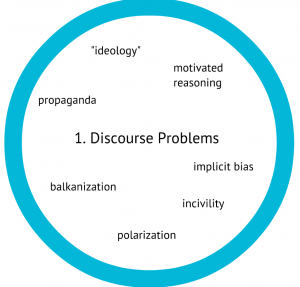
Crime, poverty, tyranny, racial injustice, and environmental degradation may be among the chief issues at a given time. But beneath such specific challenges are general forms of problems. To reprise a diagram from a previous post, we face problems of discourse (when we think or want the wrong things) and problems of collective action (when we can’t get what we want).

discourseAcademics certainly study these problems. Google Scholar finds more than 77,000 books or articles on free-riding, which is one variety of a collective action problem. It finds more than 9,000 citations of implicit bias, which I would categorize as a discourse problem. There is no shortage of material to read, and much of it is useful.
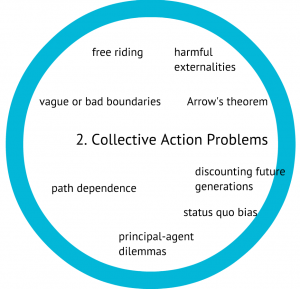
But the study of human problems and their solutions suffers from three general collective actionlimitations that we should address:

  1. Too little attention is paid to what we (you and I and the people we can influence) are able to do. For instance, pumping carbon into the air is a classic harmful externality. It’s serious enough that it threatens our survival. Economics offers a solution: tax the carbon. The tax might not even have to be very high, and other tax cuts could offset it. That sounds like the answer, but it isn’t something that we (you and I and our friends and colleagues) can implement. We lack the power to set taxes. Even if we formed the body of the US Congress, we couldn’t tax carbon in China. So the proposal to tax carbon is not the solution; it just poses new problems that we must define, analyze, and address in ways that guide our actions. (By the way, several of the most common proposed solutions are inadequate. For instance, we cannot vote for candidates who would tax carbon unless such candidates actually run, have a chance of winning, and hold a whole platform of ideas that we endorse. Also, we cannot just voluntarily cut our own carbon emissions and hope that others do as well. So what should we do?)
  2. The moral question (what is right and good?) is too often sidelined. Although the diagrams shown above list “problems,” these phenomena are not necessarily bad. For instance, when we promote competition among firms by preventing them from coordinating their prices, we are putting them in a Prisoner’s Dilemma. That is desirable because it’s better for profits and prices to be low. But when nonprofits compete instead of collaborating on the common good, that is damaging. So I say–but clearly, I owe an argument for those judgments. An underlying theory of justice must determine which Prisoner’s Dilemmas are good and bad. Some of the prevalent methods for deciding what constitutes a problem–or a solution–are morally indefensible. For example, neither false consciousness as a methodological tool on the left nor Pareto optimality on the right will reliably distinguish right from wrong. So what is right for us to do?
  3. Theory is insufficiently exploited as a resource. Sometimes people teach and investigate social problems in highly experiential ways, by rolling up their sleeves and tackling issues like homelessness or habitat loss in specific programs, classes, or other projects. Much can be learned from experience, which is why I am a lifelong advocate of civic engagement in k-12 schools and colleges. And yet, if you invite a group of people to choose, define, and address a problem from scratch, you are asking them to reinvent the whole history of thought. You may inspire them by telling them, “Never doubt that a small group of thoughtful, committed citizens can change the world.” But when they fail to improve the world, as they almost always will, their sense of self-confidence will fall–as seen consistently across a wide range of programs. It is hard enough to make noticeable progress on entrenched challenges without taking full advantage of the accumulated and organized analysis of other people. So what is smart for us to do?

The nascent Civic Studies movement proposes to ask “What should we do?” and then take very seriously the various generic forms of human problems–along with explicit moral argumentation. Three benefits should follow. We should unify our understanding of the various genera of problems–which are now distributed across the social sciences and humanities–by viewing them from a single perspective, that of a reflective small group of citizens. We should enhance human agency and satisfaction by making ourselves the cause of solutions, not just the objects of other people’s actions. Above all, we should actually improve the world by identifying solutions that we (you and I and our friends) can accomplish.

To give a little more concreteness to the list of problems, I will briefly discuss some of the key ones. This is a radically incomplete list; and the discussion of each one below is highly preliminary. The point is to indicate the agenda of Civic Studies.

  1. Discourse Problems
    1. Ideology: This word can be defined in various ways, but I have in mind a systematic distortion of one’s beliefs and preferences due to an overall theory that is wrong. For instance, some people believe that the United States was once a welfare state with a social safety net that has been badly frayed because of neoliberalism. And other people believe that the United States was once a society of free, self-reliant entrepreneurs that is now becoming socialist. They cannot both be right. If either belief or (as I happen to think) both beliefs are wrong, then we have a problem of ideology, because these ideas are prevalent and influential.
    2. Implicit Bias: In experiments using fictional resumes, “White-sounding names (e.g., Emily, Greg, Sarah, Todd) received 50 percent more callbacks for interviews than resumes with African American-sounding names (e.g., Lakisha, Jamal, Latoya, Tyrone) (Bertrand & Mullainathan, 2004). Putting this in perspective, ‘a White name yields as many more callbacks as an additional eight years of experience on a resume’ (Bertrand & Mullainathan, 2004, p. 992).” That is evidence of a bias that is pervasive and damaging even if it is unconscious and unintended. Implicit bias is not limited to matters of race and seems to be extraordinarily common.
    3. Motivated Reasoning: We are good at selecting and emphasizing facts that support our pre-determined ideas, and equally good at marginalizing or debunking facts that complicate or challenge those ideas. For example, as people obtain more education, their opinion about climate change correlates more with their political ideology. Conservatives become less likely to believe in it, and liberals more so, the more education they have. Why? Because well-educated conservatives are sophisticated enough to recognize that accepting evidence of climate change would challenge their economic views, so they use mental techniques (also exhibited by liberals on other topics) to debunk or marginalize the evidence. Many studies find that deliberate efforts to debunk myths actually reinforce the same myths because people hear the information selectively.
    4. Polarization: Numerous studies have found that groups on one general side of an issue will migrate toward more radical opinions as a result of interacting. Groups that span a wide spectrum of opinion will often polarize into relatively radical opposing subgroups. One of several reasons is that individuals want to be accepted into a group of like-minded peers.
  2. Collective Action Problems
    1. Principal-agent problems: An “agent” is someone whom a “principal” employs to take care of her interests. For instance, I employ my dentist to take care of my teeth. But my dentist’s interests may diverge from mine: for instance, if expensive surgery is an option. The same divergence can occur in political contexts. Almost all Americans believe that money has too much influence in politics and should be curtailed. Yet for decades before the Supreme Court got in the way, Congress did very little to restrain private money in politics, even when the Democrats (who were rhetorically opposed to it) controlled both branches of government. Why? Because politicians are agents of citizens, and as agents who have been elected in a system of unrestricted private money, they have different interests from their principals.
    2. Free riders: It is often tempting to let other people carry the burden for a public good, in which case the good may not be provided even if everyone wants it. Examples range from a failure to clean the dishes in a group house to the failure of nations to limit their carbon emissions.
    3. Path dependence: We might all be better off if, a century ago, cars had been developed to use electricity instead of gasoline. By the 21st century, electric cars would be fantastically fuel-efficient and convenient. But the petroleum path was chosen, and now to shift to electricity is very expensive and difficult–so much so that it might even be unwise.
    4. Arrow’s Impossibility Theorem: It has been logically proven that no system for turning votes into decisions can simultaneously meet several obvious criteria. In practical terms, the main implication is that we must choose between voting systems that force a two-sided choice (like referenda or two-party elections) or voting systems that allow many to win small shares of power (as in Israeli elections). The former systems disadvantage anyone who is dissatisfied with the forced choice. The latter can lead to stalemate or unpopular minority rule.

A subset of these problems will typically confront any concrete group of human beings who aim to improve their world. In many circumstances, the various problems will closely interrelate, causing webs or cycles of challenges. For instance, ideology may prevail over good evidence (a discourse problem) because the effort to become truly informed about public issues is not worthwhile for each party (a collective action problem).

Yet–and this is a crucial point–groups of people do solve human problems. They do build institutions and norms that make life better. Every decent and functioning government, association, neighborhood, and network is a triumph of reasonable hope over chastened experience. The master theorists of Civic Studies are people like Elinor Ostrom and Jürgen Habermas (a student, respectively, of collective-action problems and of discourse problems), who seek to understand in order to defend, improve, and spread such cases of human success.

See also Ostrom plus Habermas is nearly all we need; my piece on Civic Studies in Philosophy & Public Policy Quarterly; the book Civic Studies: Approaches to the Emerging Field; and The Good Society symposium on Civic Studies.

Peter Railton on why meetings are essential

The American Philosophical Association’s John Dewey lectures are autobiographical remarks by senior philosophers who draw lessons from their whole lives as scholars and people–much in the spirit of Dewey. University of Michigan Professor Peter Railton exemplifies the genre with his 2015 lecture, Innocent Abroad: Rupture, Liberation, and Solidarity, which is a wonderful reflection on a life of thought integrated with action.

What I want to quote is his defense of “meetings,” which is strikingly similar to the arguments I offer in We Are the Ones We Have Been Waiting For. Railton writes:

Oscar Wilde is still right—because the cost of building a society where the people have more say in how their lives are run is still many, many meetings. What is a meeting, after all, but people deliberating together with a capacity to act as a group that is more than just a sum of individual actions, and this sort of informed joint action is a precondition for significant social change. Come together, decide together, act together, and bear the consequences together. We must own our institutions or they will surely own us. As Aristotle told us, one becomes a citizen not by belonging to a polity or having a vote, but by shouldering the tasks of joint deliberation and civic governance. And there is no civic or faculty governance, no oversight of discrimination in hiring and promotion, no regulation of pollutants, no organization of faculty or students to initiate curricular reform, no mobilization by professional associations to protect their most vulnerable members or to promote greater diversity, no increased humaneness in the treatment of animals and human subjects, no chance to offset arbitrariness and bullying within offices and departments, no oversight of progress and revision of plans in response to changing circumstances, without actual people who care spending long hours in the work of planning, meeting, and making things happens. The alternative is for all these decisions to be made at the discretion of those on high—or not at all. …

Of course, I am using ‘committees’ and ‘meetings’ as stand-ins for countless forms of joint deliberation and action. It needn’t fill the streets with banners or occupy buildings—sustainable activism is the work of a lifetime, not just of youthful bravado. What most impresses me about the activism of today’s youth is that it persists, indeed, flourishes, in countless ways that are more integrated with the ways of working of the world. As I look around me from the vantage point of Philosophy, I see colleagues and students investing countless hours trying to enhance the inclusion of women and other under-represented groups, or to build collective bargaining for graduate student instructors and term lecturers, or to reach out beyond the university to promote equitable trade, or to support humane and ecological practices in agriculture, or to bring new resources to under-served communities. These efforts involve personal sacrifice, and often made by those within the academy whose positions are the least secure. Moreover, they are making these sacrifices without a movement at their backs, or a Zeitgeist to buoy them from below. So it behooves those of us who are more secure to revive our spirit of activism. To lend a hand, and to use whatever leverage we might have to provide badly-needed support.

I agree with every word above. I’d only add that opportunities to talk, listen, and work with fellow citizens have weakened. The proportions of Americans who said that they attended community meetings, worked with neighbors to address problems, and belonged to organizations fell between 1975 and 2005.

These trends were not accidental but reflected intentional moves to sideline citizens. For instance, jury trials were replaced with plea-bargaining. The proportion of Americans who served on public boards declined by about 75 percent during the second half of the twentieth century, due to consolidation of local governments and the replacement of lay bodies with professional managers. The decline of unions meant many fewer union meetings and collective bargaining sessions; it also meant that labor was no longer a force that could demand public discussion of issues.

It follows that democracy not only takes a lot of evenings. It also requires a fight for the right to use our evenings to govern ourselves–against people who would rather govern us.