Category Archives: civic theory

what defines an organization? the case of the global sangha

(National Airport) What defines an “organization”? Normally, I would cite some kind of boundary around the people who belong to the group, plus some kind of system for making decisions that affect the whole. The boundaries can be temporary or permeable, and the decisions can be partial or occasional, but these seem to be definitive features.

It’s interesting to think about the global community of Buddhist monks, the sangha. According to the received story, The Buddha himself ordained the first monks and nuns and gave them the authority to ordain others. According to this account, today’s Buddhist monastics are descendants of a continuous series of ordinations that go back to the founding; this makes them the sangha. There are strict criteria for membership, and new monks and nuns take detailed vows. Even if the lineage of ordinations doesn’t really extend from each of today’s monastics all the way back to The Buddha, the lines extend a long way through history, and the story makes a plausible hypothetical.

The sangha is clearly a network, because the ties of ordination link everyone. Is it also an organization? It has a boundary (with monks/nuns on the inside and laypeople without). The ordination criteria and vows are tools for constraining the monastics’ behavior and influencing results. A monk can be expelled by his own abbot. Because there is no leader, steering committee, or electorate, it is hard to change the direction of the sangha as a whole (as opposed to the policies of any given monastery). But the practices of the whole sangha can evolve as a result of the members’ aggregate choices. Practices could shift quickly if a change that was compatible with the traditional vows spread fast. Is that enough to make the sangha an organization?

Incidentally, priests in the Roman Catholic, Anglican, and Eastern Orthodox churches all claim a lineage of ordinations all the way back to Jesus and St. Peter—the Apostolic Succession. So do some Lutherans, Methodists, and Moravians. If the global Buddhist sangha is an organization, then all of these churches also form one organization that just happens to be internally divided today. I think that is more or less the Anglican view of the situation, but not the Roman Catholic one; and the other denominations are mixed on the issue. This raises the question of whether someone can be a member of a given organization and yet deny it.

community organizing, community-engaged research, and the problem of scale

“I have yet to see something big that’s good.” So said a friend and esteemed colleague  at a conference that I have been attending for the past two days. The conference is on “Collaboration Research for Action and Equity in Education,” and most of the participants practice either community-engaged research or community organizing. They build or participate in rather small, participatory projects, but they also care about large forces and structures. So the problem that my friend posed is a fundamental one for them.

I actually don’t believe that the precise issue that matters is scale. In the 21st century, things that used to be limited to small scales (such as friendship networks and discussions) can now be very big. The difference that interests me is between relational politics and impersonal politics.

In relational politics, you know the other people you are affecting directly. You know their names and locations and something about what they want. There is at least a possibility that you can work together. In impersonal politics, you affect people you have never heard of or met. Impersonal politics includes such structures as votes, laws, rights, policies, large firms, and markets.

The two categories certainly come together. In fact, the street-level impact of impersonal politics is almost always relational. For instance, the edge of the policies that produce mass incarceration in the United States is the back of a police van in Baltimore. The police officers there knew Freddie Gray.

That example reminds us that relational politics isn’t preferable to impersonal politics. You can’t be truly cruel without being in a relationship with the victim. From office politics–or the activities of “street-level bureaucrats” (like police officers)–to torture, some of the most problematic human interactions are relational. And impersonal structures include such excellent creations as legal rights.

But we do need relational politics, because only in relationships can we learn from other people, build networks that are sources of power and capacity, and act with agency. It is only in relational politics that we can seriously ask the question “What should we do?” A difference between the conference I am attending and a more standard conference on urban America is not that this one has been more critical. There is a vast scholarly literature that documents and analyzes inequality and oppression. You can walk up and down the halls of a hotel during a sociology, public health, or education conference, and in every room they will be talking about oppression. But they are addressing the question “What should be done?”, not “What should we do?” Agency is lost when politics and research are impersonal rather than relational.

And yet practitioners of community-engaged research and community organizing are also deeply concerned about impersonal politics. One of the most frequently-used words at this conference was “neoliberalism,” understand as some kind of mass-scale and impersonal system. (But note that a social democracy would also be highly impersonal.)

So how can we make the relational improve the impersonal? I think the most common strategy is to create or support relational projects, connect them together in networks, recruit others to join the networks, and advocate for policies in institutions like universities that will directly support these projects. (For instance, we might advocate changes in the kinds of research that help scholars win tenure.) This strategy has been implicit in a lot of my own work. But I must admit that I don’t really believe in it, because I don’t believe that networks of relational projects will seriously trouble existing impersonal systems. Finding a better connection between the relational and the impersonal seems to me the most pressing issue of our time.

See also beyond small is beautiful; leverage as a moral issue; and civic relationships (what they are and why they matter).

learning exchanges at Frontiers of Democracy

There is still space for registrants at Frontiers of Democracy 2015, and we have just posted a preliminary list of the interactive concurrent sessions, or “learning exchanges.” More details here, but the headings are:

Additive/Replacement Engagement

Organized by Stephen Abbott, Great Schools Partnership, and the Glossary of Education Reform

Advancing Equity in Civic Deliberation

Organized by Chad Raphael, Santa Clara University

The Civic Media Project

Eric Gordon and Paul Mihailidis, Emerson College

Civic Potential of Modernity: Civic Studies as an Antidote to Civic Despair

Peter Levine, Tisch College, Tufts University
Joshua A. Miller, George Washington University
Karol Soltan, University of Maryland

Community—Police Relationships: The Critical Intersection of Race, Rights, and Respect

Bruce Mallory and Michele Holt-Shannon, New Hampshire Listens and the University of New Hampshire
Carolyn Abdullah and Val Ramos, Everyday Democracy

Continuum of Civic Action

Jason Haas, MIT Media Lab/Education Arcade
Cindy S. Vincent, Salem State University
Christy Sanderfer, University of Arkansas Clinton School of Public Service
Sarah Shugars, Tisch College at Tufts University

Creative Democratic Work at the Intersection of Faith and Community

John Dedrick, Kettering Foundation
Elizabeth Gish, Western Kentucky University
Robert Turner, Mathews Center for Public Life

Democracy through Text Messaging

Timothy J. Shaffer, Kansas State University

How does conflict resolution theory and practice contribute to the field of public deliberation?

Tina Nabatchi, Syracuse University, Maxwell School of Citizenship and Public Affairs
Lisa-Marie Napoli, Indiana University, Political and Civic Engagement Program

Innovations in Civic Technology

Charlie Wisoff, Kettering Foundation
Nick Santillo, Conva

Is there a place for social justice in higher ed? Practitioners and academics share their experiences

Margaret Brower, Tisch College at Tufts University
Ande Diaz, Allegheny College
David Schoem, University of Michigan

Next Generation: Training Lawmakers for a Different Kind of Politics

Ted Celeste, NICD
Democratic and Republican legislators from Massachusetts

Schooling and Citizenship (P-20)

Lori D. Bougher
Phil Martin
Jim Scheibel
Rebecca Townsend

From Protest to Policy

Allison Fine

pay-for-success in government

Let’s say you represent a program that would really save the government money as well as serving a social need. For instance, your program can cut the number of felonies, thereby saving $31,000 per person/per year in incarceration costs while reducing human suffering and injustice.

You’d like to ask the government for funds. You can’t get money from the executive branch at any level, because government budgets are committed to specific current activities, such as incarcerating a predicted number of inmates or fielding a certain number of police officers. Most agencies lack discretionary budgets for prevention, even if an investment would save them money later.

You could get funding from a legislative appropriation, but legislatures are not well set up to distinguish between truly effective preventive programs and those that just lobby well. In a crowded environment with tight budgets, your odds aren’t especially good.

You could offer the executive branch a contract that would commit the government to pay you from the savings that you actually achieve later on. They could measure the size of the savings using the most rigorous methods, such as random control groups. Then they could afford to pay you out of the savings in their planned budgets in future years.

But how can you operate your program until you deliver the savings and get paid? That apparent conundrum may have an answer: private third parties could invest in your program and get their money back–with a profit–once the government pays you for saving it money.

This is the pay-for-success model. Last week, we heard about it at a Tisch College panel with Jeffrey Liebman of the Harvard Kennedy School (the intellectual leader of this movement, who also provides technical support to governments); Molly Baldwin, Founder and CEO of Roca Inc., which has a pay-for-success contract to cut incarceration among highly at-risk young men in Massachusetts; Jeff Shumway of Social Finance, who sets up these deals; and Brian Bethune of the Tufts Economics Department and a Tisch College Faculty Fellow for 2015-16.

The evidence seemed compelling that Roca will save Massachusetts money while helping young men get on a better track. But I am a civic engagement/democratic participation guy, so I am supposed to ask, “Where are citizens in all of this?” I would say the following:

First, pay-for-success is value-neutral. It is an efficiency measure that could be used for a wide range of purposes. A dictatorship could use it to round up human rights protesters more effectively. Reducing incarceration in Massachusetts sounds much better than that, yet it could possibly legitimize the prison system. I don’t really agree with that critique, but I would acknowledge that any social intervention is a value choice. As such, it should be informed and reviewed by the public.

We already have the power to elect the high officials who preside over Massachusetts’ state government. But an election presents a binary choice (the Republican or the Democrat), which is a crude device for influencing subtle choices, such as whether to fund Roca, Inc. We can lobby and advocate on such matters, but there is an inevitable tendency for most advocates to be biased by self-interest or strong ideology. So we need more deliberative forms of civic engagement that get a wider range of people involved in making difficult value choices.

But increasing civic engagement seems fully compatible with using a pay-for-success model to get the government’s own job done. In fact, pay-for-success is wonderfully transparent. If citizens are asked to pay for 10,000 jail cells, we have no way of knowing how that will affect crime, safety, or fairness. But we can review the Roca, Inc. agreement and decide whether it offers what we want. And we don’t pay a dime unless it delivers.

A different question is how citizens should be involved in the programs themselves. I would hypothesize that in general, programs that produce good results have been designed and built through collaborations that involve the affected communities. Social policy is not like medicine, where chemical compounds that were invented in labs can cure (some) diseases in the real world. Social interventions operate in complex contexts with lots of conflicting values and interests, so they typically work only if they have been co-constructed. That is true, by the way, of Roca; Molly Baldwin emphasized that youth in the program have influenced its design.

Finally, if you want a robust democracy, one element has got to be a reasonably effective government that is capable of delivering what the people choose after due reflection. Eighty years after the New Deal, the US welfare state is not well designed for that purpose. It can’t, for example, make sensible investments in prevention. Even when it pays for activities that should have preventive effects (such as education), it doesn’t pay for success; it just funds the activities, some of which are ineffective. So I believe that pay-for-success is one step toward restoring confidence in government as the people’s instrument. Confidence is not an end in itself, but it is an important means to reengaging citizens in public life.

But see also: “qualms about a bond market for philanthropy”,can nonprofits solve big problems?” and “innovation and civic engagement.”
America’s Civic Renewal Movement: The View from Organizational Leaders

With support from the William and Flora Hewlett Foundation, Eric Liu—the founder and CEO of Citizen University and executive director of the Aspen Institute Citizenship and American Identity Program—and I interviewed 20 key organizational leaders about strategies to expand civic engagement in the United States. Our new paper is: Peter Levine and Eric Liu, “America’s Civic Renewal Movement: The View from Organizational Leaders” (Medford, MA: Jonathan M. Tisch College of Citizenship & Public Service, 2015).

Interviewees agreed that the nation faces polarization, corruption, and weakened civic capacity. David McKinney from the Alliance for Children and families observed: “Everyone is sick-and-tired of hyper-partisanship,” and we need “stories of leaders and their lives, folks that are doing the work in ways that are trying to cut through.” Anna Galland from MoveOn said, “Right now, our government is captive to lobbyists with money to spend.” Paul Schmidt of Ducks Unlimited observed that “the need and desire for affiliation has eroded.”

Most interviewees thought that citizens would have to play a major role in reversing these declines. John Bridgeland of Civic Enterprises said that we need civic engagement “now, more than ever” because of the paralysis and dysfunction of government and changes in society such as emerging conflicts, gaps in education and social mobility, racial conflict, and divides over immigration.

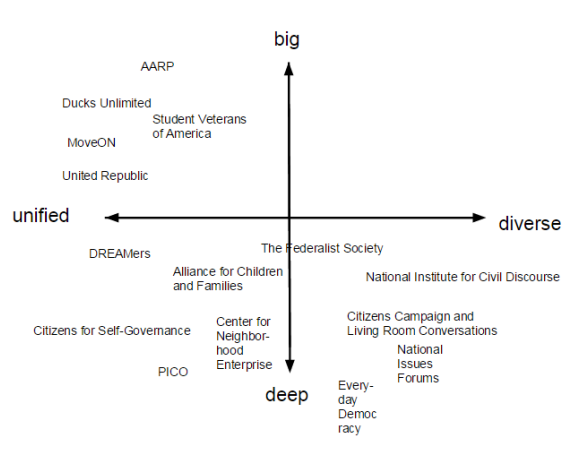
Some organizations included in this study are large, some are ideologically diverse, some have a coherent and focused agenda, and some are deep (engaging their members in learning, growth, leadership, and voice). But no organization has managed to be large, deep, diverse, and focused.

temp

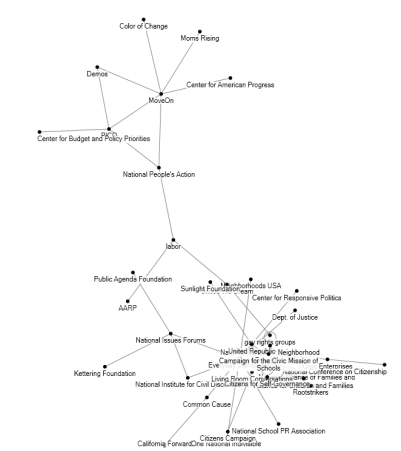
Furthermore, despite some working connections among these organizations, they do not yet form a coherent network. A simple network analysis of the connections that were either mentioned explicitly in the interviews or implied by the interviewees’ bios (for instance, when an individual holds leadership positions in two or more organizations) yielded the diagram below.

temp2

In exemplary episodes from American history, such as the Civil Rights Movement, networks of organizations have managed to be large, deep, diverse, and focused.

The paper concludes with some recommendations for research and convening to strengthen today’s network for civic renewal. You can download the full report here.