Category Archives: civic theory

adding democracy to Robert Merton’s CUDOS norms for science

Civic Science is an emerging scholarly conversation, and today we held a discussion of it at Tufts. In my group, we agreed that scientists are not value-free but are indeed defined by certain values. We went back to the list of four values that Robert K. Merton identified in 1942. Per Wikipedia, those are:

  • Communalism all scientists should have equal access to scientific goods (intellectual property) and there should be a sense of common ownership in order to promote collective collaboration, secrecy is the opposite of this norm.
  • Universalism all scientists can contribute to science regardless of race, nationality, culture, or gender.
  • Disinterestedness according to which scientists are supposed to act for the benefit of a common scientific enterprise, rather than for personal gain.
  • Organized Skepticism Skepticism means that scientific claims must be exposed to critical scrutiny before being accepted.

These “CUDOS” norms emerge from the practices of actual scientists, yet they are  aspirational. In fact, they may be rarely honored in a given population of scientists, but they would still reflect the ideals of science. They thus provide tools for the critical assessment of actual science.

We proposed adding:

  • Openness: meaning not only openness to data and evidence, but to diverse perspectives and voices.
  • Democratic Engagement It’s not enough to decide that your scientific work is disinterested. You owe an argument to fellow citizens for why it actually is in the public interest. At the same time, you must influence public priorities. If, for instance, there is no funding for addressing a disease suffered by the world’s poor, that means that you cannot just go out and study it. But you can advocate for funding.
  • Service This goes beyond “the benefit of a common scientific enterprise” to encompass benefit to the world (human beings and other species)

civic republicanism in medieval Italy: the Lucignano council frescoes

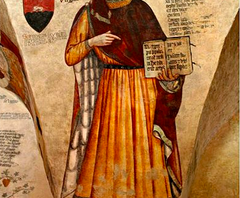
This is highlight #2 from our recent time in Italy. Lucignano is a small medieval town in Tuscany, notable for its street plan of concentric ellipses capping a steep hill. During the middle ages, it was contested by larger city-states, but it sometimes enjoyed a degree of independence or civic freedom. It certainly had its own town hall and, within that building, a Sala di Consiglio or council chamber.

At first, this room was decorated by one large fresco of the Madonna in Majesty. If I recall correctly, the inscription under her picture reminded Lucignano’s leaders to listen to both sides of every dispute. Then, between 1438 and 1475, the town’s councilors contribruted personal funds to cover the ceiling with frescoes of exemplary figures from history, each labeled with a name, and most accompanied by an instructive quotation. “Virgil the poet” is shown above.

Christiane L. Joost-Gaugier offers excellent background information on this decorative scheme.* It was not uncommon to depict heroes from the past (often known as “worthies”) in public spaces. And there was a very famous model of a council chamber decorated with frescoes about good (and bad) government in nearby Siena. But the Lucignano frescoes were unique in that the list of exemplary figures came from a specific source, Dante, who also provided many of the quotations painted on the ceiling.

Dante held an elaborate political theory that I will not attempt to summarize comprehensively here. But it seems to me that Lucignano’s civic elders borrowed the following elements of his thought for their council chamber:

  1. Civic responsibility. Cicero is depicted as one of the exemplars (no surprise there); but as Joost-Gaugier notes, it was thanks to Dante that Cicero came to represent “the value of active participation in civic life” and the “civic spirit of Roman law as it centered on the complete man espousing the common good.” The Lucignano frescoes emphasize not only the value of participating in everyday civic affairs but also the need for sacrifice. For instance, the Roman heroine Lucretia is shown. Her suicide sparked the revolt that founded the Roman Republic.
  2. Lay government. One saint (Paul) is depicted among the worthies, but his quote from Romans 12:17-19 is about obeying the law. Figures like Justinian are deeply Christian, but they mingle on the chamber ceiling with pagan Romans and ancient Jews without distinction. The Roman republic and empire were Dante’s political models, and they were led by laymen rather than clergy. Although Dante and the medieval leaders of Lucignano believed that law should be consistent with scripture, the point emphasized in the Council Chamber is the primacy of law.
  3. Independence: Joost-Gaugier notes a subtle dig at Siena, from which Lucignano had won its freedom. Siena claimed to be founded by Remus, who was its mascot, but the frescoes in Lucignano suggest that Rome had been founded by the god Janus and not by Romulus and Remus at all. While Lucignano’s elders may have simply had a quarrel with Siena, they also hoped to govern their community free of any outside domination. Self-governance is an implicit theme here.
  4. The unity of history. Ancient Romans, Jews, and Christians all look alike in these frescoes. That is partly a result of the historical naivety of Lucignano’s artists. They had no idea that Samson and Virgil should be dressed differently from a Tuscan of the 1400s. At the same time, however, Dante offered a more substantive reason to treat all these worthies as similar. He held that world history had a unity determined by providence. See Paradiso VI, where Justinian mentions several of the other figures shown on the ceiling at Lucignano as bearers of God’s unfolding will.

People who thought in this way were liable to see themselves as appropriate heirs to the republican citizens of ancient Rome, capable of self-governance, obligated to sacrifice for the common good, and committed to the same law that had prevailed in Rome. This room is a vivid illustration of the idea that civic republicanism flourished in late-medieval Italy and came to the Atlantic world from there.

*Christiane L. Joost-Gaugier, “Dante and the History of Art: The Case of a Tuscan Commune. Part II: The Sala del Consiglio at Lucignano,” Artibus et Historiae, Vol. 11, No. 22 (1990), pp. 23-46.

the year the people took back politics: a vision for 2016

Below are my keynote remarks yesterday at …

Breaking Through: Increasing Civic Engagement, Before, During and After Elections

The video is here:


I departed from the prepared text a fair amount in order to address the audience of civic innovators who had gathered in Austin. By the time I spoke, I knew more about their projects. These are the prepared remarks:

A presidential election cycle is a great civic ritual. Even though only about 60% of adults vote—when we’re lucky—a national campaign still touches most Americans in one way or another. It challenges us to consider fundamental issues. And it connects us to our political heritage, for many of the greatest moments in our political history have been presidential elections.

As the 2016 cycle heats up, what should we expect from this great national civic experience? What do we have a right to expect from the election?

I would say …

The campaign must engage all Americans, without respect to wealth, social status, age, race, gender, disability, and political and religious opinions.

It must give all Americans equal weight and importance, honoring the fundamental principle of one person/one vote. It must make our leaders accountable to the people as equals.

The campaign must provoke a serious conversation about the most fundamental issues facing us as a country.

It must enlist our higher instincts. It is absolutely fine for citizens to retain their diverse political ideologies and their various and conflicting interests. But we must all be reminded of the more generous and idealistic aspects of our own views and interests—or what Lincoln called, after the fateful campaign of 1860, “the better angels of our nature.”

During a national political campaign, Americans must have respectful interactions with fellow citizens who hold different views from their own. The goal is not consensus but mutual understanding and an awareness that we are all legitimate participants in one great political debate.

Some of our interactions must be personal, in the sense that we get to know one another and can actually reply to each others’ ideas—whether online or face-to-face. In other words, it’s not enough to relate to politicians and other celebrities by following what they say. We must also relate to one another.

Citizens must see ways of acting on their political values that go beyond casting a ballot in November, important as that is. If, for instance, you are moved by the problem of climate change or concerned about moral decline, the campaign should inspire you to reduce carbon or to restore traditional values by working with neighbors and peers. The act of voting should be just one of the political efforts that you undertake as a result of the election.

Finally, a diverse set of new actors must see openings to enter political life, whether as campaign volunteers and staffers, independent activists, or reporters, artists, and bloggers. Presidential elections are entry points for new generations of activists and leaders.

I have described a national election in rather glowing terms, but we all know that the reality falls far short. Continue reading

how to respond to a leader’s call for civic renewal

During the 2008 presidential campaign, then-Senator Barack Obama spoke at length, consistently, and passionately about renewing citizenship in the US. I collected many of the key quotes here. There was a depth to these comments because Obama had worked for a faith-based organizing network, had studied Asset Based Community Development, had served on Robert Putnam’s Saguaro Seminar, and was married to the leader of a youth engagement nonprofit. He knew what he was talking about. And although he sought to lead the Democratic Party, he explicitly included Republicans and Independents in his call for civic renewal. However, the press ignored his citizenship theme, both during the campaign and later on (examples here). Policy wonks and Democratic Party elites also ignored it. I served on both the Education and Urban Policy committees of the campaign, and neither group generated strong policy proposals for enhancing civic engagement. Thus the administration–of which I am a defender, when it comes to mainstream matters of domestic and foreign policy–has done little to support enhanced citizenship in the US. A president cannot accomplish much alone, and if even his allies don’t hear his call for something as abstract as civic renewal, nothing will happen.

This summer, Pope Francis has made an impassioned call to the peoples of the world to organize from the bottom up to combat environmental crises. Like Obama’s call in 2008, this one is rooted in experience and theory–in the Pope’s case, extending back to his sainted namesake in the 13th century, but also including sophisticated modern theology. The Pope is the leader of Catholicism, yet he has explicitly included non-Catholics and non-believers in his call for global organizing. But again, the theme of civic agency has been lost on the punditocracy. The Pope’s speech at the Second World Meeting of Popular Movements was all about popular organizing, and yet the New York Times largely ignored that theme, summarizing his visit in these words: “Pope Francis met Thursday with President Evo Morales of Bolivia and apologized for the church’s ‘sins’ during Latin America’s colonial era. … But if Francis again called for change, he also offered no detailed prescription.”

Leaders alone cannot create social movements, but their words can be useful resources. Barack Obama gave us an opportunity in 2008; I do not think we (or he) took adequate advantage of it. The Pope is giving us another chance. How–concretely and practically–should we respond this time?

friendship and politics

Last week, one session of the Summer Institute of Civic Studies was devoted to friendship, and the assignments were:

  • Jane Mansbridge, Beyond Adversary Democracy, pp. 3-35, pp. 163-82, 290-8
  • Danielle E. Allen, Talking to Strangers: Anxieties of Citizenship Since Brown, v. Board of Education, pp 140-186

When people treat one another as friends, interactions have a special quality. This is not a naive point, for people want to have friendships and will sometimes put the development and maintenance of their friendships above other goals. Aristotle observed as much.*

One might suspect that only some cultures cultivate friendships that are strong enough to make people check their conflicting self-interests. We might find people acting as friends among the ruling classes of classical city-states, but surely not in atomized and materialistic America.

Based in part on the great book by Mansbridge assigned for this session, I would propose instead that whether people act as friends depends on the immediate situation. When interactions are sustained and face-to-face (or possibly online, given sufficient bandwidth); when interests are not too starkly opposed or the stakes are reasonably low; and when groups are tolerably small, modern Americans will put friendship ahead of narrow interests and will work hard and skillfully to preserve friendship.

For instance, I hypothesize that a group like the Summer Institute itself (22 activists and scholars from six countries, gathered for 63 hours of seminar time), if asked to plan a recreational activity for themselves, would be primarily concerned with preserving their friendship. They would, for instance, be reluctant to put options for activities to a vote. If time pressures forced them to vote, they would be highly uncomfortable to see a minority disappointed and would–at a minimum–seek to acknowledge and regret their sacrifice. (Allen’s book is focused on sacrifice and how to repair it). If even one person said that he could not participate in a given activity (for instance, he couldn’t go on boat ride because of sea-sickness), that idea would instantly be retracted. On the other hand, if an individual simply didn’t like a given activity, he would be unlikely to say so because expressions of self-interest would make him look like a bad friend.

We didn’t actually assign the exercise of choosing a recreational activity, because it seems better for members of the Institute to make individual choices about how to spend their weekends. But we talked about how such a conversation would likely go, and the predictions seemed insightful to me.

Two big questions are:

  1. How can we create a degree of friendship in larger and less stable communities than the Summer Institute, or when the stakes are higher? Allen advocates “talking to strangers” in the US, to build sufficient friendship that we can govern ourselves justly. That requires, among other things, changes in the ways our cities are planned and our children assigned to schools. I doubt that Mansbridge would disagree, but her argument is that politics-as-friendship only works under certain objective circumstances, and when it is impractical, it is better to govern through explicitly adversarial politics.
  2. To what extent should friendship be a normative ideal? Philia may be a virtue, as Aristotle said, but it trades off against other virtues, such as freedom and equality. For instance, when trying to be friends, people may hide genuine interests that they should be free to express and act on. And that suppression may not play out equally.

Background on the two assigned books

Mansbridge emerged from the New Left of the 1960s and 70s, where she observed small groups , “appear[ing] everywhere like fragile bubbles” that had certain features in common. Decisions were made in face-to-face meetings, after much discussion, when someone expressed the consensus of the group. There were no formal distinctions among participants or offices. And there was a strong norm against making self-interested statements.

These forms seemed naïve from the perspective of what Mansbridge calls “adversary democracy,” which presumes that interests conflict and there must be winners and losers in decisions. Yet they seemed to work somewhat well and to have certain advantages.

She studied two examples. Helpline is a commune of the New Left: urban, somewhat racially diverse, aimed at social change. The other case is a Vermont Town Meeting in a rural, socially conservative white community. They differ, too, in that Helpline codifies the principles of “unitary democracy,” whereas Selby has official votes and office-holders and exercises powers granted by the state. And yet Mansbridge finds many similar practices.

This leads her to generalizations about where and when “unitary democracy” can work. She also finds convergence between the two examples.

Allen begins with the observation that democracy requires sacrifice. Some lose when others gain, and the losses are not fairly distributed. Her question is how you can build some kind of “friendship” when some must sacrifice?

Her friendly critique of Habermas: He explains why people will speak with reciprocity if they are in a setting where they are aiming for consensus, but not why they would enter such a space in the first place. She writes,“Friendship is not an emotion, but a practice, a set of hard-won, complicated habits that are used to bridge trouble, difficulty, and differences of personality, experience, and aspiration. Friendship is not easy, nor is democracy. Friendship begins in the recognition that friends have a shared life—not a ‘common’ nor an identical life—only one with common events, climates, built-environments, fixations of the imagination, and social structures. Each friend will view all these phenomena differently, but they are not the less shared for that” (pp. xxi-xxii).

*Our next business after this will be to discuss Friendship. For friendship is a virtue, or involves virtue; and also it is one of the most indispensable requirements of life. For no one would choose to live without friends, but possessing all other good things. … Moreover, …  friendship appears to be the bond of the state; and lawgivers seem to set more store by it than they do by justice, for to promote concord, which seems akin to friendship, is their chief aim, while faction, which is enmity, is what they are most anxious to banish. And if men are friends, there is no need of justice between them; whereas merely to be just is not enough—a feeling of friendship also is necessary. Indeed the highest form of justice seems to have an element of friendly feeling in it. And friendship is not only indispensable as a means, it is also noble in itself. We praise those who love their friends, and it is counted a noble thing to have many friends; and some people think that a true friend must be a good man (Aristot. Nic. Eth. 1155a3, 20)