Category Archives: civic theory

why we need theory for social change

Margaret A. Post, Elaine Ward, Nicholas V. Longo, and John Saltmarsh have edited the new volume, Publicly Engaged Scholars: Next-Generation Engagement and the Future of Higher Education. It’s a great anthology that describes 30 years of work reconnecting higher education to communities and proposes exciting futures for that movement. It highlights the work of a new generation of engaged scholars who are more diverse and in many ways more sophisticated and effective than their predecessors.

I wrote an Afterword entitled “Practice & Theory in the Service of Social Change.” Since many of the chapters by younger scholars are autobiographical, I allowed myself to reflect on my own experience as well.

When I was an undergraduate, I chanced upon a set of early discussions and experiments that helped create the current movement for engaged scholarship. I got to join a Wingspread meeting about national and community service that helped build momentum for George H.W. Bush’s Points of Light initiative and then AmeriCorps under Bill Clinton.

Meanwhile, back on campus, my student colleagues and I started a program that provided paid summer service internships for students who agreed to present their work to the local alumni clubs. …

Thanks to my role in student government, the clerical and technical workers’ union asked me to sit at the table in a series of round-the-clock negotiations with the university that narrowly averted a strike. The university’s lawyers studiously ignored my presence because they took the position that there were just two parties in a contractual dispute; questions of public impact and justification were irrelevant, and therefore no representatives of the community had a right to attend. …

Also during my undergraduate years, I encountered deliberative democracy in a seminar on Habermas and during an internship at the Kettering Foundation in Dayton, OH, which was then experimenting with practical deliberative democracy in the form of National Issues Forums.

That was 25-30 years ago, and in many ways, I am still in the same milieu–now a Trustee of Kettering and an Associate Dean of a college that promotes and studies service and civic engagement.

In the “Afterword,” I argue that the movement began as a result of deep and searching questions about the democracy and society as a whole. Some participants were motivated by the Habermasian argument that civil society is a space for the reasonable discourse that should generate public opinion, but it was being “colonized” by the market and bureaucratic states. Some thought more in the spirit of Habits of the Heart (1985) and believed that US society was becoming too atomized. Still others were involved in the debate about neoliberalism and the declining welfare state, either welcoming volunteerism as an alternative or seeing students’ civic engagement as a form of resistance to the market.

So the movement began with a rich and vital discussion of how to change America, which turned into concrete activities like service-learning and deliberative democracy as potential tools or tactics. The subsequent decades have brought much experimentation with those activities, as well as burgeoning research about them: do they work, why, and for whom? But I don’t think we are any clearer about how to change America–and the strategies that seemed to make sense in 1985 may now be obsolete.

In the “Afterword,” I acknowledge the value of the “emotions,” “embodied experiences,” and “personal narratives.” Yet, I argue,

we do face problems that can be posed in abstract and general terms. And I believe that to some degree, our experiences from service-learning, community-based participatory research, and campus/community partnerships have outrun our theories. Put more forcefully: we will be unable to address profound social problems until we strengthen our theoretical understanding of society, and that will come from books, data, and seminar rooms as well as from action in communities. …

This book has a generational focus and looks to younger scholars for new models and solutions. Those scholars will (and should) base many of their ideas on personal experience and identity. Their relatively diverse backgrounds and their relatively deep experience with engagement are assets. Yet I would also look to the next generation for groundbreaking theory, some of it highly abstract and challenging. The theories that are already embedded in their narratives must emerge; they may also need to develop new theoretical insights. We need theories not only about civic engagement, but also about how society works and what causes it to change for the better. Almost every successful social movement I can think of from the past has developed new bodies of such theory. The theories of gender that accompanied Second Wave Feminism or the range of theological and political philosophies that emerged because of the Civil Rights Movement are essential historical examples. I would expect nothing less from The Next Generation of Engagement.
the limits of civic life

(Phoenix, AZ), While I am here today as a guest of Arizona State, I will give a version of the following talk:

The video summarizes my view of civic life in about 10 minutes. By “civic life,” I mean applying our minds, voices, and bodies to improving the world. We can do that alone, but inevitably civic life is collaborative, because individuals rarely achieve much alone and because we need other people’s opinions and perspectives to inform our goals and values.

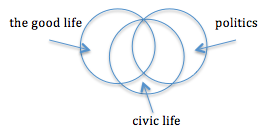
Civic life is important, but it is by no means the only important thing. It represents one circle in this Venn diagram, which also includes circles for politics–meaning all the ways that human beings govern ourselves and create a common world–and the good life.

Screen Shot 2016-03-27 at 11.51.21 AM

In civic life, certain ways of interacting are possible and desirable. We can and should be highly interactive while we are in smallish groups dedicated to improving the world. We can be responsive to one another’s needs and opinions and strive act in concert.

But a good life should sometimes be solitary and inward-looking, or directed to nature or God instead of fellow citizens. And politics should sometimes involve competition instead of deliberation and cooperation. For instance, we want incumbent politicians to be regularly challenged by outsiders who criticize them and strive to unseat them. We don’t want incumbents to get too cozy with their challengers. The same is true of business competitors and contending attorneys.

In the video, I argue—and I strongly believe—that civic engagement can enrich our inner lives and offer us psychological and spiritual benefits. But so can non-civic activities, such as observing and appreciating nature, understanding and making art, or loving and caring for other people intimately. Although I think that the spiritual benefits of civic life are often overlooked—and improving our civic culture would strengthen those benefits—I still resist the argument that the good life equals civic engagement.

Here is a typically subtle case: I love to walk in the woods with my family and dog. Enjoying those loved ones in a natural setting is not a form of civic engagement. However, it is only thanks to the Massachusetts Audubon Society and our state government—and the individuals who work in or with those organizations—that the woods have been preserved and opened for us to use. The worthy activity (a family walk) is not civic, yet it depends upon other people’s civic engagement. Still, it’s far too narrow a view of nature and of intimate personal relations to reduce them to products of civic life.

By the same token, civic life doesn’t exhaust politics or offer adequate means to improve politics. Large, impersonal institutions—such as markets and companies, governments and armies, and scientific and technical disciplines—play leading roles in 21st century politics. You and I have limited leverage over these institutions. We can form opinions about what they should do, but those opinions do not always imply meaningful actions for us to take.

If the institution in question is the United States government, I have a tiny but greater-than-zero form of leverage in the form of my vote. If the institution is Coca-Cola, I can decide whether to purchase its products or not. Allocating votes and money are worthwhile acts but hardly constitute a robust civic life. And if the institution in question is the Chinese Government or the market for oil rigs, my leverage approaches zero. In the video, I say that citizens ask, “What should we do?” rather than “What should be done?” But sometimes reasonable people realize that something should be done and yet cannot find anything to do about it themselves. That is the zone of politics that lies outside of civic life in the Venn diagram above.

In the video and almost all my work, I emphasize that “small groups of thoughtful and committed citizens” have the capacity and responsibility to change large systems. I began my professional career helping to advocate for political reform as a research associate at Common Cause, and while I worked there, Common Cause was losing its membership base due to the shrinkage of American civil society that Robert Putnam would soon diagnose in “Bowling Alone” (1995). I came to think that American politics was corrupt because citizens were not adequately organized and active, and I have spent the subsequent two decades working on civic engagement as a precondition for better government. Still, political reform eludes us in the face of hostile Supreme Court decisions, technological developments, and tenacious political opposition. When reform does come, it may be because of a massive scandal or a well-placed leader, not directly because of active citizens. In some other countries and in global markets, the scope for civic life is even narrower than it is in the US.

To discount the importance of citizens in politics is cynical, but to imagine that intentional civic action is all of politics is naive. To the extent we can, we should work to expand the overlap, so that civic life is more politically influential as well as more spiritually rewarding. But I think we will always be left with two hard questions (among others):

  1. How should we think and act and feel when bad systems are genuinely beyond our control? The Stoic and classical Indian answer was: seek equanimity and acceptance. Epictetus advised: “For if the essence of the good lies in what we can achieve, then there is no space for ill-will or jealousy. Rather, for yourself, don’t strive to be a general or an office-holder or a leader/consul, but to be free. The only road to that is contempt for things not in your power [XIX].” I am unsatisfied with that answer, because I think we have responsibilities to the world even when we cannot see a direct way to address its problems. But what are those responsibilities, exactly? And …
  2. When an aspect of the good life conflicts with civic responsibilities, how should we choose between them?

Where we vote affects how we vote. So where should we vote?

According to a summary article by Ben Pryor in The Conversation/Scientific American, people’s votes are affected by the voting location. Voting in a church “prime[s] significantly higher conservative attitudes—and negative attitudes toward gay men and lesbians.” On the other hand, “individuals voting in Arizona schools were more likely to support a ballot measure that increased the state’s sale tax to finance education.”

Pryor draws the conclusion that we should vote by mail–which, for most people, would mean voting at home. One objection is that home isn’t a neutral place. It will bring its own biases. I don’t know whether voting at home has been experimentally compared to voting at (say) a school, but let’s imagine that being home makes people more resistant to taxes. Why is that the most authentic, or most rational, or most autonomous perspective? To prefer the home seems to assume a rather contentious view of the relation between the public and private sphere. In political theorists’ terms, it’s a hyper-liberal view as opposed to a republican or communitarian one. Arguably, you should vote where you are primed to think about other people.

But isn’t it problematic that a church, for instance–with all the deliberate persuasive power of its iconography and architecture–should be the required context for voting in a secular republic? Well, maybe. But I don’t accept the view that citizens can be or should be disembodied and culture-free. The Progressive movement that achieved the secret ballot envisioned the ideal voter as a rational calculator of best interests (either his own interests or the nation’s). Progressive voting reforms were probably helpful, on the whole, but the guiding ideal seems both naive and a little unattractive. What, after all, is in our interests once we strip away values and group-memberships?

The opposite view–just for the sake of argument–is that we construct communities that are redolent of values. That’s why they are full of religious buildings, public structures with inscriptions and allusive architectural styles, businesses that promise various versions of the good life, and even natural spaces that we interpret as having moral significance. Communities govern themselves by making decisions, and a vote is one important moment for decision-making. Each person’s vote is profoundly influenced by the community context. Yet individuals push back. While the average voter may be influenced in a conservative direction by voting in a church, some are probably alienated by the context and pushed in the opposite way.

On every day, not just on Election Day, the community changes as people build, alter, and decorate its physical spaces and communicate in more ephemeral ways. For instance, the church in which a polling place may be located was built by people who wanted to change  local values and commitments. They were not satisfied with whatever religious structures and institutions already existed, but chose to make a new one. That was part of an endless process of community-formation. The material with which we reason and choose is given to us by the community so far, but we can change it one piece at a time. The real me doesn’t emerge when I am inside the home that my family has privately decorated. I am really “me” everywhere I go, and that means that I am always being shaped by my context and often pushing back.

See also: on voting by mail and voting and punishment: Foucault, biopower, and modern elections.

the long march through institutions–for civic renewal

(Baltimore, MD) I am here for a panel on “Systems Change and Culture of Health” at the Robert Wood Johnson Foundation’s Culture of Health conference. My great fellow panelists were Sonal Shah (Georgetown), Derwin Dubose (New Majority Community Labs), and Karen Matusoka (Centers for Medicare & Medicaid Services). The audience seemed to be composed mostly of health practitioners and policymakers who were already strongly committed to three goals:

  1. Doing a better job of understanding the needs, priorities, and circumstances of truly diverse people by engaging them in influencing health interventions and policies. For instance, instead of telling a specific group of new immigrants how to improve their health, pay attention to what they already know and want.
  2. Supporting solutions that require collective action by residents. Dubose brought up a situation in which individuals couldn’t exercise in a local park because it was too dangerous, but a group started tai chi exercises there every day at noon. Only a coordinated strategy would work, and coordination requires organization, trust, leadership, and skill. This point is related to the previous one, because community members would be the first to know about the danger of the park and the popularity of tai chi. Not only is a coordinated strategy essential, but only the participants are likely to be able to invent it.
  3. Recognizing and enhancing the civic capacity of whole communities to achieve better  health. For instance, Robert Sampson’s major book Great American City shows that Chicago neighborhoods achieve better outcomes for their children if the adults are organized and active in civic life.

Several participants noted that these were shared principles in the room–but none of the ideas are really new. In fact, a roughly similar discussion could have occurred 50 years ago, during the 1960s movement to make health (and research) more “community-based.” That impulse still remains marginal, which can be discouraging.

I would note that some relevant practices and networks have grown and strengthened over the past half century. (See, e.g., Community-Campus Partnerships for Health and the networks it represents.) But I would also acknowledge the powerful hold of a technocratic model in which solutions are developed at the “bench” and implemented at the “bedside.” That model is deeply rooted in modern epistemology and reinforced by the prestige of technology. It serves both governmental and corporate bureaucracies. So it is not easy to shake, and may even be worse than it was in the 1960s.

Policy changes can help. If–as one example–the National Institutes of Health funds community-based research, we get community-based research. But even the best-intentioned policies don’t implement themselves. They require dedicated and persistent work, everywhere from the national or state agency to the street level.

Civic engagement by communities can help. Why do Chicago neighborhoods get better outcomes–regardless of race and class–if they are organized and active? I would propose that this is partly because they support and compel local institutions, such as schools, police districts, and hospitals, to engage with them better. Every Chicago neighborhood has the same police chief, school superintendent, and mayor, but some neighborhoods receive more responsive government at the local level. Note that residents are not organized in specific policy domains, such as health or public safety. They are organized in multi-purpose civic and religious associations and networks. Those are essential for driving change through institutions.

Finally, we need effective organizing within the professions, a strategy that my friends Harry Boyte and Albert Dzur have advocated–and practiced–effectively for years. Like any good organizing effort, this strategy begins with recognizing the assets and interests of the people in question. Physicians, health administrators, and academic researchers are people, too. Lecturing them that they should be less arrogant and more sensitive to diversity may fail for the same reasons that it usually fails to lecture people to eat more vegetables.

But health professionals have interests that can be tapped–for instance, interests in getting better results and escaping social isolation. Most of all, they can develop genuine skills for engaging the public better. That is hard, complex, challenging work. It requires evidence and analysis. When we tell professionals to be less professional–to diminish their sense of expertise and authority–I think it goes over like asking people to eat their broccoli. Even if they want to comply, all the incentives work against it. But when we reward them for exercising advanced professional skills in community engagement, we treat them as assets and give them ways to excel. Combined with policy changes and grassroots pressure from outside, this organizing effort within professions may begin to change systems at a large scale.

on the original meaning of democracy

We call ourselves a democracy and a republic. There’s a current right-wing talking point that we are only the latter, but I’ve argued that this claim deviates from a long bipartisan consensus that the US aspires to be a democratic republic. But what do these two terms mean?

This definitional question is challenging because the words come, respectively, from Greek and Latin, and they were coined to name specific regimes that had lots of eccentric features (huge juries in Athens; a host of executive officials in Rome) that no one considers definitive. The words have subsequently been used by many writers in many languages to name a wide variety of regimes–and sometimes as terms of abuse.

For instance, a “republic” presumably must name a regime that has something in common with the original, the ancient Roman res publica. One defining feature of the Roman republic was simply that it wasn’t a monarchy. Thus people who want to remove Queen Elizabeth II as the titular monarch of Australia (or Britain) call themselves “republicans.” Their proposal would change virtually nothing about the power structure; it would be almost entirely symbolic. But they have precedent for calling a regime without a monarch a “republic.”

In a very different vein, Jefferson defined a republic “purely and simply” as “government by its citizens in mass, acting directly and personally, according to rules established by the majority; and … every other government is more or less republican, in proportion as it has in its composition more or less of this ingredient of the direct action of the citizens.” For Jefferson, a “republic” is what others would call a direct and participatory democracy. Yet the original Roman republic was composed of legislative bodies and officers who represented various classes and interests. Some were elected and others were appointed. All were limited by various laws (albeit unstably so). Thus, for some, a republic is a government that avoids direct and participatory democratic elements.

Still other writers have noticed the ancient Roman penchant for civic duty and public service and have used the word “republic” for a regime that demands a great deal from its citizens and that encourages public engagement as a positive good. It is an alternative to the kind of liberalism that favors individual rights. Meanwhile, another tradition takes seriously the etymology–“res publica” means “public thing [or good]”–and translates the phrase as “commonwealth.” A “commonwealth,” in turn, could mean all the things that are commonly owned by the people. And if the people’s wealth extends to the land, then a certain kind of agrarian socialism emerges as the definition of republicanism.

That’s all about “republic,” but I’d like to address the term “democracy,” relying on a fascinating article by Josiah Ober.* Ober notes that if the Greeks had wanted a word that meant rule of the many (or the common people), they would have used pollo- as the suffix prefix. To name a regime in which all rule, they could have used “panocracy.” If they had wanted to emphasize the equality of all, they would have used iso-. For instance, isegoria meant an equal right to participate in deliberations in the agora. But they chose demo-, which refers to the whole people as one, without sociological distinctions.

Meanwhile, if they had wanted to specify who governed, in the sense of casting votes or holding offices, they would have used the suffix -archy. A monarchy has one ruler, an oligarchy has a few, and anarchies have none. The suffix -kratia is different. It does not imply an office or action but rather power, in the sense of capacity or an ability to make things happen.

Thus, in its original form, a democracy is a regime in which the whole population has the power to make things together. By the way, this definition comes close to uses of the word “republic” that emphasize the public’s role in making the res publica. So perhaps “democracy” means “republic” after all.

*Josiah Ober, “The Original Meaning of ‘Democacy’: Capacity to Do Things, Not Majority Rule,” Constellations, vol. 15, no. 1 (2008)