Category Archives: civic theory

the world’s first and only Civic Studies rap

(Washington) And now for something different … My colleague Prof. Jonathan Garlick was a participant in last summer’s Institute of Civic Studies at Tufts’ Tisch College of Civic Life. After two weeks of wrestling with theorists like Jurgen Habermas and Eleanor Ostrom–along with fellow academics and practitioners from half a dozen nations–Jonathan summarized it all up in a rap:

“Now, Habermas’ and Ostrom’s inquiries
Are still a bit unclear to me
So let’s elucudiate these mysteries
By clarifyin their philosophies
Picture them both in a rap repartee
As they exchange views and realities
A civic rap battle of history …”

Here are the rest of the lyrics in PowerPoint.

help shape the strategy for civic renewal in America

The 2016 Annual Conference on Citizenship is co-hosted and co-planned by my colleagues and me at the Jonathan M. Tisch College of Civic Life at Tufts University and will specifically focus on issues of diversity, equity, and inclusion in civic life. Unless we make progress on these issues, we cannot move our country forward.

This year’s conference will be interactive; the whole group will think together about what civic life in America would look like if it strove for equity, diversity, and inclusion.

Participants will help shape the agenda for civic renewal in America and will leave with contacts and practical ideas to strengthen their own work.

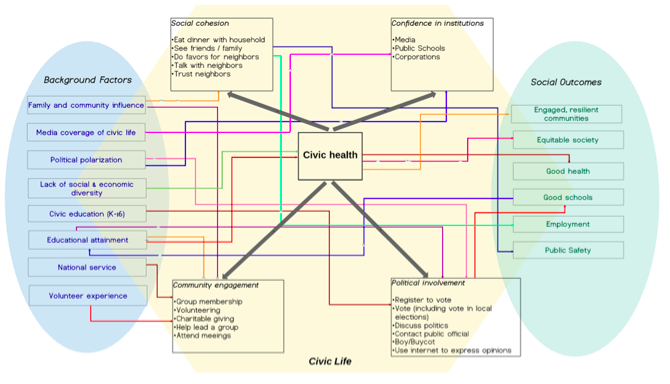
During the day, we will work together to revise and improve our collective understanding of civic life. The map below will be a starting place.
screen-shot-2016-09-27-at-11-37-57-am

On the left are factors that may affect civic life, for better or worse. In the middle is “Civic Health” as it has been measured by the National Conference on Citizenship (NCoC) and its partners over the past decade. Civic Health has four major components that radiate out from the center. On the right are valuable outcomes of having a healthy civic life, such as resilient communities and good schools.

The arrows show connections uncovered by NCoC, Tisch College, and others. For example, we know that k-12 civic education can boost political involvement, that communities with more political engagement have better schools, and that good schools boost educational attainment, so all of those boxes are connected with arrows.

This is just a start, and during the day, we will ask participants to add, edit, or move boxes and arrows to help build a better diagram. We will also ask you to place yourself on the map.

There will be opportunities to hear from inspiring and well informed speakers. Click here to view the agenda at-a-glance.

Please join us for this important convening and invite other colleagues whose voices need to be heard. Register today!
Call for Papers: Facts, Values, and Strategies in Citizen Politics

Tufts’ University’s Tisch College of Civic Life and the journal The Good Society seek proposals for papers to be presented at a conference at Tufts on May 18, 2017 and then published in The Good Society as part of a special issue edited by Tisch Associate Dean Peter Levine. Tisch College can offer travel and lodging for presenters at the conference.

Framing:

Current global crises of democracy raise fundamental questions about how citizens can be responsible and effective actors, whether they are combating racism in the United States, protecting human rights in the Middle East, or addressing climate change. If “citizens” are people who strive to leave their communities greater and more beautiful (as in the Athenian citizen’s oath), then their thinking must combine facts, values, and strategies, because all three influence any wise decision. Mainstream scholarship distinguishes facts, values, and strategies, assigning them to different branches of the academy. Many critics have noted the philosophical shortcomings of the fact/value distinction, but citizens need accounts of how facts, values, and strategies can be recombined, both in theory and in practice. John Dewey, Hannah Arendt, Mahatma Gandhi, Jürgen Habermas, Amartya Sen—and many other theorists of citizenship—have offered such accounts.

Actual civic movements also combine facts, values, and strategies in distinctive ways. For instance, the American Civil Rights Movement used the language of prophesy, and Second Wave Feminism strategically advocated new ways of knowing. This special issue invites theoretical, methodological, historical, empirical, and case-study articles related to the question: how should citizens put facts, values, and strategies together?

Paper proposals of up to 300 words should be sent to Peter Levine at peter.levine@tufts.edu and to Good Society editor Trygve Throntveit at tthrontv@umn.edu by November 1, 2016. Prospective authors must be willing to present drafts by May 1 2017, attend a one-day conference at Tufts on May 18, and revise for final publication by September 2017.

against root cause analysis

I am skeptical of the idea of “root causes” and the assumption that progress comes from addressing the roots of problems. The following points draw from discussions in our annual Summer Institutes of Civic Studies and are indebted to my co-teacher, Karol Soltan.

  1. The metaphor of a “root” seems misplaced. Social issues are not like plants that have one root system at the bottom and branches and leaves at the top, so that if you cut or move the root, you kill or move the whole plant with a single action. Very often, social phenomena are connected in systems that incorporate feedback loops and cycles, whether virtuous or vicious. It’s possible for one thing (A) to affect another thing (B) and for B also to affect A. Very often, outcomes are not the result of one ultimate cause but of the interaction of many causes. And causes can be viewed as outcomes, because there’s lots of reciprocal causation.
  2. Often, successful social action occurs even though the activists don’t know the root cause of a problem or they disagree about what it is. An example is the global movement to end slavery. Religious abolitionists argued that the root cause of slavery was sin, going back to the Fall of Man. “Free labor” abolitionists, like Abraham Lincoln, said that slavery was a plot to undermine a competitive market of labor in which the individual worker could profit. In contrast, Karl Marx wrote in 1847 that slavery was a lynchpin of global capitalism: “Direct slavery is just as much the pivot of bourgeois industry as machinery, credits, etc. Without slavery you have no cotton; without cotton you have no modern industry. It is slavery that has given the colonies their value; it is the colonies that have created world trade, and it is world trade that is the pre-condition of large-scale industry.” Frederick Douglass saw racism (“the wolfish hate and snobbish pride of race”) as a–or perhaps the–root cause of slavery. I suppose that all of them pointed to genuine causal factors, but the main point is that they formed a coalition that targeted the actual problem, not its underlying causes, and they won.
  3. Trying to identify root causes can delay or even block effective action. My friends Joel Westheimer and Joe Kahne wrote a very influential and valuable paper in 2004 entitled “Educating the ‘Good’ Citizen: Political Choices and Pedagogical Goals.”* They found that civic education programs in the US tended to fall into three categories, defined by their objectives for the students. An example illustrates the differences. In a program that aims to produce “personally responsible citizens,” a student will “contribute food to a food drive.” In a program whose ideal is to develop “participatory citizens,” a student will “help to organize a food drive.” In a program that emphasizes “justice-oriented citizens,” the student will “explore why people are hungry and act to solve root causes.” As Karol notes, the first two begin with an action, but the third begins with “exploring,” which doesn’t actually do any good in the world. Now, to be sure, one can also explore a diagram of a complex, interconnected system for a long time before doing anything, so it’s not only root-cause analysis that can fatally delay action. But I think that root-cause analysis is particularly likely to frustrate action because it sends us in search of the biggest, hardest, deepest aspect of a problem, which is exactly where the odds of success may be lowest. And that’s a mistake if problems do not actually have roots.

*Political Science and Politics, April 2004, pp 241-24.

See also Roberto Unger against root causes and roots of crime.

to the European Institute of Civic Studies

I am fleeing the country heading to Augsburg, Germany for the 2016 Summer Institute of Civic Studies. It is aimed at participants from Ukraine, Belarus, and Poland, but they are convening this summer in Germany (thanks to the generosity of the DAAD). The other organizers are my friends Dr. Tetyana Kloubert (Augsburg) and Prof. Karol Soltan (Maryland). I’ll paste the syllabus below; it may be interesting because of its European focus. It ends with a practical training on nonviolent resistance that should be particularly illuminating when experienced right after relatively abstract discussions of democracy and civic society. I will unfortunately miss that part because I’m coming back to the US on August 29, and I will resume blogging then.

Continue reading