Category Archives: civic theory

Apply for the Ninth Annual Summer Institute of Civic Studies

The ninth annual Summer Institute of Civic Studies will take place from June 12 to June 22, 2017 at Tufts University. It will be an intensive, two-week, interdisciplinary seminar that brings together faculty, advanced graduate students, and practitioners from many countries and diverse fields of study.

Organized by Peter Levine of Tufts University’s Tisch College and Karol Soltan of the University of Maryland, the Summer Institute will engage participants in challenging discussions of such topics as:

  • What kinds of citizens (if any) do good regimes need?
  • What should such citizens know, believe, and do?
  • What practices and institutional structures promote the right kinds of citizenship?
  • What ought to be the relationships among empirical evidence, ethics, and strategy?

This is the syllabus for the eighth annual seminar (in 2016). The 2017 syllabus will be modified but will largely follow this outline.

You can read more about the motivation for the Institute in the “Framing Statement” by Harry Boyte, University of Minnesota; Stephen Elkin, University of Maryland; Peter Levine, Tufts; Jane Mansbridge, Harvard; Elinor Ostrom, Indiana University; Karol Soltan, University of Maryland; and Rogers Smith, University of Pennsylvania:

Practicalities

Tuition for the Institute is free, but students are responsible for their own housing and transportation. A Tufts University dormitory room can be rented for $230-$280/week. Credit is not automatically offered, but special arrangements for graduate credit may be possible.

To apply: please email your resume, an electronic copy of your graduate transcript (if applicable), and a cover email about your interests to Peter Levine at Peter.Levine@Tufts.edu. For best consideration, apply no later than March 17, 2017. You may also sign up for occasional announcements even if you are not sure that you wish to apply.

The seminar will be followed (from June 22, evening, until June 24) by a public conference–”Frontiers of Democracy 2017″–in downtown Boston. Participants in the institute are expected to stay for the public conference. See information on the conference here. That page also explains how you can propose a concurrent session for the 2017 conference, whether or not you wish to apply for the Summer Institute.

the prophetic mode in the Civil Rights Movement and in everyday politics

On Martin Luther King Day, Kenyatta R. Gilbert published an explanatory article in The Conversation about King’s “prophetic vision.” Gilbert traced King’s rhetorical mode to three “particularly inventive” Black preachers active during the Great Migration: “Baptist pastor Adam C. Powell Sr., the African Methodist Episcopal Zion Church (AMEZ) pastor Florence S. Randolph and the African Methodist Episcopal (AME) bishop Reverdy C. Ransom.” All three were political reformers and community leaders who echoed the Hebrew prophets (as well as the Gospels) in their sermons.

If you’ve made a careful study of King’s own writing and speaking, you will recognize constant evocations of the Biblical prophets. Just for instance, in the “I Have a Dream Speech,” King quotes Amos 5:24 (“But let judgment run down as waters, and righteousness as a mighty stream”) and Isaiah 40:4 (“Every valley shall be exalted, and every mountain and hill shall be made low: and the crooked shall be made straight, and the rough places plain”).

In fact, it can be a bit of cliché to call King and other Civil Rights Leaders “prophetic.” That combination of words yields 649,000 hits on Google right now. So it’s worth looking a bit closer at the texts of the nineteen biblical books traditionally called Nevi’im, prophecies, to see what we mean when we associate them with the great Civil Rights leaders.

These are heterogeneous texts, containing biographical information, autobiographical passages, dramatic narratives (like Jonah in the whale), reports of the Lord’s words, dialogues between the prophet and the Lord, dreams, acts of these wise men and women, sermons, predictions, and much poetry.

Although this whole body of text enriched King’s speech and thought, I think that we have something more specific in mind when we use the word “prophetic” for his words.

A prophesy, in the narrower sense, often begins with a moral condemnation of the present, often directed explicitly at the most powerful people: the kings, priests, and rich men:

Forasmuch therefore as your treading is upon the poor, and ye take from him burdens of wheat: ye have built houses of hewn stone, but ye shall not dwell in them; ye have planted pleasant vineyards, but ye shall not drink wine of them.

For I know your manifold transgressions and your mighty sins: they afflict the just, they take a bribe, and they turn aside the poor in the gate from their right. (Amos 5:11-12)

The prophesy may forecast the punishment and fall of these wicked men. “Woe unto you,” says the Lord, through Amos, six verses later. A classic prophesy then predicts a better time, a time of justice. This prediction is not empirical, based on continuing the current trends into the future. Rather, it is moral and hortatory. If the people begin to act righteously, then God will help them make the world better. “Hate the evil, and love the good, and establish judgment in the gate: it may be that the Lord God of hosts will be gracious unto the remnant of Joseph” (Amos 5:15).

A Hebrew prophet derives his authority from God’s interactions with him–or her, since Sarah, Miriam, Devorah, Hannah, Avigail, Huldah, and Esther are traditionally named prophets along with the bearded men. In contrast, a modern political prophet should be cautious about claiming direct divine inspiration. Instead, a modern prophet invites the audience to consider a moral description of the present. If they agree, and they behave as recommended, then the prophesy may become true as a result of their coordinated action.

So understood, prophesies can be rather humdrum. You are using the prophetic mode if you stand up at a PTA meeting and say, “The playground is a mess. If we all get together and clean it up this Saturday, the kids will be safer and happier next week.” The divine intervention and high flown language of the King James Version are missing, but you are still submitting a moral condemnation of the present, an exhortation to action, and a vision of the better world that will result.

The problem is that some prophesies are good, and some are bad. The bad ones either describe a morally worse world or demand unproductive actions. A certain President-Elect, for example, promises to make America great again in ways that I consider both unlikely and undesirable. We need methods for distinguishing good prophesies from bad ones. And two dominant modes of thought are unhelpful.

The scientific (and social-scientific) mode is unhelpful because it tries to separate empirical descriptions from moral judgments. Moral judgment is presented as mere opinion, and anyone’s opinion is as good as anyone else’s. This mode is also unhelpful because it predicts the future based on data from the past. We can make the future different from the past, but only if we refuse to assume that observed patterns must hold.

The professional mode used in bureaucracies (whether governmental or corporate) is also unhelpful because it is limited to means/ends reasoning. It says: If you want this to happen, you may (or should) do that. But what should you want to happen?

The scientific mode fits neatly together with the professional/bureaucratic mode when institutions use social science to find efficient means to their fixed ends.

The prophetic mode challenges these ways of thinking. A prophetic voice claims that some things really are bad (not merely in the prophet’s opinion), that a better future is possible, and that we can and must create that future by changing how we act. Prophesies are not hypotheses that are either true or false. They are exhortations that we can make true by how we react to them. They should be rooted in the experience of the speaker, the experiences of the audience, and a deeper tradition that preserves many others’ experiences, such as the Biblical background on which King drew so regularly.

King and his fellow African American Christian Civil Rights leaders exemplified prophetic thought. Their texts–together with the ways they were received and used–are models of a form of reasoning that is essential to citizenship in all times and places. Theirs is a gift that we must preserve and pass on.

See also: “an exercise for Martin Luther King Day,” “a different Shakespeare from the one I love” (with a excursus on the King James Version in Black political rhetoric),”the Nehemiah story,” and “homage to Hannah Arendt at The New School” (on “natality” as human freedom from the past).
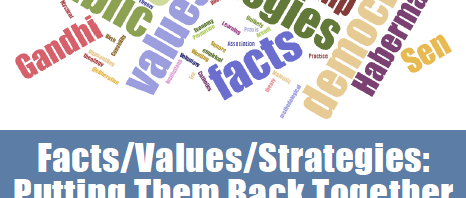
Facts/Values/Strategies: a mini-conference at Tufts’ University’s Tisch College of Civic Life

Current global crises of democracy raise fundamental questions about how citizens can be responsible and effective actors, whether they are combating racism in the United States, protecting human rights in the Middle East, or addressing climate change. If “citizens” are people who strive to leave their communities greater and more beautiful (as in the Athenian citizen’s oath), then their thinking must combine facts, values, and strategies, because all three must influence any wise decision. Mainstream scholarship distinguishes facts, values, and strategies, assigning them to different branches of the academy. Many critics have noted the philosophical shortcomings of the fact/value distinction, but citizens need accounts of how facts, values, and strategies can be recombined, both in theory and in practice. John Dewey, Hannah Arendt, Mahatma Gandhi, Jürgen Habermas, Amartya Sen—and many other theorists of citizenship—have offered such accounts.

Actual civic movements also combine facts, values, and strategies in distinctive ways. For instance, the American Civil Rights Movement used the language of prophesy, and Second Wave Feminism strategically advocated new ways of knowing.

These papers propose theoretical, methodological, historical, and empirical responses and case-studies related to the question: how should citizens put facts, values, and strategies together?

Papers

  • “Public Entrepreneurship, Civic Competence, and Voluntary Association: Self-Governance Through the Ostroms’ Political Economy Lenses” — Paul Dragos Aligica, George Mason University
  • “Giving Birth in the Public Square: Dialogue as a Maieutic Practice” — Lauren Swayne Barthold, University of Connecticut
  • “William James’s Psychology of Philosophizing: Selective Attention, Intellectual Diversity, and the Sentiments in Our Rationalities” — Paul Croce, Stetson University
  • “The Praxis of Amartya Sen and the Promotion of Democratic Capability” — Anthony DeCesare, St. Louis University
  • “Social Media, Dismantling Racism and Mystical Knowing: What White Catholics are Learning from #BlackLivesMatter” — Mary E. Hess, University of Toronto
  • “Institutions, Capabilities, Citizens” — James Johnson, University of Rochester, and Susan Orr, SUNY College at Brockport
  • “Forgiveness After Charleston: The Ethics of an Unlikely Act” — Larry M. Jorgensen, Skidmore College
  • “Facts, Values, and Democracy Worth Wanting: Public Deliberation in the Era of Trump” — David Eric Meens, University of Colorado Boulder
  • “When Democracy Had Roots and Airwaves: Putting Facts, Values, and Strategies Together in Rural America” — Timothy J. Shaffer, Kansas State University
  • “A Civic Account of Justice” — Karol Edward So?tan, University of Maryland

Paper titles are preliminary

Conference chair: Peter Levine, Tisch College, Tufts University.
Good Society editor: Trygve Throntveit, University of Minnesota

review article: Public-Spirited Citizenship: Leadership and Good Government in the United States by Ralph Ketcham

[From Political Science Quarterly, vol. 131, no. 4, winter 2016-17, pp. 896-7. Text as submitted. The definitive version is available at www.wileyonlinelibrary.com/journal/polq. ]

Ralph Ketcham is a distinguished American political historian and biographer, a renowned educator, and an avid student of political thought from classical to current times. In Public-Spirited Citizenship, the most recent of more than a dozen books, he offers a sweeping narrative about both political science and American politics from the founding era to the present, with a valuable excursion into 20th century East Asia.

His story begins with the civic republican tradition that defined the public good as the purpose of politics, civic virtue as the foundation both of a good society and a worthy life, statecraft as leadership and institutional design to encourage civic virtue and promote the public good, and education as the development of good character along with the skills and knowledge needed for civic life. Ketcham emphasizes that the founders of the American republic were steeped in this tradition.

Civic republicanism never vanished, according to Ketcham’s account, but it suffered a series of blows in the 19th and 20th centuries. The idea of a public good began to seem unscientific and naïve as theories of human nature emerged that emphasized self-interest and irrationality. Education was increasingly defined as the imparting of information and scientific insights about the way things really worked, not moral development or reflection on the public good. Public institutions, too, shifted from deliberative forums to sites of negotiation among organized interests.

The American Political Science Association played a role in that story. Starting in the early 1900s, leading American political scientists decried education that took the form of “sermonizing and patriotic expostulation” (p. 105). The only alternative they recognized was a rigorous, detached, disenchanted study of politics as it was. In keeping with that goal, they advocated specialization and expertise. Political science meant training for professors and technocrats in basically the current system.

Good citizens, Ketcham argues, will not be “’experts’ in the details of government; rather, they must have a disinterested perspective and must ask the proper public question, ‘What is good for the polity as a whole?’ and not [a] corrupt private one” (pp. 33-34). That stance is best cultivated, Ketcham argues, by a broad liberal education that is “profound,” “integrated,” and “radical.” But all those ideals seem naïve to positivist social scientists, who doubt there is anything good for the polity (apart from the aggregation of private interests) and who favor education that is specialized empirical training for the status quo.

The broad outlines of this narrative are not unique to Ketcham, but he has a sharp eye for overlooked aphorisms, incidents, and characters. This book is a treasury of quotations from proponents of civic republicanism and positivism alike. It is also a pageant of character sketches—from Benjamin Franklin in dialogue with Mohawk King Hendricks about good government in 1754, to Fukuzawa Yukichi reflecting on how republican norms might merge with Confucian ideals in Meiji Japan, to Ketcham’s own colleagues at Syracuse University’s Maxwell School of Citizenship and Public Affairs, who are giving renewed attention to the ideal of “citizenship” that is in their institution’s name.

I concur with the whole story, but I would add that an 18th century account of the public good and civic virtue can’t directly apply today, not only because we must draw from more diverse sources, but also because we have learned hard truths from history, the natural and social sciences, the terrible experiences of the past century—in a word, from modernity. The decline of civic education and civic culture reflects not only a loss of moral commitment but also a profound intellectual challenge that confronts public-spirited citizens today.

save the date for Frontiers of Democracy: June 22-24, 2017 in Boston

Frontiers of Democracy is an annual conference hosted by the Jonathan M. Tisch College of Civic Life at Tufts University with partners.

In 2017, the frontiers of democracy are threatened around the world. Leaders and movements that have popular support–yet are charged with being undemocratic, xenophobic, and illiberal–are influential or dominant in the Philippines, Russia, Turkey, Hungary, South Africa, France, Britain, and the United States, among other countries. Meanwhile, many peoples continue to face deep and sustained repression. Social movements and networks are confronting this global turn to authoritarianism. Please join us for a discussion of what we must do to defend and expand the frontiers of democracy.

You can enter your information here (shortlink: http://tinyurl.com/zp2qlpz) to let us know that you are interested in attending and to ensure that you receive additional information about the agenda and registering for Frontiers. (This is not a registration link.)

As always, the format of Frontiers is highly interactive; most of the concurrent sessions are “learning exchanges” rather than presentations or panels. We welcome proposals for learning exchanges for 2017. Please use this form to submit ideas (shortlink: http://tinyurl.com/jfdurwv).

Frontiers is a public conference that follows immediately after the Summer Institute of Civic Studies, a 2-week seminar for scholars, practitioners, and advanced graduate students. The Summer Institute requires an application, and admissions decisions are usually made in May. Prospective applicants should sign up on the Summer Institute’s webpage (shortlink: http://tinyurl.com/hgm64rb) to receive more information.