Category Archives: civic theory

what is a social movement?

Social movements are at the heart of politics right now. Drawing loosely on work by Charles Tilly, Doug McAdam, Sidney Tarrow, Frencesca Polletta, Jennifer Earl, and others, I would define a social movement using five criteria (listed below). Note that this is a value-neutral definition. It could fit a fascist movement as well as a progressive one, and it doesn’t imply that social movements are preferable to other phenomena, such as political parties. It is merely intended to categorize a set of phenomena so that we can study them.

1. A social movement consists of many autonomous groups and individuals

Movements are polycentric rather than hierarchical or centralized. A single organization can adopt the feel and spirit of a movement by empowering separate groups internally, but it is only an actual movement if those groups are autonomous and collaborate voluntarily.

2. It persists over numerous episodes and campaigns

The marches over the Edmund Pettus Bridge were episodes. The struggle for the Voting Rights Act was a campaign. The Civil Rights Movement consisted of thousands of episodes and several campaigns.

3. It makes demands on holders of power

The power-holders may be governments, firms, media entities, universities, or any other institutions. If people make no demands on any institutions, I wouldn’t define them as participants in a social movement. They might form an important grouping, such as a spiritual revival or a self-help network, but it would not be a social movement.

Just as important, a social movement makes demands on holders of power rather than trying to supplant them. A political party seeks offices. A revolutionary cadre strives to overthrow and replace the state. An established labor union negotiates contracts with a firm. None of these meet the definition of a social movement, which stands apart from the institution and makes demands on it. I acknowledge that a broad-based social movement can encompass elements that act like parties, revolutionary cadres, or collective bargainers. The Civil Rights Movement encompassed the Mississippi Freedom Democratic Party (MFDP), the Black Panther Party, and the Brotherhood of Sleeping Car Porters; but it was a movement because it wasn’t defined by any of those groups.

4. It supports its demands by displaying WUNC

Tilly observes that social movements don’t just express demands; they back them up with four assets that command attention: worthiness, unity, numbers, and commitment. For example, the women’s marches after Trump’s Inauguration demonstrated that millions of people cared (numbers), that they were willing to travel to Washington or stand outside in the streets of their hometowns (commitment), that they were unified (pink pussycat hats, marching on the same day), and that they were worthy. Worthiness can mean respectability: for instance, “We are middle-class women (with some men) who are pillars of our communities, not the kinds of people who usually make trouble.” But worthiness need not mean respectability. Sometimes, highly oppressed groups claim the worthiness that comes from suffering.

WUNC serves as a standard for evaluating the credibility of would-be movements. For example, does holding a sign on the Boston Common demonstrate enough commitment?

5. It imposes limits on itself

Social movements often adopt and attempt to enforce limits on themselves: “We will not run for office or endorse any parties.” “We will negotiate with companies but not form our own businesses.” “We denounce terrorism.” “We call for a new nation but will not commit treason against the existing state.”

No particular form of self-limitation is definitive of social movements. For instance, there are violent and even terroristic social movements; thus nonviolence is not a condition. But it is highly characteristic–perhaps even definitive–of social movements that they choose some limitations that they enforce on their own members. I would propose a functional explanation of this tendency. Coordinating the behavior of many autonomous groups and individuals is extraordinarily difficult. Movements are easily destroyed by internal disagreements or by escalation to a point where they lose their support. Successful movements avoid escalation by choosing limits and economize on the topics that are open to discussion. For instance, if the movement eschews electoral politics, then it needn’t decide who should run for which office. If it renounces violence, it needn’t debate which targets to hit with which weapons.

Thus a social movement can say: “We are [a set of groups] who want [demands] from [institutions], who demonstrate WUNC [in particular ways] and who eschew [certain tactics or ends.]”
Civic Deserts and our present crisis

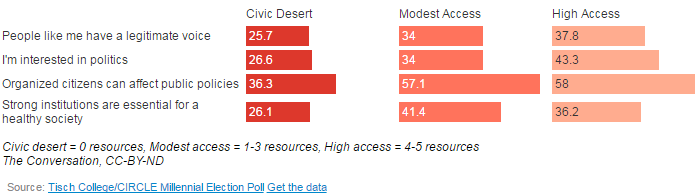
My colleagues Kei Kawashima-Ginsberg and Felicia Sullivan have published an article in The Conversation that I believe supports an important diagnosis of the 2016 election and our current crisis. Their article is entitled “Study: 60 percent of rural millennials lack access to a political life.” They find that a majority of rural youth live in areas that they call “Civic Deserts,” which are “characterized by a dearth of opportunities for civic and political learning and engagement” and a lack of “youth programming, culture and arts organizations and religious congregations.”

Young people in these areas are less civically and politically engaged than other youth. They do not belong to groups and they rarely take civic actions, like voting and volunteering. “During the 2016 presidential election, young people who live in Civic Deserts were less likely to vote compared to others with more civic resources.”

But if they did vote, “they were slightly more likely to choose Trump than those with better access to civic resources.” To illustrate that point: young urban Whites who lived in areas with many civic organizations voted for Trump at a rate of 17 percent. Young Whites who lived in Civic Deserts—which could be rural, suburban or urban—voted for Trump at more than twice that rate: 39 percent.

A person could prefer Trump over Clinton in the November election for a variety of plausible reasons. For instance, if you think that abortion is murder, that is a reason to pull the lever for Trump/Pence instead of Clinton/Kaine. But to like Trump—to appreciate his rhetoric and leadership—is a different matter.

I have argued that few people who belong to functional voluntary groups will appreciate Trump. In almost any kind of voluntary association (whether an evangelical church, a Farmworkers’ local, a business coalition, or a lending circle) leaders typically emerge who demonstrate two virtues: inclusiveness and accountability.

No matter how unified the group, it will encompass some diversity. Members normally expect their leaders to hold the group together by using words and taking actions that include, rather than exclude. Groups do sometimes expel or deliberately alienate members–but only in extremis. The normal goal is to hold the group together.

And members expect their leaders to deliver. If the pastor says the church is going to build a new playground slide, then a new slide had better appear reasonably soon, or the pastor will be blamed. If the informal leader of a social circle promises to organize a gathering but fails to set a date, her stock as a leader will fall.

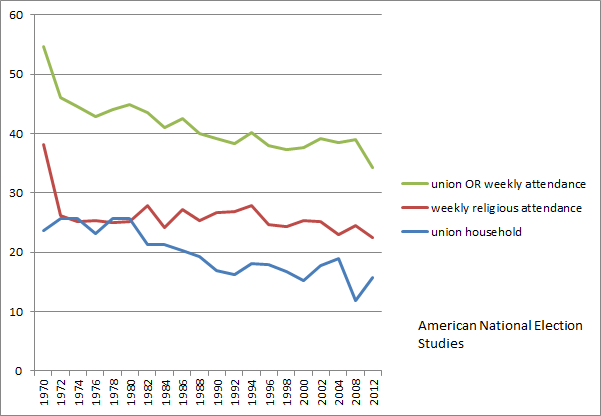
Donald Trump exhibits neither virtue. He is happy to exclude and he is utterly unaccountable. Indeed, I believe many of his fans don’t really expect him to deliver. For them, he is like a droll uncle sitting beside them on the couch, watching O’Reilly, and making remarks that reflect their feelings. When he says he’s going to drain the swamp, they take that to mean that he endorses their values and despises the lobbyists and politicians whom they despise, not that he will actually pass ethics reforms. I posit that this attitude reflects a lack of satisfying experiences with voluntary associations in which the leaders are inclusive and accountable. And that is an increasingly common situation given the steep decline in organizations like unions and churches.

http://peterlevine.ws/?p=17944

Thus I consider the decline in membership—especially among working class Whites—a fundamental cause of Trump.

As evidence, I cite my colleagues’ new finding that White Millennials who live in Civic Deserts voted for Trump. I’d also cite a recent conversation with a self-described Southern conservative evangelical pastor, who told me that he despises Trump because the president’s leadership style violates everything he believes about how to hold a community together.

I’d also cite Hannah Arendt’s argument that loneliness is a precondition of totalitarianism. For her “isolation” means being alone, but “loneliness” means having no felt capacity to control the world in conjunction with other human beings:

Isolation may be the beginning of terror; it certainly is its most fertile ground; it always is its result. This isolation is, as it were, pretotalitarian; its hallmark is impotence insofar as power always comes from men acting together, ‘acting in concert’ (Burke); isolated men are powerless by definition. …

In isolation, man remains in contact with the world as the human artifice; only when the most elementary form of human creativity, which is the capacity to add something of one’s own to the common world, is destroyed, isolation becomes altogether unbearable…

Isolation then becomes loneliness. … Totalitarian domination … bases itself on loneliness, on the experience of not belonging to the world at all, which is among the most radical and desperate experiences of man (The Origins of Totalitarianism, p. 474-5).

Donald Trump is no totalitarian, but the mechanism is similar. When individuals learn from hard experience that they stand alone in a harsh world, they are prone to follow leaders who simply echo their private thoughts and make them feel part of a unified mass.

See also the hollowing out of US democracyto beat Trump, invest in organizing and the “civic state of the union”

new project on the socio-emotional impact of civic engagement

(New York City) People can gain satisfaction, empathy, purpose, insight, and a host of other socio-emotional or psycho-social benefits from taking part in civic life. Also, if they demonstrate psychological maturity or even excellence, it can help them to be responsible civic actors. On the other hand, they can pay a psychosocial price from acting politically. I am haunted by Doug McAdam’s findings, in his great book Freedom Summer, about the longterm human costs of participating in the voter registration drives in Mississippi. Whether psychosocial development and civic engagement benefit each other depends on how we design those experiences, and in doing so, we must be attentive to the varying experiences of people who stand in different places with respect to the social issues (such as racism) that are at stake.

Therefore, I am pleased to share this news:

Tisch College is launching a new initiative in Social-Emotional Learning and Civic Engagement thanks to a generous gift from David T. Zussman, A53, J80P, and his family through the Zussman Fund for Social and Emotional Learning (SEL). The gift will support Tufts faculty’s integration of social-emotional learning into their teaching, and will promote related research and education across the University through frequent collaboration with the Center for the Enhancement of Learning and Teaching (CELT). A key aim is to encourage all Tufts students—undergraduate, graduate, and professional—to develop their social-emotional skills through civic experiences in and out of the classroom. The initiative will also generate new knowledge for the benefit of other institutions.

More at the link.

on the Deep State, the administrative state, and the civil service

The last few days have seen several prominent articles about “the Deep State”: by David Remnick in the New Yorker, Marc Ambinder in The Washington Post, Julie Hirschfeld Davis in the New York Times, and Kevin Williamson in The National Review, among others. I’d been thinking of writing myself, and I think we need some definitions:

  • The Civil Service: a body of government employees who are protected against political patronage and dismissal without cause in return for embracing norms of nonpartisanship, public service, and professionalism.
  • The Administrative State: government agencies that make and enforce rules and regulations (in contrast to statutes enacted by legislatures) and/or directly manage public resources, such as land.
  • The National Security Apparatus: military and spy agencies as well as police agencies concerned with terrorism, foreign espionage, and subversion.
  • Bureaucracy: any large organization divided into specialized offices, each requiring appropriate training and having defined roles and responsibilities, the whole being organized hierarchically and aimed at achieving some predefined or externally defined end or purpose.
  • The Deep State: a group of people within any or all of the above who collude secretly to pursue their own shared agenda, which may reflect their self-interest or an ideological interest contrary to the goals of elected leaders.

Some observations based on those definitions:

Most of the above definitely exist. Whether the (or a) Deep State exists is a matter of conjecture. One reason that the answer is not obvious is that the National Security Apparatus is cloaked in considerable secrecy. But secrecy is necessary for the existence of such an apparatus at all, and is not indefensible. There are many things we would like our government to know yet not publicly disclose. State secrecy is a problem for a democracy but not necessarily an avoidable one.

If there is a Deep State, it would form within one or more bureaucracies yet would subvert them. That is because bureaucracies constrain their employees to carry out defined tasks, but people who collude for their own agendas are evading such constraints.

The Deep State could exist within the National Security Apparatus, the domestic civic service, or both. Americans in a large swath of the center-left and left tend to be critical of US foreign policy but supportive of regulation and the welfare state. Some of them have feared secret agendas in the National Security Apparatus while viewing officials in the domestic welfare and regulatory agencies as dedicated civil servants. Americans in a large swath of the right have been more supportive of foreign policy than of domestic policy, so they have been prone to see soldiers, police officers, and spies as public servants, and other federal employees as uncontrollable bureaucrats. However, the hard right has also been critical of foreign policy, so there have been Deep State narratives on the right at least since the McCarthy Era. Some on the hard left see the domestic policy apparatus as basically a Deep State devoted to disciplining the poor, but I hear less of that than I used to 20 years ago.

To the extent that we have a genuine civil service, it is designed to push back against elected officials and political appointees. That is not sign of a conspiracy but evidence that popular sovereignty conflicts with such values as scientific rigor and legal consistency. The civil service has a checks-and-balances relationship with elected politicians.

Finally, we do have a problem with the Administrative State, but it is not a conspiracy or anything wrong with the people who work in it. Theodore Lowi was a very fine political scientist whose death on Feb. 17 didn’t get enough attention. Lowi argued that liberals built the regulatory and administrative agencies to enact demanding values for which they had received popular support. But the agencies that liberals created do not have legitimacy to make value-judgments themselves. In lieu of making explicit value-judgments, they claim to make their decisions based on science, efficiency, precedent, or stakeholder negotiation. But they actually make value judgments every day. This creates a crisis of legitimacy that threatens the liberal project.

Another way to make Lowi’s argument is to note that the Administrative State is not envisioned in our Constitution (nor is a permanent National Security Apparatus). Agencies are widely understood as parts of the executive branch or as arms of Congress. (They even employ their own judges, which makes them resemble the judicial branch.) I think a better interpretation is that they represent a fourth branch altogether, which has developed since 1900. It should embody certain norms, such as impartiality, rigor, and predictability, and it should be designed to push and pull with the branches that reflect popular will (Congress and the presidency), deliberation (Congress), discretion and flexibility (the presidency), and law (the judiciary). We should expect tension between the president and the administrative agencies and improve our means of resolving those tensions.

As long as we do not regard the Administrative State as a branch with its own norms and standing, we should expect constant crises of legitimacy, because the existence of this branch has never been recognized by the American people. This is not to defend or rationalize Stephen K. Bannon’s attack on the administrative state. But there is a deeper and longer-term problem that will require attention sooner or later.

See also:  the Citizens United decision and the inadequate sociology of the US Constitutionthe public interest and why it matters;  problems with “stakeholders”; and on government versus governance, or the rule of law versus pragmatism.

microgenetic, ontogenetic, and sociogenetic civic learning

At a Center for Ethics & Education conference last week in Kansas City, I learned from Larry Nucci about an important taxonomy. In my summary:

  • Microgenetic learning means obtaining particular knowledge, skills, concepts, values, etc. through particular experiences. A student doesn’t know about Abe Lincoln, reads a book about him, and knows and remembers the president’s story. That is an example of microgenetic learning. We often measure it with assessments before and after lessons or courses. However, it happens at more precise moments, so it’s possible to zero in on the learning events and understand the learning mechanisms.
  • Ontogenetic learning means becoming something different. A small child doesn’t know how to read but becomes literate, a reader. An undergrad doesn’t know much about medicine but ultimately turns into a skilled, practicing physician. Typically, the timescale of ontogenesis is longer than that of microgenesis, but that’s not the essential difference. In theory, ontogenetic change could happen suddenly, as perhaps for Paul on the road to Damascus. The definition is a change in who the person is, not just what he or she knows.
  • Sociogenetic learning is change at the level of a community or society. A community is oral and becomes literate, or pagan and becomes Christian, or analog and becomes digital. Such changes imply that different ontogenetic learning outcomes will become possible, valued, and typical. For instance, a Roman pagan ca. 100 BC couldn’t learn to be a Christian, but his descendants three centuries later could and even had to become Christians. That implied some new microgenetic experiences, like reading scripture and listening to sermons.

These levels of learning can relate in many complex ways. For instance, people can learn specific skills for civic engagement that help them to become activists, and as activists they can change what their society values. Then microgenesis -> ontogenesis -> sociogenesis. Probably more common is the reverse pattern: a society starts to value something, it establishes a new standard of success, and that leads schools to assign new lessons.

This diagram from Saxe 2012 illustrates the various possible pathways.

In fields like literacy and STEM education, which have received heavy investment, scholars have given attention to all three domains. However, I perceive a trend toward the microgenetic level in those fields. It’s increasingly common to apply Learning Sciences and Cognitive Sciences to understand how child A learns skill B at time C. If that trend comes to dominate, there will be need for a critique. We’ll be at risk of missing the forest for the trees and–especially–overlooking what people should learn ontogenically to produce a good society.

In civics, which is underfunded and understudied, most of the research is ontogenetic. It’s most common to use surveys to determine whether children or young adults have become good citizens of one kind or another, and then ask whether civics courses, democratic school climates, or other large influences are related to those outcomes. Practitioners and scholars are certainly interested in microgenetic questions, but that research is scattered and limited, mostly for lack of resources.

Meanwhile, there is a robust debate about sociogenetic changes in civic life. Scholars and pundits debate how the American polity and political culture have changed, what that means for citizens, and how our polity compares to others. Just as an example, Robert Putnam’s Bowling Alone offers a sociogenetic thesis: it’s about how Americans have come to engage more individualistically and less collaboratively since the 1960s. The underlying reasons include changes in technology and the economy (not shifts in civic education).

The sociogenetic debate about citizenship still tends to be somewhat disconnected from microgenetic and ontogenetic research. I didn’t know this vocabulary when Jim Youniss and I edited the volume Engaging Young People in Civic Life, but our explicit goal was to connect debates about civic education to debates about changes in civic life. We thought that developmental psychologists tended to assume that civic life was historically constant, and political scientists and sociologists tended to view civic education as historically constant. However, regimes and modes of education change, and these changes affect each other. It’s even possible for kids to gain skills through microgenetic civic learning that enable them to change what the society values.

Ultimately, we need civic education research that combines the microgenetic, ontogenetic, and sociogenetic levels and yields practical advice for practitioners, policymakers, and advocates.

Figure from Saxe, G. (2012). Cultural development of mathematical ideas: Papua New Guinea studies. Cambridge, UK: Cambridge University Press. My main source is Larry Nucci (2016) Recovering the role of reasoning in moral education to address inequity and social justice, Journal of Moral Education, 45:3, 291-307, DOI: 10.1080/03057240.2016.1167027