Category Archives: civic theory

the right to strike

Yesterday, Alexander Gourevitch from Brown University spoke on “The Right to Strike.” I won’t try to summarize (or scoop) the argument of his forthcoming paper, except to say that Gourevitch uses an account of oppression to give a strong defense of the right to strike, and he squarely addresses the hard issue. Successful strikes often require a degree of coercion in the form of picket lines, sit-ins, work-stoppages that close the firm, strong moral pressure on potential scabs, etc. Many liberal political theorists, American jurists, and European social democrats defend unions and acknowledge the right to strike but are squeamish about the coercive aspect. They either deny that coercion occurs or argue that strikes are only acceptable when free of all coercion. Gourevitch defends the coercive aspect of strikes–although not as an absolute right.

I would reach the same destination from a different starting point. I would begin with the premise that human beings have the right to create, design, and govern groups. Among the many types of groups that we design are governments (at all levels and scales), companies (privately held or publicly traded), and unions. Any of these three can allow or prevent an individual from working in a particular job. The government can regulate or legislate against the job or a category of workers, the firm can refuse to hire or fire an employee (or close the whole shop), and the union can strike. I begin with no assumption that any of these acts is more–or less–legitimate than the others. Governments, companies, and unions can be good or bad. They can do the right or the wrong thing. It all depends on the details.

In particular, it depends on how they are organized internally and what effects they have on outsiders (including natural systems as well as people). Assessing their internal structures and their consequences is controversial because it raises all the basic questions of justice.

For example, it you are a participatory democrat, you will value institutions just to the degree that they are internal democracies. Companies seem the least promising candidates, although democratic firms do exist. Both unions and governments range from highly democratic to highly authoritarian. Before you acknowledge the justice of a coercive strike, you will ask whether the union is democratic (and whether it is more or less democratic than the state that seeks to police it). You may embed in the definition of “democratic” some openness to outsiders, such as workers who are not already members of the union.

If, on the other hand, you are libertarian, you will value institutions just to the degree that the reflect individual, voluntary choice. Governments are the least promising, because very few citizens literally and actively consent to be governed. Governments are only legitimate to the degree that they create space for private agreements. Companies and unions are both potentially legitimate, but unions may be less so, to the extent that they coerce. Hayek claimed that unions “are the one institution where government has signally failed in its first task, that of preventing coercion of men by other men–and by coercion I do not mean primarily the coercion of employers but the coercion of workers by their fellow workers.”

For my own part, I am deeply pluralist. I believe in the value of maintaining a diverse set of institutional arrangements as checks against each other and as manifestations of human plurality and creativity. I am happy to see non-democratic institutions (e.g., the Catholic Church), strongly democratic ones, and many other forms. But I am not a relativist. I think that some organizations are better than others, and some combinations are more desirable than others. It’s just that an account of what makes organizations good must be nuanced and pluralist. One size doesn’t fit all.

On these grounds, I would defend unions as human creations that contribute to a pluralist public sphere. And I would accept that they will act coercively–within appropriate limits–when they strike. I am not positively enthusiastic about coercion, but I’d stress that states and companies also coerce. If you want (or need) to work, and a union has closed your workplace, then you have a complaint; but you also have a complaint if the company fires you arbitrarily or the state throws you in jail. Stronger unions make the second two forms of pervasive injustice less likely. A world with states, companies, and unions is more just than a world with just the first two.

See also my “The Legitimacy of Labor Unions” (2001), which is too moderate, China teaches the value of political pluralism, and should all institutions be democratic?
what if something is not your problem?

I frame a most of my research and teaching around the question, “What should we do?” I’d even define a citizen as someone who asks that question. In academic contexts, I argue that this question is complex and under-theorized: it raises difficult issues of loyalty, complicity, the definition of groups, dynamics within groups, problems of collective action, etc. These issues deserve attention along with the more typical questions of political theory: “What is justice?” and “Why do things happen as they do?” The citizen’s question is also central to our new Civic Studies major at Tufts.

However, insisting on this question may imply that everyone bears primary responsibility for addressing every issue. What if you are the victim of a social injustice that someone else has created or has the best opportunity to remedy? Then it is most important for them to decide what they are obliged to do to improve your situation. Not every problem is your problem.

Nevertheless, “What should we do?” remains an important question for virtually all of us. Even if the main moral responsibility lies with someone else, the only thing we can control is what we do.

We may decide that we should demand justice from another person or group, but making a demand is also a form of action that we choose to take. In fact, making demands on “target authorities” is the characteristic activity of social movements; and social movements are composed of people who ask “What should we do?” It’s just that their goal is to to compel other people to take more responsibility.

Finally, acting is not merely a price we must pay in order to improve the world. It can also be a benefit that we reap, since exercising agency can be an aspect of a good life. Although we should encourage–and sometimes even compel–other people to ask what they should do, it is also worth asking that question on our own behalf, regardless of our circumstances.

See also: a sketch of a theory of social movementswhat should we do?

from I to we: an outline of a theory

These are the main ideas that I’ve defended (or plan to develop) in my theoretical scholarship. They are organized from micro to macro and from ethics to politics. As always, I put this draft online to welcome critical feedback.

  1. Each individual holds a changing set of opinions about moral and political matters. These ideas are connected by various kinds of logical relationships (e.g., inference, causation, or resemblance). Thus each person’s moral opinions at a given moment can be modeled as a network composed of ideas, plus links. In a conference paper, Nick Beauchamp, Sarah Shugars and I have derived network diagrams for 100 individuals and provide evidence that these are valid models of their reasoning about healthcare, abortion, and child-rearing. This approach challenges theories that depict moral reasoning as implicit, unconscious, and unreflective.
  2. A culture, religion, or ideology is best modeled as a cluster of roughly similar idea-networks held by many individuals. Human beings are not divided into groups that are defined by foundational beliefs that imply all their other beliefs. Rather each person holds a unique and often flat and loose network of ideas that overlaps in part with others’ networks. This model avoids radical cultural relativism, as I already argued in my Nietzsche book (1995).
  3. This model of culture also challenges John Rawls’ argument for liberalism as tolerance and neutrality. Rawls presumes that most citizens hold incompatible but highly organized and consistent “comprehensive doctrines.” As a result, they must largely leave one another alone to live according to their various conceptions of the good. If, instead, we understand worldviews as loose and dynamic idea-networks, we find support for a liberalism of mutual interaction instead of distant toleration.
  4. We are not morally responsible for the ideas that we happen to learn as we grow up. That is a matter of luck. But we are responsible for interacting with other people who hold different opinions from ours. Such dialogues can be modeled as the interactions of people who hold different idea-networks. As they disclose and revise ideas and make connections, the discussants produce a shared network. In a paper now being revised and resubmitted, David Williamson Shaffer, Brendan Eagan, and I model Tufts students’ discussions of controversial issues as dynamic idea-networks.
  5. A person can organize her beliefs in ways that either enable or block dialogue. For instance, an individual whose network is centralized around one nonnegotiable idea cannot deliberate; neither can a person whose ideas are disconnected. Thus discursive virtues can be defined in network terms, deliberations can be evaluated using network metrics, and we can strive to organize our own ideas in ways that facilitate discussion.
  6. If people talk, it implies that they were willing to sacrifice time and attention to a conversation. If they have something significant to talk about, they must hold a good in common that they can control or influence. Thus we cannot have the kinds of discussions that improve our own values unless we are organized into functional groups. But creating and sustaining groups requires more than talk. Groups also need rules and practices that coordinate individuals’ action, as well as relationships marked by trust, loyalty, and other interpersonal virtues. In short, civic life depends on a combination of deliberation, collaboration (solving collective action problems), and relationships.
  7. To enable deliberation, collaboration, and relationships requires favorable institutions, such as appropriate legal rights, widespread education in these virtues, and a robust civil society composed of associations that offer opportunities for self-governance. Since these institutions are inadequate in the USA, we need reform.
  8. To change constitutional rights, school systems, and other large institutions, political actors must employ leverage. They must move strangers and impersonal organizations at a distance. Making effective use of leverage is an ethical obligation but also a threat to the relational values implied by points 1-7 (above), which are prized by certain political theorists, such as John Dewey and Hannah Arendt. We must understand how to use impersonal leverage at large scales without undermining or displacing relational politics.

how information relates to power, according to C.V. Wedgewood

C.V. (Veronica) Wedgewood’s The Thirty Years War is almost a century old, but it remains an inexhaustible source of insights. TaNahisi Coates loves it, too: “Take this for whatever it’s worth but she writes better than any historian I’ve ever read. Like all of my favorite writers she paints in all colors. … This is just a thrilling book. Sometimes it’s too pretty, and the details are too on point, but the insights are so thorough and the narrative so gripping that it’s hard to turn away.”

Here’s an example. Wedgewood asks how dynastic politics–births and marriages–could have been so influential. The Hapsburg Empire, for example, was the greatest power in Europe and it formed because of royal weddings. “The dynasty was, with few exceptions, more important in European diplomacy than the nation. Royal marriages were the rivets of international policy and the personal will of the sovereign or the interests of the family its motive forces. For all practical purposes France and Spain are misleading terms for the dynasties of Bourbon and Hapsburg.”

(Wedgewood doesn’t mention the Ottomans, but they were also a family, not a people. The Ottoman Empire was proudly multinational, not Turkish, and it was defined by the fact that the Sultan was the lineal descendant of Osman I [1258-1326]. In Topkapi, marriages weren’t relevant, but it mattered which heir obtained the throne.)

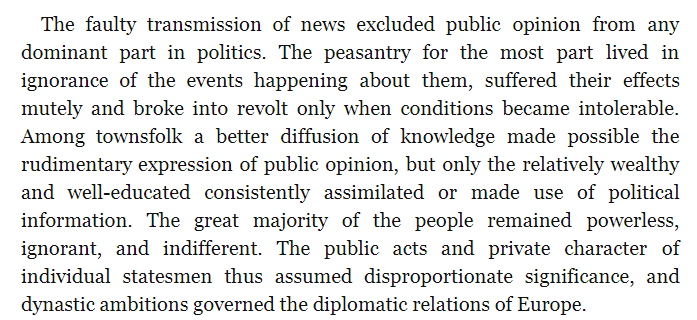
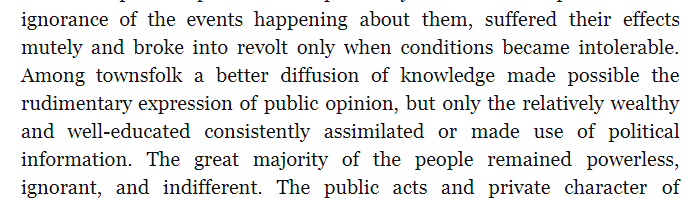
How could the fates of millions be determined by who married whom in a few families?Wedgewood thinks the reason is information:

This is an interesting explanatory thesis. Perhaps it could be restated thus: Everyone has political interests. But in order to act on their interests, people need information and the ability to coordinate. Without information, the peasants and most of the middle class were rendered powerless ca. 1600. That left the great aristocrats to govern, and they could best understand and use their own relationships to shape the world. (They presumably had poor information about things like economics and demographics.) Their relationships were transparent to the masses–for example, everyone knew when the king got married–so the most likely point for popular involvement was in supporting or blocking a dynastic union.

This thesis also raises questions about our own time. Today, we have information by the gibibyte. What we lack is the ability to focus attention on the important stuff. It’s easier to grasp Donald Trump’s marital and extramarital relations than to follow how HHS is undermining Obamacare. One dominant man holds extraordinary power–and celebrity–in China, Russia, India, Turkey, and many other countries. It’s conceivable that the 21st century will look more like the 16th than the 20th in this respect.

Nicole Doerr, Political Translation: How Social Movement Democracies Survive

A century ago, Robert Michels observed what he called the “Iron Law of Oligarchy” at work in the socialist and revolutionary labor parties and movements of Europe. He argued that these groups provided “the best field of observation” for the problem of oligarchy, because they were committed in principle to equality and democracy (p. 11). If even they turned into oligarchies, it was “probable that this cruel game will continue without end” (p. 408).

This was the pattern he observed:

Democracy is inconceivable without organization. [But] Organization implies the tendency to oligarchy. In every organization, whether it be a political party, a professional union, or any other association of the kind, the aristocratic tendency manifests itself very clearly. … As a result of organization, every party or professional union becomes divided into a minority of directors and a majority of directed. … All power thus proceeds in a natural cycle: issuing from the people, it ends by raising itself above the people (pp. 21, 32, 38).

Since about 2003, the University of Copenhagen Sociologist Nicole Doerr has been observing the successors of Michels’ socialist and revolutionary movements–the heterogeneous leftist organizations that have come together in contexts like the European Social Forum, the US Social Forum, and a low-income city in California. She observes many of the same specific dynamics that struck Michels, and she adds new ones.

For example, experienced, professional organizers tend to know one another and give each other much more attention than they give to newcomers (pp. 33-34). Representatives of “New Left” organizations that demand loose, horizontal interactions appear to union organizers to be “arrogant and upper-class” (p. 32). Questions that matter to marginalized people–such as whether the location of the next meeting will be accessible to them–get tabled as irrelevant (p. 56). Despite strong leftist convictions, leaders reveal unconscious bias against people unlike them, such as women from Turkey and Eastern Europe (pp. 54-5). Decisions laboriously reached in earlier meetings become sacrosanct, even though newcomers have reasons to object to them. The need to translate for–or to speak more slowly to–linguistic minorities is perceived as a mere nuisance (p. 39). Gatherings tend to grow more “ideologically homogeneous” over time (p. 54), as those who don’t agree drop out.

But Doerr also contributes a fascinating positive finding. She first noticed that a multilingual meeting was more equitable and deliberative than meetings in which translation was unnecessary (p. 25). That seemed paradoxical. One would assume that if some participants require simultaneous translation, a layer of inequality will be added.

But then she started noticing the translators. Although they were easily dismissed as providing a mere technical support service–and one that inconvenienced the speakers of the dominant languages–they also became involved in advocating for inclusion. They were professionally resistant to entering the discussion of substance, since their job was to translate for others. But they were also professionally committed to making sure that the people they served could be heard. Thus they often intervened on matters of process.

The translators suddenly took center stage when they went on strike during a Paris gathering, with the terse announcement, “we translators now collectively interrupt our linguistic service” (p. 42). Their demand was to change the list of official speakers so that more immigrants were included. They quickly prevailed, thanks to their leverage over the entire meeting.

At the US Social Forum in Atlanta, there were again linguistic translators. But by now, Doerr had begun using the term more broadly. Translators are people who enter a discussion without having substantive views of their own but with the goal of making sure that certain specific people, vulnerable to being ignored, are heard and understood. One of the activists in Atlanta “often intervened when established NGO staffers working on immigration reform had trouble not only understanding the language but also the content and importance of demands by undocumented immigrants.” She told Doerr, “What we did for the US Social Forum was translation … But it’s not just about linguistic translation. It’s also about emotion. It’s a translation of space, of class, of gender” (p. 59).

These translators–linguistic or otherwise–emerge for Doerr as a “third voice within deliberation” (p. 10), neither participants nor facilitators.

She recognizes that they have the power to advance their own interests (pp. 47-9). In the words of the old Italian pun, “traduttore, traditore” (translator = traitor). Their value is dependent on their motivations.  Doerr devotes a chapter to a California example in which bilingual elected officials favored their self-interests: “translation had turned into representation and domination” (p. 97). In meetings at city hall, these officials “repeatedly interrupted, disciplined, marginalized, and implicitly stigmatized residents,” especially those who spoke in Spanish.

But then a grassroots organizing group created community forums and invited the same city leaders to participate on its turf. Volunteer translators played essential roles in designing these forums, in preparing the city officials to be respectful at the meetings (pp. 102-3), and then intervening to demand that specific questions be answered (p. 110). While literally translating between Spanish and English, the organizers also explained technical matters in understandable terms. Although the votes at these community forums had no legal force, the city council made some concessions in response.

I’d like to emphasize four larger themes:

First, we are used to a dichotomy between direct and representative democracy. But translators (linguistic or otherwise) complicate that. They represent individuals in order to permit direct participation.

Second, the beneficial cases in Doer’s book depend on organized power. The translators in Paris struck, withholding their services all at once. The community organizers in the US case engaged sufficient numbers of voters that they could compel city officials to attend their meetings. It’s not just the act of translating that matters; it’s the translators’ connection to organizations. (At this point, Michels would ask how organized translators can avoid becoming a new oligarchy.)

Third, translators sometimes escape notice; their influence is unseen because all they seem to be doing is translating someone else’s words (p. 126). I imagine that listeners literally look at the original speakers, not the translators. This invisibility can be problematic if translators misuse their power. But it’s also a strategic asset, because they can get away with influencing the powerful when others would fail.

Finally, these acts of translation are classic examples of “public work,” in my friend Harry Boyte’s sense: “self-organized efforts by a mix of people who create goods, material or symbolic, whose civic value is determined through an ongoing process of deliberation” (Boyte and Scarnatti, p. 78.). Thinking of political translation as a form of work is helpful because it brings out the translators’ professional commitments and values and the craft-like skills that they contribute to make democracy work better.

References

  • Boyte, Harry C. & Scarnati, Blase. 2014. “Transforming Higher Education in a Larger Context: The Civic Politics of Public Work,” in Peter Levine and Karol Edward Soltan, eds., Civic Studies: Approaches to the Emerging Field. American Association of Colleges & Universities, 2014
  • Doerr, Nicole. 2018. Political Translation: How Social Movement Democracies Survive Cambridge: Cambridge University Press.
  • Michels, Robert. 1915. Political Parties: A Sociological Study of the Oligarchical Tendencies of Modern Democracy, trans. Eden and Cedar Paul. New York: Heart’s International Library