Category Archives: civic theory

identities, interests, and opinions

In our Introduction to Civic Studies course, this is the zone we’re currently in:
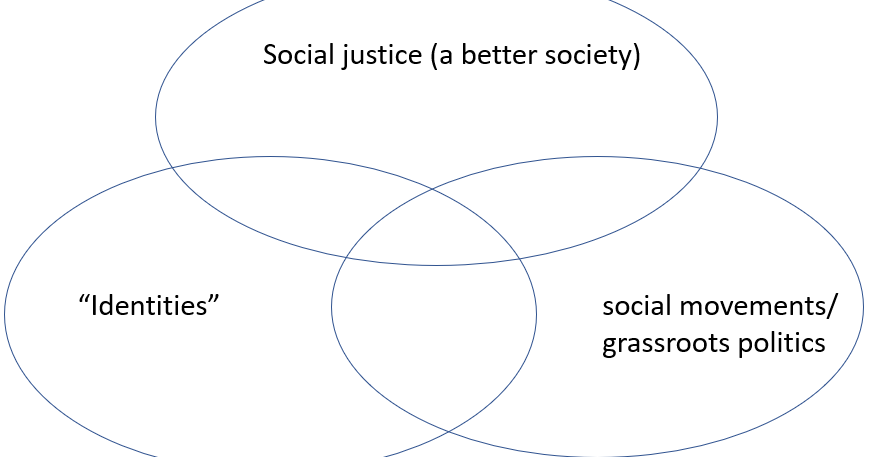
We all need some account of what would make a good–or at least a better–society. This idea can be provisional and open-ended; we still need something to orient us. If you think that it’s easy to define “social justice,” consider that it was the name of Father Coughlin’s antisemitic and pro-Nazimagazine in the 1930s.

We must consider the potential of bottom-up, participatory, social movements to promote justice, because the powerful won’t reliably offer justice. However, reasonable people disagree about how important bottom-up politics is. Maybe top-down leadership or impersonal forces are much more significant.

Finally, we must consider how identities (what we are, as opposed to what we think) fit in. Is all politics identity-politics? Or should we distinguish between “old” social movements, which made universalist claims, and “new” ones, which are identity-based? If the distinction holds, is the change good or bad? Also, does justice require fair treatment of identities? And what is an identity? For example, religion: an identity or a set of beliefs?

As always, it’s our students’ job to navigate their own way through these shoals; I don’t offer answers. But I do think it is interesting to distinguish:

  • An identity: “Speaking as a …”
  • An interest: “I want …”
  • An opinion: “We should …”

I’ll stipulate that we all use all of these forms of speech, and they are all protected under the First Amendment. Which ones are allowed is not a good question. But we might ask:

  • Which of these can be right or wrong?
  • Which can/should be subject to compromise?
  • Which does one have a moral right to? (Relatedly, which ones do other people have an obligation to honor in various ways?)
  • Which should we be open to changing, and why?

Here is an example of a view, although I am not wedded to it:

People have a right to their identities. Sometimes we should change our identities in response to new understandings. For instance, some people didn’t used to see sexual orientation as an identity, especially if they happened to be straight; now they should see heterosexuality as an identity. We should not, however, compromise our identities as part of a deal with others. We are usually right about our own identities, but not inevitably. We can lie or even lie to ourselves about who we are.

We should be open to compromising our interests in order to share the world with others. Whether to compromise depends in part on the moral standing of the other party. We should also be open to changing our interests in response to principled arguments, but that is a different process from compromise. We have a right to certain basic interests, but we can claim interests that we do not have a right to. You can disagree that something is my legitimate interest. I may even owe you an argument that it is.

Our opinions can be right or wrong. We should be open to changing them on the basis of evidence and arguments. We shouldn’t easily compromise them (in the sense of splitting the difference), although there are times when that is wise. Opinions should be sincere, so if you do compromise them, you should mean it.

See also: the New Social Movements of the seventies, eighties, and today; don’t confuse bias and judgment; and why study social justice?

Interfaith Studies, Civic Studies

In a talk yesterday at Tufts, Eboo Patel, the founder and President of the Interfaith Youth Core, said that the guiding question of the field of Interfaith Studies is how to build a religiously diverse democracy. He defined a democracy as a place “where people can make their personal commitments public.” He said that diversity “is not just the differences you like.” It means being able to deal with people who disagree with you about important matters, including politics. And he defined religion as being “about ultimate concerns.”

Eboo made an explicit connection to Civic Studies, for which the defining question is “What should we do?” How to live democratically with religious diversity is an important branch of Civic Studies. It raises empirical questions (What are the roles of religious congregations in civil society? How will they change? How do human beings react to out-groups?) and normative questions (What is the place of faith in public deliberation? How should we respond to beliefs that are intolerant? When should we treat the transmission of practices from one tradition to another as appropriation?)

In January, I got a dose of Interfaith Studies–meaning the theory, the everyday practices, and the committed people–at a conference of the Pluralism Project. I’m eager to work with our chaplaincy and others to build a stronger strand of Interfaith Studies as a complement to Civic Studies.

See also: when political movements resemble religions; the political advantages of organized religion; are religions comprehensive doctrines?; on religion in public debates and specifically in middle school classrooms; churchgoing and Trump; and is everyone religious?

what sustains free speech?

My remarks last week at a small conference on “Tolerance, Citizenship, and the Open Society” at the Tisch College of Civic Life …

We human beings did not evolve to take a broad view of justice, to collect information from diverse sources, to reason impartially, and to be responsive to other people who differ from us. These acts do not come naturally to us.

But we are capable of building prosthetics. For instance, we did not evolve with the skill to tell time precisely, which is now useful for coordinating behavior in mass societies. So we wear wristwatches, hang clocks on our walls, and display the current time on most of our electronic devices. A clock or a watch is a prosthetic device that extends our natural capacities.

An invention (in this case, a clock) will not suffice on its own. Many people must use it. That requires some kind of system that creates incentives or requirements for producing the devices and using them widely. A market with supply and demand can work; so can a state mandate. Either one is an institution.

We have created institutions that extend our ability to deliberate about justice. An example was the metropolitan daily newspaper from ca. 1910 to ca. 1990. Always very far from perfect, it nevertheless delivered important, mind-broadening information to about 80% of Americans every day in the year 1970. They (and advertisers) paid for the local press because it also provided sports, classified ads, comics, and whole package of goods–but with the most important news on the front cover, where it could not be missed.

A university is another institution that supports inquiry and discussion about important matters. It is more complex than a newspaper. Its revenues may include tuition, government aid, grants, gifts, intellectual property transfers, and clinical fees, among other sources. The goods it produces include skills and knowledge of value to each learner; virtues and skills that have public value; the pure public goods of basic knowledge and culture; monetizable forms of knowledge, such as patents; services, such as meals, art exhibitions, and clinical care; and credentials and entry to the middle class.

The skeptical view of such institutions is that their underlying economic motivations determine the ideas and discussions that they support. For example, newspapers are owned by tycoons or faceless corporations that just want to maximize profits. Universities sell social stratification and individual advancement. This analysis always merits attention and explains some of the phenomena. But it is one-sided, because these institutions are also the result of human artisanship–of people creating the means to sustain better thinking at a large scale.

For instance, the metropolitan daily newspaper can be interpreted as the product of the media industry, but it should also be seen as the product of the press. Traditional newspapers tried to distinguish the two by separating the newsroom from the publisher’s suite, but those subsystems were connected. For instance, plenty of publishers were former shoe-leather reporters. Their motives were mixed. That is good because mixed motives produce scalable public goods.

Too simple a theory would yield two predictions about newspapers that both proved incorrect. In 1900, you might predict that millions of people would never spend their own money voluntarily to purchase relatively impartial and challenging daily news. But they did–in part because they were also buying comics and box scores. In 1970, you might predict that we would always have a press, because it meets a social need. But the press has collapsed (half as many people work as reporters today compared to ten years ago) because the Internet has killed its business model.

As with other forms of artisanship, nothing is for certain. Ingenuity, commitment, and perseverance are required. The institutional structures that support broadened understanding depend on intentional work.

The results are always flawed. The recent scandals with college admissions just bring home the flaws of universities, for instance. We should have a free, open, informed, and consequential discussion about how to improve them. But no discussion can occur outside of a viable forum that depends on an institution. We don’t spontaneously gather to discuss; the discussion always happens in a university or a school, an op-ed page of a privately-owned newspaper, Facebook, a union hall, a church basement, a party convention, the state legislature–somewhere that draws resources and assembles users.

These institutions then structure and limit the discussion. There is no view from nowhere, only a permanent struggle to discuss as wisely as we can in various forums. We don’t create these forums deliberatively; most of them arise as the result of accident, power, or leadership. Because they are all flawed and limited, it is essential to have many of them, with diverse forms, competing and checking one another.

This is a “civic” perspective because it emphasizes our ability to shape the world of discourse through artisanship. And it broadens our attention so that we consider not only the rules for speech within an institution (e.g., campus speech codes) but also–and usually more importantly–the underpinnings of the institution itself.

See also a civic approach to free speech; Sinclair and Bezos: media ownership and media bias; don’t let the behavioral revolution make you fatalistic; prospects for civic media after 2016; China teaches the value of political pluralism; polycentricity: the case for a (very) mixed economy.

scholarship on engaged scholarship

We are accepting application for the APSA Institute for Civically Engaged Research (ICER) at Tisch College until March 31. In preparation for the Institute, I am looking for good writing about civically engaged research that is relevant for political scientists, although not necessarily about political science per se.

Incidentally, ICER will not be mainly devoted to reading and discussing papers; it will be more like a workshop. But readings are useful for the organizers at least, and a few texts may be assigned.

A diversity of perspectives and agendas, methodologies, topic areas, and authors’ backgrounds and social identities is important.

I’ve got these but would welcome additional suggestions. (This post is a bleg.)

  • Ackerly, Brooke, and Jacqui True. “Reflexivity in practice: Power and ethics in feminist research on international relations.” International Studies Review 10.4 (2008): 693-707.
  • Burawoy, Michael. “For public sociology.” American sociological review 70.1 (2005): 4-28. (His ASA Presidential Address)
  • Flyvbjerg, Bent. “Social science that matters.” Foresight Europe 2 (2005): 38-42.
  • O’Meara, K., Timothy Eatman, and Saul Petersen. “Advancing engaged scholarship in promotion and tenure: A roadmap and call for reform.” Liberal Education 101.3 (2015): 52-57.
  • Ostrom, Elinor. “Beyond markets and states: polycentric governance of complex economic systems.” American economic review 100.3 (2010): 641-72. (Her Nobel Lecture)
  • Struminska-Kutra, Marta. “Engaged scholarship: Steering between the risks of paternalism, opportunism, and paralysis.” Organization 23.6 (2016): 864-883.
  • Tickner, J. Ann. “On the frontlines or sidelines of knowledge and power? Feminist practices of responsible scholarship.” International Studies Review 8.3 (2006): 383-395.
  • Wallerstein, Nina B., and Bonnie Duran. “Using community-based participatory research to address health disparities.” Health promotion practice 7.3 (2006): 312-323.

a civic approach to free speech

I argued in a recent post that libertarians, social democrats, American liberals, and most US Constitutional scholars share a sharp distinction between the state and the private sector–but this distinction does not reflect our actual experience of the social world.

One result is a certain way of thinking about freedoms of speech, the press, assembly, religion, and petition (the Five Freedoms of the First Amendment, which are also important rights in other democracies).

A typical first step is to identify which institutions are public or state bodies. They should be prevented from interfering with other people’s speech and assembly, and they should be constrained from expressing themselves in certain ways. For instance, the US government may not express support for any specific religion, although anyone else in the society may.

The next step is to safeguard the freedoms of non-public groups, including their freedom to discriminate and exclude. For instance, the Catholic Church is not required to ordain non-Catholics (or women) as priests. Such requirements would violate its freedom of assembly and religion.

Then we face two recurrent debates. One is whether various private associations (universities, web platforms) should act like states, even though perhaps they don’t have to under the Constitution. For instance, should a private university accord its students untrammeled freedom of speech? The other debate is whether hybrid institutions (state universities, political parties, public broadcasting services) are more state or private. Do they have First Amendment rights or must they safeguard others’ rights, or both?

The debate about the role of speech in our democracy thus centers on questions like comment-moderation, inviting or disinviting speakers, speech codes, hate speech–all of which have a legalistic flavor. The question is who has a right to say what, where.

If I actually had any influence, I would not seek to upset the apple cart of American constitutional thought. The categories that we have drawn (public/private, freedom/restriction) reflect some accumulated wisdom and offer some practical advantages. I would give a Burkean justification for how we employ the First Amendment: it is how we have learned to operate.

But the distinction between state and private sphere is at odds with the reality of how institutions work. They are almost all hybrids, partly public and partly private, exercising power but also allowing voice, including some and excluding others.

So what if we started instead with a population of people–individual human beings–who come together in a wide range of organizational forms to define, discuss, and address problems? I think these are the important points for them to consider in relation to freedom of speech:

  1. They need structured, reflective discussions that encompass a diversity of views and respond to good reasons or insights, not to power. They don’t need consensus, but they must continuously learn from others.
  2. Good discussions take institutional forms, from op-ed pages to seminars to town meetings. All institutions have rules, norms, resources, and incentives. Incentives are necessary because participation in a discussion has costs. It takes time and energy to discuss, and the conversation may cause discomfort. Individuals don’t have to participate. Successful institutions for communication or discussion find ways to lure people in. A classic example was the package of the local daily newspaper: comics and sports to encourage subscriptions, and a sober front page to direct your attention to serious matters. The demise of this business model is an important example of what we should worry about.
  3. Any good discussion is a common-pool resource. It requires voluntary contributions, it serves all who participate, but it is easy for individuals to ruin. There are principles for the management of fragile common-pool resources.
  4. On the list of principles you will not find a requirement to discuss all the rules and incentives all the time. On the contrary, groups must economize on disagreement. They can’t handle too much of it. And any discussion assumes a prior solution to a problem of collective action. People didn’t automatically want to show up and talk; they were drawn in. This means that discussions generally rely on founders, small groups of leaders, or past generations of participants. We don’t make our own discussions; we join them. The structure of the institution constrains the discussions that take place within it, but there is no such thing as an unstructured discussion.
  5. Given the fragility of institutions for discussion and the importance of building institutions that match various needs and interests, they must be plural. We need lots of overlapping but heterogeneous forums–face-to-face, online, big, intimate, ideologically coherent and ideologically diverse. Each one will set rules for what speech it allows, but the rules will also determine who participates, the costs and benefits of participation, the scale, and a range of other issues. No set of rules is ideal; it’s the whole ecosystem that matters.

None of this is original. It reflects well-developed lines of argument from the sociology of communication and other fields. But it is an alternative to the US discourse of free speech, which is all about rights and restrictions. It focuses instead on the design of multiple institutions for communication–their resources, boundaries, rules, and norms.