Category Archives: populism

Jack Gilbert, A Brief for the Defense

The poet Jack Gilbert died this week. One of his most famous poems is “A Brief for the Defense,” from which I quote a couple of excerpts:

Sorrow everywhere. Slaughter everywhere. If babies
are not starving someplace, they are starving
somewhere else. With flies in their nostrils.
But we enjoy our lives because that’s what God wants.
Otherwise the mornings before summer dawn would not
be made so fine. …

If we deny our happiness, resist our satisfaction,
we lessen the importance of their deprivation.
We must risk delight. We can do without pleasure,
but not delight. Not enjoyment. We must have
the stubbornness to accept our gladness in the ruthless
furnace of this world. To make injustice the only
measure of our attention is to praise the Devil.

The charge against us is that we enjoy life despite others’ suffering. Does the defense (quoted above) make a good case on our behalf? Does it depend on the mention of God? Or is there a secular, ethical case for relishing life despite suffering?

Some years ago, I would have said that the best way to live is not to count one’s own happiness more than anyone else’s. My welfare or happiness should (ideally) represent about one seven-billionth of my concern. Now I am not so sure. I think that subjective happiness is only roughly correlated with objective conditions, such as prosperity and freedom. As Gilbert puts it in this poem, “There is laughter / every day in the terrible streets of Calcutta.” On the other hand, people are generally bad at being happy, we cannot make each other happy, and a world in which we all strove for each other’s happiness would be strangely empty. Everyone would be taking in other people’s laundry. Emerson and Nietzsche put the point too strongly, but they has an insight. Not only demanding justice for others but also achieving happiness for ourselves is a worthy moral objective. (See also my posts on “all that matters is equanimity, community, and truth,” “unhappiness and injustice are different problems,” and “Mill’s question: If you achieved justice, would you be happy?.”)
nine general but contradictory truths

My recent post about Native American youth demanding respect makes me think that we must keep several principles in mind, even though they conflict with each other:

1. The odds are against constructing a full and flourishing human life unless you have a secure home and neighborhood, health care, nutrition, and educational opportunities–including informal learning experiences, such as the ability to buy books or afford some occasional travel.

2. Yet the most important aspects of a full and flourishing human life (relationships, cultural expressions, understanding the external world, developing a complex inner life, and having self-respect) must be created by individuals and networks. They cannot be provided by outsiders. Further, individuals and communities can flourish fully on very low incomes, whereas some wealthy communities are hollow.

3. Yet relationships, cultural norms, and the grounds of self-respect are also often the causes of tragedies and injustices. Some cultural norms are just bad–such as discrimination. Others are commendable but have costs because they do not fit with the norms of a broader society. For example, working-class American parents have attractive parenting styles and expectations that do not prepare children well for white-collar careers.

4. To change human behavior on any large scale requires shifting the incentives, the penalties and benefits. We need to get laws, markets, and entitlements right.

5. Yet people are smart enough to subvert and compromise any system of incentives if they do not want to comply with its objectives. Even without incentives, people sacrifice when they motivated to do so and when peers expect them to do so.

6. Wise leadership requires a breadth of experience and knowledge. If you want to influence public affairs, you are obliged to challenge yourself by listening to people who are different from you, by visiting remote places (in person or through media), and by studying difficult topics.

7. Yet communities that cannot afford education or interactions with diverse outsiders still have the capacity for wise leadership. Highly educated people sometimes make the worst leaders.

8. Repressive power is not monopolized by official institutions (governments, armies, corporations) but is diffused through all human interactions and often exercised unconsciously in ways that wound both the ostensibly powerful and the putatively powerless.

9. Yet every venue of human interaction (even the limiting cases, like prisons and psychiatric hospitals) are also sites of creativity, collaboration, and a deepening of human subjectivity.

Because these principles are all true and yet they produce dilemmas when combined, I am especially interested in practices such as Positive Deviance, asking The Right Question, Power Cube analysis, social accountability, and public deliberation (all briefly described here) that start with local knowledge and assets while also developing and challenging people to do better.

is the public right or wrong about the stimulus?

I am very interested in gaps between expert or academic opinion and public opinion. An important current example is stimulus policy during recessions. Sixty-two percent of Americans recently said that the stimulus bills “just created debt,” whereas 28 percent said the stimulus “helped the economy.”That’s consistent with the belief of 64% of Americans that “big government” is the most serious threat to the country. (They are given a choice of big government, big business, or big labor.) The Keynesian argument that governments should stimulate the economy by borrowing and spending during recessions does not seem to persuade many Americans.

Meanwhile, many (although not all) economists think that Keynesianism does apply in a recession like the current one, and they estimate that federal stimulus has lowered unemployment and boosted growth. Perhaps average Americans misunderstand economic theory, overestimate the degree of waste in government, or measure impact against the wrong baseline. (The question is not whether unemployment has gone down, but whether it would be worse without the stimulus.). One might conclude that inattentive or misinformed voters are a problem.

But matters are at least a bit more complicated. The CBO calculates that the stimulus “Increased the number of full-time-equivalent (FTE) jobs by 2.0 million to 4.8 million.” The stimulus cost about $787 billion. That means that each job cost between $163,958 and $393,500. The median full-time salary for a worker age 25-64 is just under $40,000. So the cost per job was equal to between four and ten salaries. Put another way, the stimulus cost about $26,200 per capita and budged the unemployment rate down just a touch. No wonder people are a little skeptical.

I don’t know why that is. I’m inclined to guess that the stimulus was highly inefficient either because it just isn’t possible to generate jobs efficiently after a financial meltdown or because too much of the money went to tax breaks rather than sustaining state and local government payrolls. But the fact remains that people aren’t crazy. It’s not that the stimulus was a great success and all we need is more of it. Maybe we need more and better, but the judgment that it was wasteful is a reasonable one on its face. (If I am missing why the American people are just off base, please let me know.)

transparency is not enough

In a recent focus group conducted by Lake Research Partners (and cited in this report for the Campaign for Stronger Democracy), one participant said: “I don’t want to just watch it happen…I want to do something about it.” He was arguing that transparency–disclosing information about the government–is insufficient. A transparent government may still be beholden to wealthy special interests; knowing the gory details won’t enhance one’s trust, confidence, or willingness to participate. Lake Research Partners concluded that the public wants accountability, not transparency.

In a preliminary discussion of these results that I attended, Ellen Miller from the Sunlight Foundation insisted that transparency is a necessary precondition of accountability. Maybe, but it is not sufficient. If you are angry when politicians take money from wealthy interests, then knowing that both major party candidates accepted millions will only disempower you. It won’t change anything.

So we need accountability–but what does the public mean by that? Other research suggests that Americans don’t want a system of carrots and sticks for performance. They think of “accountability” in more personal and relational terms. Famous individuals who behave badly should be punished. Leaders should share our values and motivations. We should feel that we know or could know them personally. In a nation of 300 million, that either means mediated relationships (observed on TV) and anecdotal stories of public shame and punishment–neither of which we should trust–or it means fundamental structural reform. Campaign finance reform would help. Decentralizing power would give many more people opportunities to know and work with public officials. In practice, that could mean granting more power to school boards and juries.

Note that I have shifted–deliberately–from transparency to accountability and from there to active participation. I don’t believe there is any substitute for that.

the growing distance between people and schools

(Washington, DC) Liberals are often dismissive of local control in education. For example, in the current New York Review of Books, Christopher Benfey remarks on Mitt “Romney’s obligatory kowtowing to local and parental control of school systems (meaning, presumably, more school prayer and less evolution) …”*

Local control may mean more prayer and less evolution–in some districts–but it may also increase people’s stake in public education.

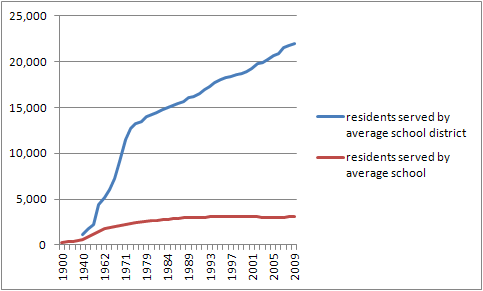
In 1940, each school district in the United States served only 1,117 people, and usually the district had an elected board. Today the average school board serves almost 20 times as many residents, and often it has an appointed leader. Meanwhile, the number of residents served by each school has grown tenfold since 1900. While these trends have unfolded–as the deliberate result of consolidation, undertaken in the name of efficiency–standardized testing has become more important, and state and federal mandates have proliferated. As a result, fewer people are involved in local school governance, which has become less consequential.

To be sure, districts can be too small for efficiency. And many of the important state–and especially federal–mandates have been enacted to protect vulnerable minorities and have had positive effects.

However, if it is true that people want accountability that is relational rather than informational, then Americans are going to perceive schools as less accountable the bigger the districts get. And they are not likely to fund or otherwise trust schools that they consider unaccountable.

This would be not be an essential problem if people generally trusted government and were involved in public life in other ways, such as on juries. But the trends of distrust and disengagement are evident across the government.

*In the same issue of the NYRB, Michael Greenberg interviews an Occupy Wall Street participant who extolls “direct democracy,” saying, “as you can see for yourself [it] works beautifully here on the whole.” Greenberg “mention[s] Proposition 8 in California, an instance of direct democracy that overturned a state supreme court ruling that had legalized same sex marriage.” Apparently, local control implies creationism, and direct democracy means overturning gay marriage. So much for democratic vistas.