Category Archives: verse and worse

doggerel by a dad

“O aid me ere I err!” bade he.
“Nay, nay, I’ll not,” said she.
“I’ll aid ye not–you’re overwrought,” she sputtered in her tea.
“Avail me, please, I’m on my knees,”
Beseeched the lad, awailing.
“Peace,” said she, “your tears they’ll be completely unavailing.”
“I am,” said he, “a wretched me, with only this petition …”
“Your prayer,” said she, “moves not me, nor will I grant permission
To drip upon my tattered shoe your salty drops o’ woe.”
“I’d only note,” the laddie quote, a-pointing to his toe,
“That you have ta’en seat upon a steamin’ pot ‘o stew.
Underneath that very pot is set a hot fondue
And as you settle in, you see, the one flows in t’other
And both begin to drip upon my only little brother.
As he shakes, our boat it quakes, and o’er the gunnels flow
The last of the drips off the honeyed lips o’ the Bonghi-Donghi-Do.”
“Cease!” cried she. “Prattle not. I care not what you say.
I’ll sit right here and pull yer ear and watch the driplets flow.
I care not a wit for the Bonghi-Do; let him do what ere he may!”

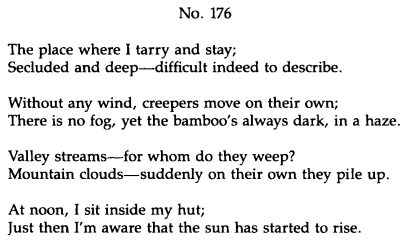
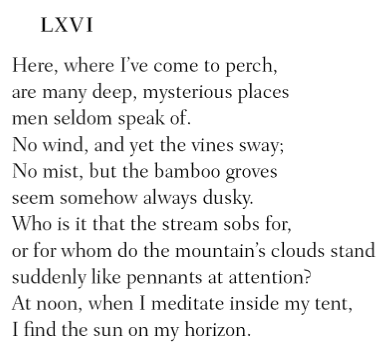
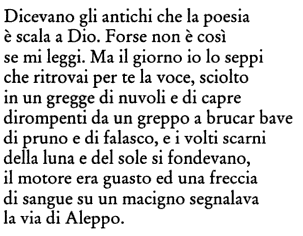
Syria by Eugenio Montale

They said, the ancients, that poetry
is a ladder to God. Maybe it’s not like that
when you read mine. But the day I knew it,
that I had recovered my voice through you–loose
as I was in a flock of clouds and goats
crashing out of a ravine to graze on dribble
of thornbush and bulrush, and the lean faces
of the moon and sun were fusing together–
that day the car broke down and an arrow
of blood on a boulder marked the road to Aleppo.

(“Siria,” from La bufera e altro, 1956, translated by Peter Levine)

Montale

a poem should

A poem should compel respect and pity
As a siren stops the city,

Cry
To see the stricken hobble by.

A poem should mutely display
What would hush a room to say:
A handful of dust, a rapist swan,
Bodies scythed into ditches of clay.

A poem should see
What the fry-cook sees, the whale,
The refugee.

It should lay its wrinkled fingers
Gently on and squeeze.

It should release in the back of the nose
Scents of salt water, sex, new rain on soot,
Grandfather’s undiscarded clothes.

A poem is built from parts
And then left on the curb.
You take a piece home, plug it in.
It restarts.

A poem’s every line
Can split and recombine,
Lie unexpressed until it arrests
An ethical decline.

A poem is equal to:
Me plus you.

(With apologies to Archibald MacLeish.)

six-ten

I am not forty-six. It’s not six-ten.
I have no appointments and no inbox.
I am just a head pinned to a pillow,
An eye watching the shade turn from black
To a grey rectangle with pale white rims,
The same shape an infant would see before
It cried, or an old man on his last bed,
Or a cat on its side with its legs stretched.
The clock ticks until it buzzes, but while
It ticks, it ticks, and I am just a head.