Category Archives: fine arts

Jonathan Strange and Mr. Norrell

I just finished reading Susanna Clarke’s Jonathan Strange and Mr. Norrell, an amazing novel about the “return of English magic” during the Napoleonic era. It resembles books in which the author conducts research into some occult or supernatural beliefs and then pretends that these beliefs are true. That mix of historical research and make-believe is evident in Umberto Eco’s novels, in the Historian by Elizabeth Kostova, and (to name two less successful examples) in my Something to Hide and Tongues of Fire. However, Clarke’s book is different. As far as I can tell, the scholarly research that appears to underlie the novel is entirely invented. Clarke has made up the historical tradition that she seems to have rediscovered. That tradition is so richly imagined and so multidimensional that it seems real.

At the same time, Jonathan Strange and Mr. Norrell is a compelling, suspenseful story. Despite being about magic, it’s for grownups. Adult relationships (especially a marriage and the competition between two professionals) are at the heart of the book. I read it jealously, since I would rather have written it than done any other kind of work. But my jealousy–which also happens to be a big theme in the book–did not prevent me from enjoying it thoroughly.

trying to look at Las Meninas

Last week in Madrid, I spent a long time staring at Las Meninas by Velazquez. I soon realized that some of the other tourists, especially those accompanied by professional guides, were deliberately looking at the painting in pocket mirrors. I went to the museum gift shop and bought myself a small mirror. I thought I was clever to find one, but on reflection I suspect that the Prado stocks mirrors just so that people can use them to view Las Meninas.
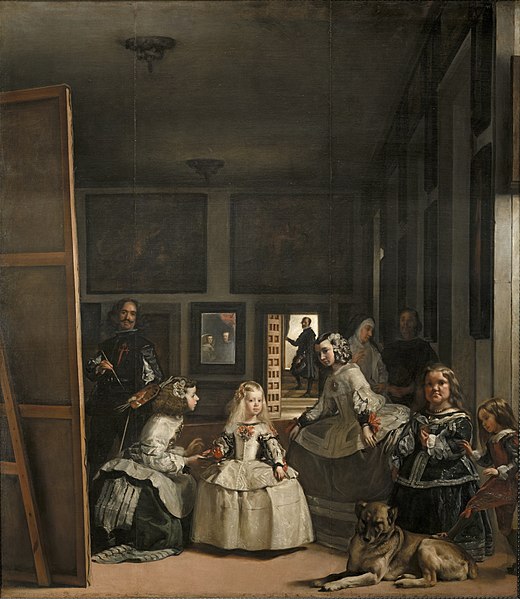
I don’t know precisely why people look at Velazquez’ masterpiece in a mirror. To me, however, the reflection of the painting looked extraordinarily three-dimensional–more real and natural than the tourists who constantly passed in front of it. Velazquez depicts light coming from three angles, the back, the right, and the front; and all the resulting shadows and highlights create a startling illusion of depth when viewed in a small mirror.

Many of the tourists behaved in the following way. They rapidly approached the painting, planted one of their party in front of it, took a digital picture of this person, and then walked away. I often saw this in my mirror.

Las Meninas shows Velazquez looking back at us, so to speak. He has been painting a large canvas that we cannot see. It blocks his view, so he looks around and directly at the middle of the crowd of tourists. Several of the other people represented in Las Meninas also look in our direction.

What is Velazquez painting? There is a mirror behind him on which appear the faces of the King and Queen of Spain. So perhaps the mirror reflects the canvass that Velazquez has been working on. In that case, we are viewing a double royal portrait reflected in the mirror. There is no reason to assume that the King and Queen still stand before Velazquez at the moment depicted in the painting. He might be working on the background or applying a varnish after his sitters have left.

Alternatively, perhaps the King and Queen do stand in front of Velazquez, just where I stood with my mirror and the other tourists posed for their snapshots. Then the mirror behind Velazquez shows the two live Royals. He might be painting them, or he might be painting something else while they happen to visit his studio.

In fact, the royal couple could be visiting Velazquez while he paints Las Meninas, which is a portrait of their daughter and her attendants. Then, on the canvas in front of him, Velazquez would also appear–painting Velazquez, painting Velazquez, painting Velazquez, in a mise-en-abime. All these theories have been advanced and defended.

When I was in the Prado, Velazquez appeared to be looking–not at the King and Queen–but at the backs of tourists, who faced the viewfinders of cameras, which appeared in my mirror as I stood with my back to Velazquez looking at him. It was a very “post-modern” moment, made even more self-referential by the fact that Foucault himself wrote a famous essay about the self-referentiality of Las Meninas.

Why were the tourists taking pictures of Las Meninas? Because it is a Masterpiece. Walter Benjamin explained that when a unique object is reproduced thousands of times over, the original gains an aura. It alone is “real,” and all the coffee table books, documentaries, postcards, coasters, and candles that reproduce it are fakes. People want to be able to go home and see themselves in a reproduction of Las Meninas that proves that they were near the actual object, the one that Velazquez himself made. Velazquez, after all, was a Great Artist–which happens to one of the messages of Las Meninas. The artist shows that his genius has made him the peer of great aristocrats.

Las Meninas is a Masterpiece for several other reasons: the excellence of the illusion, the air of mystery, the striking ensemble, the self-portrait (which ties the image to its genius-maker), the perennial appeal of a princess and her life at court, and even the remoteness of Madrid in the 19th century, which allowed visitors to report that there was a great painting in the Prado that people couldn’t appreciate unless they went all the way to Spain to see it. “Las Meninas” had an aura even when it could only be reproduced in lithographs.

I have spoken of “tourists.” I want to make clear that I was also a tourist in the Prado, also standing in front of the artifact to be near it and blocking others’ view. I would never take a snapshot of myself in front of a painting; I’m too much of a snob for that. But I am writing a souvenir right now, wanting to remind myself what it was like to be near Las Meninas. While I was there, I had so many meta-thoughts that I’m not sure how well I saw the thing-in-itself.

One kind of tourist wants to do what is typically done by tourists. The goal is to experience the classic experience. In contrast, we academics are trained to be original. We get no credit for writing something that has already been written. For us, Masterpieces like Las Meninas become imposing, they gain a kind of aura, because so much has been said about them in the past that there is surely nothing we can add. Ortega y Gasset argued that Velazquez had established the nobility of painting by depicting himself as a courtier-painter. Foucault declared Las Meninas to be the death of representation. John Searle declared Foucault to be wrong. Svetlana Alpers took issue with both Foucault and Searle. And legions of specialists have isolated the pigments, analyzed the perspective lines, traced Velazquez’ influences, and identified the figures in the painting. What else is there to say?

Actually, if I had time to play the academic in relation to Las Meninas, I would look at what has been written about the dog (hoping, of course, that no one has written anything, because then I could leave my mark). Pets are domesticated nature, and nothing could be more domesticated than a large hunting dog that allows a dwarf to step on its back without moving. In Renaissance terms, court dwarves are natural (as opposed to supernatural), but also unnatural (as opposed to normal); and they are part of the King’s domestic scene. Painting, too, is domesticated nature: it is infinite, shifting space reduced through magical artifice to a flat, motionless surface.

In Las Meninas, everyone is looking at someone or something: everyone except the dog, whose eyes seem to be closed. We look at nature; nature doesn’t look at us. We look at paintings, and usually paintings don’t look at us. But Las Meninas is an unusual painting, one in which the artist has to peer around a large canvass to look in our direction, and in which a mirror pointed in our direction eerily reflects the King and Queen of Spain. Las Meninas is a piece of canvass with some paint on it; it is also an artifact with a sacred aura. Viewed in a mirror, it looks more real than reality. All this is enough to make you wonder how natural the painting really is.

the monastery of the royal shoeless

Yesterday, before my conference began, I explored Madrid and took a tour of El Monasterio de las Descalzas Reales. This is actually a Franciscan convent, which is why the nuns are “shoeless.” They were originally “royal” because the institution was created to house princesses and other aristocratic women who (thanks to dynastic politics) were not destined to marry, or were widowed, or needed to retreat from court scandals.

Franciscan nuns are called “Poor Clares” after their founder, Chiara of Assisi, the daughter of Favorino Scifi, Count of Sasso-Rosso. Chiara (or Clare) renounced all her considerable worldly goods in order to follow the example of her personal friend, Francis of Assisi. In her struggle to become poor, she had to contend first with the hostility of her father and then with a series of popes who wanted the nuns who followed her to hold property in common. Other orders held vast quantities of joint property, but radicals of Clare’s day believed that such wealth, even if it technically belonged to the group rather than to individuals, corrupted the Church. Clare persuaded Gregory IX to change his own prior written instructions and grant her the Privilegium Paupertatis, the “privilege to be poor.” He knew this was a radical and subversive idea. For if the “Clares” were poor, why might the Church be rich?

Anyway, the Royal Shoeless of Madrid, although Poor Clares, have certainly held some collective wealth. Their monastery contains numerous chapels and halls arrayed around a tranquil, two-story cloister. Practically every inch of the interior is covered in religious art: paintings, sculptures, frescos, reliquaries, gilt altarpieces, and dioramas made of porcelein figurines. Most of the art is distinctly second-rate, although there seems to be a fine Titian and some magnificent Flemish tapestries executed to designs (“cartoons”) by Rubens.

I am very accustomed to religious art and love a great deal of it. I have also been in nunneries built for aristocratic women, such as the Beguine-houses of Bruges. But I must admit that the sentimentality of the art at the “Descalzas” put me over the edge. Picture cloistered virgin princesses spending their lives worshipping before images of the Mother and Child. I presume they see Mary as the ideal woman because she represents motherly charity without sex. Then notice that underneath several of the Madonnas in the Descalzes are wounded babies laid out on crosses or tombs. In each of these images, a Baroque putto has been crucified to foreshadow his tragic end.

The “Descalzas” also contains an extraordinary collection of saintly relics in elaborate containers. They are said to be the body parts of tortured and murdered Christians, displayed for adoration. Then there are whole rooms full of Hapsburg portraits–the men depicted in armor–and some elaborate allegories of Catholicism versus heresy.

Sentimentality, opulence, aristocratic pedigrees, vows of poverty, military violence, images of torture in a home walled off from all worldly evils … the mixture is hard to take. Not that I envy the nuns of the Descalzas. There was something about the walls–scrubbed clean but last painted a long time ago–the bare electric lighting, the stern signs, and all that didactic art that made me think of a hospital, a scary old boarding school, or even a reformatory. We never saw the nuns themselves; they hide away while the tours go through.

Laxdaela Saga: political freedom and psychological insight

On our way to Iceland, I read an Icelandic saga that we happened to have in our apartment (because my wife had read it in college). The sagas were written in the thirteenth century, when Iceland was reasonably well integrated into Christian Europe; but they are set 200-300 years earlier, in the days of the Icelandic Free State. This was an amazing polity, a nation formed by chieftains from Norway, Ireland, and other diverse places and cultures. They met annually at an assembly called the Althing, which functioned as a legislature–writing criminal and civil laws–and a court. They had no executive branch at all. This meant that there were no taxes and no public expenditures on things like temples and churches, roads, or armies. For the same reason, there no police power. The main sentence passed at the Althing was outlawry. An outlaw was supposed to leave Iceland. If he stayed, anyone could kill him.

Me and my girls at Thingvellir, where the Icelandic assembly began meeting in 930

Continue reading

books I read as a teenager that I’d like to read again

On the blog “Balloon Juice,” John Cole lists five books that he read as a teen or young adult and that he considers worth re-reading today. He asks some other bloggers to compile similar lists, picking them out by name. By way of Laura at 11D, the game reached Russell Arben Fox at In Medias Res, who passed it on to me. I’m flattered to be “tagged.” Besides, nostalgia is one of my most pervasive and favorite emotions. So here goes …

When I turned 12 and 13, I attended a very scary English school, then for boys only, physically resembling Hogwarts but much more concerned with corporal punishment and personal neatness. To get there, I rode British Rail by myself and often read the newspaper on the way. (The headlines must have been about recession, oil shortages, racial conflict in London, terrorist bombings, and revolution in Iran. The details change, but the wheel keeps turning.) Most of my books came either from the school’s library or from the public library branch behind Victoria Station, where I would walk on my own.

I mention all this because it’s only by thinking of physical places that I can conjure up titles of books from that era. Among the ones that I would like to read again were Rudyard Kipling’s Kim and William McFee’s Casuals of the Sea (1916). I thought Kim was a great adventure (no parents, espionage, mysticism, the Empire–what more could a boy want?). Later in life, I would have assumed that it was sheer imperial propaganda. But Pankraj Mishra’s recent essay in the New York Review of Books has made me want to look at it again (although I’d rather read Mishra himself). As for Casuals of the Sea–it was some kind of fictional biography, beginning with the hero’s conception in an extramarital sex scene that I shouldn’t have read when I was 12 (although I suspect it was tame). The protagonist then lived in London and worked on ships, but I remember little else.

During those years, I read a series of Napoleonic sea novels that traced the hero’s career from midshipman to admiral. It wasn’t the “Horatio Hornblower” series, because I had read that earlier. I vaguely remember that the author’s name was Irish. Could I have been reading the Aubrey/Maturin series by Patrick O’Brien? It seems unlikely, especially since I read Post Captain in 2004 and had no recollection of it whatsoever.

For the next five years, we lived in Syracuse, New York, making frequent, long visits to New York City and spending the summers in England, with two separate months in Paris. I believe a read a lot of history and archaeology in those years. The one book that I recall well enough to want to re-read is Edmund Wilson’s To the Finland Station, which is basically the history of the idea that human nature is highly changeable. I would call that idea “historicism,” and it became my main intellectual interest right through graduate school. Wilson brilliantly combines intellectual history with portraits of major political figures: above all, Lenin.

In about tenth grade, I read a series of anti-totalitarian novels from the 1930s, cementing my liberalism. They included Orwell’s Nineteen-Eighty Four (which I was assigned to read, with millions of others, in 1984), Malraux’s Man’s Fate, and Koestler’s Darkness at Noon. The 1930s seemed much closer then than they do today, partly because another 20 years have elapsed, and partly because the Soviet Union still existed.

I also read lots of mystery, suspense, fantasy, and adventure, ranging from Ivanhoe to John le Carre. I fondly remember Ursula Le Guin as well as Tolkien. I have no idea whether I would find the Earthsea trilogy fascinating or sheer hokum today, but I’m looking forward to trying it with my little daughter in a few years.

One summer in my later teens, I went each day to the National Art Library inside the Victoria & Albert Museum, which is open to the public as a nineteenth-century venture in democratic education. There I read Ernst Gombrich‘s Art and Illusion with great interest. Gombrich was deeply influenced by his friend Karl Popper; he saw the history of art as a series of scientific experiments in representing the world realistically. Since the stone age, people have found or randomly created objects that happen to resemble the world. They notice the resemblance and so learn to imitate nature. But each imitation is wrong in some ways; later artists learn to correct it. One of Gombrich’s aphorisms is “Making comes before matching.”

By the way, Gombrich’s account of art history is intended to answer the following question: “Why is it that different ages and different nations have represented the visible world in such different ways?” He replies that art has always had a single purpose–representation–and it has proceeded by trial and error. This theory contradicts a historicist account, according to which each “culture” has its own fundamental conception of art. In my late teens, I wanted somehow to put those two ideas together.

So whom do I “tag” to continue this game? How about: Prairie Weather, Brad Rourke, Brett Marston, Ciar?n O’Kelly, “Imshin”, Anjali Taneja, and Eli.