Category Archives: fine arts

was Velazquez left-handed?

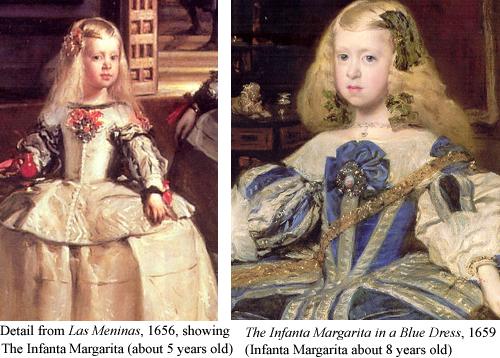
My post from 2005 on Las Meninas, Velazquez’ masterpiece, has drawn some very interesting and original comments. The latest contribution comes from Barbara Robinson of London Ireland who, like Colin Dixon, believes that the whole painting is a mirror image. Ms. Robinson adds some evidence. These two paintings are both by Velazquez and they show the same girl, the Infanta Margarita, three years apart. The image on the right is a detail from Las Meninas; the one on the left is part of a freestanding portrait.

Barbara Robinson (who sent me these images) emphasizes the parting of the hair and “the decorative hair slide,” which are reversed in these two pictures. Her son adds that if Las Meninas is an image in a mirror, then Velazquez is shown holding his paintbrush in his left hand, which makes him what we Americans call a “southpaw.” (Note that there were very large mirrors in Valazquez’ day.)

top 10 paintings

The Guardian proposes “20 paintings to see in the flesh before you die.” There’s much discussion on the Guardian’s site and on Crooked Timber. I happen to have my own list lying around. I notice that I have picked innovative pictures, because I believe that we derive aesthetic pleasure not only from a work in itself but also from the story of art, which is a sequence of courageous discoveries and experiments. Further, the following are mostly pictures that have something to say about art. They imply theories of painting and representation that we could try to paraphrase in prose. That makes them especially interesting. But they are not mere manifestos or illustrations of ideas; they are also extraordinary images.

  • Giotto, Scenes of the Passion, Capella Scrovegni (a.k.a Arena Chapel), Padua, 1305
  • Masaccio, Tribute Money, Brancacci Chapel, Santa Maria della Carmine in Florence, 1426-8
  • Jan Van Eyck, The Arnolfini Wedding, National Gallery, London, 1434
  • Piero Della Francesca, The Flagellation, Urbino, 1455
  • Giorgione and/or Titian, F?te Champ?tre, Louvre, Paris, 1508
  • Caravaggio (Michelangelo Merisi), Madonna di Loreto, 1603-05, S. Agostino, Rome
  • Diego Vel?zquez Las Meninas, The Prado, Madrid, 1655
  • Johannes Vermeer, View of Delft, Mauritshuis, The Hague, ca. 1660-1661
  • Edouard Manet, The Old Musician, National Gallery, Washington, 1862
  • Some limitations: These are all paintings (not sculptures, drawings, stained glass, or buildings) that I have personally seen during my late adolescence or adulthood. I can’t recommend such reputed masterpieces as Caravaggio’s Burial of St. Lucy, because I have only seen them in illustrations. This stricture also explains the European bias; I’ve never visited Asia (beyond Turkey), Africa, or South America. Finally, my list doesn’t adequately represent Modernism. I didn’t want to add token works to represent a whole category of art; I wanted individual masterpieces. I had difficulty identifying specific Modernist works that could stand up to particular “Old Masters.” (However, I was tempted to include a Picasso like The Guitar Player, or a Matisse.)

    a production of Lear

    (Chicago) Last night, I saw King Lear at the Goodman Theater. Stacy Keach was the King, and the director was Robert Falls. It was a “strong” production, in the sense that the director’s choices were bold and potentially controversial. For example, the setting (stunningly produced) was somewhere in post-Soviet Russia or Eastern Europe.* Lear, Cornwall, and Edmund were either gangsters or Putin-like dictators. The “knights” were riot police.

    I thought all of the director’s choices were defensible, and some were brilliant. For example, it was a good idea to make Cordelia a quietly rebellious teenager who detests her family’s vulgarity. The actress, Laura Odeh, is small and young-looking and wears plain jeans, whereas her sisters are gangster molls. Her rebelliousness plausibly explains why she refuses to make a speech in praise of her father.

    Likewise, the setting reminds us how unjust is Lear’s original regime. He recognizes the injustice himself, once he loses his knights:

    …. A man may see how this world goes

    with no eyes. Look with thine ears: see how yond

    justice rails upon yond simple thief. Hark, in

    thine ear: change places; and, handy-dandy, which

    is the justice, which is the thief?

    I also liked the violent, urban setting. Regan and Cornwall order Gloucester’s castle “shut up” against Lear. The stage directions tell us that the banished men wander on a “heath”–a natural place. Nature is a major motif in the play, always opposed to artifice. Several characters wrestle with whether nature is just or cruel. But the word “heath” is never spoken on stage, so it is a legitimate idea to make that barren place into nighttime streets, populated by the poor, the naked, and the crazy. When Edgar, Gloucester, and Lear are cast out, they become homeless–just like the homeless men in our cities.

    Robert Falls’ bold directorial choices remind me of a general point. Any written text dramatically under-describes what is literally going on. It gives us only partial information about setting, clothing, “blocking,” tone of voice, pacing, facial expressions. Even a staged or filmed production must leave much to the imagination and will be seen differently by different people. But the director and cast fill in some missing details.

    We might think that their first task is to figure out what is literally going on, so that we can watch and make up our own minds about general themes. But any intepretation of the literal meaning of the text must be informed by a theory of its general meaning. So, for example, Robert Falls knows from the end of the play that Lear will come to see his own kingdom as deeply unjust, arbitrary, and artificial. Therefore, Falls sets Act 1, Scene 1 in a Russian gangster’s club. If Lear’s regime is brutal, then Kent (his most loyal follower) must be a bit of a thug. That is how Stephen Pickering played him last night.

    Likewise, toward the end of the play, Regan suspects a sexual relationship between Oswald and her sister Goneril. (“I know you are of her bosom.” “I, madam?” “I speak in understanding; you are; I know’t.”) Therefore, several scenes earlier, Falls introduces Oswald and Goneril in flagrante delicto. That is an extreme case of using gesture and stage position to illustrate a theme.

    That scene underlines the play’s pervasive sexuality, which is often overlooked. Regan and Goneril are sexual rivals for wicked Edmund. Falls also thinks that Lear is sexually jealous of his youngest daughter. In this production, the King is not enraged by her first word — “nothing” — but by her explanation:

    They love you all? Haply, when I shall wed,

    That lord whose hand must take my plight shall carry

    Half my love with him, half my care and duty:

    Sure, I shall never marry like my sisters,

    To love my father all.

    Overall, Fall’s production could be described as nihilistic. He chooses, for example, to have Goneril suffocate Regan and then kill herself, joining a heap of bodies on stage. And Albany literally rapes his wife Goneril while he curses her:

    Thou changed and self-cover’d thing, for shame,

    Be-monster not thy feature. Were’t my fitness

    To let these hands obey my blood,

    They are apt enough to dislocate and tear

    Thy flesh and bones: howe’er thou art a fiend,

    A woman’s shape doth shield thee.

    I don’t know if those are good choices, but there is no question that Lear is a bleak play. Since it is set in a pagan world, Shakespeare need not assume divine providence or a morally ordered universe. Post-Soviet Russia seems an ideal metaphor for cosmic disorder and cynicism. “As flies to wanton boys, are we to the gods. / They kill us for their sport.”


    *Charles Isherwood, the NY Times reviewer, says that the setting is Yugoslavia. That makes sense: a kingdom divided in parts turns to anarchy.

    Calvino’s free hyper-indirect discourse

    I recently finished Italo Calvino’s If on a Winter’s Night a Traveler, in William Weaver’s translation. It’s a novel about trying to read a novel of that name by Italo Calvino–a difficult and even perilous task, since the book is constantly being mixed up with others, stolen, or fraudulantly exchanged. Ten of the chapters are the beginnings of novels that the protagonist (“you”) try to read, hoping that they are continuations of what you have read so far. Each is a parody of a particular type of literature and a genuinely suspenseful story that breaks off just when your interest is most aroused.

    Calvino’s writing has an aspect that I have never seen before, although it could be viewed as a radical extension of “free indirect discourse.” That is the technique of describing something in the omniscient third person, but in such a way that it seems to take on the perspective and language of a character within the book. A famous example from Austen’s Emma:

    She had ventured once alone to Randalls, but it was not pleasant; and a Harriet Smith, therefore, one whom she could summon at any time to a walk, would be a valuable addition to her privileges. But in every respect as she saw more of her, she approved of her, and was confirmed in all her kind designs.

    Harriet certainly was not clever, but she had a sweet, docile, graceful disposition; was totally free from conceit; and only desiring to be guided by anyone she looked up to. Her early attachment to herself was very amiable; and her inclination for good company and power of appreciating what was elegant and clever, shewed that there was no want of taste, though strength of understanding must not be expected. Altogether she was quite convinced of Harriet Smith’s being exactly the young friend she wanted — exactly the something which her home required.

    Literally, that is the narrator’s description of Harriet Smith mixed with some of Emma’s thoughts–but the two are inseparable. The whole narration is suffused with Emma’s voice. It is Emma, for example, who sees Harriet as “not clever.” Emma’s patronizing attitude is presented with delicious irony.

    Calvino takes this technique a step further. He describes what books would be like if they told particular stories. He uses such descriptions of imaginary texts as a means of story-telling. Examples:

    A fight scene from the chapter entitled “Outside the Town of Malbork (p. 39): “The page you’re reading should convey this violent contact of dull and painful blows, of fierce and lacerating responses; this bodiliness of using one’s own body against another body …” As you read about the description of a fight, you visualize the actual struggle–but through the eyes of a book that Calvino regards with irony.

    From Calvino’s parody of Magical Realism entitled “Around and Empty Grave”: p. 225: “I pass through a series of places that ought to be more and more interior, whereas instead I find myself more and more outside; from one courtyard I move to another courtyard, as if in this palace all the doors served only for leaving and never for entering. The story should give the sense of disorientation in places that I am seeing for the first time but also places that have left in my memory not a recollection but a void.”

    Calvino flagrantly violates the rule that writers should show and not tell. He tells us what the story is about and thereby narrates it.

    Las Meninas and mirrors

    Last fall, after a business trip to Madrid, I posted a mini-essay about Velazquez’ great, complex, and enigmatic painting, Las Meninas. My essay was mainly about the difficulty of looking at and enjoying a work so famous and so heavily interpreted–and how that same self-consciousness is a subject of Las Meninas itself.

    Now Colin Dexter from London has written to propose a theory that, to the best of my knowledge, is original as well as plausible and attractive. As he puts it: “Surely the whole painting is a mirror image.” See here for two slightly different versions of his theory.

    In poking around for online histories of mirrors (to confirm that there could have been very large mirrors at the Spanish court in 1656), I found this fascinating excerpt from Glass: A World History by Alan Macfarlane and Gerry Martin:

    Some who have traced the rise of autobiographical writing during the Renaissance have suggested that this ‘discovery of the self’ was linked to mirrors. Likewise it is pointed out that Renaissance artists such as D?rer explored the inner man through the use of mirrors during their painting. This is an argument forcefully put by Lewis Mumford and he cites the self-examining portraits of Rembrandt as the high point in this artistic introspection.

    The timing of the causal link is right; good mirrors developed in almost exact pace with the development of a new individualism between the thirteenth and sixteenth centuries. The geography is right; the epicentres of Renaissance individualism in painting and other art forms were Italy and the Netherlands, two of the most advanced areas of mirror-making and their use. The psychological link is plausible; people saw themselves in a new way that detached them from the crowd and allowed them to inspect themselves more carefully. We can see the process at work in a number of great artists. Yet as with all supposed connections there are doubts. Most cultures have mirrors of some sort and one wants to know more about how mirrors are used, the relative clarity of metal and glass mirrors and so on.

    On the question of use, it is clearly important to discover the way in which mirrors were regarded. In the west they were largely looked into to see the person. This was both a cause and consequence of growing individualism. In China and Japan and perhaps other civilisations mirrors were used for different purposes. It is worth examining one example in some detail to see the differences that mirrors and culture could make.

    A number of analysts, both foreign and Japanese, agree that in Japan mirrors were traditionally used in a very different way from that in the west. They looked through the mirror image and through the ‘observing self.’ The mirror was not an instrument of vanity and self-assessment, but of contemplation, as can be seen in Shinto shrines where the mirror is the central object. The individual does not gaze into the mirror to see a rounded portrait of the physical and social person in front of the mirror, but to gaze through the physical into the innermost, mystical self.

    I like the idea that mirrors were both a “cause and consequence” of individualism–the kind of individualism that we see so strikingly in Las Meninas. It makes sense to me that the technology of reflective glass would have different effects depending on the cultural context. Likewise, I reject the simple theory that the invention of printing increased freedom and undermined authority. There was a complex reciprocal relationship between technological and cultural change in the era of Gutenberg–just as there is today.