Category Archives: fine arts

on the proper use of moral clichés

In Joseph Roth’s finely wrought novel The Redetsky March (1932), a simple and good-hearted peasant orderly tries to make a huge financial sacrifice to help his boss, Lieutenant Trotta. The feckless Trotta is badly in debt, and the orderly, Onufrij, has buried some savings under a willow tree. Onufrij has already appeared in the novel many times by this point, but always as a cipher. Now suddenly we see things from his perspective as he walks home (fearfully and yet excitedly), tried to remember which one is his left hand so that he can identify the location where he buried his money, digs it up, and uses it as collateral to obtain a loan from the local Jewish lender.

Apparently, cheap novels that were popular among Austro-Hungarian officers in Trotta’s day “teamed with poignant orderlies, peasant boys with hearts of gold.” Because his actual servant is acting like a literary cliché, Trotta disbelieves and callously rejects the help. He tells Onufrij that it is forbidden to accept a loan from a subordinate and dismisses him curtly. Trotta “had no literary taste, and whenever he heard the word literature he could think of nothing but Theodor Körner’s drama Zriny and that was all, but he had always felt a dull resentment toward the melancholy gentleness of those booklets and their golden characters.” Thus he understands the offer from Onufrij as a fake episode from an unbelievable book. Trotta “wasn’t experienced enough to know that uncouth peasant boys with noble hearts exist in real life and that a lot of truths about the living world are recorded in bad books; they are just badly written.”

Trotta can be compared to two other characters who have problematic relationships with clichés. In Dante’s Divine Comedy, Francesca da Rimini utters a speech that consists almost entirely of slightly garbled quotations from popular medieval romantic literature. She justifies her actions with these clichés and avoids any mention of her own sin. It becomes evident that she never really loved her lover, Paolo, but was only in love with the cliché of being a doomed adulteress. Like The Redetsky March, the Inferno is a beautiful and original construction in which clichés have a deliberate place.

Flaubert’s Madame Bovary (living more than five centuries after Francesca) also quotes incessantly from popular romantic literature and thereby avoids having to see things from the perspective of her victims, notably her husband and children. Flaubert italicizes her clichés to draw attention to them. He uses his own brilliant and acidly original prose to describe a person who can only think in clichés.

Even though Francesca and Emma Bovary quote statements that are literally true, they rely on stock phrases instead of seriously thinking for themselves. They love what they would call “literature,” but they reduce it to a string of clichés.

Trotta is in some ways their opposite and in some ways similar. He despises “literature” but knows some clichés that popular books contain and uses them to avoid reality. His method of avoidance is to doubt anything that is a literary cliché, whereas Emma Bovary and Francesca da Rimini believe them all.

Although Dante and Flaubert were making different points from Roth about clichés, I think both perspectives have some value. Certain cultural movements—notably, the Romanticism of ca. 1800 and the High Modernism of ca. 1900—have prized originality and have scorned cliché as one of the worst aesthetic failings. Indeed, they have defined “literature” as writing free of cliché at the level of style, plot and character, or theme. These movements have enriched our store of ideals, but they have been overly dismissive of the wisdom embodied in tradition. If you respect the accumulated experience of people who have come before you, you may reasonably assume that many truths are clichés and that many clichés are true. To scorn cliché can mean treating one’s own aesthetic originality as more important than the pursuit of moral truth.

Thus I would not try to delete statements from my list of moral beliefs because they have been made many times before or have been expressed in a simple and unoriginal fashion. I would even be inclined to consider our culture’s store of moral clichés as a set of likely truths. Roth was right: “a lot of truths about the living world are … just badly written.” Situations repeat, and what needs to be said has often been said many times before.

But the risk is that a stock phrase can prevent a person from grasping the concrete reality of the situation at hand. I’d propose two remedies for that problem. First, it is worth recognizing which of our moral commitments, even if they are fully persuasive and valid, are also clichés in the sense that they are standardized and prefabricated phrases. Those commitments deserve special scrutiny.

Second, it is worth attending to the ways that all of our various moral commitments fit together. Each cliché may be true, but when it is juxtaposed with other general statements, it always turns out to be only partly true. Life is full of tradeoffs and tensions. Even if the components of my overall worldview are mostly clichés, the whole structure of moral ideas that emerges from my best thinking about my own circumstances is original–just because I am my own person.

Sources: Joseph Roth, The Radetsky March, translated by Joachim Neugroschel, Part II, chapter 17; my article “Why Dante Damned Francesca da Rimini,” Philosophy & Literature, vol. 23 (October, 1999), pp. 334-350. See also on the moral peril of cliché and what to do about it; and on the moral dangers of cliché.

St. Margaret of Cortona and medieval populism

Screen Shot 2015-07-27 at 9.55.07 AM

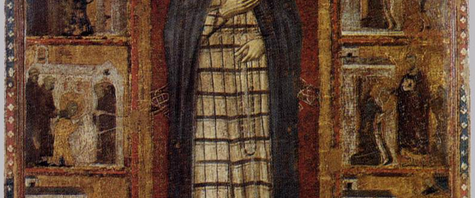
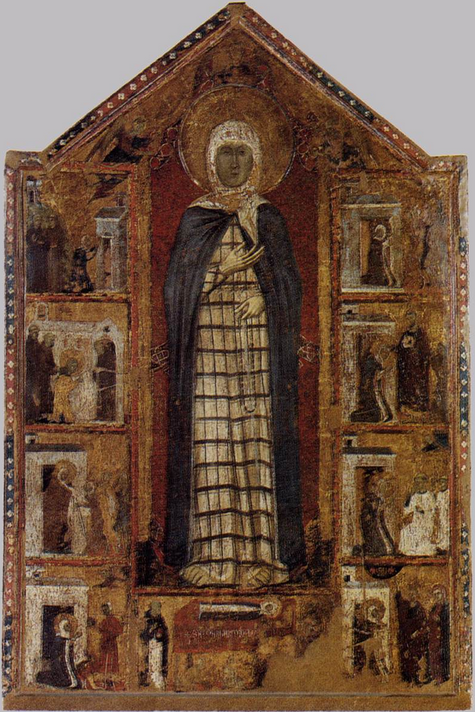
This is highlight #3 from our recent vacation in Italy. St. Margaret of Cortona was a remarkable person–more on her in a moment. The picture is a narrative of her life painted around 1298, or just one year after she died. She wasn’t canonized until 1728. In her own community of southeastern Tuscany, she was treated from the moment of her death (and perhaps even while she was still alive) as a saint to be venerated and depicted on par with St. Clare or St. Agnes. A major local church was immediately renamed in her honor, and her mummified body was placed under its altar. Those actions offer insights into medieval Catholicism, which was much more populist and decentralized than we assume on the basis of recent centuries of Church history and governance.

Margaret’ story would work for a novel (and has inspired an opera and a film). A beautiful peasant girl, she quarreled with her stepmother and ran away to live in sin with a nobleman in his castle. One day, his most loyal hound returned alone from the hunt and led Margaret to the scene of his death at the hands of a murderer. Deeply shaken, Margaret became a Franciscan sister, thus joining the most radical and compelling  religious/political movement of the era. She swore personal poverty but may have used her ex-lover’s wealth for philanthropy; we know that she obtained the resources to found a hospital and a convent. No wallflower or passive penitent, she twice challenged the bishop of Arezzo for acting like a warlike lord instead of a man of God. Her example and the force of her thought and personality must have resounded powerfully.

civic republicanism in medieval Italy: the Lucignano council frescoes

This is highlight #2 from our recent time in Italy. Lucignano is a small medieval town in Tuscany, notable for its street plan of concentric ellipses capping a steep hill. During the middle ages, it was contested by larger city-states, but it sometimes enjoyed a degree of independence or civic freedom. It certainly had its own town hall and, within that building, a Sala di Consiglio or council chamber.

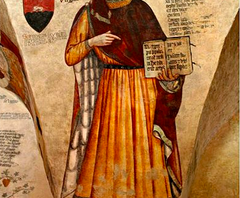
At first, this room was decorated by one large fresco of the Madonna in Majesty. If I recall correctly, the inscription under her picture reminded Lucignano’s leaders to listen to both sides of every dispute. Then, between 1438 and 1475, the town’s councilors contribruted personal funds to cover the ceiling with frescoes of exemplary figures from history, each labeled with a name, and most accompanied by an instructive quotation. “Virgil the poet” is shown above.

Christiane L. Joost-Gaugier offers excellent background information on this decorative scheme.* It was not uncommon to depict heroes from the past (often known as “worthies”) in public spaces. And there was a very famous model of a council chamber decorated with frescoes about good (and bad) government in nearby Siena. But the Lucignano frescoes were unique in that the list of exemplary figures came from a specific source, Dante, who also provided many of the quotations painted on the ceiling.

Dante held an elaborate political theory that I will not attempt to summarize comprehensively here. But it seems to me that Lucignano’s civic elders borrowed the following elements of his thought for their council chamber:

  1. Civic responsibility. Cicero is depicted as one of the exemplars (no surprise there); but as Joost-Gaugier notes, it was thanks to Dante that Cicero came to represent “the value of active participation in civic life” and the “civic spirit of Roman law as it centered on the complete man espousing the common good.” The Lucignano frescoes emphasize not only the value of participating in everyday civic affairs but also the need for sacrifice. For instance, the Roman heroine Lucretia is shown. Her suicide sparked the revolt that founded the Roman Republic.
  2. Lay government. One saint (Paul) is depicted among the worthies, but his quote from Romans 12:17-19 is about obeying the law. Figures like Justinian are deeply Christian, but they mingle on the chamber ceiling with pagan Romans and ancient Jews without distinction. The Roman republic and empire were Dante’s political models, and they were led by laymen rather than clergy. Although Dante and the medieval leaders of Lucignano believed that law should be consistent with scripture, the point emphasized in the Council Chamber is the primacy of law.
  3. Independence: Joost-Gaugier notes a subtle dig at Siena, from which Lucignano had won its freedom. Siena claimed to be founded by Remus, who was its mascot, but the frescoes in Lucignano suggest that Rome had been founded by the god Janus and not by Romulus and Remus at all. While Lucignano’s elders may have simply had a quarrel with Siena, they also hoped to govern their community free of any outside domination. Self-governance is an implicit theme here.
  4. The unity of history. Ancient Romans, Jews, and Christians all look alike in these frescoes. That is partly a result of the historical naivety of Lucignano’s artists. They had no idea that Samson and Virgil should be dressed differently from a Tuscan of the 1400s. At the same time, however, Dante offered a more substantive reason to treat all these worthies as similar. He held that world history had a unity determined by providence. See Paradiso VI, where Justinian mentions several of the other figures shown on the ceiling at Lucignano as bearers of God’s unfolding will.

People who thought in this way were liable to see themselves as appropriate heirs to the republican citizens of ancient Rome, capable of self-governance, obligated to sacrifice for the common good, and committed to the same law that had prevailed in Rome. This room is a vivid illustration of the idea that civic republicanism flourished in late-medieval Italy and came to the Atlantic world from there.

*Christiane L. Joost-Gaugier, “Dante and the History of Art: The Case of a Tuscan Commune. Part II: The Sala del Consiglio at Lucignano,” Artibus et Historiae, Vol. 11, No. 22 (1990), pp. 23-46.

Donatello’s Madonna in Citerna

This is highlight #1 from our recent Italian vacation. In the little Umbrian hill town of Citerna, in the church of San Francesco, a small, badly damaged, and heavily painted terracotta Madonna and Child stood on a shelf above the choir for many centuries, unnoticed by art historians. To the extent that its existence was recorded at all, it was assumed to be a folk work from the 15th-16th centuries.

In 2001, Laura Ciferri–then a graduate student–paid it a visit and realized that it was not the kind of Umbrian folk piece that she was studying for a paper. She proposed instead that it had been made by the great Donatello himself.

Experts in Florence removed numerous layers of thick paint, chemically tested the materials, and rebuilt portions of the sculpture, working on the little object for seven years. Although I have found peer-reviewed scholarly articles from ca. 2002 that doubt its attribution, now that the restoration is complete, the consensus seems to be that it is a work of Donatello. He probably made it in Florence between 1415 and 1420–not using a mold but working directly with clay. He personally painted the baked terracotta, and his polychrome surface is now visible again.

To support the attribution, specialists point to similarities with more famous works, such as the hands of Donatello’s “David.” I would add that this most idiosyncratic artist always visualized scenes in his own unprecedented way. Here the baby senses an unknown danger in the distance. His face is disturbed; his body tenses even as one hand reaches for his mother. He curls the big toe of his left foot. Most of his wrap has fallen away to reveal his vulnerability and humanity. Mary, who knows what lies ahead for him, reflects soberly as she touches her cheek to his forehead and very gently supports his foot.

empathy: good or bad?

I am speaking next week on a panel about empathy:

“Generative Empathies” (Rabb Room, Lincoln Filene Hall, Tufts University, March 30, 12 pm) with …

  • Amahl Bishara, Assistant Professor, Department of Anthropology, Tufts
  • Doris Sommer, Ira Jewell Williams, Jr. Professor of Romance Languages and Literature and Director, Cultural Agents Initiative, Harvard University
  • Peter Levine, Associate Dean for Research, Tisch College

I don’t know quite what to say yet, but I am inclined to raise the following points.

First, for a very long time, writers have argued that sad stories generate empathy and improve the character. From his dismal exile on the shore of the Black Sea, the poet Ovid addresses a soldier friend in these lines:

Is it true? When you heard of my misfortune
From a distant land, was your heart sad?
You can hide and shrink to say it, Graecinus,
But if I know you well, it was sad.
Revolting cruelty does not fit your type,
And even less your avocation. For
The liberal arts, your highest concern,
Soften the chest so that harshness escapes.
— Ex Ponto, 1.6 (my trans.)

Ovid presumes that his story will soften the gruff Roman’s heart, especially because it comes in the form of a poem and the soldier is a devotee of the artes ingenuae: the liberal arts, or literally, the freeborn arts. The poem will work because the reader has been habituated by many previous poems to dislike cruelty. Apparently, “ingenuae” has aristocratic connotations, and so Ovid’s phrase for the “liberal arts” implies a higher class of people who have been civilized or humanized by the arts.

Here is another classic source for the idea that writing generates empathy:

  1. And early in the morning, he came again into the temple, and all the people came unto him; and he sat down, and taught them.
  2. And the scribes and Pharisees brought unto him a woman taken in adultery; and when they had set her in the midst,
  3. They say [sic] unto him, Master, this woman was taken in adultery, in the very act.
  4. Now Moses in the law commanded us, that such should be stoned: but what sayest thou?
  5. This they said, tempting him, that they might have to accuse him. But Jesus stooped down, and with his finger wrote [or drew] on the ground.
  6. So when they continued asking him, he lifted himself up, and said unto them, He that is without sin among you, let him first cast a stone at her.
  7. And again he stooped down, and wrote [not drew] on the ground.
  8. And they which heard it, being convicted by their own conscience, went out one by one, beginning at the eldest, even unto the last: and Jesus was left alone, and the woman standing in the midst.
  9. When Jesus had lifted up himself, and saw none but the woman, he said unto her, Woman, where are those thine accusers? Hath no man condemned thee?
  10. She said, No man, Lord. And Jesus said unto her, Neither do I condemn thee: go, and sin no more (John, 8:2?11)

What was Jesus writing? One answer: something concrete about the specific Woman, which made the scribes and Pharisees think about her (and about themselves) instead of applying the abstract law.

For centuries in the English-speaking world, to enter the ranks of the civilized and humane meant reading Shakespeare. One possible reason: Shakespeare’s special capacity for empathy, which is related to his refusal to push arguments of his own. Keats found in Shakespeare the quality that he called “Negative Capability, that is when man is capable of being in uncertainties, Mysteries, doubts, without any irritable reaching after fact and reason.” Other critics have noted Shakespeare’s remarkable ability not to speak on his own behalf, from his own perspective, or in support of his own positions. Coleridge called this skill “myriad-mindedness,” and Matthew Arnold said that Shakespeare was “free from our questions.” Hazlitt said that the “striking peculiarity of [Shakespeare’s] mind was its generic quality, its power of communication with all other minds–so that it contained a universe of feeling within itself, and had no one peculiar bias, or exclusive excellence more than another. He was just like any other man, but that he was like all other men.”

So we have a model of the humane and sensitive educated person as one who has been habituated by the reading of moving stories to be empathetic and thus to show mercy or otherwise depart from harsh decisions.

This model conflicts with the idea that a just person knows the truth and obeys the consequences.  St. Augustine recalls his sinful younger self enjoying the theater, where he was “forced to learn I don’t know what wanderings of Aeneas, oblivious to my own, and to lament the dead Dido, because she killed herself for love, while meanwhile with dry eyes I endured my miserable self dying among these things before you, God, my life. … In the theaters I took pleasure along with the lovers when they used each other for vice, even though their behavior was just the imaginary sport of a play, and when they parted I was sad along with them, as if I were really compassionate; yet I enjoyed both parts.”  At the moment of his conversion, Augustine hears a voice saying, “take up and read, take up and read.” He understands this as a command to open the Bible at random. The first words he finds are those of Paul: “But put ye on the Lord Jesus Christ, and make not provision for the flesh, to fulfil the lusts thereof” [Rom. 13:13?14]. Augustine recalls: “I wanted to read no further, nor was there need” (Conf., 1.13.20; Conf. 3.2.3.; Conf., 8.12.29).

This is a model of the just person as one who is unmoved by inappropriate empathy and who avoids reading texts that might make him sympathize with sin. Although he is a very different kind of person from Augustine, Judge Richard A. Posner writes in “Against Ethical Criticism” that “empathy is amoral.”

Imaginative literature can engender in its readers emotional responses to experiences that they have not had. We read King Lear and feel how–or some approximation to how–a failing king feels, the wicked bastard feels, the evil daughters, the good daughter, the blinded earl, the faithful retainer, the corrupt retainer, the fool, all feel. We experience simulacra of the agony of madness and the pang of early death in Hamlet, the depths of mutual misunderstanding in The Secret Agent, the loneliness of command in Billy Budd, the triumph of the will in Yeats’s late poetry. This is the empathy-inducing role of literature of which [Hilary] Putnam and [Martha] Nussbaum speak. But empathy is amoral. The mind that you work your way into, learning to see the world from its perspective, may be the mind of a Meursault [from The Stranger], an Edmund [from Lear], a Lafcadio [the lion?], a Macbeth, a Tamerlane, a torturer, a sadist, even a Hitler (Richard Hughes’s The Fox in the Attic).

Empathy can even undermine justice. It can make the empathetic person feel more virtuous without doing anything, and it can even strengthen his position in a conflict by making him look better to third parties. This can be true of sincere empathy. I believe, for instance, that the median Israeli voter has achieved some empathy for Palestinians, and that feeling both blunts the urgency of justice and makes Israel look better than it should in the eyes of the world. Note the applause in this speech by Barack Obama in Jerusalem on March 21, 2013:

I — I’m going off script here for a second, but before I — before I came here, I — I met with a — a group of young Palestinians from the age of 15 to 22. And talking to them, they weren’t that different from my daughters. They weren’t that different from your daughters or sons.

I honestly believe that if — if any Israeli parent sat down with those kids, they’d say, I want these kids to succeed. (Applause.) I want them to prosper. I want them to have opportunities just like my kids do. (Applause.) I believe that’s what Israeli parents would want for these kids if they had a chance to listen to them and talk to them. (Cheers, applause.) I believe that. (Cheers, applause.)

In sum: I don’t think empathy will suffice on its own. It must be connected somehow with justice and with actually taking just action. If you favor systematic moral theories, than you may recommend using one or more general moral premises that distinguish good empathy from bad empathy. A feeling of empathy will not be a reliable guide to right action, only an urge that you must critically assess in other terms.

If, like me, you are skeptical about organized moral theories and believe that empathetic responses can convey truths about the world, then you will view an empathetic response as a valid source of guidance. But not as the only kind of valid input: relatively abstract and impersonal considerations must also apply.