Category Archives: Uncategorized

Election Day

I’m as distracted as anyone else by the looming decision. We waited more than an hour to vote and met some of the local candidates while we ate school bake-sale muffins. It’s inspiring to be part of that long virtual line of citizens that’s snaking across America. My five-year-old thinks that it’s time for John Kerry to have a turn at being president, if he wants to do it. I’ll bet hers is the consensus view in the 3-8 age cohort (an overlooked demographic). They don’t believe in giving anyone two turns in a row if someone else wants to “go.”

Meanwhile, CIRCLE will calculate the youth turnout rate as soon as possible–probably very late tonight. Check in with us if you’re dying to know whether the 18-29s participate.

hopes for a Kerry administration

I think the odds favor the Democrats on Tuesday, although it will be close and nobody really knows who has the edge. If John Kerry is elected president, my hopes will be modest–not because I lack respect for him as a person, but because the situation is awful and good ideas are scarce. I will be more than satisfied if Kerry and a Republican Congress are able to get the deficit down somewhat; America is extricated from Iraq without a devastating defeat; and people in the executive branch and the congressional Democratic Party begin to work out solutions to problems that Kerry currently does not know how to solve. Those problems include:

  • The loss of manufacturing jobs or decent substitutes. Playing with tax policy will have only a marginal effect. Better education is a long-term strategy, and it’s going to be hard to achieve big improvements in education now that we’ve solved some of the easier problems. So what should we do to provide stable, remunerative, rewarding employment for people with less than a college degree?
  • Dependence on foreign oil. There are chalkboard “solutions” to this problem: higher fuel taxes and tougher economy standards. These solutions are politically implausible. A real answer would come with a political game-plan that could work.
  • The highest incarceration rate in the world. (5.6 million Americans are in prison or have prison records.) They are disproportionately younger male African Americans and Latinos. Even if massive incarceration is a way to reduce crime, the cost is far too high. There has to be a better way.
  • This list could also include the 40 million without health insurance, al-Qaeda (and its clones), global warming, and nuclear proliferation. I think John Kerry’s biggest contribution, just like Bill Clinton’s, may be to keep the fiscal situation reasonably sound so that the government is able to act later on; and to veto the most dangerous ideas from the right. This would not be a small achievement, but it is disappointing that we have no better solutions to our deepest problems than we had 12 years ago.

    Uzbek TV

    A news crew from Uzbekistan interviewed the CIRCLE staff earlier today. They were nothing like Balat from the “Ali G. Show.” For one thing, they only spoke Russian and had to use an interpreter. For another, they asked extremely serious and sober questions, like “What precentage of eligible voters are under 30?”

    All interviews are one-sided affairs; and when everything has to be translated, you can’t make small talk or ask irrelevant questions. As I watched, I wondered: What is it like being in a car with four Uzbeks and a State Department handler, driving around suburban DC for an interview with people at some “Center for Information …”? Why do Uzbeks care about youth turnout in the US election? When we say that kids study “civic education” in American high schools, what scenes pop into their heads? What do they imagine goes on in a place like the University of Maryland? What are they going to say in Russian voiceover as they show my colleagues talking? Are they even paying attention?

    In short, I found the news crew more interesting–but probably more mysterious–than they found us and our issue of American youth civic engagement.

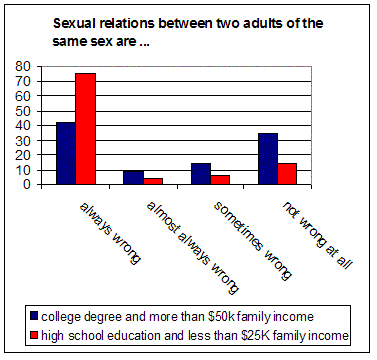
    social class and tolerance for gays

    I

    was wondering whether people who are more educated and wealthier are more tolerant

    of homosexuality. According to the General Social Survey, the answer is yes.

    I guess this result is intuitive, but I always like to check.

    Education and income each correlate with tolerance. I don’t have the time right

    now to figure out whether the real driver is education (which may increase both

    income and tolerance). There could be a third factor underlying the relationship,

    such as urbanicity, age, religious denomination, or region. But just to dramatize

    the basic situation, here is a graph that contrasts upper-middle-class people

    who have college degrees (in blue) and lower-income people with no more than

    high school (in red). The difference in attitudes toward gays is pretty stark.

    hope for reform of gerrymandering

    Many political scientists view partisan gerrymandering as the worst flaw in our political system today, worse than campaign finance abuses or poor and biased journalism. By drawing districts that are reliably Democratic or Republican, incumbent politicians have basically stripped voters of their choice. In approximately 385 congressional districts, a vote really doesn’t matter, because the lines have been drawn to preclude competition. Since challengers have virtually no chance, they tend to be weak and under-qualified. In these districts, parties and interest groups make little effort to mobilize voters, so turnout falls. Also, there is little discussion and debate within such districts, so people who live there don’t grasp the diversity of opinion in America. They regard the debate in Washington as mere mud-slinging and believe that every reasonable person agrees with the views that are prevalent in their own districts. Jim Gimpel, Celeste Lay, and Jason Schuknecht show, in Cultivating Democracy, that growing up in an uncompetitive district has a lasting negative effect on one’s civic engagement.

    Until recently, I assumed that this problem was basically intractable. Incumbent politicians like things as they are. There is a public interest in competitive districts, but each citizen has relatively little to gain from reform, so it is difficult to mobilize people for this cause. Even if citizens do get mad about gerrymandering, their votes don’t count in most districts. Finally, the courts seem basically tolerant of gerrymandering if the intentions are partisan rather than racial.

    But a recent conversation with the lawyer Tom Geogehegan made me more optimistic. It turns out that all the existing case law on gerrymandering pits one major political party against the other. The plaintiff says: You gerrymandered too much, or with unacceptable motives. The defendant says, No we didn’t. Neither party says: The current system for drawing districts violates the Constitution. If a public-interest group were to bring suit on broader constitutional grounds, it would be a novel and untested legal strategy–which means that there’s a chance it would succeed.

    By the way, there are several possible remedies for the existing system. One option is a nonpartisan electoral commission, as in Iowa. As a result of Iowa’s reform, that small state has more competitive congressional districts than California and New York combined. One might worry that a “non-partisan” commission would ultimately by hijacked by stealth partisan appointees. An alternative is a computer algorithm that would randomly group citizens in compact districts. In drawing districts, it is necessary to weigh competing values (compactness, “naturalness” of communities, tradition, racial justice, and competitiveness). A computer cannot resolve this balancing problem neutrally. However, it can dramatically reduce the odds of seriously bad results. It can deliver what John Rawls called “pure procedural justice,” which is an important basis for legitimacy.