Should there be a large membership organization for youth that lobbies on economic issues that affect them–an American Association of Young People? I can think of three major arguments in favor. First, there are huge and perhaps unprecedented issues of generational equity. The government is borrowing and spending with wild abandon and saving the bill for younger people; and things are likely to get worse as the boomers age. The injustice (and short time horizons) reflected in current policy seem to require an organized response. Second, young people tend to be low political priorities because they don’t vote and aren’t organized to lobby. An “AAYP” would help. Third, it’s important for people to have reasonably positive political experiences when they’re in their late teens and twenties, because Karl Mannheim’s classic theory of development suggests that early experiences permanantly shape people’s civic identity, making them active or passive for the rest of their lives. If young people were more organized as a political bloc, then parties and interest groups would compete for their support, and as a result they would have more experiences of being important and sought after.
There are also some arguments against an “AAYP.” First of all, organizing it would be heavy-lifting. Young people are comparatively hard to organize at all, since they are relatively unlikely to give money and to voluntarily support disciplined organizations. Besides, compared to their elders, they are not too interested in the kinds of programs and issues that involve generational equity–Social Security, Medicare, and the like. For example, only six percent of under-25s (and 3 percent of college students) picked medical care as the top voting issue in the 2004 elections. To the extent that young people do think about Social Security reform and other relevant issues, they certainly disagree about what should be done, which would make it hard to show a united front. In any case, young people may be relatively unconcerned about the impact of these issues on youth because they don’t see themselves as essentially young. They expect to move on and become middle aged, whereas the AARP consituency is “retired” for good.
Some people see the AARP’s model as bad for democracy because it empowers a few experts in Washington to decide what makes good policy and then “sell” their ideas to a huge population using advertising techniques–not very empowering. It’s also a special-interest model, and a clash of special interests does not often make good policy. Then again, if the over-60s have an expert-driven, special-interest organization with 35 million dues-paying, voting, letter-writing members, then maybe youth need one too.

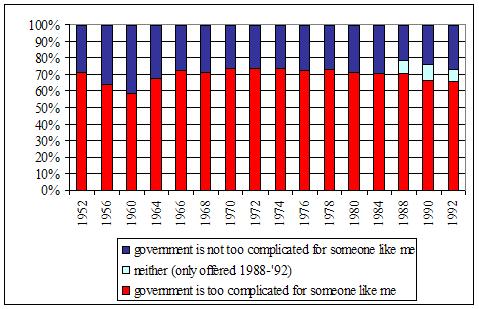 I think there must be something to this theory. Between 1952 and 1992, the National Election Study (NES) asked people whether they agreed with the following statement: “Sometimes politics and government seem so complicated that a person like me can’t really understand what’s going on.” Generally, people have found politics too complicated–or at least, have doubted their own capacity to understand it. However, the results do not show a lot of decline in Americans’ sense that politics is too complicated for them. The trend is pretty flat. Unfortunately, the question was dropped in 1996, and it changed a bit in 1988, when people were offered the option of refusing both choices (“too complicated” and “not too complicated”). If we assume that the people who chose “neither” would otherwise have said “too complicated,” then there was an erosion of confidence after 1984. But that’s a big assumption.