Category Archives: Uncategorized

on McCain in ’08

The other candidates, including all the Democrats, are going to have to show why they’re preferable to John McCain in 2008. McCain takes positions to my right on certain issues, notably abortion. However, I am not yet convinced that Democrats have a serious plan for moving the country to the left on the economic issues that matter most to me. A “serious plan” would not only include a plausible policy idea–I guess John Kerry’s health plan qualified as that–but also a way of paying for the idea and a strategy for enacting it. Kerry had neither.

In any case, there is a dimension of politics that is orthogonal to the left/right spectrum (which is itself a crude representation of our values). This orthogonal dimension measures our civic condition, broadly understood. To improve civic affairs would require procedural changes, such as campaign finance reform and a better system for drawing electoral districts. It would also require a different kind of leadership, one that put genuine issues and choices before the public and scorned name-calling and character assassination.
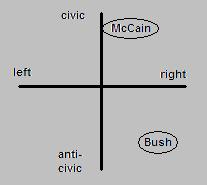
I suspect that McCain would improve our civic condition. I do not say that because I know that he is a wonderful person. (I am against hero-worship as a matter of principle, and I distrust judgments of character mediated by reporters.) I say it because improving the quality of public life–like any serious political endeavor–requires spending energy and capital, thinking tactically, and confronting opponents. Civic reform would be McCain’s strongest suit; therefore, he would be smart to make it a genuine priority.

For my own part, I’d like to see the country move somewhat west on this chart and as far north as possible. Bush is way over east, although not consistently so. The real shame is how far south he has taken us. McCain has the potential to move us northward, and that is a promise that others will have to work hard to surpass, in my opinion.

quiz

For one free annual subscription to this blog, what is wrong with the following passage from a front-page article in the Sunday New York Times? “Mr. Vald?z, a k a La Barbie, does not look like a monster. He gets his nickname, the authorities said, because he has the light complexion and blue eyes of a Ken doll.”

“privatizing the neighborhood”

In several books and articles, my colleague Bob Nelson has made an interesting proposal that he neatly summarizes in a new Forbes Magazine column (Robert H. Nelson, “Privatizing the Inner City,” Dec. 12). I would rephrase his argument as follows:

1. Older cities have a disadvantage in attracting new development and investment, because their land is divided into small, individually held parcels. If there is a plan afoot to redevelop a district, each landowner can refuse to participate, either because he wants to extract a high price or because he holds a principled objection to the redevelopment. Investment therefore flows to the exurbs where there is wide-open land and no one can veto a plan.

2. Like other old cities, New London, CT, tried to avoid this problem by using eminent domain, a power that the Supreme Court upheld last June. But many people were outraged by the Court’s decision, and the U.S. House has already passed a bill to restrict the use of eminent domain for economic development. Indeed, New London’s tactic was a troubling exercise of state power–one often used in the interests of gentrification and to the disadvantage of poor residents.

3. There is an alternative. An existing urban neighborhood could be allowed to become a homeowner’s association if a super-majority of its residents filed a petition to that effect. The association would gain ownership of the streets and other public facilities. The city would cease providing certain services, such as street cleaning, but the association would buy those services on the market. It would be governed by an elected board with considerable power. Among other things, it could decide to sell the whole neighborhood to a developer and divide the profits among the owners. This is what the residents of Sursum Corda, a public housing project in DC, have decided to do–taking $80,000 per unit as proceeds from the sale of the whole development. Alternatively, the association could allow portions of its neighborhood (such as open spaces or blighted lots) to be developed and then put the profits to common use.

More than half of all new American homes are built in homeowners’ associations that collectively own the streets and public facilities, that are governed by majority-rule, and that exercise enormous power over each owner. Most of these community associations are new suburban developments. The association is formed before anyone moves in. Nelson’s innovative proposal is to allow associations to be formed in existing urban neighborhoods.

Forbes has entitled Nelson’s piece “Privatizing the Inner City.” Nelson is something of a libertarian (who once included me in a Liberty Fund conference on homeowners’ associations). However, the political valence of his proposal is not straightforward. An orthodox libertarian would not like Nelson’s idea because it allows a super-majority to override individuals’ rights, thanks to a law. Nelson ends his piece with this analogy: “In the 1930s the Wagner Act provided for collective bargaining between newly organized workers and businesses. Today we need a new Wagner Act that will enable collective bargaining between neighborhood property owners and developers.” I can’t believe that most Forbes readers admire the Wagner Act. But liberals and leftists ought to give Nelson’s proposal a serious look.