Category Archives: Uncategorized

strengths and weaknesses of volunteer networks

As I write, I’m in my third consecutive meeting of a different volunteer network or coalition. These three networks (and others that I know) share the following features: One or more grants funds a staff, which ranges in size from less than one full-time person to a substantial secretariat. Individuals belong and devote substantial amounts of volunteer time. Organizations also belong, and some donate their employees’ paid time for projects.

Although each network works differently, I think I’ve noticed some patterns about what volunteers will and will not do. (Here I include paid employees whose time is volunteered by their organizations):

1) Volunteers will plan and run meetings and conferences, even doing hard, detailed work on invitation lists, agendas, and menus. But they will not reliably write up the results of meetings for public distribution. After a meeting, writing feels like a chore, and there’s usually no specific deadline. Therefore, many meetings leave no tangible public record.

2) Volunteers will write grant proposals, because proposals are plans that determine the work that will actually be done later on. However, they will not do the other work involved required to obtain grants, such as identifying potential funders. If they have their own contacts with foundations, most won’t share them.

3) Volunteers will handle pleasant human interactions, but will avoid difficult relationships.

4) Volunteers may provide regular, written information under their own names and control, but few will contribute in a sustained way to collective writing projects. That problem can be overcome with scale but is serious in small networks.

5) Volunteers will generate wonderful ideas but are much less likely to implement them.
love where you are

In Fort Worth last Friday, I spoke about the importance of civic engagement. I was followed by a series of local officials (the superintendent of schools, the public safety commissioner, a county commissioner, a former mayor, and others), who analyzed the main issues on their city?s agenda.

In my speech, I claimed that public engagement has declined for various reasons, including the rise of professional management and the lack of incentives to prepare young people to be capable citizens. A large proportion of the audience was young, so I ended with some arguments in favor of participating. For instance, I mentioned the intrinsic satisfaction of work on public problems. I ended by saying that you should always love where you are.

I explained that I couldn?t give any specific reasons to love Fort Worth or North Texas, because I?d only been there for 12 hours; but every place where human beings live can be loved. Every place has assets, history, and interesting complexity. To miss the place where you live is a great waste. Further, to love it means to explore it, to study it, and to work to improve it. This turned out to be a good way to conclude, because three or four of the subsequent speakers picked up my challenge and explained why one should love their city. (Incidentally, Dallas/Fort Worth–love it or not–is expected to double in size and become the megalopolis of the southern great plains.)

cliches of civic engagement

I’m on my way to Texas Christian University in Fort Worth, where I’ll be speaking about–what else?–youth civic engagement. I’m happy to support the launch of TCU’s Center for Civic Literacy.

I hope that my speech does not sound like this article by Douglas Brinkley from 1994, entitled “Educating the Generation Called ‘X.'” The links are to Cosma Shazili’s commentary:

But all in all, to paraphrase Gertrude Stein, a “young person is a young person is a young person.” They are essentially no different from their predecessors; they simply want to be regarded as individuals. By 1988, those born between 1961 and 1981 will comprise the largest voting bloc ever in American history, numbering 80 million strong. They will soon step up to the plate to try to clean up the mess. Their teacher should strive to do what education has traditionally done for the young: Bring out their best, encourage hope and nourish their imaginations.

the sincerest form of flattery

So, I’m ego-surfing as usual, and what do I come across? A term paper about an article (pdf) that I wrote–for sale at $31.95. The summary and excerpt of the term paper are poorly written and highly inaccurate. Can I sue? Should I write a better paper about myself and sell it? If a wildly inaccurate summary of my article is worth $31.95 on the open market, can I start selling the actual article for, say, $40? (Right now, it’s free.) Should I be offended that people are willing to pay $31.95 not to have to read and write about my article? Does a plagiarized term paper count as a citation of my work? Why does my own article rank lower on Google than a site that sells a lousy term paper about it?

overcoming polarization?

Dan Yankelovich (chairman and co-founder of Public Agenda) has published a new book on polarization, which is excerpted online. The excerpt argues that Americans aren’t all that deeply divided between liberals and conservatives. According to Yankelovich’s polls, we Americans share eleven “core values that blend traditional and progressive attitudes into a new social morality.” This social morality is “centrist”; “both liberals and conservatives have something positive to contribute.”

However, look at the list:

  • Patriotism
  • Self-confidence
  • Individualism
  • Belief in hard work and productivity
  • Religious beliefs
  • Child-centeredness
  • Community and charity
  • Pragmatism and compromise
  • Acceptance of diversity
  • Cooperation with other countries
  • Hunger for common ground
  • To me, the first seven items look basically conservative. I don’t see “equity,” “peace,” “freedom from want,” “saving nature,” “civil liberties,” or “fairness” on the list. The American majority prefers patriotism, individualism, faith, and family. However, as the last four items show, they’d rather not fight about such matters. They dislike sharp disagreement (that’s well documented in other studies), preferring compromise, acceptance, and cooperation. Thus, while their own views are conservative, they’re hoping that everyone will agree to some practical, “common-sense” ideas.

    I wish the list of core values were somewhat different, although I suspect it’s an accurate picture of public opinion. “Acceptance of diversity” and “child-centeredness” are the most promising items for progressives. As we know, Americans support spending for education and some diversity in corporate employment and the media. However, those beliefs are perfectly consistent with mainstream modern conservatism.

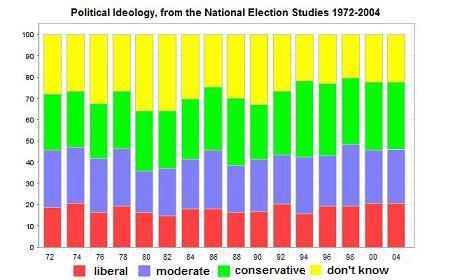
    Despite the majority’s hope for “common ground,” the conservative 25-30% of the population actually disagrees pretty sharply with the liberal 17-20%. The middle holds the balance. They are the ones who most consistently endorse Yankelovich’s eleven “core values.” While they may identify themselves as moderates, I would call them conservatives without an angry edge.

    [Note: This is my graph, not Yankelovich’s.]