Category Archives: Uncategorized

Millennials set the record for low trust in other people

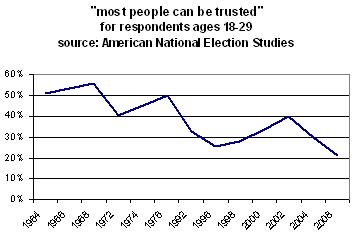
Whether you trust other people (in general) affects whether you collaborate voluntarily. Trust has been linked to prosperity, happiness, and health. It has been falling for young Americans–not in a smoothly downward path, but notably. And 2008 set the record, in a bad way, with just 21.4 percent of young Americans saying that other people can generally be trusted.

I am generally supportive of the kind of analysis that’s summarized in today’s New York Times: “surveys show that the majority of the nation’s millennials remain confident … that they will have satisfactory careers. They have a lot going for them. ‘They are better educated than previous generations and they were raised by baby boomers who lavished a lot of attention on their children,’ said Andrew Kohut, the Pew Research Center’s director. That helps to explain their persistent optimism, even as they struggle to succeed.”

But it’s a mixed picture. Optimism about careers is one thing; confidence in other people is a different story. Perhaps protective Baby Boomers failed to raise kids who trusted the outside world, or perhaps it’s a simplification to say that today’s generation was raised by protective parents. The young man in today’s Times profile was raised by a married couple in exurban Grafton, MA, with a family income in the national top ten percent. But 258 students enrolled in the Chicago Public School system were shot last year–quite a different context in which to grow up. And most young Americans fall somewhere in between: neither coddled nor terrorized, but hardly secure.

why is this not terrorism?

I have no brief for Grand Ayatollah Mohammed Hussein Fadlallah, who died on Sunday. But I was struck by this paragraph from the New York Times obituary:

    The C.I.A. is thought to have carried out an assassination attempt against the ayatollah in 1985, in which a 440-pound car bomb was placed along the short route between his apartment and mosque. Ayatollah Fadlallah narrowly escaped the explosion, but 80 other people were killed.

I do not know whether this claim is true; the Guardian attributes it to Bob Woodward. If it accurate, our government murdered 80 people by detonating a car bomb in a crowded urban street, with the intention of killing one person whose main crime was to endorse terror attacks. By what definition of “terrorism” were we not guilty of it?

the corruption that the financial reform bill reveals

I support the pending financial reform bill as about as good a product as our legislative system is likely to produce, but it also illustrates how badly that system is broken.

Congress has negotiated for months to produce a bill that is 2,000 pages long, full of special exemptions and breaks that no individual could even count, let alone understand, prior to passage. The legislative process has offered rich opportunities for professional lobbyists and their clients. Steven Brill estimates that $15 million was spent to lobby on one particular technical provision that reduced corporate tax obligations by $10 billion–an excellent return on investment. Brill observes:

    Complexity is the modern lobbyist’s greatest ally. Three lobbyists showed me three different proposals for rewording what may be the bill’s biggest-money section: a provision in the Senate version that would force the five major banks that do most of the country’s trillions of dollars of trading in derivatives–and make nearly $23 billion a year doing so–to spin off those operations. Even holding the dueling paragraphs side by side by side, I found it difficult on first read to appreciate the differences. But with some pointers from the lobbyists, it was clear that billions in profits depended on the variations in this nearly impenetrable language.

The passage of the bill will by no means end the process of negotiation. Binyamin Appelbaum writes in The New York Times:

    Well before Congress reached agreement on the details of its financial overhaul legislation, industry lobbyists and consumer advocates started preparing for the next battle: influencing the creation of several hundred new rules and regulations. The bill … is basically a 2,000-page missive to federal agencies, instructing regulators to address subjects ranging from derivatives trading to document retention. But it is notably short on specifics, giving regulators significant power to determine its impact–and giving partisans on both sides a second chance to influence the outcome.”

Part of the problem is campaign finance: firms that are regulated by the federal government also fund elections, in a scandalous conflict of interest. Another contributing factor is the fillibuster, which gives individual Senators far too much leverage. But I would like to draw attention to a different problem that will persist even if (unlikely as that may be) we remedy the other two flaws.

Law-making has been substantially replaced with rulemaking and administration. In a republic, “law” classically means consistent, durable, binding principles that are enacted after public deliberation. Laws should not change arbitrarily–without substantial changes in the outside world–nor be subject to exceptions and negotiations after passage. The Constitution (article 1, section 1) vests “all legislative powers” in Congress, although the presidential veto power gives the White House a role in lawmaking as well. Under our system, Congress and the president are supposed to make laws that are as durable and coherent as possible. Interest groups and party blocs will inevitably negotiate before a law is passed, although there is also supposed to be a public deliberation about matters of principle and philosophy. Once the president signs the bill, it is supposed to be fixed until significant changes in the world require reform.

But meeting those standards would be hard for elected politicians. They could be held accountable for their own momentous decisions, and they would have nothing to offer interest groups once they had passed any important law. They are tempted to act in quite a different way. First, instead of deliberating and passing coherent, durable statutes, they issue voluminous and constantly amended statutes–too long for anyone to read before the vote. That may be inevitable in a complex modern society, but Congress compounds the problem by delegating its lawmaking role–not so much to the president and the cabinet as to administrative agencies, civil servants, and special courts within the executive branch.

They do this by passing statutes that empower regulatory agencies to make policy within very broad outlines. In 2004, federal agencies generated 78,851 pages of proposed rules, filling 69 volumes of the annual Federal Register. The number of pages has crept almost steadily up, from one volume of 2,620 pages in 1936 (when the government was more powerful and activist, but also more coherent, than it is today).

This process has several advantages for legislators. It defers decisions and makes them provisional and negotiable, so that no interest group ever loses a fight definitively. It allows elected officials to take credit for general principles, even if they conflict, and then blame bureaucrats who actually make choices. A classic but not atypical example is the “dual mandate” that Congress gave to the Federal Reserve: to maximize employment and control inflation. Those goals often conflict in practice, but Congress claims to have mandated both and can critically question any Federal Reserve Board Chairman who fails to achieve both. Finally, a process of continuous negotiations favors organized interest groups, the very ones that give campaign contributions and physically appear on Capitol Hill.

James Madison explained why such “mutable” policymaking is disastrous, using words that now seem prophetic:

    To trace the mischievous effects of a mutable government would fill a volume. … It poisons the blessings of liberty itself. It will be of little avail to the people, that the laws are made by men of their own choice, if the laws be so voluminous that they cannot be read, or so incoherent that they cannot be understood; if they be repealed or revised before they are promulgated, or undergo such incessant changes that no man, who knows what the law is to-day, can guess what it will be to-morrow. Law is defined to be a rule of action; but how can that be a rule, which is little known, and less fixed? Another effect of public instability is the unreasonable advantage it gives to the sagacious, the enterprising, and the moneyed few over the industrious and uninformed mass of the people. Every new regulation concerning commerce of revenue, or in any way, affecting the value of the different species of property, presents a new harvest to those who watch the change, and can trace its consequences; a harvest, reared not by themselves, but by the toils and cares of the great body of their fellow-citizens. This is a state of things in which it may be said with some truth that laws are made for the FEW, not for the MANY (The Federalist, number 62).
doing good and doing well (civic engagement and happiness)

(On a northbound Amtrak train in Connecticut) I spent today at Wagner College on Staten Island, NY with knowledgeable colleagues from around the country. We were discussing the “psychosocial” effects of civic engagement. The idea is that people are better off when they participate in civic affairs, from volunteering to joining social movements. College students were the focus of today’s meeting, and the theory holds that they would flourish or thrive better if they were more engaged in community and civic work. We have a grant at Tufts to investigate that thesis rigorously.

I think the literature shows pretty convincingly that if you offer disadvantaged or marginalized teenagers opportunities to serve or contribute in ways that are constructive and feel positive, they will do better psychologically. In field experiments, teenagers’ rates of unwanted pregnancies and other bad outcomes have been cut through service programs.

But Doug McAdam showed rigorously in his book Freedom Summer that the successful college students who went to Mississippi to fight de jure segregation in 1964 paid a severe psychological price for their “service.” Using statistical data with comparison groups and in-depth interviews, McAdam showed that the Freedom Summer experience made the volunteers more likely to be divorced, less likely to be employed, and less happy by the mid-1980s. Of course, they were heroes for their contribution to the Freedom Movement. But no one would argue that their kind of “civic engagement” was good for their psychological well-being–not to mention that three of them were tortured to death within the first week of the summer.

Thus, although I am eager to investigate the empirical link between civic engagement and well-being, I think we should not be surprised to find tradeoffs between doing good and doing well.

the Russian spies, and me

(On the Acela train south of Boston) If yesterday’s federal charges are correct, Russia decided to place 11 people in middle class American lives so that they could gradually “develop ties in policymaking circles.” Their ultimate prize was secret information about “nuclear weapons, American policy toward Iran, C.I.A. leadership, Congressional politics and many other topics.” To obtain positions where such information was available, the Russians allegedly were ordered to “pursue degrees at target-country universities, obtain employment, and join relevant professional associations to deepen false identities.” Meanwhile, they kept in touch by means of classic cloak-and-dagger techniques and high-tech gizmos.

I find this strategy fascinating. I was born in the United States and had many advantages: educator parents, an identity as a white, male, native-born citizen, an Ivy League education and an overseas graduate school. I am ambitious, interested in politics, and eager to share opinions with policymakers, both for my own satisfaction and because I think I have something to offer them. I am curious about what is really going on in Washington. Like one of the alleged spy couples, I live with my family “on a residential street [near] where some Harvard professors and students live.” In a sense, I actually have the identity that these alleged spies allegedly sought to simulate.

Yet in my 43 years, I have never found myself in a place where I know anything that couldn’t be found with a Google search. I’ve met some famous people; they have never told me anything that would be news to the Kremlin. I have informed opinions–not about nuclear weapons or CIA leadership, but about congressional politics. Those opinions are based on books and articles that the Russian government can also read if they subscribe to JSTOR.

So what’s going on? Perhaps I utterly misunderstand how the game of politics is played in the United States and consequently have failed to parlay my advantages into influence and insider knowledge. Or perhaps the Russians utterly misunderstand where valuable knowledge exists in the modern world, and how to gain it. Instead of spending all that money on spies (who are now at risk of long prison sentences), they could have sent some legal diplomats over to read good books, attend a few lectures, and do a Google search or two.