I am on a very brief trip to California–heading back to Boston later today, with no time to blog. But I recommend perusing the suggestions for how to improve civility that Jim Fallows’ readers have sent him. I disagree with many, but it’s a thought-provoking list.
Category Archives: Uncategorized
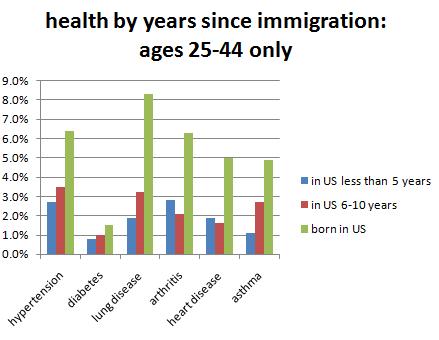
is immigrating to the US bad for your health?
In general, young immigrants (ages 18-44) have much better health than people who were born in the USA. But the more years pass after they immigrate, the worse their health becomes.

(adopted by Peter Levine from Guillermino Jasso, Douglas S. Massey, Mark R. Rosenzweig, and James P. Smith, “Immigrant Health and Acculturation,” in National Research Council, Critical Perspectives on Racial and Ethnic Differences in Late Life, 2004, table 7-6.)
I wouldn’t make too much of the above graph all by itself, but I was separately told by a well-informed colleague that there is a well documented “immigrant paradox.” Even as individuals grow more likely to have health insurance, stable employment, and stable housing, their health status falls towards the levels of native-born Americans of the same age.
It seems important to understand the reasons for this “paradox” so that we can improve the lives of large numbers of younger immigrants. Also, understanding why exposure to America seems to worsen health might reveal some important, general facts about life in America.
my blogaversary
I published my first blog post on January 8, 2003. Sunday will therefore mark my eighth full year of blogging. Today’s post is number 1,967. That’s equivalent to five posts per week for forty-nine weeks each year. I never post on weekends, so the actual blogaversary will pass in silence.
The medium has changed somewhat. In the early years, the only responses were emails, comments posted on my actual site (www.peterlevine.ws/mt), and other people’s blog posts that referred to mine. Locating such responses required ego-surfing, with search engines like Technorati.
Now my posts go forth in several ways: on my site, on my Facebook page, via Twitter, and via RSS feed. I also publish my more ambitious entries that have political themes on Huffington Post, where the number of comments is much higher. Facebook draws the most frequent and most civil and helpful comments. Twitter and RSS reach relevant audiences.
Fewer peers’ blogs now refer to mine, and I think that may be because fewer people are operating their own free-standing blogs. A higher proportion of the dialogue now is quasi-private–Facebook friends posting comments on my personal page–rather than blogs as an imitation of a “public sphere.”
I like Facebook, but I will hold onto my personal site because I want to control the archive of more than 1,900 entries. The vast majority of people who read anything on my blog are reading old entries that they find with Google searches. “Black dentists,” “Nabokov heroine,” and “Was Velazquez left-handed? are some frequent queries that land people on my site. (He was.)
Meanwhile, I think my content has been pretty consistent: the same mix of youth civic engagement, general politics from a “civic” angle, and bits of philosophy and literature. I generally try not to be self-referential, but the annual blogaversary is an excuse for summing up.
connoisseur of spam
CIRCLE’s website is not a blog, but it uses blogging software (WordPress) and accepts comments. “Comment spam” means inappropriate and irrelevant comments, usually with embedded advertisements for other people’s sites or products. WordPress automatically blocks most comment spam, but every day, at least a half dozen spam comments reach the queue and I have to block them by hand. Often, they make generically flattering remarks to encourage us to allow them to stay. I actually appreciate some of the creative efforts. E.g.:
“Your web-site has 100 % exceeded my expectations. From when I begun reading through your webpage I have acquired completely new facts and had old information reinforced. Let me recommend many folks i know.”
From Travel Deals: “Hi I like this article and it is so informational and I am definetly going to save it. One thing to say the Indepth analysis you have done is trully remarkable.No one goes that extra mile these days? Well Done! Just one more suggestion you can install a Translator for your Global Readers !!!”
“Thanks a lot for sharing. Your article is truly relevant to my study at this moment, and I am really happy I discovered your website. However, I would like to see more details about this topic. I’m going to keep coming back here.”
A website that provides football statistics comments on our research about the civic opportunity gap in high school: “This seems rather unsurprising – there is an obvious link between $ and education.” (Link to the NFL stats provided.)
Commenting on a youth turnout rate of 52% in 2008: “How true. Wish things could be better.”
“This post includes all information that I have always required.”
(You can’t do much better than that.)
lower the voting age to 16
I support lowering the voting age, because then most people would be in school when they became eligible to vote, and schools could teach them both the mechanics of elections and some neutral principles and skills helpful for responsible political participation. Today, we don’t teach voting mechanics much, and even if we did, most students would have to wait years before practicing their knowledge. Previous research shows that voting is habitual,* so raising the turnout of 16-year-olds should increase participation for decades to come.
Mark Franklin found that turnout during the first election at which a generation is eligible to vote has lasting effects. He argued that lowering the voting age to 18 had caused turnout to fall in most democracies, because 18-year-olds are less likely to vote than 21-year olds.** True, but 16-year-olds might be more likely to vote than 18-year-olds because they are in school settings where voting can be encouraged and become normative.
Now Daniel Hart and Robert Atkins have published a psychology article addressing the main argument against 16-year-old voters: that they are too young to be informed or wise participants.*** Hart and Atkins find that Americans at age 17 score about the same on questions about political knowledge, tolerance, political efficacy, perceived civic skills, and community service as 21-year-olds, probably because their experience with civics classes, service projects, and so on are more recent. The rate of improvement on these questions is rapid from age 14-18, but then tapers off or even declines, so that 16- and 17-year-olds are on a par with people in their twenties.
Another way of looking at the data is that teenagers’ scores are quite close to the average for all adults.
Hart and Atkins note that teenagers have somewhat different political priorities from older people, reflecting their different interests. For example, they are more favorable to education spending. Basic democratic principles suggest that if they have distinctive values and interests and are capable of voting, they should be allowed to do so.
Finally, an interesting theoretical observation from the paper:
- young adolescents’ brains differ from those of young adults in ways significant for decision-making …. For example, young adolescents’ brains seem particularly sensitive to reward and novelty and lack full maturation in areas responsible for the modulation of emotion and impulse control. … While it is likely true that adolescents’ capacities to restrain impulsive, emotional behavior may be reduced relative to that of adults, and their life experiences are relatively circumscribed, these capacities do not figure prominently in citizenship and particularly in voting. Neither the sense of membership, the concern with rights, nor the ability to participate in the community rests heavily upon the ability to resist emotional, impulsive actions. Citizenship and voting in the electoral process require, for the most part, decisions made over long periods of time, which allows for deliberation and discussion with others. To date, there is no neurological evidence that indicates that 16- and 17-year-olds lack the requisite neurological maturation necessary for citizenship or for responsible voting; nor is there evidence to indicate that a breadth of life experience is necessary for effective citizenship.
* Eric Plutzer, “Becoming a Habitual Voter: Inertia, Resources, and Growth,” The American Political Science Review 96/1 (March 2002), pp. 41-56.
**Mark N. Franklin, Voter Turnout and the Dynamics of Electoral Competition in Established Democracies since 1945, Cambridge University Press, 2004.
***Daniel Hart and Robert Atkins, “American Sixteen- and Seventeen-Year-Olds are Ready to Vote,” Annals of the American Academy of Political and Social Science, vol. 63 (January 2011), pp. 201-221