Category Archives: Uncategorized

a typology of denominations

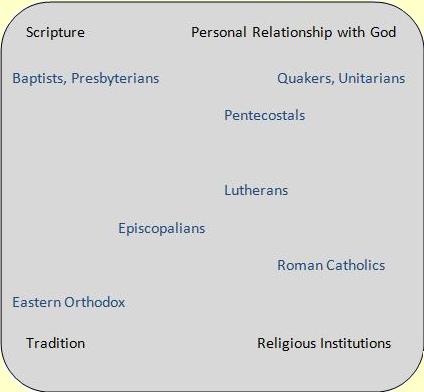
I think that in the Abrahamic faiths, guidance and inspiration come mainly from four sources:

  • Scripture, understood as the written word of God, which may variously include the Pentateuch, the whole Hebrew Bible, both Christian testaments, or the Qur’an.
  • A personal relationship with God, manifested in prayer and the inner voice of conscience.
  • Tradition, understood as the ideas and actions of the historical community inspired by God.
  • Religious institutions that provide guidance and doctrine today.

Almost all believers will acknowledge all four authorities, yet the weight that they give each one varies substantially. That variation is so important that I almost think one can classify denominations by how they weigh the four.

For example, the Reformation doctrine of sola scritura (by scripture alone) implies, first, that the Christian Old and New Testaments have a unique status as the perfect and complete word of God, and second, that one needs no other guidance. The Bible is not part of tradition: it is the sole basis of tradition. It is not produced by institutions: it creates them. It checks and inspires personal prayer. Hence the reading of scripture is the most important religious act.

In sharp contrast, Orthodox Christians believe that the Bible is one manifestation of the true (“orthodox”) religious tradition. The Bible is not fundamentally different from other fruits of tradition, such as the liturgy, the writings of the Fathers, the icons, and the shape and orientation of churches. St. Luke wrote the Gospel named after him, but he also painted the first portrait of Mary and Jesus, which is the model for subsequent icons. St. Basil was post-Biblical but he was inspired in the same way St. Luke was. The decision of a church synod is only valid if it is consistent with tradition and becomes traditional.

Meanwhile, Catholics take seriously the Bible, tradition, and personal devotion, but a defining characteristic of Catholicism is the belief that the institutionalized church (founded by Jesus and headed by St. Peter) is able to teach “magisterially,” changing tradition, reinterpreting scripture, and redirecting belief.

Near the fourth corner of the graph would be denominations like the Society of Friends, which strongly emphasize the personal, inner voice of prayer and conscience. Quakers pray collectively as well as individually, but any individual may be moved to speak. They read the Bible but also other works that are seen as inspired, including (at least nowadays) non-Christian writings.

These are all Christian examples, but I think a roughly similar analysis would work for Jews and Muslims.

“A Tale of Two Cities”: comparing the best and worst cities for civic engagement

I am one of several co-authors of a new report released on January 24 in Miami by the National Conference on Citizenship and its Florida and Minnesota partners. According to Tale of Two Cities: Civic Heath in Miami and Minneapolis-St. Paul, Miami is the least civically engaged major city in the country, and Minneapolis-St. Paul is the most engaged metropolitan area.

In both communities (as elsewhere in the United States), people with more education and income tend to engage more in civic affairs. But individuals in Minneapolis-St. Paul who are in the lowest income group are more likely to volunteer, attend public meetings, work with neighbors, participate in politics outside of elections, and participate in associations than are people in the wealthiest tier in Miami. An individual with a high school education in Minneapolis-St. Paul is about as likely to be engaged as an individual with a college education in Miami.

The report finds that the civic culture of Minneapolis-St. Paul is oriented toward enlisting and empowering diverse people–paid employees as well as volunteers–in the common work of shaping the area’s future without abandoning their own cultural backgrounds and values. This culture of civic empowerment generates a widespread sense of optimism that people can shape their common future. Those norms are less evident in the Miami area, which appears to be more balkanized and less reliant on citizens to create a common future. Our colleague Harry Boyte provides a historical and interpretive portrait of civic culture in the Twin Cities that should inspire similar strategies everywhere.

we can have political reform and equitable political engagement even if the economy is unjust

Justice Louis Brandeis is supposed to have said, “We can have democracy in this country, or we can have great wealth concentrated in the hands of a few, but we can’t have both.” Whether or not Brandeis uttered these exact words, it is reasonable to fear that democratic participation is fruitless and frustrating whenever a small number of people control major employment and production decisions through direct ownership and influence government by literally paying for the decisions they like (though campaign finance contributions) and implicitly threatening to move their investments if they dislike policies.

In 2007, the wealthiest one percent of American households held 34.6 percent of the nation’s wealth. The assets of that top percentile consisted mainly of investments that gave them power over other people. Almost 90 percent of their assets took the form of non-home real estate (mainly business facilities and rental properties), business equity, stocks, and other securities—in other words, stakes in firms that employed their fellow citizens and made things. In contrast, typical families (those between the 20th and 80th percentiles) had sunk two thirds of their modest wealth in their own homes and were deeply in debt.

One could conclude that it is naïve to expect ordinary (not to mention poor) Americans to participate in the demanding ways that I advocate: attending meetings, forming groups, and influencing the government. If their participation threatens the economic interests of the rich, one would expect them to fail. It would appear that economic reform must precede political engagement.

A different version of the argument focuses not on the top one percent and their control of the “commanding heights” of the economic and political battlefields, but rather on the bottom 20 percent, who ostensibly cannot participate because they have more pressing and immediate needs than civic engagement. According to Abraham Maslow’s theory of a “hierarchy of needs,” people will not participate in politics until they have sufficient safety, welfare, and love. “When millions lack health insurance, live at or below the poverty level, face racism is their lives, it is no wonder there is disengagement.” [quoting David A. Shultz, “The Phenomenology of Democracy: Putnam, Pluralism, and Voluntary Associations,” Scott L. McLean, David Andrew Schultz, Manfred B. Steger (eds.), Social Capital: Critical Perspectives on Community and “Bowling Alone” (New York: New York University Press, 2002), p. 92.]

The difficulties that this analysis presents are severe. First, it is not clear how we can attain higher levels of economic equality unless lower-income people do engage politically, using their votes and other forms of influence to change policies in their own favor. Strategies that rely on some kind of political “vanguard” to look out for their interests have usually been disastrous, not only in the notorious case of state communism, but also in many machine-dominated American cities, where ostensibly progressive leaders who claim to represent the poor have become corrupt.

Even if our political system does pass redistributive legislation, the resulting spending will benefit lower-income people only to the degree that it funds programs that genuinely serve their needs. Programs are most effective and sensitive (and popular) when citizens engage with them, holding agencies accountable and contributing their own talents and energies. Thus, until there is more and better public participation in institutions, it is not clear that governments can promote equality. I would personally favor expanding certain tools of financial redistribution, such as the Earned Income Tax Credit and Medicare. But such programs do not address inequality that emerges from gaps in literacy, nutrition, mental health, residential segregation, and neighborhood-level violence and crime. To address those causes of inequality, one needs effective programs, and such programs rely on active citizens as well as tax dollars.

Finally, it is difficult to use the open-ended, deliberative style of political engagement that I advocate if one is convinced than an essential goal is to reduce the share of wealth controlled by the top one percent of Americans. Many citizens do not share that goal. The General Social Survey regularly asks people to place their opinions on a scale between two statements: (1) “the government in Washington ought to reduce the income differences between the rich and the poor, perhaps by raising the taxes of wealthy families or by giving income assistance to the poor” and (2) “the government should not concern itself with reducing this income difference between the rich and the poor.” The mean answer is always slightly closer to the latter than the former, and between 10 and 20 percent of the sample consistently place themselves at the anti-redistributionist extreme of the spectrum. This is not evidence that Americans are overwhelmingly against modest amounts of additional redistribution. It is evidence that their opinions vary. The issue can be discussed, but to assume that more redistribution is needed is no way to invite all kinds of people to participate.

The dilemma that I have introduced here is real, but it can be overstated. The poorest 20 percent of Americans—not to mention the middle 50 percent—have considerable potential power in politics and the marketplace. They do not own very many securities, but they do make important discretionary decisions about where to live and work and which consumer goods to buy. They also have a lot of potential votes. They do not actually vote or join political organizations and movements at nearly the same rate as wealthier Americans, but that disparity isn’t inevitable.

Consider India, the world’s largest democracy, where “scheduled castes” are groups (including the traditional “Untouchables” or Dalit caste) that are recognized as subject to historic deprivation and discrimination. More than one third of scheduled caste members live below the Indian poverty rate, which is about eight US dollars per person per month. Nevertheless, in the national elections of 1996, voter turnout among the scheduled castes was 89.2 percent, and turnout among the upper castes was about three points lower than theirs. In the same year, the United States held a presidential election in which 58 percent of all adult citizens voted—31 points lower than the scheduled caste members in India. Even Americans who held college degrees (a privileged minority) voted at rates far below the scheduled castes.

Sometimes this kind of comparison is offered to chastise Americans. Why can’t we vote like Indians? Indeed, why do Americans choose to vote at lower rates than in all other democracies except (sometimes) Switzerland? I happen to think the voting is an ethical obligation, like many other forms of civic and political participation. But personal virtue does not explain enormous differences in participation by social class, by nation, and within the United States over time. (Almost three quarters of American men voted in 1900, even though most African American men were still blocked from voting.) Nor can moral exhortation raise the turnout rate or encourage other forms of civic and political participation. Structural factors, such as the competitiveness of elections, the issues that are open to debate, the functioning of parties, interest groups, and the mass media, and the prevailing political culture, affect the rate of participation.

We need to analyze the structural reasons for declining engagement in the United States and suggest reforms. In the present context, the point of invoking India is simply this: economics does not determine political participation. People who experience absolute deprivation and profound relative disadvantage sometimes vote at rates far above privileged Americans.

Voting is by no means the only form of civic engagement, but similar conclusions can be drawn regarding democratic participation in general. The proportion of people who say they take “local community action on issues like poverty, employment, housing, [and] racial equality” is higher in some poor countries, such as Bangladesh and Tanzania, than it is in rich countries such as Germany, Singapore, and the United States. The correlation between economic development and grassroots political participation is weak but negative at the global level. In a study of highly demanding and effective forms of grassroots political action, Gaventa and Barrett find successful examples no less common in poor countries, war-torn countries, and dictatorships than in peaceful and developed democracies. In the United States, voting and volunteering are strongly correlated with social class: wealthy people are the most likely to participate. But attending community meetings and working on local problems are different: rates of participation are almost the same for low-income people as for rich people.

Overall, I think we can conclude that economic disadvantage is not an insuperable barrier to participation. In fact, economic need can spur engagement and make it more common in poor and even undemocratic contexts than it is in affluent communities. Some of our most impressive and innovative civic movements have originated with our poorest and most oppressed people, starting with slaves in the 1800s. That does not mean that democratic participation is equitable in the United States at the beginning of the twenty-first century, nor that our major institutions allow equal participation. It does mean that we can begin by reforming our political institutions, confident that all Americans are capable of participating in a reform movement if we organize it well.
Sargent Shriver, 1915-2011

I never met Sargent Shriver, who died on Tuesday, but I have been knocking around the movement for national and community service since the 1980s and know several people for whom his death is a personal loss. My condolences to them and my respects to Mr. Shriver, who exemplified a political moment that we badly miss today.

Sargent Shriver stories are numerous and inspiring. For example, he traveled so much as Peace Corps Director that he became accustomed to sleeping under the rows of airplane seats during almost daily long flights (something that today’s cabin attendants would quickly forbid). But I would like to honor his core principles more than his particular actions:

He was committed to “service.” His own service record included a bronze star at Guadalcanal, stints as president of the Catholic Interracial Council (a civil rights group), chairman of the Chicago Board of Education, founding director of the Peace Corps, director of the Office of Economic Opportunity during the War on Poverty, and ambassador to France, plus holding the Democratic nomination for Vice President in 1972. Several of the organizations he directed were also devoted to “service.” The Peace Corps provides opportunities to serve one’s country and the host country; and many of the anti-poverty programs that Shriver directed at OEO were also driven by service (Job Corps, ViSTA, Legal Services). The kind of service he exemplified was not charitable, nor amateurish, nor necessarily unpaid. The Peace Corps, for example, is the “toughest job you’ll ever love.” It’s serious, responsible, more-than-full-time work, and you earn a paycheck for it.

He stood for fairness and equality of opportunity. It was at his suggestion that Senator John F. Kennedy interceded on behalf of Martin Luther King in 1960, and Shriver had a lifetime commitment to inclusion, as reflected also by his anti-poverty work and the Special Olympics. His idea of fairness was never patronizing or disempowering. He saw excluded people as assets and potential leaders.

He exemplified a government that was popular, ambitious, and accessible. In 1960, nearly 80 percent of Americans said they trusted the government in Washington to do what is right. The government in which they placed their trust was busy doing things. In 1963-4, Congress passed the Economic Opportunity Act (launching the War on Poverty and creating Head Start, Job Corps, and many other programs that Shriver was soon to run), the Food Stamp Act (institutionalizing food stamps as a permanent federal welfare program), the Federal Transit Act (providing federal aid for mass transportation), the Library Services and Construction Act (offering federal aid for libraries), the Community Mental Health Centers Act (de-institutionalizing many mental health patients), the Clean Air Act (the first federal environmental law allowing citizens to sue polluters), the Wilderness Act (protecting nine million acres of federal land), the Equal Pay Act (addressing wage discrimination by sex), the Civil Rights Act of 1964 (ending de jure racial segregation in the United States), and the Tonkin Gulf Resolution (rapidly escalating the Vietnam War).

Many of these programs were criticized as imperial impositions of federal power. Some were serious failures. But several were designed to expand political opportunities for ordinary citizens. Announcing the War on Poverty, President Johnson said, “This program asks men and women throughout the country to prepare long-range plans for the attack on poverty in their own communities. These are not plans prepared in Washington and imposed upon hundreds of different situations. They are based on the fact that local citizens best understand their own problems and know best how to deal with those problems.” Johnson was honoring a particular social contract: people were expected to trust and pay for an aggressive government, but in turn it would honor their political ideas, energies, and values. For various complex reasons, that contract soon broke down, but Sargent Shriver personally exemplified it.

While he presided over the OEO, the Federal Government paid the salaries of thousands of people who worked at the grassroots level, organizing communities and running programs. The Great Society included elements of bureaucracy and centralization, but it also required the “Maximum Feasible Participation” of citizens. As a result, there was a lot of civic experimentation. Some people who were heavily involved in those experiments later switched over to electoral politics. Some burned out or lost the opportunity to serve when their budgets were cut. But a considerable number continued to experiment and learn, often moving from federal programs to nonprofits such as Community Development Corporations. When they lost their government grants, they developed local financial sources. When they got tired of fighting city hall, they developed collaborative relationships with local governments. This human trajectory is a major theme in Carmen Sirianni and Lew Friedland’s book Civic Innovation in America.

That brings me to a final principle of Shriver’s: the permeable boundary between state and civil society. In his own career, Shriver worked consistently on certain public problems but moved between the government and the private sector. He also established programs that allowed other people to work for the federal government for a little while, and then take their skills and knowledge into civil society–or vice-versa. The War on Poverty launched many such careers. I think one reason–although surely not the only reason–for the broken contract between the government and the people is the loss of opportunities to innovate within government and to address public issues in the private sector.

what is socioeconomic status (SES)?

More articles that you could read in your lifetime demonstrate that socioeconomic status correlates with important outcomes, from voting to longevity. But what is SES? The American Psychological Association’s Task Force on Socioeconomic Status says (PDF):

    social status is commonly conceptualized in terms of socioeconomic standing derived from formulas, taking into account various combinations of income, education, and occupation … Although social scientists continue to disagree about how best to operationalize SES, which indicators are the most valid (e.g., occupation vs. education vs. neighborhood), and the translation of different combinations of these indicators into class groupings (e.g., college degree plus corporate position equals “middle class”), the fundamental conceptualization

    involves access to resources.

The Task Force proceeds to complicate the picture by introducing conceptions that are less focused on absolute resources and instead emphasize relative standing or the ability to reproduce advantage from one generation to another. But all the conceptions seem to presume that the SES of an individual can be captured by a single composite measure which is not equivalent to wealth, income, or occupation and which does not incorporate race, gender, or age. (Those are treated as correlates of SES, not components of it.) To know whether the formula is valid, we must decide what one thing we want to measure.

Perhaps SES is a measure of the comparative advantage that A has in getting what A wants in life, once we account for personal aptitudes and character traits, demonstrable skills, and race, gender, and age (which we measure separately).

We know, for example, that US Senators have median assets of $1.7 million and that 51 members of the last Congress had family members who had also served in Congress. So it seems likely that SES affects (but does not completely determine) your odds of getting into Congress–which is something that some people want.

But what we want is affected by SES, not just whether we can get what we want. Perhaps, for example, being related to a Member of Congress not only makes it easier to be elected; it also makes it more likely that you want to be a politician. (Certainly, many Americans would rather be almost anything else.) To take another example: you need wealth and family connections to be admitted to certain snobby clubs. But having wealth and family connections might hurt your chances of hanging out with the cool kids behind the gym or going ice-fishing with the guys. In short, SES (as we typically measure it) confers advantages on those who want to get into high-SES social circles and makes them more likely to want such entree. But that doesn’t mean that SES increases the odds of any person, A, to get whatever A wants.

Now it is starting to seem as if SES is not a continuous variable at all. “High SES” is just the name we give to certain subcultures, although other subcultures are equally exclusive and desirable. But that can’t be right, because it’s obvious that getting into the US Senate or the World Economic Forum at Davos is more valuable than being included with the cool kids behind the gym (even if most people would rather be with the cool kids).

Another possibility: SES is the most refined measure of economic power. The idea is that some people can influence their own and others’ economic circumstances more than other people can. (They can also use their economic power for political leverage.) Wealth is one measure of how much economic power individuals have. If you have a billion dollars, you can buy a company and fire everyone: that is power. But wealth is not the best measure of economic power, as a couple of examples will demonstrate:

  • It is 1974 and George W. Bush is a graduate student at the Harvard Business School. He is an alumnus of Yale and a member of Skull & Bones. His father is chairman of the Republican National Committee and is on the road to becoming president of the United States; his grandfather had been a United States Senator and a board member of Yale, CBS, the Union Banking Corporation, and other companies. George W. Bush has high SES, if anyone does. But his income may be quite low because he is a graduate student, and even his wealth may be negligible if the Bush family’s assets are structured in such a way that he has to wait for his share. An auto mechanic of the same age may have more wealth.
  • A 95-year-old widow lives in a house worth $2 million, but she can only use that $2 million asset as a place to reside. She has less power than George W. Bush had in 1974, but more wealth.

Yet another possible definition emerges: SES is an estimate of how much money the individual will be able to invest and spend according to choice during the rest of his or her lifetime. That definition appropriately gives a current Harvard MBA student higher SES than an auto mechanic or an elderly lady in a big house. But it won’t quite work, because not all “socioeconomic” advantages are monetary. For instance, having a grandfather in the US Senate is an advantage that money cannot buy.

If we want to measure economic power rather than wealth as SES, then such factors as age, educational status, parental occupation, family reputation, and family income should also count as aspects of SES.

Those factors could be included. But geographical location, language, race, gender, physical appearance, and religious belief–not to mention personal traits and accomplishments–also confer economic power. I understand the value of measuring these factors separately from SES so that we can investigate the changing relationships between race or age and SES. But if SES is defined as economic power, and if being white confers economic power in the US, then on what conceptual basis can we exclude race from our measure of SES?