I’m at Boston’s Logan airport, waiting to fly to DC for a day’s meetings. Then we’re going on vacation for a week, and I will try to stay offline as much as I can. So no blogging until July 5 or so.
vacation
Leave a reply
Does civic engagement (or you can call it “democratic participation,” or “stronger civil society”) help communities economically? I don’t think there is a large literature on that question, at least with explicit reference to the United States. Of course, wealthier communities tend to be more engaged, but that could be because income and other assets make engagement easier. It is trickier to detect a causal arrow that points in the opposite direction. However, based on the sources listed below, I would make the following hypothesis: the quality–not the quantity–of civic engagement is related to whether communities can withstand economic crises and make difficult collective decisions that help them to recover.
If I am missing research or plausible hypotheses, I would love to know.
When the lead headline of the New York Times reads, “Greek Turmoil Raises Fears of Instability Around Europe,” and the whole world’s economy is vulnerable to political decisions in this country of about 11 million, here is something important to note about Greece. About 27%-30% of the Greek economy is “informal”: off the books, in the shadows, unreported, or otherwise shielded from taxation (see Stavros Katsios’ analysis, in PDF). That compares to about eight percent of the US economy.
The consequences are severe and directly relevant to the current crisis. It’s hard to balance the budget when nearly one third of economic activity is arbitrarily shielded from taxation. It is equally difficult to muster political support for steep tax increases and deep spending cuts (which are necessary to balance the budget) if some people pay what they owe and others pay nothing. To make matters worse, the ones who avoid taxes are likely to be affluent and well-connected. I wouldn’t vote to cut my own retirement benefits and raise my own taxes if I thought that my wealthiest compatriots could shield their income from the government.
Tax avoidance doesn’t come free but requires bribes known as “speed money,” and political quid pro quos that are costly. Finally the whole economic system (the least efficient in Europe) is hampered because people arbitrarily channel their investments and consumption into the informal economy.
I can’t say what to do about this, because reform strategies always depend on local conditions, traditions, and leaders. The country that coined the word “xenophobia” (and that lost 520,000 lives during the Nazi occupation) is evidently reluctant to be pushed around by outsiders. But the idea of enforcing Greece’s own laws should be relatively palatable to Greeks. That is not an imperialistic concept foisted on them by the Germans (through the European Central Bank) or the IMF. In any case, the size of the Greek informal economy is our problem insofar as it contributes to an international economic crisis.
The Mercatus Center, a libertarian outfit, provides rankings of states’ “freedom,” defined as the absence of taxation, spending, and regulation by governments. So if a state spends more on education or requires more years of schooling, its people are considered less free. Writers like de Tocqueville and Mill provide classical liberal accounts in which social norms and families (not just governments) are threats to personal freedom, and mind-broadening experiences like education (even if state-funded and mandatory) can expand freedom.
But the Mercatus Center is entitled to its view, which is state-phobic. They are eager to show that their index of freedom correlates with economic growth. What jumps out at me, instead, is the appearance of some of our most economically dynamic and important states (Massachusetts, California, Hawaii, New Jersey, and New York) at the very bottom of their freedom list.
In fact, I find a not-very-strong but negative correlation between freedom and median household income:
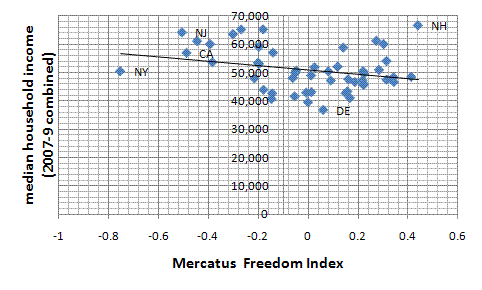
New Hampshire is a Mercatus utopia: high freedom, high wealth. But what about New Jersey: low freedom but rich? Or New York, an outlier on the unfree end of the spectrum, yet with above-average household income?
The graph above uses the whole Freedom Index, including items like drug laws and same-sex marriage that seem fairly remote from economics. Indeed, Mercatus found no correlation between its “personal freedom” subscore and growth. But they also have an economic freedom index that’s all about taxation and regulation. Again, the correlation with wealth is negative–less freedom means higher household income:
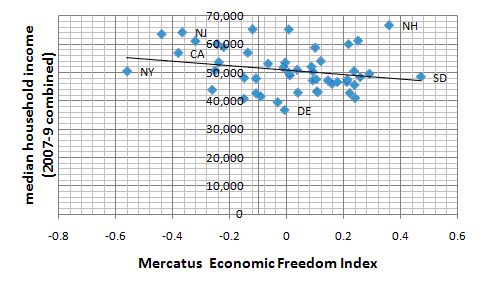
My graphs do not by any means prove causation. But I suspect that more than a century of state investment in infrastructure and education is one reason for the high income (but low “freedom”) of New York and Massachusetts, whereas low state investment helps to explain the relative poverty (but high “freedom”) of states like Texas and Oklahoma.
(in Washington, DC) Friends who were with me at the first National Action Civics Conference this weekend in Chicago–see my HuffPost piece for more on the conference–know that a running joke emerged there. Because I had helped to connect some of the groups that formed the Action Civics collaborative and knew most of the people at the conference, people started calling me the “Kevin Bacon of Civics.” Flattering–but I could prove that several other individuals in the room were just as connected as I am.
In fact, 875 other movie actors are better connected than Kevin Bacon is. The reference, of course, is to a game that three college students invented when they realized that they could link the actor, Mr. Bacon, to any other actor in Hollywood by no more than three links (where a “link” means appearing together in a movie or commercial). They concluded that Kevin Bacon is extraordinarily well connected. But Albert-László Barabási and his colleagues have found that Hollywood forms a dense network in which almost all actors are within three links of each other. (See his book Linked, pp. 59ff). Hundreds are more central to the network than Kevin Bacon is.
Now, it is possible that civic education is not as tight a network as Hollywood is, so that only a few people in civics have many links within the field. In fact, I think I have demonstrated through network-mapping that the civic renewal field is insufficiently networked. If there are only a few “Kevin Bacons of Civics,” we have a problem. But there are certainly more than just me.
How is it possible for an illusion to form that one individual is a uniquely significant network hub? Basically, you randomly start by exploring one person’s links and, if the network is pretty tight, he or she seems to be in the middle of it all. George Eliot’s Middlemarch (1871) is a brilliant book about networks, and Eliot already saw how the illusion could form:
Your pier-glass [mirror] or extensive surface of polished steel made to be rubbed by a housemaid, will be minutely and multitudinously scratched in all directions; but place now against it a lighted candle as a centre of illumination, and lo! the scratches will seem to arrange themselves in a fine series of concentric circles round that little sun. It is demonstrable that the scratches are going everywhere impartially and it is only your candle which produces the flattering illusion of a concentric arrangement, its light falling with an exclusive optical selection. These things are a parable. The scratches are events, and the candle is the egoism of any person now absent …. [Chapter 27]
Her mention of “egoism” is a warning against thinking that your network position is unusually significant.