Category Archives: Uncategorized

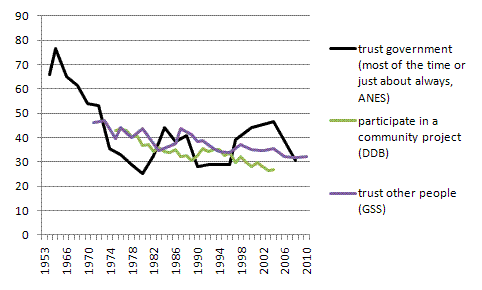
where do you turn if you mistrust the government and the people?

If you mistrust the government but trust your fellow citizens, you may be drawn to political changes (such as referenda, campaign finance reform, or electoral reform) to increase the power of “the people,” collectively. That was the main trend of reform between 1890 and 1914. If you mistrust many of your fellow citizens but trust some version of the government, you may be convinced to expand the power of technocrats or charismatic politicians, as has happened in many countries, especially the most divided ones. But the clear trend in America for the last several decades has been growing distrust for both.

If one distrusts both the public and the government, a consistent response would be individualistic libertarianism: asking to be left alone to the greatest possible extent. (I distinguish this philosophy from communitarian libertariansm, which means devolving power to localities.)

Individualistic libertarianism has been a growth stock during the period depicted above, when–not coincidentally–people have also become less likely to work together with their neighbors. But without arguing its merits, I would note that most Americans don’t buy all the tenets of individualistic libertarianism. In particular, they are concerned about negative externalities (whether from smokestacks or from drug sales) and want to regulate other people’s behavior to prevent them. They are also at least somewhat concerned about economic equality.

So where will Americans turn if they want to regulate society but distrust both the government and their fellow citizens and are not working with their neighbors? That seems to me a great underlying issue of our time.

Liberal Education special issue on civic engagement

I have a piece in the latest issue of Liberal Education that looks at civic engagement very broadly. I claim that efforts to increase or improve youth civic engagement are motivated by several different projects or goals–from using young volunteers to provide services to reducing gaps in political power. I quickly assess the merits of each project. The issue as a whole also contains articles by Barry Checkoway (former CIRCLE advisory board member and still a close colleague), Connie Flanagan (CIRCLE board member and frequent collaborator), Jim Youniss (frequent co-author), and Shawn Ginwright (CIRCLE board member).

the decline effect

A fascinating article in the New Yorker by Jonah Lehrer explores the phenomenon of scientific findings that seem to “wear off.” They are proved in a series of initial studies that cannot be replicated later.

For example, “second generation” antipsychotic drugs worked well in double-blind experimental trials when they were first developed, but now perform worse than the first generation drugs. The phenomenon of “verbal overshadowing” (in which describing something degrades our memories of it) was well demonstrated in experiments that, when replicated today, find much smaller effects. Symmetry was found to attract mates in numerous species, from insects to people, but recent studies no longer find that pattern as strongly, if at all. Even in physics, “the weak coupling ratio exhibited by decaying neutrons … appears to have fallen by more than ten standard deviations [if one compares experiments conducted] between 1969 and 2001.”

It’s not clear that we should expect one explanation for all these examples. In fact, it’s not clear that one phenomenon is occurring–rather than a series of anecdotes plucked from a vast and diverse literature. But the article drew my attention to a specific problem that may, indeed, be widespread.

In statistical studies, we usually say that the effects are significant if there is no more than a 5% chance that they arose as the result of a random bias in the sample. That means that 5% of all “significant” statistical results are false. This error rate should not be a problem if studies are replicated and knowledge is built cumulatively. False results should become outliers and have little effect on the literature.

But most studies are not published, either because the researchers don’t think they have found anything interesting and try a different approach before they submit their articles, or because they submit drafts that are rejected. A study is more likely to be published if it is interesting (meaning counter-intuitive), if it supports the researchers’ bold hypotheses, and if their hypotheses reflect beliefs that are either popular or interestingly controversial. So an erroneous result that arises from random sampling error–which is no one’s fault, by itself–is much more likely to be published than a valid but boring null result. For instance, if you raise students’ test scores with a simple and quick new intervention, journals will be delighted to publish your study; but if you show that this new idea didn’t work, you will be hard pressed to publish. Also, if you show that a conventional form of teaching modestly raises students’ skills, your study may be rejected as dull.

Once a study is in print, none of the incentives (money, fame, and promotion) encourage replicating it exactly to make sure it wasn’t a fluke. Instead, researchers are encouraged to try similar studies in different contexts–and those are most likely to be published if they again confirm the hypothesis. If, by predictable luck, 5% of studies falsely confirm a faddish new theory, they will have decent odds of being published and dominating the literature. It is only once a theory becomes well established that the incentives shift and one can make a mark by disproving it. That could explain why particularly well-established findings are suddenly subjected to replication, decades after they first arose, and are shown to be false or exaggerated.

There is nothing particularly spooky about this process. The fault lies not with nature but with how we organize the institutions of science. Lehrer’s subtitle asks: “Is there something wrong with the scientific method?” I think the right answer may be a little like Gandhi’s purported comment about Western civilization: “It would be a good idea.”
measuring the impact of civic engagement

With funding from the Kellogg Foundation, the Alliance for Children and Families (which represents 350 nonprofits active in health, education, and welfare) and the United Neighborhood Centers of America (which has represented Settlement Houses and similar centers since 1911) have developed surveys to measure civic engagement in their members’ programs. For them, “civic engagement” means “people and organizations purposefully interacting and working together with their neighbors, fellow community members, other organizations, and decision makers and administrators to create positive community, institutional, and/or policy change.” They provide a detailed survey for the leaders of participating organizations, plus surveys that those leaders can give to their constituents and key informants. The questions for the organizations include (among many others):

  • What percent of the adults served by your organization have been helped to become more active as advocates for healthy living within the community this past year?
  • How many public policy actions (e.g., new or modified regulations, ordinances, laws) and/or changes in community practices did your organization’s activities help bring about this past year …?”

The questions for the constituents include:

  • [Organization] has helped me to develop the skills to work for better schools or education for my family or others in the community.
  • [Organization] has introduced me to other organizations or individuals working for better schools or education.

Once organizations complete the survey, they can begin to track changes in their levels of civic engagement and connect civic engagement to outcomes.