Category Archives: Uncategorized

incivility: the problem behind that problem

Most Americans believe that civility is important in politics and perceive that it has declined, especially if they listen to the radio and/or pay close attention to politics. Half believe that there has been a decline in the tone of politics since Barack Obama was elected [survey by Dan Shea and colleagues: PDF].

But it is not clear that incivility is the root problem. One person’s passion–or righteous indignation–is another’s incivility. It’s easy to find websites in which the author interprets a charge of incivility as an effort to silence the people on his side of the political spectrum. During the civil rights era, respectable opponents of the movement typically accused its leaders of ignoring “the civilities” in order to block their progress.

Even if we can agree that an utterance is uncivil, that is not necessarily an argument against it. Civility can conflict with other values, such as freedom of speech.

Finally, blatant incivility is nothing new in public life. In the election of 1800, John Adams’ “men called Vice President Jefferson ‘a mean-spirited, low-lived fellow, the son of a half-breed Indian squaw, sired by a Virginia mulatto father.’” The incentives in a competitive political campaign have usually favored nastiness–and competition is healthy.

What has changed is the lack of an everyday alternative. I think Americans are responding to a lack of constructive civic engagement in their own communities.

Unions, religious congregations, and neighborhood and membership organizations have all shrunk dramatically since 1970. People are substantially less likely to work on community projects and to attend meetings than they were a generation ago. Newspaper readership has fallen at a similar pace. Jury service plays a shrinking role. School districts have been consolidated to the extent that the proportion of Americans who serve on a school board is down by 95%.

As a result, we cannot react to a nasty fight on the television news by telling ourselves, “That is not how we get along in our community.” Increasingly, we are not involved in the business of our own communities. Because we lack experience making decisions about public matters with fellow citizens who are different from ourselves, we are in no position to judge the quality of arguments among leaders or to choose representatives who are good at dialogue. We cannot distinguish between rudeness and passion, or between obfuscation and complexity.

Civil society is in grave condition, measured not by the proportion of talk that is “civil” (for which no statistics exist) but by the sheer rate of participation in voluntary organizations that involve talk. People are less likely to participate in discussions, and especially discussions that draw diverse citizens and that have meaningful impact on public life.

We are withdrawing from such conversations, by, for example, deliberately enacting policies that disempower juries, school boards, and other local bodies; by choosing to live in politically homogeneous communities; and by leaving multi-purpose, diverse organizations for single-issue lobbies and narrowly-defined professional organizations.

Some of the symptoms of this withdrawal include alienation from public life (with Congress holding a 9% approval rate) and pervasively manipulative communications. Our first instinct now is to develop a “message” to persuade masses of other people to our view—rather than initiate a conversation to decide what would be best. It’s in an environment of dueling “messages” broadcast to passive citizens that incivility feels so toxic.
activism when ideology is weak

I am reading a forthcoming book about a whole set of academic programs–centers, certificates, majors, and minors–devoted to service or civic engagement. I am struck that the numerous authors in the volume cite virtually no living intellectuals who are associated with political or social movements.

Some of the authors are overtly hostile to Big Ideas, grand narratives, and large-scale movements. One endorses a “militant or radical particularity, knowing a place in its fullness, with its contradictions, its conflicts, its questions, what it means to be a citizen in that place.” Several write strongly in favor of complexity, enduring relationships, listening, and questioning. The major authors whom they cite most frequently tend to be proponents of pragmatism, of learning from particular and personal experience, and of open-ended conversations: John Dewey, Miles Horton, Paolo Freire, Parker Palmer, C. Wright Mills. The one ideology that is discussed frequently is “neoliberalism”; but it emerges as a shadowy enemy without a specific parallel on the left.

I am sympathetic to these values and also happen to believe that none of the available ideological movements of the present moment is going anywhere. But I would note that the implicit strategy of community-based, open-ended, non-ideological, relational politics is very difficult. It is much easier to participate in politics if you can join a political movement that provides values, diagnoses, prescriptions, strategies, networks, inspirational stories, living leaders, candidates and party slates, regular news reports, organizational supports, cultural expressions (from songs to clothes), and potential career paths. If you have to make everything up by talking with diverse people in your own community, the cognitive and motivational demands are extreme.

When we compare today’s student activists to their forebears, it is important to recognize that their world has dramatically changed because ideological movements have collapsed. Fifty years ago (early in the Kennedy administration):

  • Some young activists associated themselves with Marxism, in one of its versions from revolutionary communism to Liberation Theology or European-style social democracy. Today, Marxism lives on college campuses only as scattered reading assignments.
  • Other aligned with the liberalism of the New Deal and New Frontier. Liberal values have actually grown more popular among young Americans, but theirs is now basically a defensive or conservative posture, dedicated to protecting or possibly expanding the laws and institutions that were built between 1932 and 1968.
  • Still others joined the Civil Rights Movement, then at its apogee and heading toward both triumph and disintegration.
  • Rachel Carson’s Silent Spring was published in 1962, and some students were gravitating toward the nascent environmental movement, widely seen as in crisis in 2012.
  • Just a year later, Betty Friedan published The Feminine Mystique, and by then some young people were beginning to create Second Wave Feminism. But in 2008, just 14% of Americans (of all ages) said that they considered themselves feminists. (PDF)
  • Finally, a few activist students and faculty endorsed the libertarianism of Barry Goldwater and Milton Friedman. That movement remains vital today, but it draws only a small minority’s support.

Now we ask our young people to go into a community, listen, observe, and figure out for themselves what to do. We are asking a lot.

OWS research

(On a bus near Concord, NH): Occupy Wall Street may turn out to be a historic watershed or a footnote. Either way, it is an important research opportunity, a chance to study social movements, non-hierarchical organizations, citizens’ impact on media (and vice-versa), personal change, and many other topics in real time. Thus I am very interested in Occupy Research, a wiki page that includes a research agenda, a survey instrument, a semi-structured protocol for qualitative interviews, guides for researchers, and even a sample release form. Doing this in a “wiki” style, so that anyone is allowed to edit the instruments, is of course very much in keeping with the ethos of the movement itself. Whether it will yield interesting research is an open question. I do like the instruments and questions so far.

Margaret Mead’s quote is trademarked

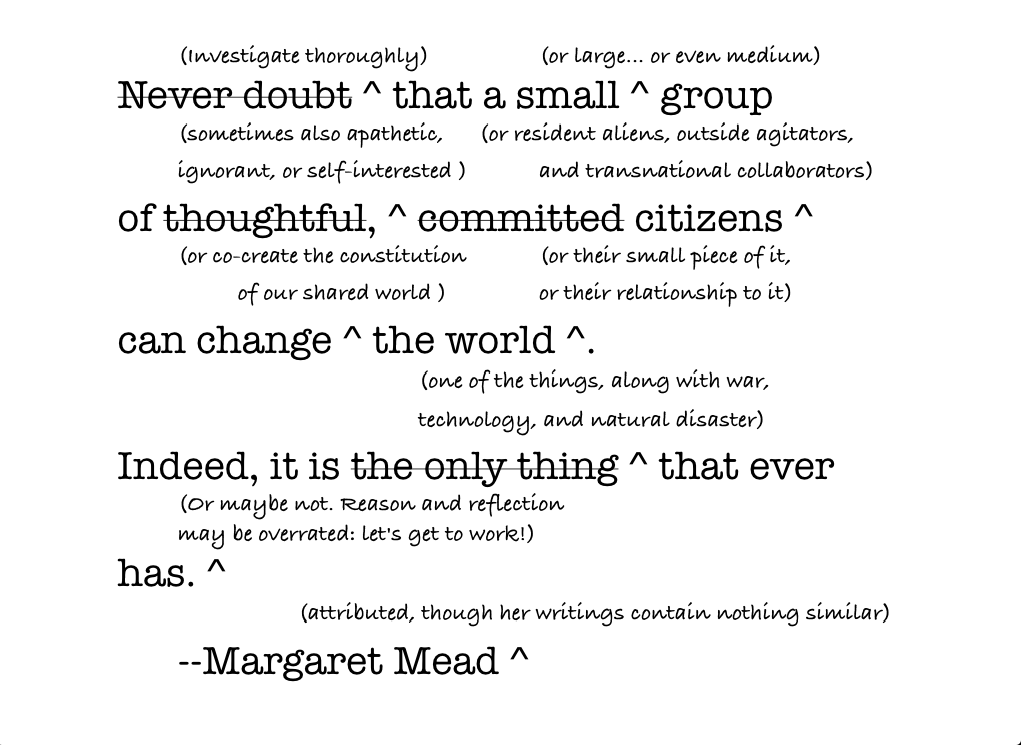
I like to start seminars and talks by quoting Margaret Mead: “Never doubt that a small group of thoughtful, committed citizens can change the world. Indeed, it’s the only thing that ever has.” Almost everyone in my audience recognizes the quotation, and many have been using it in their email signatures or posting it over their desks. I provoke them by claiming that the statement is incorrect on several levels. Yet we should admire the inspirational intention behind it. We need to go “beyond Margaret Mead” by asking when, how, and under what circumstances small groups can change the world, and when, why, and under what circumstances such change is good. Last year’s Summer Institute of Civic Studies had rich discussions on that topic, captured humorously in this graphic by Joshua Miller:

It has never been clear that Margaret Mead actually uttered the quote in question. But a friend alerts me to this page on the Institute for Intercultural Studies website.

What is the source of the “Never doubt…” quote?

Although the Institute has received many inquiries about this famous admonition by Margaret Mead, we have been unable to locate when and where it was first cited, becoming a motto for many organizations and movements. We believe it probably came into circulation through a newspaper report of something said spontaneously and informally. We know, however, that it was firmly rooted in her professional work and that it reflected a conviction that she expressed often, in different contexts and phrasings. …

The “Never doubt” challenge is sometimes quoted in a longer form, with the coda, “indeed, it’s the only thing that ever has.” We decided on the shortened form both for brevity and because the exaggeration in the coda may, in print, weaken the basic concept rather than reinforce it.

Can my organization use the “Never doubt …” quote?

… If you wish to use the quote for non-commercial and non-partisan purposes, including the trademark sign where noted above, please do so with no charge and our good wishes. Following the quotation and the name Margaret Mead, you may put “Used with permission.”

This quote is now trademarked, and the trademark is held by Sevanne Kassarjian, New York. …

It seems to me that the motivation to trademark the phrase is benign: the Institute for Intercultural Studies is not charging anything and mainly wants to prevent partisan or commercial uses.

I don’t know much about intellectual property but find it surprising that one can trademark a quotation that a Google search finds 809,000 times (almost never with an ® after it) and that has appeared in published texts for decades. If I ever say something pithy and worthwhile, I won’t expect to be able to prevent partisan or commercial readers from quoting it–nor are partisan and commercial uses necessarily contrary to the spirit of the Mead quote. (Couldn’t a movement within a political party be a small group of thoughtful, committed citizens? How about a social enterprise?)

For now, I think I will continue to cite the following as my source for Mead’s remark: Nancy C. Lutkehaus, Margaret Mead: The Making of an American Icon (Princeton, NJ: Princeton University Press, 2008), p. 261.

should we be talking about non-college youth?

(Cincinnati) I was in Dayton today for a meeting about “non-college youth” and their civic and political participation.  CIRCLE defines this population as all Americans between the ages of 18 and 29 who have never attended college (including community college). They represent about 43% of their age cohort. Studying how they engage–or don’t engage–in all forms of civic and political life is our major focus. We care because they should have a voice in government and civil society and because engaging as citizens gives them skills, networks, and motivations that help them to flourish in life. I doubt very much that the college attendance rate will rise substantially; therefore, offering young people opportunities outside of college is an important and neglected policy issue.

Yet treating “non-college youth” as a category is problematic for several reasons. First, it’s a negative definition, using a deficit as its basic criterion.

Second, it’s a very large category, encompassing enormous diversity. Just for example, 52% of this group is white, 16% is African American, 27% is Latino, and 3% is Asian or Pacific Islanders. Some are “inner-city” youth, but many live in suburbs, and nearly 20% are rural. (See our fact sheet for details.) The question, given this diversity, is whether any research program or policy should be directed at “non-college youth” as a category. Note also that non-college youth may closely resemble peers who happen to be in college or have some college experience.

Third, “non-college” does not define disadvantage. You can be wealthy and powerful without going to college: Paris Hilton is a non-c0llege youth. On the other hand, you can be deeply disadvantaged and yet in college–especially given our broad definition of the term. The most marginalized and oppressed people have other problems (such as disease, incarceration, or criminal victimization) that make college attendance seem almost beside the point. More than half of “non-college youth” are white, yet young white people are not afflicted nearly as much by poverty, violence, preventable disease, and discrimination as are young people of color.

Yet I continue to see reasons to focus on the non-college 43%. They are almost invisible in a society whose formal leaders and opinion-makers usually hold college degrees. Reporters still routinely equate college students with young people. College attendance itself is a powerful predictor of many important outcomes. For instance, people with any college experience vote at more than twice the rate of their non-college peers. Just because you are not in college, you may need different opportunities and supports. Finally, there can be strength in numbers, and talking about 43% of the population may carry extra weight.