Category Archives: Uncategorized

segregation can result even when people prefer diversity

Between 1969 and 1971, Tom Schelling, later my esteemed colleague at the University of Maryland, found that segregation results if people can move freely, even if they actually prefer a modest degree of diversity. For example, if everyone wants their children to attend schools that are racially diverse, but they would prefer their own race to be the majority, they will segregate into mono-racial schools. Similarly, if people prefer to live in politically vibrant communities where many opinions are held–but everyone prefers his own party to be the local majority–perfect partisan segregation will result.

You can test this pattern with a nice app by Uri Wilensky.* It distributes green and red turtles randomly in a “pond,” leaving some spaces open. You can set the turtles’ preference for the diversity of their immediate neighbors. Even if they prefer to sit among 25% turtles of the opposite color, they quickly sort into 99% homogeneous blocks, ringed by empty space. This is the result after the turtles have moved:

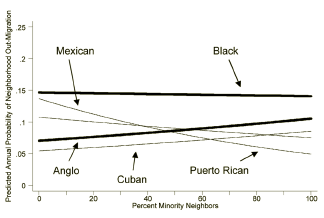
I showed this app to my students last Friday, but we also looked at an empirical study of Americans’ actual movement patterns in recent years.** This graph from Pais et al shows, for example, that a white family has about a 7% chance of moving in any given year if their neighbors are 100% white, rising to an 11% chance if their neighbors are 100% black. (The model controls for economics, crime, etc.)

On one hand, that’s not a very steep curve, and it doesn’t reflect deep racial animosity or aversion. On the other hand, a 4-point annual shift will quickly accumulate, especially since neighborhoods that start with any diversity are quite rare. This means that any integrated neighborhood, school, college, or workplace is endangered even if people prefer a degree of diversity.

Continue reading

activism without ideology is hard

Traditionally, most student activism had ideological motivations. Most students (and faculty) would take action as muscular Christians, socialists, liberals, anarchists, Young Republicans, Maoists, or under some other label of that type. Their label would not only stand for abstract ideas but also for living heroes, strategies, organizations, career paths, specific publications–even hairstyles and music.

Today, we often ask students to do civic work in a thoroughly open-minded fashion, with full attention to local circumstances and diverse people’s views. I resonate to that philosophy but I think it makes motivation, recruitment, organization, and sustainability much harder.

Or so I argue in my “provocation,” one of 16 in a monograph edited by Don Harward and available free from Bringing Theory to Practice. All the provocations were casual, 10-minute talks delivered at a conference last fall, transcribed, and lightly edited for publication. They adopt very diverse perspectives on civic work, and are worth a read.

global citizenship and justice

Oxfam provides some excellent resources for civic education. Among its products is a guide for schools on “global citizenship” (pdf). This document says:

Oxfam sees the Global Citizen as someone who:

  • is aware of the wider world and has a sense of their own role as a world citizen
  • respects and values diversity
  • has an understanding of how the world works
  • is outraged by social injustice
  • participates in the community at a range of levels, from the local to
    the global
  • is willing to act to make the world a more equitable and sustainable
    place
  • takes responsibility for their actions.

By the way, a Global Citizen (so defined) can also be a good national citizen. But what interests me is the mix of principles on this list, many of which are logically separable. You could value diversity, be outraged by injustice, and take responsibility for your actions, but not think of yourself as a “world citizen” or operate at the global level. Or, if you run a multinational oil company, you could very much take a global perspective, understand how the world works–and even value diversity–but not care a fig for injustice.

In the 1800s, progressive nationalists, like Abraham Lincoln and Charles Dickens, were concerned with profound injustices–slavery and urban poverty–and saw advantages to a strong national consciousness. As I argue here, Dickens thought that British nationalism was a means of enlarging human sympathies, and Lincoln argued that preserving the Union as a democracy would serve human-kind. But other nationalists of the 1800s tried to develop nation-states as a means to wipe out hated minorities and dominate their regions.

Nationalism was a means, not an end. I am inclined to think the same of globalism today.

In the 1800s and early 1900s, political thinkers often romanticized “the people” as a homogeneous and progressive force. Marxists assumed that working people were beginning to share class-consciousness that would prevail in a revolution. Democratic populists assumed that the people would vote for justice if they achieved genuinely equal political power. In fact, the working people of Europe supported slaughtering other working people on the battlefields of World War I and then splintered into left and right.

I fear we risk romanticizing the people of the world in the early 2000s. If they all saw themselves as global citizens and wielded equal power in global forums, that does not mean that they would unite. In Canada, for example, climate change may mean an improved standard of living as the extent of arable land expands and oil and gas reserves become even more valuable. If Canadians (who are already quite cosmopolitan) become more active and influential at the global level, that’s not necessarily good news for Bangladeshis.

All of which is to say that fighting injustice is the important part. Being a global citizen is only desirable to the extent that it promotes justice.

the real Rosa Parks

(Washington, DC) I have long known that Rosa Parks was not a tired secretary who just decided one day to sit in the front section of the bus because there were no open seats in the back. I knew that the Montgomery bus boycott was a planned and laboriously organized social action; Rosa Parks was a highly trained and experienced activist. Telling the false story has long seemed to me a form of “civic education malpractice”: we are teaching students that reform happens automatically and randomly, when the real story is about skillful, courageous, long-term organizing.

But I didn’t really know the most important story about Rosa Parks until I heard a brilliant presentation in Detroit by Professor Danielle McGuire, author of At The Dark End of the Street: Black Women, Rape, and Resistance–A New History of the Civil Rights Movement from Rosa Parks to the Rise of Black Power. McGuire shows that Parks was already one of the most effective and respected civil rights leaders in the whole South by the 1950s. Specifically, she had focused for almost two decades on white men’s sexual aggression and violence against black women. One of her great battles was the Recy Taylor case. In 1944, a gang of racists had raped Taylor and dropped her in the middle of town; Parks investigated the case on behalf of the NAACP and organized a national publicity effort to get the rapists prosecuted.

Parks’ background is directly relevant to the Montgomery Bus Boycott because the most salient injustice on the buses was not the segregated seating pattern. Most of the black riders were female domestic servants traveling to White neighborhoods to work in private homes where sexual harassment was routine. The drivers, who were white men, armed and deputized as police officers, routinely sexually harassed and sometimes sexually assaulted these African American women on their way to and from work. That injustice was the impetus for the boycott, conducted and organized by female domestic workers.

Making all black people sit in the back of the bus was profoundly unjust, but it’s part of a story that now feels comfortable, which may explain why Rosa Park has become an uncontroversial national icon, featured on stamps, awarded a state funeral, used as the name of avenues and boulevards.

Imagine how difficult it would be to digest and discuss this story: White men rape or sexually humiliate black women. Rosa Parks fights that violence, drawing on militant theories about race and sex (e.g., Marcus Garvey’s black nationalism) to develop her own views. The Montgomery buses are particular sites of sexual violence. Women organize to withdraw their business from the bus system and create their own alternative transportation network. Their boycott is taken over by black male leaders who choose to downplay the sexual aspect of white supremacy so that they can attract wider support for their main agenda, which is to end de jure racial segregation.

Here are some of the uncomfortable aspects of that–real–story: Rosa Parks was angry and radical. Unjust policies changed only because she and others were organized and politically effective. Certain injustices did yield to pressure; we no longer have white sections of public buses. But other injustices remain unacknowledged and have diminished only slightly (if at all): rape is an example. The reform movement began with women working on an explicitly sexual issue. They yielded the stage to men because a different issue (racial segregation in public services) was easier to deal with. Finally, integration, or the mixing of people, is not necessarily beneficial, because the original problem was not separation but the direct exposure of black women to white men. A separate transportation system run by black women for black women–which began during the boycott–may actually have been more just than an integrated public system.

in Detroit, promoting active citizenship

(Detroit) I am here for a conference on “Generations: Rethinking Age and Citizenship.” In my keynote, I will try to argue that civic engagement, properly understood, is a solution to our grievous, chronic, “wicked” problems, the problems that national politicians, for all their alleged polarization and heated disagreement, almost all ignore.

Detroit is an appropriate place for that discussion because its population is about half what it was in 1950, the exodus compelled by a permanent closing of factories and the service industries that once supported factory workers. Detroit’s high school dropout rate is 75%. Michigan incarcerates five times as many people as it did in 1973 and spends 20% of its state’s general fund revenue on prisons. Detroit’s traditional industry has contributed badly to global warming.

I don’t happen to know the city but would always begin a serious analysis by looking for local assets and productive projects, rather than simply listing problems. I hear that many important positive experiments are underway here; Declare Detroit is an example.