Category Archives: Uncategorized

cutting entitlements to make room for innovation

The administration’s decision to cut entitlements in its proposed budget has mostly been interpreted as a tactical political move (whether smart or foolish). It’s treated as a pure compromise, the president giving up his real preference in order to achieve a deal with the Republicans or to make them look bad for not negotiating. In other words, it is interpreted as a shift rightward, either for tactical reasons or because the president is just wobbly as a liberal.

But there are hints that the administration sees longer-term entitlement cuts as good for their version of liberal priorities. The Times’ Jackie Calmes reports:

But to Mr. Obama, cost-saving changes in the nation’s fastest-growing domestic programs are more progressive than simply allowing the entitlement programs for older Americans to overwhelm the rest of the budget in future years.

Even so, he emphasized that his support is contingent on Republicans agreeing to higher taxes from the wealthy and new spending, in areas like infrastructure, to create jobs.

The president’s views put him at the head of a small but growing faction of liberals and moderate Democrats who began arguing several years ago that unless the party agrees to changes in the entitlement benefit programs — which are growing unsustainably as baby boomers age and medical prices rise — the programs’ costs will overwhelm all other domestic spending to help the poor, the working class and children.

Many contemporary liberals are struck by the effectiveness of particular programs that can be rigorously evaluated. They know about these programs because they are wonks who read research, and also because nonprofit leaders advocate effectively. This advocacy is not merely special-pleading, but involves real evidence of need and positive impact. Just for instance, see the dozens of educational interventions that have been found effective in randomized controlled studies, as collected by the US Department of Education. But the really big policies are usually not evaluated at all. For instance, there is no official evaluation of federal farm subsidies, although independent economists would almost all oppose them.

This combination leads to a sense that the government could be much more effective at achieving liberal ends if it could invest in innovation. That is the theory behind the White House Social Innovation Fund, which operates much like a private foundation. Its style of governance as investment/innovation fits the Zeitgeist. The same philosophy is taught in policy schools and learned on the job in the nonprofits, businesses, and foundations from which today’s government leaders usually come.

This worldview makes liberal policymakers want to hold money for discretionary federal  programs that are smart, accountable, innovative, and otherwise “21st century.” Given the aging of the US population, those programs will be squeezed by the older entitlement payments that were launched in the 1930s-1960s, unless the latter are trimmed. So the administration proposes $200 million in a competitive pool for state governments that cut energy use, while it reduces farm subsidies by $38 billion over ten years. The administration proposes to expand HOPE (Hawaii’s Opportunity Probation and Enforcement scheme), which is officially an “evidence based program,” but it cuts Social Security by $130 billion and Medicare by $380 billion.

What should the government be: a check-writing operation or an incubator of social innovations? It could be both, but given limited funds, choices must be made.

On one hand: it is possible that taking money from Social Security to spend on HOPE would maximize the net human benefits. Deep cuts in Social Security would reduce human welfare and also violate a promise, but modest cuts could pay for more effective programs.

On the other hand: I am worried about biases that result from (1) too much attention to data and advocacy in favor of small, evaluatable programs that are almost inconsequential compared to the entitlements; and (2) class backgrounds that make our liberal political leaders very interested in entrepreneurial innovations and not adequately concerned about the boring old check-writing operations.

See also: “the proper role of experimentation in social reform.”
three upcoming talks

Here are three speeches or lectures I’ll be giving soon:

“The Moral Core of Citizenship: Deliberation plus Collaboration and Civic Relationships.”
April 26, 2013, 12:00-5:00, Miner 224, Tufts University (Medford, MA)
Part of day-long symposium on “Philosophy and Civic Engagement” sponsored by the Jonathan M. Tisch College of Citizenship & Public Service and the Tufts Philosophy Department. The other two speakers are Anthony Laden (University of Illinois at Chicago), whose subject is “Taking the Engagement in Civic Engagement Seriously,” and Meira Levinson (Harvard University), who will discuss “Redefining Civic Action.” More information here.

“How Can Engagement Drive Economic Growth?”
Social Capital Inc.’s Social Capital Forum: “How Can Engagement Drive Economic Growth?” (with a special guest appearance by Somerville, MA Mayor Joe Curtatone)
Boston, MA, Friday, May 3, 2013 from 8:00 AM to 10:30 AM (EDT)
Register here.

Plenary Session: “A Defense of Higher Education and its Civic Mission”
American Democracy Project National Meeting
Denver, CO, Friday, June 7, 2013, 9 a.m. – 10:30 a.m.

Although I won’t literally read from the manuscript, these are three chips off the big block of my forthcoming book, We are the Ones We Have Been Waiting For: The Promise of Civic Renewal in America, Oxford University Press (fall 2013).

does workplace stress lower civic engagement?

The Los Angeles Times’ Alana Semuels reports, “The relentless drive for efficiency at U.S. companies has created a new harshness in the workplace. In their zeal to make sure that not a minute of time is wasted, companies are imposing rigorous performance quotas, forcing many people to put in extra hours, paid or not. Video cameras and software keep tabs on worker performance, tracking their computer keystrokes and the time spent on each customer service call.”

In a companion piece, she argues that the rising stress and longer hours also push down community engagement. She quotes me:

Political engagement often declines when the workplace is a harsher place. Unions were once a driving force behind civic engagement at work, said Peter Levine, director of the Center for Information & Research on Civic Learning and Engagement at Tufts University. Now that they’re such a small part of the private workforce, there’s no one at work encouraging employees to go out and vote, he said.

When people don’t like their jobs, or feel stressed at them, they’re also not predisposed to volunteer in the community, give blood, or participate in food drives organized through their employer (if, indeed, their employer still organizes food or blood drives or community activities).

“If they don’t like their employer, it’s not going to be a path to engagement,” he said.

I think the key issue here is the quality of work and the degree to which the employer empowers its workers (or they organize against the company). The sheer number of hours of work is less important.

In Bowling Alone (2000, p. 202) Robert Putnam argued that working more did indeed reduce hours spent on civic activities–but not by much. He estimated that rising economic pressures and the voluntary entry of women into the workforce had accounted for “less than one tenth of the total decline” of civic engagement that he found from 1970-2000.

Of course, Bowling Alone measured unpaid, after-hours work. If we’re fortunate, our paid work can serve public and democratic purposes, even if our employer is a for-profit corporation.

Besides, employment can raise civic and political engagement outside of work. We can be recruited at work and can find peers with similar needs and concerns. Skills that we acquire at work may translate into the civic and political domains. And just getting out of the house can give a person momentum. An old maxim says that if you want something done, you should ask a busy person. That could be because some people are just energetic and effective (a psychological explanation), or because busy people obtain networks and resources that make action rewarding and effective.

One would think that attending college while working substantial hours per week would force individuals out of civic life. However, in “The Political Participation of College Students, Working Students and Working Youth” (CIRCLE Working Paper 37, 2005), Sharon E. Jarvis, Lisa Montoya & Emily Mulvoy find that “student workers report higher levels of political interest, political skills, political mobilization and political participation than their college student and working youth peers.”

Having said all that, I think Semuels is onto an important story about the suppressive effects of work today. It’s not so much the longer hours as the lack of workers’ organizations, the fragmentation of the workforce, the weakening civic mission of many firms and organizations, and the atmosphere of surveillance that likely reduces civic and political participation.

Semuels writes, “Civic engagement has been proved to help people flourish, Levine said. They develop skills that help them at work, they’re less depressed and they live longer, he said.” Work that involves public problem-solving can therefore be good for the worker as well as the society. When work lacks a public dimension, unpaid civic engagement can be a partial antidote, giving the worker a sense of purpose and value (and also imparting skills and network ties that can lead to better careers). But if a job suppresses civic participation outside of work, then the negative psychological impact may compound. It will then be even harder for a person to get engaged in order to improve her community, her work environment, and her personal well-being.

See also: soft skills for the 21st century workplace: empowered teamwork or emotional labor?

remembering Thatcher

Opposition MP: If the Rt. Honourable Prime Minister had spent 20 years on Robben Island —
Opposition backbencher: As she SHOULD!
(Jeers, cheers)
Speaker: Order! Order!

That’s a snippet from a parliamentary debate on South Africa ca. 1990, as I recall it. By then, I was a graduate student living in England, and Margaret Thatcher was soon to be deposed by her own party; the country was tired of her. Eleven years earlier, I had been a schoolboy in London. It was then the Winter of Discontent, with whole sectors on strike, more than 1 million non-striking workers temporarily laid off because of disruptions in the supply chain, inflation at 13.4%, the National Front calling for “repatriation for all coloured immigrants,” the IRA embarked on its “Long War” strategy, and even nature contributing blizzards. My family was against Thatcher–and rightly so–but a change in her direction felt inevitable.

Her rise and fall framed my own adolescence and early adulthood and was probably formative for me, not in the sense that I agree with her, but because she set the terms of the debate. From 1980-1992, I moved back and forth across the Atlantic and watched in freeze-frame action as two countries experimented with Thatcherite reforms.

Overall, I share the Guardian‘s appraisal:

Much was wrong with the Britain she inherited in 1979, undemocratic union power among them, and many things, though not wrong in themselves, were unsustainable without radical change, including some nationalised utilities. Britain would have had to alter radically in the 1980s and 90s, and the process would have been hard and controversial. But, as Germany and other northern nations have shown, economic dynamism has been possible without the squandering of social cohesion that Mrs Thatcher promoted.

The first quoted sentence is important. I have nothing in principle against strong unions and a social welfare state, but nations must engage their people in building a just and good society. When the British first constructed the National Health Service, high-rise public housing, and other aspects of their post-War welfare state, many could feel that they were engaged in a constructive project. By 1979, I don’t think anyone really believed that the British public sector was improving or that citizens could use it for idealistic purposes. The general feeling that I recall was pessimistic and deeply zero-sum. The best case that could be made for the welfare state was Burkean: it existed, people were accustomed to it, and Thatcherite reforms were radical and untested. As I have argued before, the parties of the left have been deeply conservative (in the Burkean sense) since about 1970.

Thatcher saw the need and opportunity to change, and I would acknowledge that she gave quite a few Britons the sense that they could build something valuable together (through the market rather than the state). But she changed the country too much, too fast, too much from the top and the center, with too little attention to social cohesion, equity, agreement, and sustainability. Again, to echo the Guardian, “There can certainly be no going back to the failed postwar past with which Margaret Thatcher had to wrestle. But there should be no going back to her own failed answer either.”

taxing the college vote in North Carolina

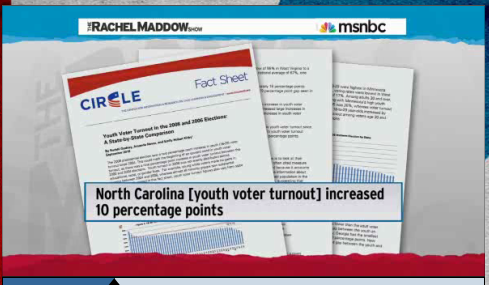
MaddowHere is a CIRCLE Fact Sheet, as prominently displayed on Rachel Maddow’s MSNBC show (April 4). She is reporting on pending bills in North Carolina that would require the parents of  students enrolled in the state to pay a state tax if their children opt to vote in their college town instead of at home.

Specifically, North Carolina residents would lose the dependency deduction of up to $2,500 per dependent if the child chose to register at her college address. I am sure the sponsors would argue–and perhaps believe–that the bill is fair because a student who chooses to vote away from home is not a dependent. I have argued that the decision about where to vote is indeed a weighty one; students should not simply choose the address where their vote will count more. Deciding to register in a given place is an expression of citizenship there that comes with responsibilities.

However, from a legal perspective, the Supreme Court has found that students have a right to register at college.* Choosing to register at college can be the most civic decision and does not imply that one is financially independent.

Considering that Mitt Romney won North Carolina by two points, but lost the 18-24 vote in the state by more than two-to-one (67%-31%), it is worth asking why the Republican legislature would raise taxes on these young people’s parents. Maddow simply describes the bill as a “tax hike” intended to “curb the college vote in North Carolina, to lower college turnout.” This legislation bears the Orwellian title of “Equalize Voter Rights.”

*See Symm v. U.S – 439 U.S. 1105 (1979), but the majority summarily affirmed a Texas District Court decision, so the Supreme Court provided no legal or theoretical basis for the conclusion that voting in one’s college town is a constitutional right.