Category Archives: Uncategorized

Emerson’s advice on how to decline a meeting

One of the stresses of modern office work is being called to do more than one thing at the same moment. How painful to decline an important meeting because another event has been scheduled simultaneously, and how often the scheduling process creates intricate moral tangles. But not for Ralph Waldo Emerson:

Why should I fret myself because a circumstance has occurred which hinders my presence where I was expected? If I am not at the meeting, my presence where I am should be as useful to the commonwealth of friendship and wisdom, as would be my presence in that place.
(From Experience, 1844)

That is not what I would write in an apologetic response to a Doodle or Meetingwizard request, but I admire the sentiment. Of course, in the same essay, Emerson also suggests a deeper aversion to being helpful in the customary ways: “A sympathetic person is placed in the dilemma of a swimmer among drowning men, who all catch at him, and he give so much as a leg or finger they will drown him. … In this our talking America we are ruined by our good nature and listening to all sides.”

(See also: Ben Franklin’s fundraising advice.)

how terrorism made me a Bostonian

This could be the heart-warming story of a slightly alienated outsider–still relatively new to a city of distinctive character–who realizes that he loves it when he lives through an attack. But I want to explore some problematic aspects of my recent psychological journey.

Terrorism typically creates in-groups. I have seen that happen at various stages of my life: as a child in London during the height of the IRA attacks, as a father and husband in DC on 9/11, and now in #BostonStrong. If you watched Neil Diamond leading the entire swaying Fenway crowd in a chorus of “Sweet Caroline” on Saturday, it was hard not to grin. But membership in such passionate mass communities can do harm as well as good. The psychological dynamics are powerful and require attention.

Last Friday, I got my hair cut, as usual, by a middle-aged woman who has never lived anywhere other than Somerville, MA–traditionally, a working-class Irish and Italian city deep in the Boston metro area. I told her that our kid has moved back from LA to work in Boston, and she said, “Oh yeah, people are so much nicer here.” She caught me smiling in the mirror because Bostonians do not, in fact, have a reputation for niceness. Even moving from DC (the city of northern gentility and southern efficiency), we were struck by the brusque manners and chilliness of Boston. I understand where my hair-cutter is coming from, but my smile was the ironic response of an outsider.

On Monday, we heard about the Marathon bombings from Martha’s Vineyard, where we are fortunate to spend a lot of time. That means we were across some salt water and through some dense woods from Boston, which couldn’t have felt much more remote. I started receiving messages of concern and commiseration. I was (and remain) grateful for these sentiments, but they felt undeserved. Although I replied warmly, I was partly thinking: Of course I’m OK. The bombers have killed one person per two million in the greater Boston area. There were 52 murders in the city alone last year, and this is just three more. What all terrorists want is attention. Let us not give them more than we have to.

I now feel a little guilty admitting that we were on Martha’s Vineyard–so safe and far away–because that places us outside of the circle of the victims. We weren’t there when the bombing happened. But of course, if we had been sitting in our suburban house, we wouldn’t have been there, either. What’s interesting is the psychological mechanism that makes me feel mildly embarrassed that we were outside the community when it was attacked.

As I wrote last week, I was not a victim–not harmed, not frightened, and not even inconvenienced. I could have made myself very sad by reading about the actual victims. And I could have put myself in the picture (so to speak) by drawing personal connections to the events. For example, we have close ties to the high school from which the younger bomber graduated. But to follow the human side of the story closely and emotionally would have been a choice, not an obligation. It was the choice that the terrorists wanted, and not one that would have done the victims any good. I do not think that stoking one’s own emotions of pity and fear in reaction to terrorism is likely to yield good results. What terrorists want is attention, and we do not have to give it to them.

Then flash forward to Friday, when we were under “lock down” just blocks from the Watertown town line. Dzhokhar Tsarnaev was on the loose within easy jogging distance. It was an eery feeling, reminiscent of DC in the early days after 9/11 (when we also faced the anthrax mail attacks and the Washington-area snipers). A helicopter hovered overhead. You would have had to talk me into opening our own garage door to look inside.

By now, I was shifting toward a full identification with Boston. An Arkansas state representative named Nate Bell tweeted, “I wonder how many Boston liberals spent the night cowering in their homes wishing they had an AR-15 with a hi-capacity magazine?” I was enraged. I wanted to tweet back something like, “Why don’t you come up here and say that to our faces? We’ll show you how Boston liberals ‘cower.'” On any given day, I read many political statements that I strongly disagree with. It was interesting how this one felt like a personal insult, as if my name were “Boston liberal.”

I was supposed to spend that day with organizers of the International Summer School on Religion and Public Life. It was a small group of deeply committed activists and intellectuals from Uganda, Britain, Canada, and the US, talking about how to live together with solidarity in deep ethical difference. Since we were under lockdown and I felt responsible for the kids, they met at a private house in Newton and I Skyped in from Belmont. A straight line between us would have run through Watertown. We talked soberly about peace while the sirens blared.

By the next morning, the sense of emotional identification was almost complete. I was humming “Sweet Caroline” all day. But a quiet voice said something like this: We now know that one badly injured 19-year-old was hiding in a boat, and an entire metro area shut down for more than 12 hours. I have sympathy for the police, who were actually in danger (unlike me) and who must have expected to lock down a few towns for an hour or so before they caught Tsarnaev. I can hardly imagine their frustration as the hours passed. But still, if a single fugitive teenager can cause our lives to stop–and ignite a national debate about basic constitutional rights, and turn an outsider into a passionate Bostonian–how strong are we?

I do appreciate the emails and Facebook posts of sympathy. But we must make sure 4/15 doesn’t turn into the tragedy of 9/11 repeated as some kind of cruel farce. Nine-Eleven involved one thousand times more deaths, it was genuinely scary because we assumed that more attacks were imminent–and yet we drastically overreacted. We militarized the nation’s capital, violated the Constitution, invaded two countries, and (at a personal level) altered our behavior and expectations. We should have absorbed 9/11 with far more resilience. The lesson for 4/15 is to move on rapidly and with confidence.

But I still care for Boston more than I used to  …
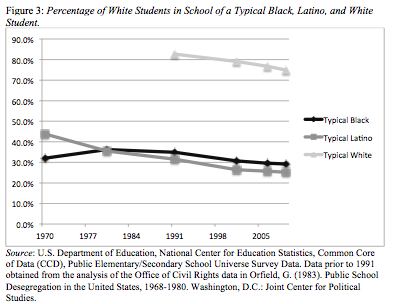
who is segregated?

The graph below comes from Gary Orfield, John Kucsera, and Genevieve Siegel-Hawley, E Pluribus…Separation: Deepening Double Segregation for More Students. It shows that African American and Latino students attend schools with decreasing numbers of White students. The trend by itself could be a natural result of growing diversity in the youth population as a whole. In 1970, 79.1% of all public school students were White; in 2009, that was down to 53.7%.  If a lower proportion of all students are White, then White, Black, and Latino students will (as a mathematical inevitability) attend schools with fewer Whites–see the graph. But the graph also displays something else: a large gap between the White students’ line and the other two. Basically, White students still attend overwhelmingly White schools even though they represent just over half of the nation’s public school kids.

Screen Shot 2013-04-19 at 8.49.22 AM

Orfield et al. make a strong case that persistent (and even rising) racial segregation is bad for students of color:

Schools of concentrated poverty and segregated minority schools are strongly related to an array of factors that limit educational opportunities and outcomes. These include less experienced and less qualified teachers, high levels of teacher turnover, less successful peer groups and inadequate facilities and learning materials.

This is important, but I’d like to suggest an additional perspective. Leaving aside questions of inequality for a moment, we can simply define racial segregation as attending schools without people of a different race. That is true today for some students of color. Fifteen percent of Blacks and 14% of Latinos attend schools that have 99%-100% minority enrollments (although, in some cases, the minorities may come from very diverse racial, cultural, and national backgrounds). But what group is more likely to be isolated? By a large margin, the answer is White students. Only 15.2% of them attend multiracial schools (those with at least a tenth of their students coming from at least three groups), as compared to 27.1% of Black students, 26.2% of Latino students, and 42.1% of Asian students.

I am moved to write this because I just heard the British sociologist John Holmwood make an important point about his country. People of color in the UK are socially, culturally, and economically integrated with individuals from diverse overseas backgrounds and also with White citizens who are working-class or middle-class and who live in metro areas. Two groups in the UK remain segregated: some rural Whites and very wealthy White people. The latter are the ones who are most likely to decry segregation and the supposed failure of multiculturalism. But they are the ones who are segregated.

Frontiers of Democracy 2013: Innovations in Civic Practice, Theory, and Education

 July 18-20, 2013, Medford, MA

Conference Framing and Session Formats

Both in the US and around the world we find ourselves in a dramatic period of civic awakening. We know this work and ideas under different names: public engagement, deliberative and participatory democracy, collaborative governance, educating for democracy and civic learning, public work, building social capital, and strengthening democracy. We promote it using diverse means; we think about it in diverse ways.

With a civic awakening all around us, in US, in the Arab world, in Russia and Burma, in India, Greece, Spain and Hungary, in many countries in Africa and Latin America, it is a good time to rethink what we have been doing and to formulate how it fits into and contributes to this larger effort. At this year’s Frontiers of Democracy conference, we considered a wide picture of work and ideas that support and promote civic vitality.

Frontiers of Democracy is sponsored by the Tisch College of Citizenship and Public Service at Tufts University, the Democracy Imperative, and the Deliberative Democracy Consortium.

You can register for the conference here. If you just want to add your name to the “Frontiers” email list for very occasional updates, you may enter your information here.

This year, the Center for Engaged Democracy is joining with Frontiers to offer its fourth annual conference on the Future of Community Engagement in Higher Education – from 5:00 pm on Wednesday, July 17 to 4:00 pm on Thursday, July 18, immediately prior to the start of Frontiers of Democracy. We encourage attendees to take advantage of this opportunity to learn more about developing academic programs focused on civic engagement, Core Competencies in Civic Engagement, and on-line civic engagement.  To learn more about and see the agenda for The Future of Community Engagement in Higher Education, click here.

Members of the National Coalition for Dialogue & Deliberation are invited to join NCDD’s director and several Board members for an informal afternoon meet-up on Thursday, July 18, from 1:00 to 4:00 pm, also immediately before Frontiers begins.  Network, talk about the New England region’s most exciting D&D projects, and explore what is and can be done to strengthen the region’s civic infrastructure.  To register, please visit this page.

In this 4th year of the Frontiers of Democracy conference, we have once again worked to design a program responsive to the times and to the interests of participants. This year’s conference offers four kinds of sessions:

  • Learning Exchanges in Civic Practices (plenary & concurrent sessions, 8 am – 4 pm, Friday, July 19):

Multiple plenary and concurrent sessions intended for both academics and practitioners

Democratic and interactive discussions, rather than traditional academic panels, on topics likely to move the needle on civic renewal. For learning exchanges, the assumption is that everyone has valuable experiences and knowledge to share, and the sessions are designed to shift from the descriptive to the strategic.

  • Mini-Conference in Civic Studies (8 am – 4 pm, Friday, July 19)

One day-long, academic-style conference

Panels in a more traditional academic format, but with a focus on debates of key issues, not the reading of academic papers.

  • Short Takes (four sets – on each day of Frontiers)

Provocative, 10-minute presentations by invited speakers, some live and some via videos pre-recorded for this event. The speakers’ topics will be diverse. Instead of following their presentations with Q&A and plenary discussion, we will go directly into small-group conversations that will be generally inspired by the speakers but not limited to their remarks.

  • Open Space (Saturday, July 20):

Throughout the conference, we ask participants to be thinking about topics that you would like to learn more about, areas of interest that call for more discussion, and strategic alliances and working groups.  On Saturday, participants can convene a group.  Watch for sign-up sheets located in the main rooms of the conference.

on saying that you are NOT a victim

Since we live very near Boston, friends are writing to inquire about our safety and to commiserate. A colleague from Mexico writes, “Dear Peter, I am so sorry for what happened. My Solidarity with you and all the people of Boston.” Official emails from our various schools and workplaces warn us that we may feel traumatized and we should be on the lookout for signs of depression and panic. Facebook has provided a steady stream of compassionate thoughts. National groups send blast emails of support to “members in Boston and throughout Massachusetts during this difficult time” (quoting from Gov. Dean’s message a few minutes ago).

If you or a person you care about was directly hurt or terrified yesterday, I am very sorry. And if you feel part of a community under attack, then I sympathize. But I would like to state that I was not attacked. I am not in danger. I was not even inconvenienced. And I think it is important to make those points because I don’t want the terrorists to count me as a victim. I don’t want to act in disproportionate or unwise ways out of a sense of threat, and I would rather not contribute to that feeling in the community at large.

After all, we are prone to make very stupid decisions when we feel threatened and violated. Already, Rep. Steve King (R-IA), has used the Boston bombings to argue against immigration reform. Senator McConnell (R-KY) has claimed that we’ve become too “complacent” about domestic terrorism and should now “recommit ourselves to the fight against terrorism at home, and abroad.” Rep. Steny Hoyer (D-MD) has cited the attacks as “proof, … if proof is needed” that sequestration is bad policy because it cuts funds for law enforcement.

Actually, we spend $43 billion per year on Homeland Security, we have engaged “in the practice of torture” against suspected terrorists, we have redesigned our public spaces and put ourselves to incredible inconvenience to prevent terrorism at home, and yet it has posed an unimaginably low risk to Americans over the last decade. We invaded two countries supposedly in response to 9/11, and just yesterday, 30 Afghans were killed by one US bomb at a wedding.*

I understand that one might feel Boston itself was the victim yesterday. Our State Representative emailed: “As a marathoner and also someone who has long loved Copley Square, I feel deeply the violation of a holy space by senseless violence.” I understand his feelings and I see some benefits to this kind of statement. Unlike philosophical cosmopolitans, I believe in loyalty and commitment to groups, including geographical communities. I must admit that I do not happen to identify with Boston, the Marathon, or Copley Place as our State Rep. does. That is a subjective difference that results from our relatively recent move here. I can sympathize with his feelings, which many neighbors, friends, and colleagues share.

Yet the best way to respond is to count on Boston to bounce back. Monday’s attacks were cowardly murders of individuals, but they did no permanent damage to our metro area of 4.6 million people. Boston was founded in 1630 and has survived many worse events. The attacks could ruin the Marathon and harm the city more generally–but only if we allow them to do so.

*This turns out to have been a hoax. Apologies.