(Denver, CO) Mara Liason interviews me on the economic situation of young people and what the economy is making them think about politics. The audio is below:
my Morning Edition comments on young voters
Leave a reply
(Washington, DC) On the New York Times’ “The Stone” blog, Rutgers philosopher Ernie Lepore recently posted a photograph from a philosophy conference in 1984. It was a meeting on the work of Donald Davidson, and many famous philosophers attended. I was in high school at the time and nowhere nearby, but not long afterwards, I was working on my BA and then my PhD in philosophy, so I remember the general scene. Here is a detail (the whole photo can be explored in large scale on the Times site):
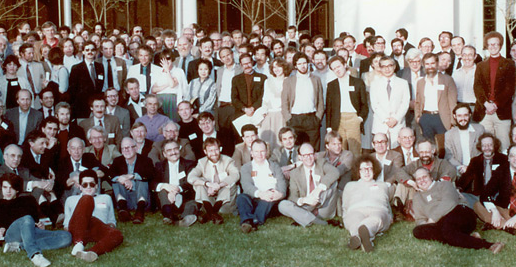
I find that snapshots in general–and not just pictures of geeky philosophers from my youth–are often sad. The smiling, posed subjects present themselves to be remembered and somehow assessed. Because they are regular humans, they don’t measure up to their own hopes. Oil paintings from the 1700s and glossy photos from the old LIFE magazine idealized their subjects so that we can still view them with respect–as people whose presence outlived their time. But in regular snapshots, the first thing we realize is that time has passed since the shutter clicked, and everyone in the image must look older now (if they’re still kicking at all). They present themselves in ways that they considered normal or natural, but we observe the faintly risible fashions of their day. That is true of their clothes and haircuts. The merciless camera suggests that it may also be true of their ideas.
Today, amateur photographs are so ubiquitous and so widely shared (Flickr is offering you a free terabyte of space just for your own snapshots) that I wonder whether our reactions will change. Or will the pathos of old photographs simply mount as their numbers swell?
(Washington, DC) The 2013 Frontiers of Democracy conference (“Innovations in Civic Practice, Theory, and Education”) is coming together nicely. It’s scheduled for July 18-20, 2013 in Medford, MA. Detailed information and the registration form are available on the conference website. As samples of what you will experience, here are four of our “Short Takes” speakers:
These speakers and others will provoke the audience with 10-minute talks, and there will be plenty of time for discussion.
Also, here is the agenda for the “Mini-Conference on Civic Studies,” which is one track of activities for July 19 (running opposite other discussions). It has been organized by alumni of the Summer Institute of Civic Studies at Tufts:
8:30 Opening Remarks
8:45 Civic Studies: What is it? What can it become? What research questions are pressing? What do we need to know? How do we find it out?
Moderated discussion including discussants and attendees
Closing Remarks
10:15 Break
10:30 Prisons and crime as venues of civic work and topics for civic research/social scientific phronesis
Moderated discussion including discussants and attendees
Closing Remarks
12:00 Lunch
12:45 The Theory and Practice of Civic Studies: What do we mean by theory/practice, practitioners/academics? How can we think and write better at these intersections?
Closing Remarks
2:45 Break
3:00 Interactive Capstone: Advancing Civic Theory and Practice
Reflecting on today’s panels and discussion, what do we need to move forward?
Who is this “we”? What networks or actions will sustain this work?
Fifty years in the future, what would a healthy Civic Studies look like?
Takoma Park, MD has lowered the voting age for municipal elections to 16. Lowell, MA, is working to allow 17-year-olds to vote, and there’s a pending bill in California that would make that change statewide.
I am in favor. Strong evidence suggests that when students are explicitly taught about voting and elections in their high school classes, they are more likely to vote and become informed voters once they reach voting age. I think schools will be more likely to teach about elections if most of their juniors are eligible to vote, and the impact of the lessons may be greater if students can put the information into practice right away.
No evidence suggests that 17-year-olds are less knowledgeable about politics or less responsible than older voters, and in fact there is the potential for current high school students to be particularly well informed because they would be studying social studies and civics around election time.
In the Washington Post, columnist Petula Dvorak has a piece entitled “Takoma Park’s new 16- and 17-year-old voters push a Cheech and Chong agenda,” in which she quotes people-on-the street saying things like, “This is the enfranchisement of Beavis and Butt-head.” Dvorak is getting lots of flack for the article and has been responding politely, so I don’t want to pile on or make her reporting the issue. But there are substantive questions here.
Like the people Dvorak interviewed, many Americans are cynical about youth as political actors. Practically every piece we publish attracts comments that mock young voters or assume a Democratic partisan agenda behind efforts to boost their engagement. Of course, if one is cynical about voters in general, that opens a worthwhile conversation. But young voters aren’t Beavis and Butt-head. Their top issues are economic. I have never seen marijuana or other behavioral issues attract significant interest as political priorities. Many (45% of the respondents in a recent Harvard poll of 18-29s) think that they lack sufficient information to vote–and they tend to disenfranchise themselves. In other words, Beavis and Butt-head will not turn out. A reform like Takoma Park’s is very unlikely to produce a mass of youth participating in local elections, but the ones who take advantage of the new right will probably be highly substantive and idealistic young people. Think of policy nerds rather than Cheech and Chong–if you have to use stereotypes at all.
In any case, it’s a worthy experiment, very well intentioned, and we will see what happens.
Is this a good exam question?
“What are the dangers to a democracy of a national police organization, like the FBI, which operates secretly and is unresponsive to criticism?”
In the late 1950s, applicants to the University of California had to write a 500-word essay to demonstrate their writing skills. This was one of the topics they could choose in 1959. Reviewing a book by Adam Hochschild, Seth Rosenfeld writes that the essay prompt caused FBI Director J. Edgar Hoover to “issue a blizzard of orders”:
One FBI official drafted a letter of protest for the national commander of the American Legion to sign; other agents mobilized statements of outrage from the Hearst newspapers, the Catholic Archdiocese of Los Angeles, and the International Association of Chiefs of Police. An FBI man went to see California Governor Edmund G. Brown and stood by while Brown dictated a letter ordering an inquiry into who wrote the essay question.
Hoover himself wrote to members of the university’s board of regents, who swiftly apologized. But his ire did not subside; he ordered an FBI investigation of the university as a whole, assigning an astounding thirty employees to the task. The result was a sixty-page report, covering professorial transgressions that ranged from giving birth to an illegitimate child to writing a play that “defamed Chiang Kai-shek.” The report also noted that seventy-two university faculty, students, and employees were on the bureau’s “Security Index.” This was the list Hoover kept of people who, in case of emergency, were to be arrested and placed in preventive detention, as in the good old days of the Palmer Raids.
It is amusing that Hoover was so upset to see the FBI described as “unresponsive to criticism” that he went into hyperactive response mode.
As someone who has written exam questions for the feds, editorialized about the US citizenship test, and advocated professionally for better assessment of civics at the state and national level, I would insist that testing kids is never value-neutral or “scientific.” It is always a matter of deciding what is good to know and believe (and who has a right to decide).
By the way, not testing students is also a decision. You cannot run an educational system–public or private, a kindergarten or UC Berkeley–without taking a stand on what people should know.
Of course, the University of California was not out to assess civics in 1959. The offending question was part of an English composition test. But an aspect of communicating well is being able to defend one’s own opinions about topics that are important. UC decided that the potential threat posed by the FBI was an important issue, hence a good essay prompt. Implicitly, they were saying something about citizenship. If they had deliberately avoided political controversy in their writing prompts, they would also have made a judgment about what students should be able to do–just a different judgment.
The president of the UC system, Clark Kerr, ultimately lost his job as a result of this particular choice, and his battle with Hoover seems to have helped Ronald Reagan win the governorship, without which he wouldn’t have been president. So the stakes were high. The story is a helpful reminder that controversies about citizenship, testing, and higher ed are hardly new. We must simply make the best judgments we can and defend them with public reasons.