Category Archives: Uncategorized

Albert O. Hirschman on exit, voice, and loyalty

Jeremy Adelman’s recent biography of the recently deceased Albert Hirschman has prompted good writing: see Malcolm Gladwell in The New Yorker, Cass Sunstein in the New York Review, and a nice discussion at the Reality-Based Community.

For me, Hirschman’s Exit, Voice and Loyalty is a touchstone. The insight of this book is that we have two potential responses when we don’t like an institution or community. We can leave it (“exit”) or we can advocate change (“voice”). When both options are available, what causes us to choose voice over exit is loyalty.

I study citizenship, which has a lot to do with voice and loyalty. I happen to think that Hirschman’s emphasis on voice omits work as another means of improving situations. That said, his scheme is powerful and illuminating. It usefully challenges laissez-faire economics, civic republicanism, and socialism.

Hirschman believed in exit. It saved his life, since he was a refugee from tyranny. And he endorsed exit from businesses as a means of improving them. Exit is the fundamental market mechanism: owners must either produce good services or lose their customers. Because Hirschman understood the value of exit, he was not a classical republican or a socialist.

But he saw that exit will not solve all our problems …

For one thing, monopolies actually like people to exit. It helps them maintain their power without changing their behavior. For instance, if there really is no alternative to the cable company, then disgruntled customers will make a fuss, using their voices to cause trouble. The cable company prefers the angriest people to leave (albeit at some cost and inconvenience). Non-murderous dictatorships, like today’s People’s Republic of China, use the same strategy, encouraging their toughest dissidents to go into exile.

Bureaucrats in governments and corporations are not necessarily constrained or chastened by exit. Why should they care if some employees or customers leave? One of the limitations of standard public choice theory (a la James M. Buchanan) is its attribution of the same motives to bureaucrats as entrepreneurs. Both are assumed to want bigger operations. But this is only true of some bureaucrats. At least as many would like to see people leave. The workload shrinks and the most troublesome individuals depart. For instance, leaders of urban public school systems do not suffer because some kids leave for private schools and charters. At the extreme, they could lose their jobs–but senior bureaucrats are the last to go. In the meantime, exit just makes their jobs easier.

Besides, exit confers no information. You can count the people leaving, but that doesn’t tell you why they’re exiting or what would make them stay.

Hirschman quotes Milton Friedman’s argument for school vouchers. “Parents [with vouchers] could express their views about schools directly, by withdrawing their children from one school and sending them to another, to a much greater extent than is now possible. In general they can now take this step only by changing their place of residence. For the rest, they can express their views only through cumbrous political channels” (p. 16).

Hirschman responded (with dry sarcasm):

I am not interested here in discussing the merits of the Friedman proposal. Rather, I am citing the above passage as a near perfect example of the economist’s bias in favor of exit and against voice. In the first place, Friedman considers withdrawal or exit as the “direct” way of expressing one’s unfavorable views of an organization. A person less well trained in economics might naively suggest that the direct way of expressing views is to express them! Secondly, the decision to voice one’s views and efforts to make them prevail are contemptuously referred to by Friedman as a resort to “cumbrous political channels.” But what else is the political, and indeed the democratic, process than the digging, the use, and hopefully the slow improvement of these very channels? (p. 17)

If exit is the only means of improvement, then human organizations and communities are like species in a Darwinian struggle for survival. They just do what they do, and the ones that lose their customers or employees die off. But Darwinian struggle is incredibly wasteful, slow, and inconsistently beneficial. (Cockroaches are much “fitter” than tigers, but which is more impressive and beautiful?) We humans can do a lot better than that, but it takes thinking, communicating, and listening. In a word, it takes politics.

One of the commentators on the Reality-Based Community (“Ebenezer Scrooge”) puts the point well:

I work as a bureaucrat in a bureaucratic business organization. I therefore know a little something about bureaucratic employment practices. … Any management that primarily relies on exit information is way behind the curve. When the cost of exit is high (as it is in most employment), almost all forward-looking information comes from voice. Employment exit is only useful for upper levels of management, who need some accessible metric to evaluate lower levels. There is a way to generalize this. The invisible hand is–ultimately–the invisible hand: incentives matter. Lousy monopolists ultimately collapse. But the force and fingers of the invisible hand are often social structures … .

If you are trying to set the rules of the game at a very high level, e.g., by writing a constitution, you should allow exit, both to preserve human rights and to create competition. But if you actually work in an organization or a community, you’d better encourage and listen to voice. That is what will determine your success and survival. Strengthening markets may increase the incentive to promote voice, but people must still learn to communicate and listen.

Finally, the choice between exit and voice is fundamentally ethical and relates to the question of a good life. I am not saying that voice is always better. The right thing to do can be to resign from a committee or go into exile as a matter of conscience. (“Ich kann nicht anders.”) And sometimes exit is fine just because the moral stakes are very low–you are entitled to walk out of one pizza joint and into another because the slices there are better.

But there are important situations in which staying and speaking is the right thing to do. That idea is invisible if we imagine that market competition is the only means for improving institutions. Not only is voice in some circumstances the more honorable choice, but it creates the potential for various forms of satisfaction and fulfillment that are lost if one casually exits. As Hannah Arendt wrote, the Americans of the Revolutionary era “knew that public freedom meant having a share in public business, and that the activities connected with this business by no means constituted a burden but gave those who discharged them in public a feeling of happiness that they could acquire nowhere else.”

Another weakness of Chicago School economics is defining incentives too narrowly. The opportunity to speak and be heard, the satisfaction of responding well to someone else’s thoughts, and the reputation one can acquire from effective speaking–those are powerful as well as honorable human motives.
young people and government data surveillance

Sixty percent of young Americans support Edward Snowden’s leaks of the NSA data surveillance program, versus 36% of people age 65 and older. CNN’s latest poll finds that just 45% of young people now approve of the president’s performance, down from 69% in May. Granted, the CNN survey has a margin of error of plus or minus 7.5 percentage points, but it still suggests a decline, and the NSA story is one possible explanation. In USA TODAY, Lauren Kirkwood and Michael Auslen quote me:

Members of the younger generations were also more likely to disapprove of the government’s collection of data, which Peter Levine, director of Tufts University’s Center for Information and Research on Civic Learning and Engagement, attributed to a greater distrust of government.

Although young people are used to sharing private data on social networks such as Facebook and Twitter, which often share user information with advertisers, they don’t view information the NSA gleans from its surveillance programs in the same light.

“I don’t think it’s right for corporations to do that either, but it’s different,” Grace Quiroz, a 24-year-old graduate student from Houston, said. “They (the NSA) can go as far as to hear phone conversations.”

Young people’s concerns don’t all stem from an expectation of privacy online, though.

“I think there’s an expectation of transparency – not privacy,” Levine said. “They’re in a world where they don’t have much privacy because of commercial data mining. But they do seem to have faith in transparency, so they expect governments and other institutions to be open.”

Levine said that although 18- to 29-year-olds might not expect all the information they put online to remain personal, they retain a sense of ownership over it.

“People are used to being traceable and visible. They don’t have a sense of privacy, but they don’t like powerful people using their information, whether it’s Facebook or the government,” he said. “I think they’re pretty suspicious of shadowy power.”

supporting a beleaguered news industry

This is the second in a series of blog posts about CIRCLE’s evaluations of initiatives funded by the Democracy Fund to inform and engage voters during the 2012 election. It is cross-posted from the Democracy Fund blog.

Two Democracy Fund grantees–the Center for Public Integrity (CPI) and the Columbia Journalism Review–worked to support reporters and editors in order to improve their election coverage and better inform the public on key issues of national concern. We evaluated these initiatives by interviewing some of the potentially affected journalists, 97 in all.

One theme that emerged very clearly was the challenging situation that confronts the news industry. This context has been well documented in other research. For example, according to a study of the changing news environment in Baltimore, conducted by the Pew Research Center, the number of news outlets in the city has proliferated to 53 “radio talk shows, . . . blogs, specialized new outlets, new media sites, TV stations, radio news programs, newspapers and their various legacy media websites.” But the number of reporters has fallen. That means there is more written and spoken about the news than ever, but it is highly repetitive. A search of six major news topics found that 83 percent of the articles and blog posts repeated the same material—sometimes with commentary—and more than half the original text came from paid print media such as the Baltimore Sun.

In turn, Baltimore’s remaining professional journalists are so overstretched that they cannot provide what is called “enterprise reporting” (digging to find new information not already in the public domain). The city government and other official institutions now have more, rather than less, control over the news. The report notes, “As news is posted faster, often with little enterprise reporting added, the official version of events is becoming more important. We found official press releases often appear word for word in first accounts of events, though often not noted as such.”

Our interviews found ample evidence of similar conditions. One reporter said, “the political reporting in our state has shrunk to the point where a lot of the major reporters are ones that have been doing it for decades and, quite frankly, their reporting (and lack of digging) reflects how tired they are.”

On the whole, our interviewees were very pleased to be provided with support in the form of CPI’s in-depth reporting and the Columbia Journalism Review’s coverage of their work. For example:

  • “Without that kind of work I don’t know how one could sort themselves through what’s happened, unless they’ve been following for the past 5 years.”
  • “Without Open Secrets and CPI I don’t know how a journalist who is new could figure this stuff out.”

They noted various ways in which these interventions had affected them. They mentioned learning about good practices that are used in other newspapers, getting ideas for stories, and encouraging high quality work. Commenting on the CJR’s effort, one reporter said, “It sort of serves as a watchdog to remind people to do a good job, to do a thorough job, to look for fresh angles, to dig beneath the surface, and, ah, hopefully those are things that I’m doing already.”

Local coverage emerged as an area that needs special attention and support. As a reporter told us, “One of the faults with journalism coverage and journalism criticism, in general, is that it tends to focus on the big national players and the big national issues. And as we’ve seen a number of major publications pull back on local coverage …, it’s become all the more important that we have some sort of press criticism function taking care of local media and engaging with local media. And I think that a lot of reporters working locally and regionally would benefit from that sort of attention and that sort of engagement as well.”

There were, however, a few concerns that also related to the limited capacity and fragile financial condition of the news industry. CPI’s model is to provide in-depth reporting that news sources can use in writing their own articles and broadcasts, and a few respondents were worried that CPI might become a competitor for readers. The Columbia Journalism Review wrote appreciative as well as critical articles about political news coverage, but a few respondents felt that these articles did not demonstrate adequate sensitivity to the limited capacity of local newsrooms. Although most interviewees were pleased with the CJR’s coverage, the relatively few respondents who felt it was unfair were likely to think that the CJR’s correspondent had overlooked their limited capacity to accomplish what was being suggested.

CIRCLE’s interviews suggest the following conclusions:

  • Because of staffing cuts and turnover in the profession, the news media struggles to cover politics. They are aware of their difficult situation and generally grateful for assistance.
  • Providing high-quality information and constructive criticism does change reporters’ behavior.
  • Professionals in the news media are understandably somewhat sensitive about being given advice unless the person offering it recognizes the practical limitations they face.
  • They are also concerned about being manipulated by ostensibly nonpartisan organizations that they fear may have partisan objectives. (See our previous blog post on the problem of distrust.)
  • Interventions designed to support the news media should not inadvertently compete with the news media by taking away readers or viewers.

trust in science, by party, over time

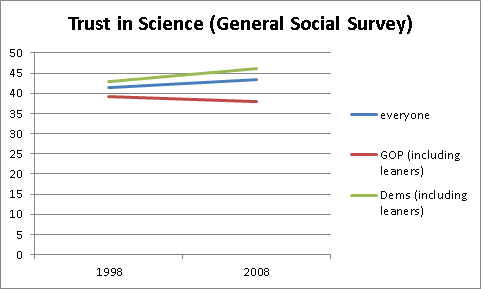
scienceThe General Social Survey has twice asked national samples of adult Americans, “[Do] we trust too much in science and not enough in religious faith?” The graph shows the proportion of people who disagree, i.e., who support the amount of trust we place in science compared to religion. I show results for 1998 and 2008, for everyone and by party.

As might be expected, the party lines diverge, with Republicans becoming less favorable to science when the question is asked this way. To flip the question around, 36% of Republicans said in 2008 that we trusted in science too much, up from 33.5% in 1998. That does not mean that individuals changed their minds; more likely, the composition of the people who called themselves Republicans changed.

But what jumps out at me is actually the relatively high degree of consensus. The partisan difference (as of 2008) was not vast. The population had become more trustful of science, with the exception of Republicans–but the shift for them was small. A plurality of Republicans still shared the view that trust for science was appropriate.

By the way, I report these numbers without a strong implied value-judgment, since I have my own ambivalent feelings about trust in science, especially when it spills over to questions of ethics and justice.

(see also “Is all Truth Scientific Truth?” and “Building Alternative Intellectual Establishments.“)

Edward Snowden and the psychology of whistleblowing

(Washington, DC) After reading many speculative articles about the personality and personal ethics of Edward Snowden, I Googled the name “Fred Alford” to see if he had anything to say on the matter. That is because my former colleague literally wrote the book on Whistleblowers. His subtitle is “Broken Lives and Organizational Power,” and it’s a sad but insightful book. Whistleblowers are usually abandoned by co-workers and friends and defeated by the organizations they take on. They may sacrifice not only their jobs, but also their families. Some of their causes are truly noble, but just as often they are consumed by technical rule-violations, such a minor Medicare reimbursement violations. They are not concerned, Alford finds, about concrete other people. Some wish to avoid being polluted by belonging to an organization that lies. “Most do not talk about the others they are serving except in the most general terms, such as the ‘public.’ In this regard they are different from rescuers.” In situations of genocide, rescuers also act with courage and against the crowd, but they are moved by intense commitment to the individuals they save (p. 67).

David Brooks sees Snowden as an “atomistic” individual: “When a neighbor in Hawaii tried to introduce himself, Snowden cut him off and made it clear he wanted no neighborly relationships. … Though thoughtful, morally engaged and deeply committed to his beliefs, he appears to be a product of one of the more unfortunate trends of the age: the atomization of society, the loosening of social bonds …” Alford, who has almost the opposite normative orientation from Brooks, sees whistleblowers as existential rebels against pervasive and growing conformity.

But Alford also makes a wise point in a Salon piece: “Ultimately, Alford argued, we shouldn’t care what kind of a person a whistle-blower is. [Daniel] Ellsberg, he said, was ‘not necessarily the most saintly human being, but who cares?'” The question in each case is whether leaking was the right thing to do.