Category Archives: Uncategorized

programs for poor people are poor programs

Georgetown Law professor David A. Super argues that the technical problems with the Obamacare website are unusual mainly in their mildness and the degree to which they have been rapidly addressed. Obamacare was heavily scrutinized because of the political stakes for the president–and because many middle-class American voters were trying to use the website. The White House jumped to address the initial failure. But when only poor people are involved, services can be far worse and nothing is done to address errors. Among the “epic” meltdowns that Super lists, Georgia recently neglected to send renewal notices to 66,000 food stamp recipients and then terminated their benefits for failure to respond to the unsent messages.

He cites failures in electronic services, but the adage that “programs for poor people are poor programs” also applies to face-to-face services like policing, health services, and (too often) k-12 education.

The ideological valence of this point is complicated. Progressives (like me) believe that poor state services for poor people should receive more attention; this is a core explanation of social inequities. But in making this point, we are indicting governmental agencies, the very tools we want to use to address inequality and suffering. At a minimum, the argument for more state action requires an extra step: some plausible strategy for improving the quality and responsiveness of state services.

One piece of that strategy may be adequate investment: decent services always cost money. But we know that some urban school systems have high per-student spending and still deliver unsatisfactory education. So cash per recipient hardly guarantees success.

Another piece of the strategy may be political empowerment. The White House jumped to fix Obamacare because voters were mobilized. But voter turnout among poor people is low. That is one reason that leaders don’t care about welfare services. But again, political empowerment is no panacea. Some cities have demographically representative electorates and leaders and still deliver poor results.

The people who most emphasize poor quality in governmental services are reformers who want to disrupt unionized bureaucracies by introducing competition or radical decentralization. I am not talking only about glib politicians, but also about hard-working founders of charter schools and social enterprises. They are usually labeled “conservatives,” but the label can be confusing. Witness the way that charter schools appeal to both left and right, or the scrambled ideological debate about education reform. Some people hold inconsistent views about unionized public services, defending prison and police forces while demonizing teachers and social workers–or vice-versa.

In my book We are the Ones We Have Been Waiting For, and in other work, I argue for culture-change within institutions and communities: the Gramscian “long march,” if you like that kind of terminology. The very concept of “service” needs to change, because citizens who interact with government are more than service-recipients. Market mechanisms may have a place, but markets have special limitations for the delivery of welfare and education. (See also this post on housing vouchers.) Top-down reforms may sometimes do some good, but technocrats always set objectives incompatible with the legitimate values of diverse poor people, and top-down reforms always run out of steam. Serious improvement does require political empowerment, but that does not mean more voting alone. Better skills, better processes, more collaboration, more discussion, and better relationships are essential. Of course, the question is how we can get that–and I do have some suggestions in my book.
is the US a racial democracy?

My friend Jason Stanley and his colleague Vesla Weaver have written an important New York Times piece arguing that the US is a “racial democracy,” by which they really mean a society that fails to be a democracy because of racial injustice. They argue that:

  1. Compared to other Americans and other groups around the globe, African Americans are far more likely to be targeted by the police, arrested, tried, convicted, and incarcerated. These disparities are far out of proportion to any differences in actual criminality.
  2. Involuntary contact with the criminal justice system suppresses political participation. Not only do felony convictions and prison sentences directly block voting, but being stopped, questioned, and/or searched by the police also reduces turnout. Stanley and Weaver note that 90 percent of the times when police stop young minorities, no evidence of wrongdoing is found.
  3. Disenfranchisement is a profound injustice. The authors cite Aristotle to the effect that “humans fully realize their nature in political participation, in the form of discussions and decision making with their fellow citizens about the affairs of state. To be barred from political participation is, for Aristotle, the most grievous possible affront to human dignity.”

I would endorse the argument and even add three points to it:

  • Black students are far more likely to be subjected to harsh discipline within schools, and that has also been found to suppress political participation (whereas feeling that one is a valued member of a school community encourages political engagement). Evidently, the school represents the state and sends a powerful message of exclusion or inclusion.
  • Several studies find that felony disenfranchisement laws depress the turnout of people who were never convicted of felonies, especially African Americans, in part by reducing the amount of election-related activity in their communities. In other words, if many residents cannot vote because they have felony convictions, canvassers don’t bother with the whole neighborhood.
  • Especially in poor minority neighborhoods, police sometimes shut down other forms of civic engagement beside voting. In one of our focus groups in Baltimore, for example, a young man said, “Democracy is … where everybody has an opinion. Like you got some places, it’s dictatorships where the people don’t have any opinion on nothing. … Because like everybody said here they had a situation where the police have come into your neighborhoods and told you all to go back in the house or do this or do that.  You know, so that’s not democracy.”

But although I generally endorse the argument, I do want to raise a complication. If one simply surveys a national sample of young Americans using a high-quality method, young African Americans will report voting at a rate at least as high as that of young White Americans. We find that pattern in our own surveys (calling cell phones as well as landlines), and the US Census finds it, too. According to the Census, 58 percent of African-American youth voted in 2008, the highest turnout rate of any youth racial/ethnic group since 1972. This is a surprising result because educational attainment and income strongly predict turnout, and young Black Americans still lag on those measures. One would conclude that being Black is, net of other factors, a positive correlate of voting.

To be sure, these surveys omit incarcerated youth, a point that Stanley and Weaver make, citing Becky Pettit’s book, Invisible Men: Mass Incarceration and the Myth of Black Progress. The omission of prison populations from polls is a blatant problem, and a subtler bias could arise if the same factors that suppress turnout (e.g., harsh school discipline and unfair encounters with police) also reduce the likelihood of answering a survey.

Nevertheless, the high turnout of young African Americans who participate in surveys is a significant fact. Stanley and Weaver say, “one in 9 young black American men experienced the historic 2008 election from their prison and jail cells.” That implies roughly six percent of all young Blacks (including women), and even subtracting that proportion from the turnout rate in surveys would still leave a high level of voter participation. We wouldn’t predict that pattern if all we saw was a set of White-dominated institutions suppressing Black political participation. They try to do that, but they get some pushback. African Americans respond by mobilizing, with some support from outside the community. This does not excuse the injustice, but I think we get a distorted picture of “democracy” if we see only the policies of official institutions and neglect the agency of citizens.

a symposium on civic studies

(New Orleans) I am here for a daylong symposium on “Civic Studies” at the Southern Political Science Association. It starts with an author-meets-critics session about my book, which is offered as one example of civic studies, along with Paul Dragos Aligica’s new book, Institutional Diversity and Political Economy: The Ostroms and Beyond.

According to our latest definition:

  1. Civic studies is the intellectual component of civic renewal, which is the movement to improve societies by engaging their citizens.
  2. The goal of civic studies is to develop ideas and ways of thinking helpful to citizens, understood as co-creators of their worlds. We do not define “citizens” as official members of nation-states or other political jurisdictions. Nor does this formula invoke the word “democracy.” One can be a co-creator in many settings, ranging from loose social networks and religious congregations to the globe. Not all of these venues are, or could be, democracies.
  3. Civic studies asks “What should we do?” It is thus inevitably about ethics (what is right and good?), about facts (what is actually going on?), about strategies (what would work?), and about the institutions that we co-create. Good strategies may take many forms and use many instruments, but if a strategy addresses the question “What should we do?”, then it must guide our own actions–it cannot simply be about how other people ought to act.

The phrase “civic studies” was coined in 2007 in a joint statement by Harry Boyte, University of Minnesota; Stephen Elkin, University of Maryland; Peter Levine, Tufts University; Jane Mansbridge, Harvard University; Elinor Ostrom, Indiana University; Karol Soltan, University of Maryland; and Rogers Smith, University of Pennsylvania.

Civic studies is not civic education. Nor is it the study of civic education. However, once it is fully developed, it will influence how citizenship is taught in schools and colleges.

great job openings in civic renewal

(en route to New Orleans via DC) Occasionally, I post open positions in the civic renewal field. These seem especially exciting.

Hewlett Foundation, Program Officer for Special Projects

This person will orchestrate Hewlett’s grantmaking in support of campaign and election reform across the states. See http://www.hewlett.org/about-us/careers/program-officer-special-projects

Community-Campus Partnerships for Health Executive Director

CCPH is a national leader in community-based participatory research. It seeks a new Executive Director beginning on September 1st. With CCPH operating in a virtual environment, the person can be located anywhere in the U.S. Application review begins on February 24th. For the position description and application instructions, see “what’s new” at http://ccph.info

Jonathan Tisch College, Tufts University, Special Projects Administrator

(Come work with me!) The Jonathan M. Tisch College of Citizenship and Public Service prepares Tufts students to become engaged public citizens and community leaders. Reporting directly to the Dean of the Jonathan M. Tisch College of Citizenship and Public Service, the Special Projects Administrator (SPA) will provide a range of programmatic and administrative supports to further the mission of the College and extend the impact of its Dean.

Applicants may apply via the Tufts University employment website under requisition ID number 2338: http://www.tufts.edu/home/jobs/

The Presidio Trust (San Francisco) Leadership Education Manager

The Presidio Trust is a Federal government corporation that manages and protects the Presidio of San Francisco. The Trust is now accepting applications for a Leadership Education Manager who will  develop and oversee exciting programs such as the Presidio Leadership Experience and Cross Sector Leadership Fellows Program. See http://www.presidio.gov/about/jobs/Pages/Leadership-Education-Manager.aspx

the Times’ poverty map

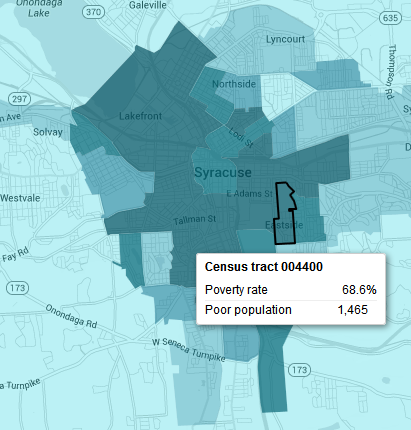
On the 50th anniversary of the War on Poverty, I recommend playing with the New York Times’ remarkable zoomable map. Click on both views: the percentage and the number of people who are poor, because they tell different stories.

I do have some questions about accuracy or validity. For instance, this is my hometown of Syracuse, NY. Almost all of it is at least 30% poor, which I am sure is true. The Census tract in which I grew up is outlined. More than two-thirds of the residents of that tract are considered in poverty. That is a high rate. Philadelphia’s poverty rate is 26.7%, and Baltimore’s is 24.5%. I cannot find any Census tract inside Baltimore City that matches the poverty rate of my home neighborhood. And the tract just to the west of ours is even worse, at 82.4% poor.

Syracuse

But that tract includes Syracuse University and its student housing. Even granting that SU is in a poor area of a highly stressed, post-industrial city, I find it misleading that these two tracts are poorer than anywhere in Baltimore or Philadelphia. I suspect that students are missing from the Census data, and that is one of several sources of error. Another possibility is that the Census tract is actually too large a unit to be fully meaningful. Several of the Syracuse tracts bridge quite different neighborhoods.

Still, as you zoom outward, a powerful picture of US poverty emerges.