Category Archives: Uncategorized

Saul Alinsky on video

I am teaching about Saul Alinsky (with due consideration to both his strengths and his weaknesses). I enjoyed showing my class actual footage of the man at work–from a 1968 Canadian documentary.

In this excerpt:

[o:00 to 0:55] A Chicago woman complains about rats the size of cats in her apartment. This is not a “one-on-one” interview in which she tells her own story and displays her agency as a human being. It is a documentary filmmaker’s invasion of her apartment to demonstrate her poverty. However, it does reveal some of the problems that would emerge in a one-on-one.

[0:55-1:42]: Two Alinksy-trained organizers plan “direct actions,” including pickets and a rent strike. In the ideal model, they would choose the topic and target only after much consultation with residents in one-on-ones and house meetings. But sooner or later, they would have to deal, as they do here, with practical issues like babysitting the moms who picket. By the way, a rent strike is a classic collective action problem: an individual renter who fails to pay will be evicted, but a whole building can obtain relief from the landlord if they act together. Even a picket line works a lot better if everyone joins it. That’s why I enjoy this exchange between the organizers at 0:58:

How many tenants in the building?

Ah, the building has, I think something like 27-30 tenants.

Tell you what–why don”t we turn out all 30 of them?

[1:43-3:40] A dignified picket line and some interaction with police.

[3:40-5:15] A debate with a neighbor (a young White man) who doesn’t like to see picketing on his street. The resident seen earlier talking about rats in her bedroom expresses herself pretty effectively.

[5:15-6:41] Alinsky himself, trying to establish his credibility as an anti-racist organizer with a group, probably from Dayton, OH, that is considering hiring him.

[6:41-8:09 ] The committee deliberates on whether to employ him.

In the next segment, he argues with a Canadian hippie about building utopian alternatives. (Alinksy is against.)

Chua and Rubenfeld, The Triple Package

The new book by Amy Chua and Jed Rubenfeld (The Triple Package: How Three Unlikely Traits Explain the Rise and Fall of Cultural Groups in America) is stirring controversy, as it was meant to do. The authors are nothing if not successful marketers.

I don’t agree with critics like Sekuta Mehta who argue that exploring the relationship between cultural traits and prosperity is racist. If a culture is a cluster of norms, preferences, habits, and values, than each culture will be more or less consistent with the culture of capitalism. Consistency with capitalism will confer advantage, and we should understand that.

Chua and Rubenfeld should not be condemned just for arguing that culture matters. But I think they fail in two other ways, and these weaknesses bother me less for ideological reasons than because I don’t like to see senior academics ignoring complexity and rigor in order to publish best-sellers that would not pass even the most ideologically open-minded peer-review process. In other words, I am not offended by the conclusion but by the methods.

First, their empirical argument is deeply problematic. They identify eight prosperous US ethnic groups and, after rejecting other explanations for their economic success, insist that the essential reasons must be three cultural traits (a sense of superiority, a sense of insecurity, and impulse control). This is the kind of method that persuaded physicians, for many centuries, to use leeches to bleed patients. Look at my eight most successful medical cases–people who recovered from mysterious illnesses. What do they have in common? I bled them all. Ergo, leeches work. You don’t have to be a fool to think this way, but the scientific method works much better.

When studying the impact of culture on prosperity, the scientific gold standard (an experiment) may not be possible. But one must at least avoid selection bias to choose large and representative samples, measure each case using independent data, and rigorously consider multiple explanations. In this case, you would look at all US ethnic groups (poor as well as rich) and treat their median income or wealth as a function of many plausible explanations that can be reliably measured. Cultural factors might or might not emerge as significant predictors in a multivariate model. You won’t find out from Chua and Rubenfeld.

The second problem is their very thin moral (or normative) framework. Assume that having a sense of cultural superiority conveys competitive advantage in a market economy–what of that? The authors do raise the point that striving for material success may not be the best way of life, but that is an aside. Surely, each of the grand ideas in their book–a sense of superiority, insecurity, delayed gratification, and wealth itself–is problematic.

More rigorous research than theirs brings into focus other ways in which fitting well with capitalism can be morally troubling. For instance, Annette Lareau finds that middle-class siblings are quarrelsome because they are raised to see each experience as an investment in their own success. If Brother has to wait during Sister’s violin lesson, that is a waste for him, and he acts out. Working-class children are much better at cooperating and more cheerful about it, because they are expected to make their own entertainment together. Sister is a potential playmate for Brother.

This is just one small example of the ways in which fitting well with capitalism can deform the soul. Capitalism may also uplift, liberate, and improve. The moral impact of capitalism is a complex and challenging topic, on which Chua and Rubenfeld have little to offer.

That said, we ought to have this conversation and not treat it as inherently offensive. Mehta, for example, decries as racist the claim that culture affects prosperity and ends with his uncle Vipinmama, “who lived every day of his life in the pursuit of happiness” and was wise enough not to fit with capitalism. But that just underlines the importance of capitalism as a culture with which a person may fit–or not. If you live like Vipinmama, you may be happy, but you will not long be rich. We ought to recognize that fact before we decide what to do about it.

Eight years ago, I proposed that we might think of three axes of debate: whether cultural norms affect success; whether material success is a worthy goal; and whether state action can enhance welfare. All combinations of answers to those three questions are tenable. I think I am with people like Pierre Bourdieu and Annette Lareau who emphasize the economic impact of culture while doubting that it is morally good to be materially successful under capitalism. They want to use the state to change the relationship between culture and wealth, thus falling at the front top of this cube (which I explain more fully here):


what it means to serve: three takes

(On the DC-Boston Shuttle) One day in DC, three meetings, three views of “service.”

First, I enjoyed a gathering of leaders who engage at-risk teenagers and young adults in community service as a way to improve their academic success, job skills, and psychological wellbeing. The best of these programs, such as YouthBuild USA, transform lives for the better.

I think that the service component of this kind of program is necessary but not sufficient. It is necessary because the whole rationale and spirit of the organization is colored by the ideal of serving communities (in YouthBuild’s case, by building low-income housing). That gives a moral purpose to the work.

But service is certainly not a sufficient condition of success. These programs also provide caring adults, positive interactions among peers, experience in collaborative decision-making, academic skills, career counseling, personal counseling, and many other benefits. It is possible that a different demanding rationale–not service but rather science, art, or God–might also work. That is no criticism of these service-oriented programs, which create pathways to success. But we should not conclude that by offering service opportunities (alone), we can help at-risk kids succeed. This is my own view, but I sense it’s consistent with the main stream of opinion in the service world today.

Second, I was in the Pentagon–indeed, in the executive suite of the Secretary of the Navy–to witness my dean, Alan Solomont, receive the Navy Award. He got it for his work as US Ambassador to Spain, when he achieved an agreement that allows us to base certain military forces on Spanish soil, dramatically increasingly their value for operations in Europe and Africa. An ambassador negotiating an international agreement serves his country in a very different way from a YouthBuild student constructing a house. Different still are the uniformed officers and NCOs who stood near me in the Pentagon, witnessing the ceremony. But it is all service.

Third, I was with my colleagues at the National Conference on Citizenship, discussing how to use data to assess the “civic health” of American communities. Now the focus broadens to behaviors beyond volunteer service–activities like belonging to associations and attending meetings. And the scale expands from the individual to cities, states, and the nation. But again, it is all part of the same story. At the risk of repeating my formula one time too often, I think the core ideals are deliberation (deciding together what we should do), collaboration (actually doing it, whether for pay or not), and the civic relationships that result. These three components are present in a YouthBuild construction site, a US Navy ship, or pervasively in a community like Minneapolis/St Paul that scores high on measures of “civic health.” They benefit the individuals and the common good.

what Google Streetview has mapped

When I need to occupy 10% of my brain and not get distracted by emails, I have recently been playing the BBC’s Geoguessr game. It drops you randomly on a stretch of road that has been photographed by Google Streetview, and you have to guess where you are. Here is my current high score (click through to see if you can beat me).

bbc

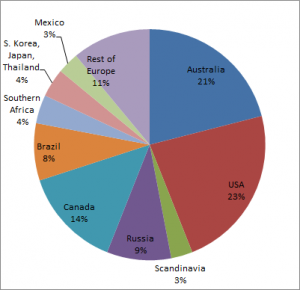
I started to wonder which roads Google has photographed so far. Certain kinds of scenes kept coming up, whereas vast nations (India, China, Nigeria) are entirely missing. Here is the breakdown based on 100 locations.

Streetview

It’s very much an index of road mileage per country in the nations that have been mapped so far, which, in turn, tend to be the wealthier nations of the world. So Australia has roughly 0.3% of the world’s people but 21% of the Google Streetview mileage. (Those “kangaroo crossing” signs are dead giveaways.)

Very common scenes: stretches of two-lane US or Australian highways going through arid open land; long, straight, traffic-less roads through boreal forest; Brazilian highways with lots of trucks and motorcyclists. Almost all the European roads wind through old villages–I’ve never hit a city or a stretch of wilderness in Europe.

Based on this sample, I’d say our world is a beautiful place. If you’re randomly dropped on a stretch of road that has been photographed by Google, at worst, it will be in somewhat bleak wilderness. And best, you will have a stunning view of ancient stone farmhouses, snow-capped peaks, or palm-fringed seashores.

We are the Ones on WPFW

WPFW 89.3 FM (Pacifica Radio in Washington, DC and environs) has chosen “We are the Ones We Have Been Waiting For” as the theme of their pledge drive this year. People who pledge $50 to the station this morning get a free copy of my book by the same name (and the station keeps the whole $50). Here is the audio of me on WPFW’s “Community Watch & Comment,” discussing the book. My segment starts halfway through, at about the 33:34 minute mark.

The special offer from WPFW will not last long, but I encourage DC-area folks to support the station.