Category Archives: Uncategorized

Thomas Jefferson and Thomas Picketty

In the earlier times of the colony, when lands were to be obtained for little or nothing, some provident individuals procured large grants; and, desirous of founding great families for themselves, settled them on their descendants in fee tail. The transmission of this property from generation to generation, in the same name, raised up a distinct set of families, who, being privileged by law in the perpetuation of their wealth, were thus formed into a Patrician order, distinguished by the splendor and luxury of their establishments. From this order, too, the king habitually selected his counsellors of State; the hope of which distinction devoted the whole corps to the interests and will of the crown. To annul this privilege, and instead of an aristocracy of wealth, of more harm and danger, than benefit, to society, to make an opening for the aristocracy of virtue and talent, which nature has wisely provided for the direction of the interests of society, and scattered with equal hand through all its conditions, was deemed essential to a well-ordered republic.

Thomas Jefferson, recalling his own Bill for the Abolition of Entails, August 11, 1776

Thomas Picketty has become the world’s best-selling economist with a simple argument. Normally, he says, the people who own capital not only become richer (which would helpfully encourage investment), but their wealth grows consistently faster than the economy. Thus, even if they lounge around–even if they fall into comas–their share of GDP will grow, giving them disproportionate political as well as economic influence. That pattern was suspended for most of the 20th century but is now returning.

Picketty has been called Marxist and anti-American, but Thomas Jefferson shared his concerns. In colonial Virginia, capital took the form of land and slaves. Some of the earlier settlers had put their families on course to dominate the colony by writing wills that passed their estates to their first-born sons and prevented their land from being sold or divided. Since the British were blocking westward expansion, holding together a large estate meant gaining a growing share of the colony’s wealth as the population expanded. Jefferson thought this was a recipe for an “aristocracy of wealth” that was incompatible with republican government. He passed bills to abolish the “entails” that kept family estates from splitting.

Scholars seem to disagree about the economic and social consequences of his legislation. But he saw his own bills as radical efforts and as components of a multi-pronged strategy:

I considered 4 of these bills, passed or reported, as forming a system by which every fibre would be eradicated of antient or future aristocracy; and a foundation laid for a government truly republican. The repeal of the laws of entail would prevent the accumulation and perpetuation of wealth in select families, and preserve the soil of the country from being daily more & more absorbed in Mortmain. The abolition of primogeniture, and equal partition of inheritances removed the feudal and unnatural distinctions which made one member of every family rich, and all the rest poor, substituting equal partition, the best of all Agrarian laws. The restoration of the rights of conscience relieved the people from taxation for the support of a religion not theirs; for the establishment was truly of the religion of the rich, the dissenting sects being entirely composed of the less wealthy people; and these, by the bill for a general education, would be qualified to understand their rights, to maintain them, and to exercise with intelligence their parts in self-government: and all this would be effected without the violation of a single natural right of any one individual citizen. To these too might be added, as a further security, the introduction of the trial by jury, into the Chancery courts, which have already ingulfed and continue to ingulf, so great a proportion of the jurisdiction over our property.

Jefferson certainly should have favored (instead of opposed) the abolition of slavery. But note his explicit class theory; his concern with “future” as well as “antient” aristocracy; and his willingness to use a combination of economic, cultural, legal/governmental, and educational strategies to produce the “foundation … for a government truly republican.” I think the nation’s third president would view today’s proposals for combatting oligarchy as but weak and tentative.

See also: why is oligarchy everywhere? and why is oligarchy everywhere? (part 2).
defining civic engagement, democracy, civic renewal, and related terms

My post entitled “What is the definition of civic engagement?” gets lots of traffic. It does not actually present my definition but a compendium of alternative versions. I have volunteered to draft some new definitions for a particular purpose. This is what I am thinking:

Active citizenship: Working to improve a nation or other community, independent of whether you have legal status as a member of that community. (“You were an excellent active citizen in Massachusetts while you visited here from South Africa.”)

Civil society: The array of nongovernmental organizations and networks that address public issues. Sometimes the definition introduces a qualitative dimension, so that civil society is an array of associations and networks marked by peacefulness, mutual respect, trust, and other virtues. Civil society may include for-profit enterprises as well as nonprofits. (“The government worked with civil society groups to help victims of the storm.”)

Civic education: Any process that strengthens people’s capacity for civic engagement and political participation, at any age and in any setting. (“Newspapers traditionally provided some of the best civic education in America.”)

Civic engagement: Any act intended to improve or influence a community. Often, the phrase has positive connotations, so that engagement is viewed as “civic” to the extent that it meets such criteria as responsibility, thoughtfulness, respect for evidence, and concern for other people and the environment. (“Informed voting is an example of civic engagement.”)

Civic health: The degree to which a whole community involves its people and organizations in addressing its problems. (“Minneapolis/St Paul has the best civic health of large American cities, thanks to a long tradition of strong civic organizations and responsive local government.”)

Civic institutions: The organizations and associated norms and rules that people use for civic engagement. (“Political parties and volunteer groups are two examples of civic institutions.”)

Civic life: For an individual, a life in which civic engagement has an important place. For a community, all the acts of civic engagement and associated norms and values of its members. (“A service experience prepared her for civic life.” “The civic life of Somerville, MA is vibrant.”)

Civic renewal: Efforts to increase the prevalence, equity, quality, and impact of civic engagement. (“Attending a public meeting is civic engagement, but making such meetings work better for the whole community is civic renewal.”)

Democracy: Any system for making decisions in which all the members of the community or group have roughly equal influence, whether they exercise it directly or through representatives. Voting is common in democracies but is not definitive of it. Other means–such as reaching consensus or choosing representatives by lot–can also be democratic; and voting requires other elements to be satisfactory, such as free expression and civil peace. (“An elementary school is not a democracy, but it helps prepare students for democratic participation.”)

Democratic participation: Civic engagement that involves democratic political institutions. (“Petitioning Congress is a form of democratic participation.”)

Politics: Broadly, the means and processes by which people govern themselves and others, using power and influence. One important setting of politics is government, but politics also occurs in other institutions. Politics is not necessarily contentious or zero-sum. (“The Marshall Plan was politics at its finest.”)

Political engagement or political participation: Civic engagement that emphasizes governmental institutions and/or power. (“Voting is a touchstone of political participation in the United States.”)

the kind of organization we need

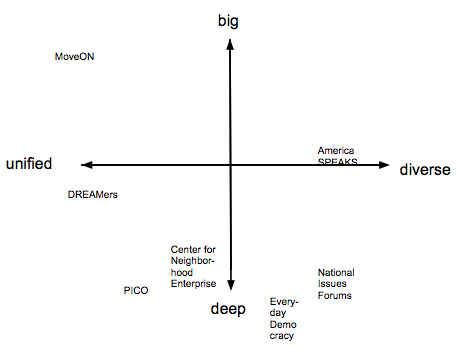
Our important civic organizations can be arrayed from “big” to “deep,” where the big ones touch lots of members, and the deep ones engage relatively small numbers in intensive ways. Meanwhile, the groups can be arrayed from “unified” to “diverse,” where the former organize people who share some common trait–such as an ideology or a social disadvantage–and the latter specialize in convening people who are different from each other. Here are some illustrative examples (with apologies to my friends who are shown below, if you think you should be a placed a little differently).
Screen Shot 2014-05-09 at 3.00.46 PM
The top right quadrant (big and diverse) is empty. Charles Tilly said that all social movements needed WUNC: “worthiness,” “unity,” “numbers,” and “commitment.” If your group is demographically or ideologically homogeneous, you can achieve unity along with numbers pretty easily–you just need the mass membership to demonstrate worthiness and commitment. And if your group is small, you can make it unified by bringing everyone into close relationships with each other.  But if you want all the people in a diverse nation to engage with each other, that requires numbers, commitment, worthiness, and unity in the face of diversity. The nation-state is supposed to achieve that, but it is not working well. It is no surprise that we lack mass, committed organizations capable of generating unity out of diversity–it is a tall order. But we have done better in the past, and we suffer from the lack today.

a conversation about the Millennials and politics

I enjoyed a conversation yesterday on Minnesota Public Radio with host Kerri Miller, my fellow guest Ron Fournier, and many callers, mostly young adults. The topic was billed as “Can the parties motivate young voters to turn out for midterm elections?,” but the discussion was actually much broader than that. It was about the generation’s engagement with politics, civil society, the news, and social entrepreneurship. The audio is here.

intelligence is more like confidence than height

(Washington, DC) According to experimental studies collected by Gregory M. Walton*:

  • You can explain to seventh-graders that people build their intelligence by working and learning, and their grades on math will be better for the whole school year.
  • You can give 7th graders a writing exercise designed to affirm their personal values, and as a result, the Black students will be half as likely to receive a D or an F on the whole course (even though their teacher is blind to whether they did the exercise).
  • You can give fifth graders a test and tell them they scored well because they are smart, they scored well because they worked hard, or just give them their scores. Then give them a very hard test on which they all score poorly. Then give them a third test. Those who were told that they scored high the first time because they were smart will do 30 percent worse on the final assessment–their confidence in their innate ability shaken.
  • You can tell African American college students that items from the GRE are just a puzzle and they will perform as well as white students, but tell them the same items are an intelligence test, and they will score much worse.

As Walton argues, your height won’t change depending on the context, but your score on tests will. That implies that intelligence is–to a significant if not complete degree–relational. It is a measure of how you relate to the immediate environment and the other people in it. Much as I would be far more confident, motivated, secure, and competent in my own living room than on a sound stage, I will be more “intelligent” in some settings than others.

These studies have profound implications for how we should test aptitude, whom we ought to promote and admit in school, college, and work, and how we should design educational institutions.

*Gregory M. Walton, “The Myth of Intelligence: Smartness Isn’t Like Height,” in Danielle Allen and Rob Reich, eds., Education, Justice & Democracy (University of Chicago Press, 2013), pp. 155-172.