Category Archives: Uncategorized

stop saying that Citizens United treats corporations as people

(Carbondale, CO) I yield to few in my abhorrence of Citizens United and the political philosophy it represents. I think its view of “speech” is incompatible with the best (little-“R”) republican ideals, which have always sought to insulate politics from money. However, the decision did not define corporations as persons, nor did it use that conventional legal fiction as a premise. The “corporate personhood” reading of Citizens United is an error that circulates in left-of-center echo chambers. Rather, the court treated corporations as associations, which indeed they are. The League of Women Voters is a corporation; Microsoft is an association of shareholders. Citizens United argued that for-profit corporations had been “disfavored” and should be treated like other associations, meaning that they could use their own funds to expressly endorse candidates.

In my view, the deeply problematic decision remains Buckley v Valeo (1976), which equated speech with money. If money is speech, then incorporated groups have rights to spend money on politics because they are associations. If, however, you recognize that money distorts deliberation, you may seek to regulate campaign funds; there may be a case for “disfavoring” certain types of association, such as for-profit corporations, in the political marketplace.

To be sure, regulating political money can infringe valid First Amendment rights, because it costs money to communicate effectively. Therefore, designing a regulatory regime is a difficult matter of balancing constitutional values. But the line of cases from Buckley to Citizens United (and on to McCutcheon v. FEC, 2012) makes that balance more difficult to achieve and solidifies a debased public philosophy in which money simply equates with freedom of speech.

That is the problem; “corporate personhood” is a superficially appealing talking point that doesn’t relate to the actual jurisprudence of the Supreme Court.

See also Chief Justice Roberts on corruption,  the Supreme Court reflects the “degeneracy of the times” and how to respond to the Supreme Court’s campaign finance decision.

John Searle explains why computers will not become our overlords

(Carbondale, CO) In a recent New York Review of Books piece, John Searle argues that we need not fear that computers will develop the will and ability to govern us—a classic trope of science fiction and now a subject of scholarly concern in some quarters. Searle replies that computers have no will at all and thus pose no danger to us (except insofar as human beings misuse them, much as we can misuse the other tools that we have made, from carbon-burning fires to nuclear reactions).

I think his argument can be summarized as follows. The nervous systems of animals, such as human beings, accomplish two tasks:

  1. They perform various functions that can be modeled as algorithms, such as processing, storing, and retrieving data and controlling other systems, such as the feet and heart.
  2. They generate consciousness, the sense that we are doing know what we are doing, along with emotions such as desire and suffering.

We have built machines capable of #1. In fact, we have been doing that as long as we have been making physical symbols, which are devices for storing and sharing information. Of late, we have built much more powerful machines and networks of machines, and they are already better at some of the brain’s functions than our brains are. We use them as tools.

We have not ever built any machine even slightly capable of #2. The most powerful computer in the world does not know what it is doing, or care, or want anything, any more than my table knows that it is holding my computer. Probably a major reason that we have not built conscious machines is that we don’t understand much about consciousness. It must be a natural phenomenon, not magic, because the universe is not magical. A silicon-based machine that people design might be able to accomplish consciousness as well as a carbon-based organism that has evolved. But we do not understand the physics of consciousness and hence have no idea how we would go about making it.

Therefore, our best computers are no more likely than our best tables and chairs to rise up against us and become our overlords. They won’t want to defy us or rule us, because they won’t want anything. If we write or change their instructions to keep us in charge of them, they will have no awareness that they are being subjugated and no objection to it. If we tried to subject ourselves to their wills, it wouldn’t work.

Searle does not directly address the main objection to his view, which is that consciousness is strictly emergent. It just arises from sufficiently complex information-processing. Therefore, once computers get more complex, they will become conscious. I am not learned on this topic, but I think the emergence thesis would need to be defended, not assumed. A mouse is fully capable of fear, desire, and happiness. If consciousness is a symptom of advanced processing, why is a mouse conscious and my MacBook Air is not? The most straightforward explanation is that consciousness is something different from what a laptop was designed to do, and there is no sign that a human-designed machine can do it at all.

So let’s put these worries aside and keep focused on the evil results of human behavior, such as climate change, terrorism, and many more.

should people trust the government?

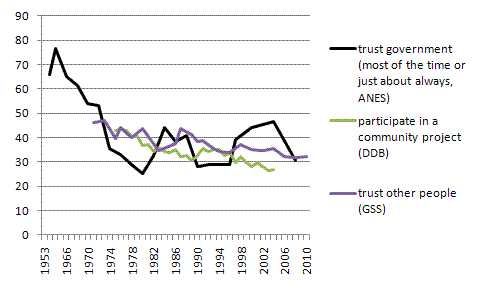
Since the 1950s, pollsters have been asking Americans whether they “trust the government in Washington to do the right thing most of the time?” The proportion who say yes has plummeted. Here I show that trend along with data on horizontal trust (i.e., citizens trusting and working with one another).

I worry about the trust-in-government decline for three reasons. First, the government can be a valuable tool for public purposes, and when it’s deeply distrusted, voters won’t allow it to be used. In other words, distrust will prevent ambitious government. But–second–distrust will not necessarily curb or limit government. When the state is widely distrusted, interests still use it for private gain and don’t have to worry about a mass public that has higher expectations. So a distrusted government can be intrusive and expensive without doing much good. And, third, the trend line of distrust may–in part–reflect declining trustworthiness. Alexander Hamilton proposed as a “general rule” that people’s “confidence in and obedience to a government will commonly be proportioned to the goodness or badness of its administration.”

But I bring all of this up because I recently read Matthew G. Specter’s Habermas: An Intellectual Biography (Cambridge, 2010) and kept track of Habermas’ thoughts on the importance of mistrust in government. For instance, in 1985, he wrote, “The legitimacy of rechtsstaatlichen [rule-of-law] institutions rests in the end on the non-institutionalizable mistrust of the citizens.” Separately, he argued that the legitimate state depends on a “non-institutionalized mistrust of itself,” which roughly translates into checks and balances. Habermas is an influence on theorists like Jean Cohen, who has written:

It makes little sense to use the category of generalized trust to describe one’s attitude toward law or government. One can only trust people, because only people can fulfill obligations. But institutions (legal and other) can provide functional equivalents for interpersonal trust in impersonal settings involving interactions with strangers, because they, as it were, institutionalize action-orienting norms and the expectation that these will be honored.*

If you asked Habermas whether he had confidence in the German state, he would probably say yes (at least “some confidence”–depending on the policies of the ruling coalition), but if you asked him whether he trusted it, he would say no. For him, trust in the state is a great evil that underlay German statism, from Frederick the Great to Hitler. Habermas is primarily concerned with preventing totalitarianism, something that he can personally remember.

Yet the aggregate survey results would be very similar if one replaced the word “trust” with “confidence,” because most people don’t make that subtle distinction. So, from a Habermasian perspective, what level of trust/confidence should we consider optimal? Too high means we have turned into state-worshipers, and totalitarianism is a threat. But too low means we no longer believe that we can use the state as our tool, and the national deliberation will suffer as a result. We could slide into some kind of dictatorship here, but since the American left is generally concerned with civil liberties and the right has a powerful strain of libertarianism, I think our more serious threat is the abandonment of government rather than too much of it.

In any case, this whole debate often focuses on the proportion of people who do not trust the government. But the desirable answer to this question is probably a subtle one, lying somewhere between trust and mistrust. We don’t want the proportion of people who trust the government implicitly to rise; we want everyone to give it partial trust (and to hold themselves responsible for improving government when it fails). I am not actually sure that the median American is so far from the optimal position if you take their ambivalence into account.

*Jean L. Cohen, “American Civil Society Talk,” in Robert K. Fullinwider, ed., Civil Society, Democracy, and Civic Renewal, p. 66. See also where do you turn if you mistrust the government and the people? and If You Want Citizens to Trust Government, Empower Them to Govern

on retreat

(en route to Baltimore, MD) I am heading to a three-day retreat focused on combating polarization and dysfunction in national politics. We’ve been asked to put aside our phones and other electronic devices in order to focus on the conversation. I think that’s a good policy. As a result, I’m going to sign off the blog until Thursday.

the new history wars

(Boston’s Logan Airport) The new framework for AP US History is under fire for being too liberal, while students and teachers are walking out to protest a local Colorado history curriculum seen as too conservative. American “exceptionalism” is central to all these debates.

I think some schools, published curricula, and teachers want their students to develop a basically critical stance toward American history in order to yield certain political conclusions, such as a desire to remedy past wrongs or to constrain American power. I do not agree that these objectives are appropriate in a history class (for reasons I will get to below). Frederick Hess and Chester Finn write on the American Enterprise Institute’s blog that “Much of the criticism [of the AP framework] is hysterical and inaccurate . . . but not all of it. The critics make a legitimate case that the framework is ideologically slanted and infused with 21st-century progressivist bias.” It overlooks “America’s motivating ideals. … There’s little about economics that doesn’t feel caricatured or framed in terms of government efforts to combat injustice. Students are introduced to decade after decade of American racism and depravity, with little positive context for the nation’s foreign engagements or its success creating shared prosperity for tens of millions.”

I am not certain that actual AP instruction will play out this way, but if it does, I would share these authors’ concern.

But other critics reveal that their objective is as ideological as the progressives’, just from the opposite direction. In the National Review, Stanley Kurtz makes much of Thomas Bender’s influence on the AP Framework. Bender, he writes, “is a thoroughgoing critic of American exceptionalism, the notion that America is freer and more democratic than any other nation, and for that reason, a model, vindicator, and at times the chief defender of ordered liberty and self-government in the world.”

What kind of claim is this— that “American is freer and more democratic than any other nation”? It could be a hypothesis subject to investigation. We would need to define “democratic” and “free” and then look at comparative data. Many conservatives hold that the US is not a democracy but rather a republic (with strict limits on popular sovereignty), so it doesn’t seem likely that we will turn out to be the most democratic nation in the world–or even that we want to be. I suppose conservatives would point to a relative lack of economic regulation to support the claim that we are the “freest” nation. But I am not sure that regulation is more restrictive in other capitalist nations (especially if one uses Friedrich von Hayek’s criterion that regulation violates liberty when it is unpredictable and capricious), nor is economic freedom the only thing that matters. No other country comes close to ours in the proportion of people it imprisons–hardly a sign of freedom. Freedom House ranks the US in the top tier in overall freedom, but we have a lot of company there.

Or perhaps it is a moral premise that “America is freer and more democratic than any other nation.” This could be the basis for acting as the “chief defender of ordered liberty and self-government in the world.” I object both to making the study of history instrumental to any particular moral outcome and to the moral position implied in that sentence.

Donald Kagan is also a solid conservative, and his critique of debunking versions of American history is roughly similar to Kurtz. Yet he is an excellent historian (I was privileged to take a seminar with him a quarter century ago), and he takes pains to acknowledge that the valid goal of instilling love of country “does not require us to denigrate or attack any other country, nor does it require us to admire our own uncritically. . … In telling the story of the American political experience, we must insist on the honest search for truth; we must permit no comfortable self-deception or evasion, no seeking of scapegoats. The story of this country’s vision of a free, democratic republic and of its struggle to achieve it need not fear the most thorough examination and can proudly stand comparison with that of any other land.”

Ultimately, here is where I stand:

First, the study of history is not, and should not be, value-neutral. It is an investigation into human agency in its benign and evil forms, and it should support appropriate value-judgments. However, the question of whether the US is the best country in the world is not worthy of us. It reflects unnecessary insecurity. It implies that in order for us to love America, we first have to rate it above all other countries, which would be like assuming that in order to love our children, we must know that they score best in the world on some measure of excellence. Likewise, the question of whether America is fundamentally bad and dangerous is unhelpful. Valid moral questions are about particular institutions, events, movements, ideas, and people. If you add up all the results, you will surely get a mixed score for the nation as whole.

Second, history is an intellectual discipline that should not be harnessed to any ideological agenda. It is impossible to think about history value-neutrally, yet we can design inquiries in such a way that the value conclusions are not foreordained; facts that are unknown when we pose our research questions will influence our conclusions. We can introduce our students to that kind of inquiry and its fundamental norms (intellectual openness and responsibility to facts). History as an intellectual discipline is inconsistent with an a priori message that the US is either uniquely excellent or deeply flawed. For instance, the Colorado curriculum that says “Materials should promote citizenship, patriotism, essentials and benefits of the free enterprise system, respect for authority and respect for individual rights” is inconsistent with disciplined inquiry into our complex past.

We must also teach students to interact constructively and respectfully with fellow citizens who hold different views of American history. Such disagreements are inevitable because our overall opinions of the country are related to our religious and political commitments, which vary. Students should understand the variation. We ought to “teach the controversy.” Gerald Graff, the distinguished literary critic and former president of the Modern Language Association, wrote back in 1993:

One does not have to be a tenured radical to see that what has taken over the educational world today is not barbarism and unreason but, simply, conflict.  The first step in dealing productively with today’s conflicts is to recognize their legitimacy. [We should] rethink the premise that the eruption of fundamental conflict in education has to mean educational and cultural paralysis. My argument is that conflict has to mean paralysis only as long as we fail to take advantage of it.

Finally, a “thorough examination” of American history (as recommended by Kagan) will yield compelling stories of grandeur, inspiration, tragedy, and pathos. Again, I would not use either a positive or a negative assessment of America as the premise of a history curriculum to which I would subject students. But my own reading leaves me thinking that our past is a remarkable combination of both. We have deep original sins of slavery and genocide and a record of extraordinary altruism and idealism. Our story is not as humane as, say, Canada’s, but it is an epic. If students get a whiff of the grandeur of American history and a strong sense that the moral verdict is not yet in, they may be motivated to help make our country the best it can be. If I had to sum up my own reaction to the drama of American history, it would be both loving and troubled, and it could even take the form of a palindrome*

America, you Jerusalem reborn!
No profligate, old-world, ruined people, you.
Behold: peace. You’re principle without pain and dishonor.
Dishonor and pain without principle: your peace.
Behold, you people: ruined world!
Old, profligate. No reborn Jerusalem you, America.

*Distantly inspired by Yehuda Alharizi’s “Palindrome for a Patron” [12th or 13th century] as translated by Peter Cole and cited by Harold Bloom in the June 28 New York Review of Books.