Category Archives: Uncategorized

talking about the youth vote

(Orlando, FL) Here is the audio of an interview I enjoyed doing recently on BYU Radio. The conversation ranged pretty widely, but here are a few excerpts (from their writeup):

Lack of engagement among young people is not entirely their fault, says Levine. “Young people are often just not asked to vote,” says Levine. “If someone knocks on your door, you’re more likely to vote. Young people are often left off those campaign lists because they haven’t voted before or they’re considered unlikely to vote. So that becomes a vicious cycle.” …

There is no shortage of engagement among young people in efforts to improve their world –socially conscious hashtag campaigns, boycotts and protests are evidence of that. But engagement in the formal political process is where today’s youth are lacking, says Levine. “Politics needs to make room for youth. The process isn’t committed to them, it’s not reaching out to them and it’s serving up a complex voting system.”

the left has become Burkean

David Brooks makes a point today that is one of my hobby-horses:

[Edmund] Burke is known as the founder of conservatism, but his thought sits oddly these days with the Republican Party and those who call themselves conservative. The party has become much more populist, supporting term limits and political outsiders over those who have been educated by experience. Most call for pretty radical change to the welfare state. It’s the Democrats who fight to preserve the current structures of Social Security, Medicare and food stamps. It’s the Democrats who have been running ads through this election campaign accusing their opponents of being a bunch of wild-eyed radicals. Are Democrats now the conservators of tradition?

I would say: yes. And I would say the same of the European left and even of grassroots movements that view themselves as to the left of the Democratic Party in the US. I’ve argued that America’s most authentic conservative movement is composed of grassroots groups that emphasize community voice, localism, and sustainability. A characteristic leftist stance today is that a given institution (such as the public schools, higher ed, welfare programs, or public employees’ unions) fails to meet criteria of justice, yet we should defend the institution because it’s better than an untested alternative and because we should respect the experience and commitment of the participants (i.e., the teachers, professors, public employees, and their clients). The most ambitious leftist proposals are mostly patches to keep these existing institutions going, not whole new strategies. Therefore, I’ve posited that Edmund Burke would vote Democratic.

To the extent that other people make this argument, it’s often to score a debating point–either to denounce the left for abandoning its radicalism or to tweak conservatives for failing to recognize that their opponents are now more genuinely conservative than they are. For instance, Andrew Sullivan uses the premise that Democrats are conservative to endorse Obama and denounce both neoconservativism and what he calls “progressivism.”* But I intend this point as an analysis, not a polemic. If the left is the true home of conservatism today, that raises some important questions, but it is not necessarily good or bad.

*Sullivan: “As for our time, an attachment to a fixed ideology called conservatism (which is currently suffused with the zeal and passion Montaigne so deeply suspected) or to an ideology called progressivism (which increasingly regards most of its opponents as mere bigots) does not exhaust the possibilities. A disposition for moderation and pragmatism, for the long view over the short-term victory, for maintaining the balance in American life in a polarized time: this remains a live option. You can see how, influenced by this mindset, I have had little difficulty supporting a Democratic president as the most conservative figure, properly speaking, now on the national stage. You can see why I have become so hostile to neoconservatism whose unofficial motto is ‘Toujours l’audace!'”

Goya’s Familia del infante Don Luis

I’d call this large painting the highlight of the Goya exhibition at Boston’s Museum of Fine Arts:
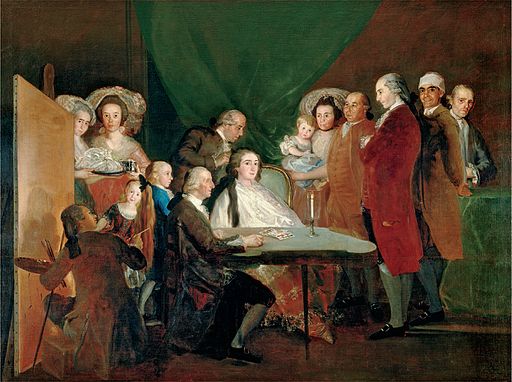
La familia del infante don Luis

Goya depicts himself at the bottom left, painting the Spanish nobleman Luis de Borbón and his family in 1784. Don Luis was a brother of the king who had been sentenced to internal exile for being both a liberal and a libertine. A patron of the arts, he is here depicted with the painter Goya and probably the composer Boccherini, along with his wife, children, and other friends or retainers. The atmosphere is casual, cheerful, and warm. The infante’s wife is shown with her hair down; Don Luis is playing cards; the standing man near the right grins at us; and one of the children is curious in a friendly way about what Goya is doing.

“La Familia del infante Don Luis” must be compared to two other paintings. In “Charles IV and His Family” Goya depicts the monarch and a large retinue visiting his studio. Goya stands in the back behind a large canvass that he is working on. The royal family is dressed formally and splendidly and stands stiffly for an official portrait. The color scheme is cold; the image is crisp and precise; the air is oppressive.

These two family portraits (that of the king and of his brother) are both replies to the most famous work of art in Spain, “Las Meninas” (1656), in which Velasquez depicts some members of the royal family visiting his studio while he works on a canvass.
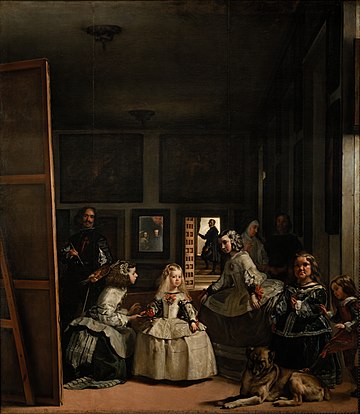
The precise topic of “Las Meninas” is controversial (see this post). The faces of the King and Queen of Spain appear in the mirror behind Velazquez. The mirror could show the painting he is working on, in which case he is touching up a royal portrait while the princess and her servants visit his studio. Or the real King and Queen could be visiting, standing where a viewer stands to see “Las Meninas.” In that case, we have no way of knowing what is depicted on the canvass, but it could be “Las Meninas” itself, which is a portrait of the royal princess and her attendants. Then, on the canvas in front of him, Velazquez would also appear–painting Velazquez, painting Velazquez, painting Velazquez, in a mise-en-abime. On my blog, Colin Dexter once proposed that Velazquez and everyone else in the picture is staring into a mirror set up where we stand, so that the artist can depict himself.

In any case, “Las Meninas” is remarkably three-dimensional, almost like a Vermeer in its uncanny realism. It is ambiguous and complex, with mirrors, paintings within paintings, people looking at people who look at us: an image about images. It is historically significant, marking a moment at which the genius-artist becomes a peer of royals. And it is “iconic,” immediately recognizable thanks to many famous critical essays, reproductions, and replies (e.g., Picasso’s “Las Meninas” series), of which Goya’s are just two.

I presume that the differences between “Las Meninas” and “La Familia del infante Don Luis” are intentional on Goya’s part:

  • “Las Meninas” looks magically “real.” Goya’s painting is matte and sketchy, happy to look like a painting (even though Goya was capable of more polish, as in “Charles IV and His Family”)
  • Velazquez is dashing and distinguished, a courtier from the Age of Absolutism. Goya is informal and comfortable, representing the Age of Reason.
  • Velazquez is painting a massive baroque work, which we cannot see at all. Goya is working on a painting of modest size that would belong in a drawing room.
  • Velazquez stares at us, but we cannot see his work. Goya stares at his subject and lets us see his canvass.

Goya is truly a pivotal figure. He starts working under the Old Regime, painting courtiers in a version of rococo, the frivolous last comer in the long procession of European period styles (Archaic Greek, Classical Greek, Hellenistic Greek, Roman, Byzantine, Romanesque, Gothic, Renaissance, Mannerist, Baroque, Neoclassical, and Rococo–to name just the big ones). But the French Revolution and war come to Spain, rococo peters out, and Goya starts creating strange and original works that are as much about art as they are works of art. He spans the history of art from Fragonard to William Blake and anticipates Expressionism. The MFA’s exhibition is organized thematically rather than chronologically and thus downplays the radical change in Goya’s work, but it offers enough fine and diverse works that you can recreate the story yourself.

(See also this post on Goya’s contemporary Giambattista Tiepolo).

on the importance of measuring civic engagement

Yesterday’s White House Summit on Civic Learning and National Service focused heavily on how civic learning and engagement should be measured at the college level–on the theory that if we don’t measure something, we don’t take it seriously and we can’t improve our practices. Right now, I am on a conference call discussing how ambitiously, and how often, the U.S. Census should survey Americans about our civic engagement. In the midst of these conversations, the National Journal’s Fawn Johnson published an article that drew heavily on the available public data (“Why Are Political Scientists Studying Ice Bucket Challenges?“). She writes:

Levine and his colleagues [who were numerous and more influential than I was] were instrumental in pushing the U.S. Census Bureau to add a series of questions to its Current Population Survey that might capture less traditional types of community involvement. Pollsters began asking respondents in 2008 if they have worked with neighbors to fix a community problem; if they have done favors for their neighbors; or if they are a member of any organization—whether it be religious, recreational, school, service, or sports.

The upshot is that we now know that well over one-third of Americans participate in one or more groups, the most common being religious and school organizations. We know that about 10 percent have served as a group officer or committee member of those organizations. We know that almost half of Americans talk to their neighbors frequently. About one-third of them discuss politics more than once a week.

Lo and behold, when you ask the right questions, the country doesn’t look nearly as disconnected as it might seem to the civics professors who wring their hands when only half of Americans vote.

where I’ve been

Some observations about this map:

Screen Shot 2014-10-15 at 6.14.55 PM

  1. It is creepy that Google knows, automatically from my cell phone, where I’ve been for the past 30 days. (Try https://maps.google.com/locationhistory to track yourself.)
  2. I have been traveling a lot.
  3. This is a great country. We may be running it down a bit. Its people are very divided–including the people I’ve enjoyed meeting over the past month in settings as different from one another as downtown Baltimore and Provo, UT. But it remains magnificent in its natural and architectural beauty and its endless parade of human beings.