It is widely held that if a person votes three times in a row for a given party, she will always vote for that party. (For instance, a CNN “Election Night” segment in 2012 began with that explicit premise). The implication is causal: voting the same way three times makes the person a lifelong Democrat or Republican.
I have not been able to chase down the evidence for this claim in the form of quantitative social science. I admit that I have not searched intensively and may have missed the source. The seminal study by Campbell, Converse, Miller, and Stokes, The American Voter (1960), found a lot of stability in individuals’ partisan identification but devoted a whole section (pp. 149ff.) to “fluctuations in party identification,” which were pretty common. Nearly 40 years later, a sophisticated and well-annotated study like David O. Sears and Carolyn L. Funk, “Evidence of the Long-Term Persistence of Adults’ Political Predispositions” (Journal of Politics 61/1) neither mentions nor supports the “three-times-and-you’re hooked” thesis. These authors find a high degree of stability in partisan preference but much variation, and no magic number of three elections in a row. Both studies (and several others that I reviewed this morning) find that events can change people’s prior voting habits.
The claim has been made for many decades, at least by pundits and political consultants. Thus, if it has any validity at all, it must derive from an era when parties were very different from our parties today. Hence I am highly skeptical that the causal version of the theory will apply in the 21st century–even if it did in the 20th. It will be decades before we know for sure, but I doubt that partisan voting is now habitual.
Parties have changed in two fundamental and pertinent ways. First, until the 1970s, US political parties were ideologically incoherent coalitions of demographic groups. For instance, white Mississippians and Jewish-Americans from Brooklyn both voted solidly Democratic, even though they disagreed with each other on almost every contested issue. As long as a party’s positions were unpredictable and contested, but demographic groups had strong partisan loyalties, then it made sense that people would vote consistently for the party of their heritage. Casting three consecutive votes for the same party did not make people Democrats or Republicans or solidify their identities. It reflected their foreordained commitments.
Now that parties are ideologically coherent, people will still vote consistently if they are strong liberals or strong conservatives. But if they change their views, or hold mixed views, or fall near the ideological center, they may switch allegiances. We will still see a common pattern of consecutive votes for the same party, but it will not be causal. It will reflect relatively durable ideological positions.
The other important change is in the structure of parties. They used to be genuine associations, with ward leaders, county officers, and frequent face-to-face meetings. Now they are (mostly) designations that we select when we register. It seems plausible that joining an association would have influence. If you not only voted three times in a row for Republicans but also formed human connections to local Republican activists, that might indeed cause you to stick with the party. But if there are no local human connections within the party structure, that influence is gone.
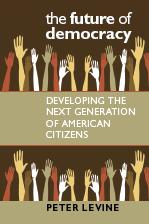 The Future of Democracy: Developing the Next Generation of American Citizens has been selling slowly but steadily since 2007 and has filtered into the literature on youth civic engagement. It has now been issued as a paperback, priced at $23.83. I believe an e-book edition is also coming soon.