Category Archives: Uncategorized

Ducks Unlimited and civic renewal

I had the pleasure today of interviewing Paul Schmidt, the Chief Conservation Officer for Ducks Unlimited, Inc. While Americans are joining traditional associations at lower rates, Ducks Unlimited has a steadily growing base of roughly one million supporters and volunteers, including an increasing number of younger people, some of whom enter through Facebook. (Ducks Unlimited has more than 1 million Facebook “likes”.)

Schmidt explained that civic engagement is crucial to the conservation movement. Ducks Unlimited does not own or manage much land on which waterfowl live. Instead, the organization tries to influence landowners to be good stewards of their land. These owners may be agencies but often are regular citizens. Influencing them is “not a manipulation,” Schmidt added; it is genuine engagement that changes behavior.

In general, Schmidt thought, the “need and desire for affiliation has eroded.” This trend (documented in “Bowling Alone”) is bad for the conservation movement because “belonging and partnering are key elements … to conservation.”

But duck hunters form strong bonds. It is a “unique recreational pursuit” in that sense, different from deer hunting. I asked what turns the social bond of hunting into associational membership, since the social bond of bowling doesn’t seem to produce bowling leagues any more. Schmidt was not sure, but he thought that for many hunters, the real goal is to appreciate nature together. A classic experience is watching the dawn break over a pond with friends. “We capitalize on the experience,” Schmidt told me. People who appreciate nature together can be activated to protect it, whether that is through their stewardship of their private land, voluntary cooperation and collaboration, influencing other people, or supporting policies. “They will do what it takes to make sure [the view] doesn’t get bulldozed.”

the two basic categories of problems

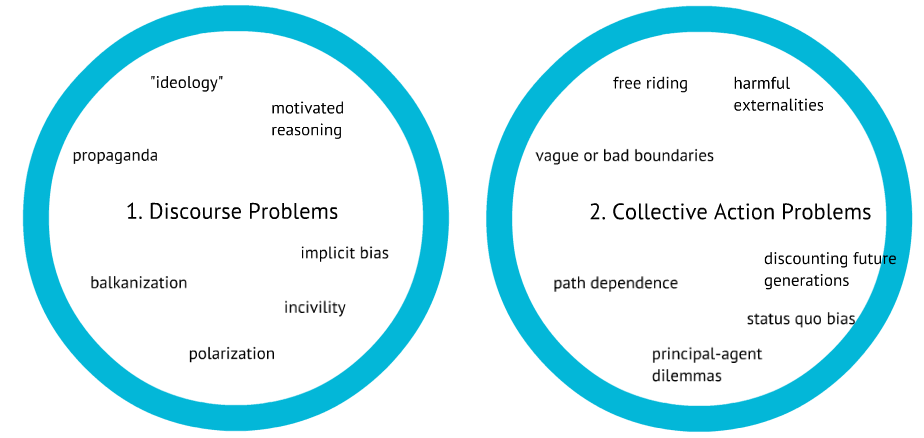
Human beings face two fundamental categories of problems: problems of discourse and problems of collective action.

Problems of discourse make our conversations go badly, so that we believe or desire the wrong things. They include, for example, our unconscious biases in favor of members of our members of our own groups and our strong tendency to “motivated reasoning,” or picking facts and theories because they yield the results we want. A different example is ideology, defined (in this context) as holding a distorted view of reality that preserves the advantages of the privileged.

Meanwhile, problems of collective action cause us to get results that we do not desire, even when we agree about goals and values. An example is the temptation to “free ride” on other people’s contributions, or the extreme cost of changing a system once it has been chosen and developed (“path dependence”).
Screen Shot 2015-02-10 at 10.20.04 AM

How can I justify the claim that these are the two fundamental categories of problems? My claim is subjective, but it does arise from 20 years of thinking about social problems, during which I have constantly found myself drawn to two quite different conversations. One is about deliberation, communication, and the flaws thereof. The most relevant disciplines are political philosophy, cultural studies, and communications. Famous authorities include Marx and the Frankfurt School, Habermas, Derrick Bell, John Rawls, Judith Butler, and many more. The other conversation is about rational choice, public choice, and game theory. The most relevant disciplines are economics and social psychology. Authorities include Elinor Ostrom, James M. Buchanan, Mancur Olson, and Kahneman & Tversky.

The two sets of problems are connected. For instance, one explanation of motivated reasoning is that to choose the most convenient facts is easier than giving all the evidence a full and rigorous consideration; and we can get away with the easier path because we can free-ride on other people’s intellectual labor. Thus the discourse problem of motivated reasoning is linked to a basic collective action problem.

Yet neither set of problems is, in my view, reducible to the other. For instance, a very ambitious game theorist might assume that game-like models can explain all breakdowns of human interaction. But game theory takes as given the values and identities of the players. In fact, those are not fixed but are generated and changed by discourse.

By the same token, some cultural critics might argue that all of our problems arise from distorted discourse, bias, and ideology. But I think that even if we all sincerely agreed about something as important as climate change, problems of collective action would still be formidable. We would not only face the mother of all tragedies-of-the-commons but also challenges of path dependence (e.g., our dependence on internal combustion engines) and boundary issues (the countries that use the most carbon are separated from the big producers).

I am well aware that we also face a whole range of urgent concrete problems not shown above, such as global warming or racism today–or (at other times in our history) plagues and famines and invading hordes. But while those threats are matters of life and death for specific communities, the two categories shown above apply at all times. They establish the form of human interaction, into which are poured such specific content as poverty, racism, authoritarianism, disease, etc.

I was trying to think of a place where demographic diversity would be absent and where there would be such a high degree of consensus about one transcendent goal that the participants would not care about matters like poverty or climate change. In such a place, we might see neither discourse problems nor collective action problems. I came up with the all-male Orthodox Holy Community of Mount Athos, which is now a quasi-autonomous monastic republic within the EU. Although I certainly do not know the details, I quickly found an example of the two generic problems afflicting this community:

In June 1913, a small Russian fleet, consisting of the gunboat Donets and the transport ships Tsar and Kherson, delivered the archbishop of Vologda, and a number of troops to Mount Athos to intervene in the theological controversy over imiaslavie [the belief that the Name of God is God].

The archbishop held talks with the imiaslavtsy and tried to make them change their beliefs voluntarily, but was unsuccessful. On 31 July 1913, the troops stormed the St. Panteleimon Monastery. Although the monks were not armed and did not actively resist, the troops showed very heavy-handed tactics. After the storming of St. Panteleimon Monastery, the monks from the Andreevsky Skete (Skiti Agiou Andrea) surrendered voluntarily. The military transport Kherson was converted into a prison ship and more than a thousand imiaslavtsy monks were sent to Odessa where they were excommunicated and dispersed throughout Russia.

If a bunch of white men who have voluntarily renounced property, sex, and freedom and who are totally devoted to the Orthodox faith can face deadly problems of discourse and collective action, then these challenges seem universal. That doesn’t mean they always defeat us; it just means we always have to work on them.

a USA Today debate about the citizenship exam

USA Today’s editorial board has an editorial today supporting the recent laws in Arizona and North Dakota that require students to pass the federal test designed for naturalizing citizens. The board acknowledges, “Some questions are easy or trivial. But many about voting, the First Amendment, states’ rights and the Supreme Court offer jumping-off points for enticing discussions about current events. In the hands of a good teacher, they can make students realize how much the American system of government affects their lives. The test can provide a floor on civics learning. It doesn’t have to set the ceiling.”

To their credit, the board gave me equal space for an “opposing view.” I argue, “Requiring students to pass the citizenship exam will reduce both the amount and the quality of civic education in our schools.” I conclude:

The citizenship exam requires, for instance, that you know that “27” is the correct answer when you’re asked how many constitutional amendments have been passed. You don’t need to understand reasons for or against those amendments, or have any sense of why they were important.

A month after students pass this test, they will forget the number 27. But they might retain the message that being a good citizen is a matter of memorizing some random information. That seems like an excellent way to turn people off.

civic education and deeper learning

Today, Jobs for the Future (JFF) a national nonprofit that advocates for all youth to gain the skills they need to succeed in the economy, releases a paper entitled “Civic Education and Deeper Learning” by me and CIRCLE Deputy Director Kei Kawashima-Ginsberg. This paper was funded by the William and Flora Hewlett Foundation as part of its Deeper Learning Initiative. It was discussed at a Harvard Graduate School of Education event: “More than College Readiness: Engaging Students in Work and Civic Life.”

The Hewlett Deeper Learning initiative envisions k-12 students “using their knowledge and skills in a way that prepares them for real life.” When deeper lear`ning occurs, students “are mastering core academic content, like reading, writing, math, and science, while learning how to think critically, collaborate, communicate effectively, direct their own learning, and believe in themselves (known as an ‘academic mindset’).” Deeper Learning should occur in all disciplines and should encourage interdisciplinary learning.

In “Civic Education and Deeper Learning,” we argue that k-12 civic education must be strengthened to meet these goals. The best civic education exemplifies deeper learning, but many students receive more superficial and less interactive forms of civics. For its part, the deeper learning agenda must encompass civic education, because among the topics that students must learn to think critically about, discuss, and collaborate on are social and political issues.

We argue that aligning civic education with deeper learning points the way to pedagogical, curricular, and policy innovations that will be overlooked if we think of civic education as merely the acquisition of basic facts about the political system—the view that seems to drive such policies as requiring students to pass multiple-choice civics tests.

recent research on state laws and youth voting

In 2013, we used our own survey data, public data, and a literature review to assemble evidence on the effects of state voting laws on youth. I would say the highlights were:

  • For young people without college experience, the existence of a photo ID law in their state predicted lower turnout in 2012, even after we included many other potential explanations in our statistical models. Photo ID requirements may also disenfranchise some eligible college students, but the law did not lower the college student turnout rate appreciably. The overall turnout effects of new photo ID rules were modest in 2o12, but these laws were met with active opposition that year, so their effects may worsen in the future.
  • Allowing people to register to vote on the same day that they vote had a positive effect on youth turnout in 2012, and that finding is consistent with previous research on other elections.

We have had another election since 2013 and also seen a lot of new research using historical voting data. I would note these findings:

  • Allowing early voting is often thought to increase turnout only among people who are likely to vote anyway, but Ashok, Feder, McGrath, and Hersh find some evidence that young voters who were likely to be targeted by political campaigns in the weeks before the 2012 election (because they lived in high-profile swing states), had higher turnout if they could vote early. The argument here is that young people vote when mobilized, and early voting helps mobilization efforts.
  • Citrin, Green, and Levy find that informing minority voters about photo ID requirements raises their turnout (by informing these voters about the process or by making them angry about the potential barrier to their participation). It does not discourage them from voting. This is an argument for getting the word out, as long as photo ID laws are on the books. It is also a warning that photo ID laws may have worse suppressive power once the salience of these now-controversial laws declines.
  • Another policy option is to allow 16- or 17-year-olds to preregister, so that they are automatically registered on their 18th birthday. That reform has the advantage of allowing outreach to occur in schools and gets youth on the rolls at the earliest possible opportunity. The sooner a young person is registered, the sooner she can be canvassed and mobilized by parties. Holbein and Hillygus find that preregistration boosts youth turnout, and they find that the youth electorate diversifies, so that Republicans do better than they would if turnout were lower.
  • Keith Gunnar Bentele and Erin O’Brien argue that states are more likely to impose restrictive voting measures if they have higher minority populations, higher and/or rising minority turnout, and if the state is both competitive and has a Republican legislative majority. This is circumstantial empirical evidence in favor of the view that these restrictions have partisan motivations.