Category Archives: Uncategorized

community organizing between Athens and Jerusalem

Mark Readhead weaves the more philosophical arguments of my book We are the Ones We Have Been Waiting For into his recent Polity article entitled “Reasoning between Athens and Jerusalem.” I won’t do justice to Readhead’s complex and subtle position here, but a quick précis would go something like this: Habermas advocates “post-secular public reasoning,” in which both religious believers and non-theists (liberals, scientific naturalists, Kantians, Marxists) open themselves up to real mutual learning. “Secular and religious citizens must meet in their public use of reason at eye level. For a democratic process the contributions of one side are no less important than those of the other side.” But Habermas develops this ideal in ways that actually require the religious to “translate” their views into secular terms while not troubling the secular very much. Furthermore, the philosophical dialogues that Habermas envisions can’t build real solidarity among people who disagree about foundational matters. In accounts of faith-based community organizing by Jeffrey Stout and others, Readhead finds more genuine and promising examples of dialogue that is connected to work and relationships:

Contra Habermas, the actors whom Stout describes promote not an impersonal democratic process, but very personal democratic experiences fuelled by passion. Organizers plan intimate “one-on-one conversations, neighborhood walks, and house meetings,” as well as broader assemblies of diverse constituencies. All of these activities illustrate an under-resourced and under-appreciated genre of politics that Levine has called open-ended politics. Open-ended politics have no predetermined goals. Instead, citizens decide what to do as they work together.


Hannah Arendt and philosophy as a way of life

In “Martin Heidegger at Eighty” (1971), Arendt recalled:

The rumor about Heidegger put it quite simply: Thinking has come to life again. … People followed the rumor about Heidegger in order to learn thinking. What was experienced was that thinking as pure activity–and this means impelled neither by the thirst for knowledge, nor the drive for cognition–can become a passion which not so much rules and oppresses all other capacities and gifts, as it orders them and prevails through them. We are so accustomed to the old opposition of reason versus passion, spirit versus life, that the idea of passionate thinking, in which thinking and aliveness become one, takes us somewhat aback.

I first read this passage many years ago. Lacking any enthusiasm for Heidegger, I thought that Arendt was just celebrating her former teacher’s excellence and originality. “Thinking has come to life again” meant that someone as important as Kant or Hegel was again developing a philosophy, and one could study with him.

Now, having read works like Pierre Hadot’s Philosophy as a Way of Life, I think I understand Arendt better. People called “philosophers” have made at least three kinds of contribution over the millennia; Arendt was seeking a union of the three and believed that Heidegger offered it. That’s what she meant by “Thinking has come to life again.”

First, philosophers have interpreted other people’s thought in valuable ways. In this mode, philosophy is form of cultural critique or intellectual history. Describing the rumors about Heidegger’s seminar, Arendt recalled: “the cultural treasures of the past are being made to speak, in the course of which it turns out that they propose things altogether different from the familiar, worn-out trivialities they had been presumed to say. There exists a teacher; one can perhaps learn to think. …”

Second, philosophers have offered arguments: chains of reason that carry from a premise to a conclusion. If you hold the premise and the reasons are valid, you should endorse the conclusion. Following the argument to its end should change your store of beliefs, because now the conclusion should join the list of things you consider true.

Third, philosophers have taught reflective practices, methods of introspection or even meditation. These are different from interpretations of texts, because the process is more personal and creative. If a text is used it all, it is a prompt for introspection. These reflective techniques are also different from arguments, because they can begin with a range of premises and go in unexpected directions. They tend to require practice and repetition to yield their outcomes, which are changes in mental habits, not just lists of beliefs. You can read an argument once and evaluate it. You must introspect many times to have any impact on your psychology.

It makes sense to put these three contributions together because we are reasonable creatures (capable of offering and sharing reasons for what we do), but we are also habitual creatures (requiring mental discipline and practice to change our thinking) and historical creatures (shaped by the heritage of past thought). Reason without acquired habits of self-discipline is empty. But self-discipline without good reasons is blind and can even lead in evil directions. Both are rootless without a critical understanding of the ideas that have come before us.

Hadot argued that the schools of Greek philosophy between Aristotle and Christianity offered reflective practices more than arguments or readings. We misread a work like Marcus Aurelius’ Meditations if we assume that it is a set of conclusions backed by reasons. Instead, we will find there a record of a Stoic’s mental exercises, beginning with his daily thanks to each of his moral teachers. He lists his teachers and other exemplary men by name because he would actually visualize each of these people in turn. The Meditations shows us how.

Martha Nussbaum (in The Therapy of Desire, p. 353) and others have argued that Hadot exaggerated. The ancient Greek philosophical schools all took argumentation very seriously. (I would add that they were serious about interpreting older works, such as those of Plato and Aristotle.) But Hadot’s thesis strikes me as interesting even if he overstated it. The Greek schools combined argumentation with repeatable mental exercises and saw the two as closely linked. In this respect, they resembled the early Buddhist teachers who flourished at the same time. Today, the latter are often stereotyped as merely offering mental exercises (such as yoga), but they excelled at exacting formal argumentation. Indeed, the Buddhists and Hellenistic philosophers were in close contact in Northern India and learned from each other. (I see a distinction between Eastern and Western philosophy as useless, because each tradition encompasses enormous diversity, and the two have been closely linked.)

Hadot claimed, however, that Christianity ruptured the combination of argument and mental exercise that had been common in the Mediterranean and in Northern India before the Christian Era. Christians adopted all the major ideas of the classical Stoics but parceled them out. Abstract reasoning went to the medieval university, where Arendt’s “thirst for knowledge” and “drive for cognition” were prized. Hadot wrote, “In modern university philosophy, philosophy is obviously no longer a way of life or form of life unless it be the form of life of a professor of philosophy.” Meanwhile, the reflective practices went to monasteries.

Arendt perceived Heidegger as putting these parts back together. Reading classical works in his seminar (or in a reading group, called a Graecae) was a creative and spiritual exercise as well as an academic pursuit. Karl Jaspers held different substantive positions, but he had a similar view of philosophy, the discipline to which he had moved after a brilliant career in psychiatry. Elisabeth Young-Bruehl writes that Jaspers’

new orientation was summarized in many different ways, but this sentence is exemplary: ‘Philosophizing is real as it pervades an individual life at a given moment.’ For Hannah Arendt, this concrete approach was a revelation; and Jaspers living his philosophy was an example to her: ‘I perceived his Reason in praxis, so to speak,’ she remembered (Hannah Arendt: For Love of the World, pp. 63-4).

Arendt fairly quickly decided that “introspection” was a self-indulgent dead-end and that Heidegger’s philosophy was selfishly egoistic. Then the Nazi takeover of 1933 pressed her into something new, as she assisted enemies of the regime to escape and then escaped herself. She found deep satisfaction in what she called “action.” From then on, she sought to combine “thinking” (disciplined inquiry) with political action in ways that were meant to pervade her whole life.

That combination is hard to find today, if it can be found at all. Moral philosophy is dominated by an argumentative mode that doesn’t take seriously mental exercises and practices. Meditation is increasingly common but usually separate from formal argumentation and moral justification. Meanwhile, “therapy”–the ancient Greeks’ word for what philosophers offered–has been taken over by clinical psychology. That discipline does good in the world but misses the ancient objectives of philosophy. Modern therapy defines the goals in terms of health, normality, or happiness (as reported by the patient). Therapy is successful if the patient lacks any identifiable pathologies, such as depression or anxiety; behaves and thinks in ways that are statistically typical for people of her age and situation; and feels OK. Gone is a restless quest for truth and rightness that can upset one’s equilibrium, make one behave unusually, and even bring about mental anguish. To recover that tradition, we would need thinking to come alive again.
is our constitutional order doomed?

Mathew Yglesias has brought renewed attention to Juan Linz’ thesis that our constitutional order is doomed. The basic idea is that if the chief executive and the legislature are elected separately, they can belong to different parties. In such cases, the legislature has every incentive to undermine the president, who will respond by expanding executive power. That situation will degenerate until the constitution fails, as it has in almost every presidential system outside the USA. See Yglesias’ Vox piece, “American Democracy is Doomed,” Jonathan Chait’s response (“There’s a Chance American Democracy Is Not Doomed“), and my own post “Are we seeing the fatal flaw of a presidential constitution?

The Linz thesis requires an explanation for why the US system has not already collapsed after more than two centuries. The leading explanation is that we have never actually had two parties in Congress, notwithstanding the labels. Internal party splits have caused us to have at least three–and often four or more–effective parties. Thus presidents have been able to construct governing coalitions even when they face a majority of the opposite party. Reagan, for example, got most of his agenda through Tip O’Neil’s Democratic House because Southern Democrats voted with Republicans on key issues.

Our current situation looks unprecedented because the two parties are now perfectly polarized, with all the Democrats to the left of all the Republicans. Thus the Linz thesis explains paralysis and executive unilateralism under Obama and predicts worse to come.

But then we observe the Department of Homeland Security funding bill pass the Republican House with unanimous Democratic support. Democrats are also saying they would protect Speaker Boehner from a Tea Party effort to unseat him. (The Speaker is chosen by majority rule, so Boehner could hold his gavel with a mix of Republican and Democratic votes). These two examples suggest that Boehner is in the same place as O’Neil during the Reagan Administration. He leads a caucus that formally and rhetorically opposes the president. But sometimes the governing coalition in the House consists of 75 Republicans plus all the Democrats. Boehner is like a Prime Minister whose own party (the Center-Right) is smaller than its coalition partner (the Center-Left) but who alone can command more than 50% in votes of no confidence.

This situation only applies some of the time. Boehner does not like (and will not even acknowledge) his dependence on Democrats. It poses a serious problem for all Republicans, not just for Tea Partiers, because it cedes considerable power to the other party. Thus Republicans will make creative and sustained efforts to change the situation. But to the extent that it prevails, we will return to the classic US pattern instead of dissolving into a Linzian nightmare.

in what ways are Millennials distinctive?

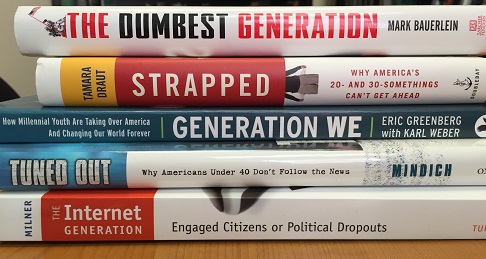
There is a thriving market for generalized portraits of Millennials, whether positive or negative. These are just some examples from my own bookshelf:

Millennial books small

There are interesting things to say about this generation–and about generational change as a phenomenon. But if you look closely, the picture is pretty complicated. Differences among people born at the same time are usually much greater than differences among generations–a point that my colleagues and I have emphasized in much of our work. Also, trends over time rarely point to sharp and stable differences among generations.

So many beliefs and behaviors have been measured regularly over 40 years that it’s hard to generalize, but I’ll pick two trends just to illustrate the complexity.

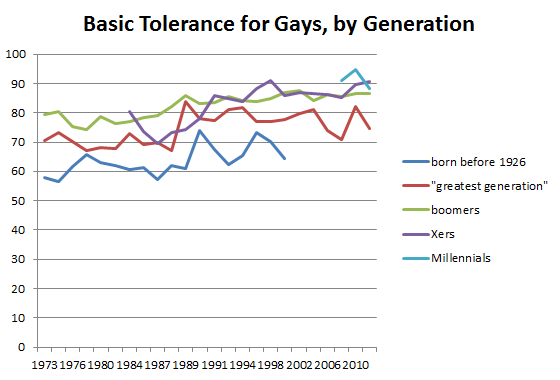
First, it is widely believed, and reasonably so, that attitudes toward gays are generational, changing (for the better, in my view) with each new age cohort. The longest relevant survey time-series that I know is from the General Social Survey, which asks whether a list of types of people should be allowed to speak in one’s community. One person on the list is an “admitted homosexual” man–the terminology itself reflecting a more prejudiced era. The question is imperfect for our purposes because it conflates attitudes toward free speech with views of homosexuality. (Someone might be homophobic yet a First Amendment absolutist.) Nevertheless, the pattern is interesting.

Millenials1

Each generation does enter the adult population with successively more positive views of speech by a gay man–until the Xers, who are no different from, and perhaps slightly less tolerant than, the Boomers who preceded them. Each generation grows slightly more tolerant over its life course, but the main reason for increasing tolerance in the population as a whole is generational replacement. A nation of Millenials will support speech by gay men much more than a nation of people born before World War II.

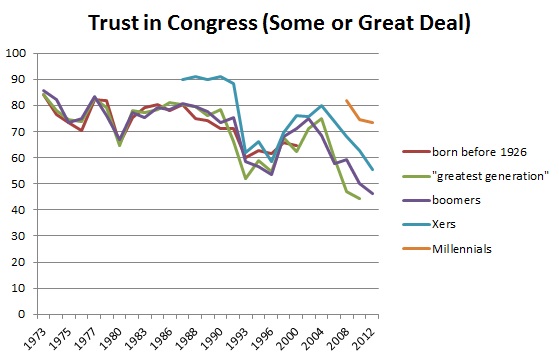
It is also widely believed that younger generations have less trust or confidence in government. This general construct can be measured in many ways. One useful time-series is a GSS question about confidence in the US Congress to do the right thing.

Millennials2

In this case, I see lots of change but little evidence of a generational thesis. The older three generations move in lockstep. Their confidence falls sharply after the Reagan/Tip O’Neil era, recovers from the Gingrich speakership and late Clinton era through 9/11, and falls subsequently. They are all seeing the same political situation and reacting similarly. Generation X does start at a much higher level in the 1980s. They also rise more in the middle of the George W. Bush administration. I would chalk this up to partisanship (since Xers have been somewhat more Republican than other cohorts), but the question concerns trust in Congress, and the Xers’ early trust is in a Democratic House. As for the Millennials, they enter with higher confidence than their parents show at the present time, but with similar views to older generations when those were young.

Overall, I would not describe this graph as evidence of a generational story but as an illustration of a “period effect”: everyone, regardless of age or birth year, has similar views of the current situation in Congress, and everyone is prone to fairly rapid changes depending on their perception of recent news from DC.

See also: a generational shift leftward?support for abortion rights: a generational storytolerance & generational changetalking about this generation; and young people and trust in government.

exemplary civic science: the CAFEH project

Highways produce very fine particles as pollutants. These particles concentrate close to the roads and are seriously dangerous for the people who live in range.

Neighborhood activists who were concerned about pollution from I-93 (which cuts through Somerville, Boston’s Chinatown, and Dorchester in our metro area) approached my colleagues at the Tufts University School of Medicine to study the problem. That began an elaborate, multi-year collaboration called CAFEH, the Community Assessment of Freeway Exposure and Health Study.

As an example of the scientific work, an especially equipped RV drove a fixed route close to and then away from I-93, collecting air samples for more than 50 days. Individuals both close to and further from the highway were interviewed in their homes (in many languages) and asked for blood samples. The resulting dataset showed conclusively that highway exposure is dangerous. In subsequent stages, the CAFEH team has been exploring strategies for mitigating these effects, including new filtration units.

This was civic science because neighborhood activists identified the topic and the hypotheses. They also played an essential role in recruiting human subjects. They were at the table throughout the project, deliberating about essentially normative or political questions. (For instance, would it be better not to build housing near highways at all, or would that give up on valid objectives, such as affordable housing and urban density?) The project built strong partnerships among the university, community organizations, local elected officials, and even developers, some of whom are now actively committed to filtration. Those are all signs of civic work or, in Albert Dzur’s terms, “democratic professionalism.”

At a public event on CAFEH today, I said that Tisch College has been proud to support the project throughout. We are not experts on pollution, health, or urban planning. We are a college of “citizenship and public service.” We recognize that institutions like Tufts, the NIH and EPA (which contributed funds to this study), and science writ large are powerful. Their power leaves ordinary citizens feeling marginalized. Thus to strengthen our democracy and civic life, we must make science more democratic. But how to do that? Not by asking laypeople to vote on whether ultrafine particles cause cardiovascular disease or by erasing the distinction between science and lay knowledge. The best way is the kind of painstaking collaboration that CAFEH exemplifies. Scientists really had to learn communities’ needs, values, and interests. And laypeople really had to learn the science of air pollution. They held each other accountable for demanding work. Greatly expanding the scale and scope of such projects seems to me one path to civic renewal in America.