Category Archives: Uncategorized

Kei Kawashima-Ginsberg to lead CIRCLE

I am thoroughly delighted about this announcement:

Kei Kawashima-Ginsberg has been named the new director of Tisch College’s Center for Information and Research on Civic Learning and Engagement (CIRCLE).

Dr. Kawashima-Ginsberg served as deputy director of CIRCLE since 2013, and has been a senior researcher with the team since 2008. She will be the third director in CIRCLE’s 14-year history, succeeding Peter Levine, who will remain active with CIRCLE while overseeing all of Tisch College’s research in his role as Associate Dean, and founding director William A. Galston, now of the Brookings Institution.

“It’s truly a privilege to serve as CIRCLE’s next director. I look forward to helping deepen our collective expertise and impact on opportunities for civic and political development among young people who are marginalized or disadvantaged,” said Kawashima-Ginsberg. “These young people are virtually shut out of public life, and our research can help identify barriers, test solutions, and transform the dialogue about the engagement of young people in our country.”

Kawashima-Ginsberg brings her extensive experience overseeing CIRCLE’s core research projects and producing resources, scholarly works, and reports for practitioners and researchers alike. With a background in positive youth development and an interest in diverse and marginalized youth, Kawashima-Ginsberg is primed to bring a sharpened focus to this important dimension of CIRCLE’s work. She is ideally prepared to provide organizations, communities, and the public with research that will increase civic and political learning and engagement opportunities.

Among her research projects at CIRCLE, Kawashima-Ginsberg has led studies on the leadership and political development of women and girls, the social class divide in the extracurricular experiences of youth, and the diversity of Millennials.

“Kei is the perfect choice to lead the next phase of CIRCLE’s development,” said Levine. “Her impressive background in youth development brings an important perspective to our work. She has been our lead researcher since 2008 and played an essential role in all of our activities. Many colleagues, both practitioners and scholars, already know her as a superb scholar and leader. I am excited to continue to work with her as she takes CIRCLE in important new directions.”

As Tisch College’s Associate Dean for Research, Levine will remain active in CIRCLE’s research and will support the organization.

Kawashima-Ginsberg earned her Ph.D. in Clinical Psychology with Specialization in Children and Families from Loyola University Chicago and has extensive experience in working with youth of diverse backgrounds both as a researcher and practitioner.

As it says above, I will remain deeply involved with CIRCLE–and more broadly with the research of Tufts’ University’s Tisch College of Citizenship, of which CIRCLE is a key part. In fact, my time commitment will not diminish. At the same time, Kei will be the true leader of CIRCLE, and that represents an enormous opportunity to develop and strengthen the organization in the service of youth civic engagement.
Frontiers of Democracy 2015

Frontiers of Democracy 2015
June 25-27
145 Harrison Avenue, Boston, MA 02111

To register and hold a place at the 2015 conference, please use this form. The conference venue is in downtown Boston, easily accessible from hundreds of hotels. Participants are responsible for arranging their own lodgings.

While powerful forces work against justice and civil society around the world, committed and innovative people strive to understand and improve citizens’ engagement with government, with community, and with each other. Every year, Frontiers of Democracy convenes some of these practitioners and scholars for organized discussions and informal interactions. Topics include deliberative democracy, civil and human rights, social justice, community organizing and development, civic learning and political engagement, the role of higher education in democracy, Civic Studies, media reform and citizen media production, civic technology, civic environmentalism, and common pool resource management. Devoted to new issues and innovative solutions, this conference is truly at the frontiers of democracy.

Most of Frontiers is devoted to interactive discussions and learning exchanges, but we do offer very short, provocative, invited talks. The “Short Takes” speakers for 2015 will include, among others:

Harry Boyte leads the Center for Democracy and Citizenship at Augsburg College. Boyte has been an architect of a “public work” approach to civic engagement and democracy promotion, a conceptual framework on citizenship that has gained world-wide recognition for its theoretical innovations and its practical effectiveness.

Hahrie Han teaches political science at Wellesley College. His two most recent books are How Organizations Develop Activists: Civic Associations and Leadership in the 21st Century and Groundbreakers: How Obama’s 2.1 Million Activists Transformed Field Campaigns in America (co-authored with Elizabeth McKenna)

Diana E. Hess is Senior Vice President of the Spencer Foundation and Professor of Education at the University of Wisconsin-Madison. Her most recent book, with Paula McAvoy, is The Political Classroom: Evidence and Ethics in Democratic Education.

Caroline W. Lee teaches sociology at Lafayette College. Her most recent books include Do-it-Yourself Democracy, based on her ethnography of the public engagement industry, and Democratizing Inequalities, an edited volume with Ed Walker and Mike McQuarrie about the dramatic expansion of democratic practices in an era of stark economic inequalities.

Abhi Nemani is currently the first Chief Data Officer for the City of Los Angeles. Formerly, he helped build, launch, and run the national non-profit, Code for America.

Ajume Wingo teaches philosophy at the University of Colorado Boulder. His last book is entitled Veil Politics in Liberal Democratic States, and he is collaborating with Michael Kruse on The Citizen, a book about how Africans can move beyond where their history has put them and begin to make their own future and secure their own political freedom.

Brenda Wright is Vice President of Legal Strategies at Demos.  She has led many progressive legal and policy initiatives on voting rights, campaign finance reform, redistricting, election administration and other democracy and electoral reform issues and is a nationally known expert in these areas.

Frontiers is sponsored by the Jonathan M. Tisch College of Citizenship at Tufts University, which is the host, along with the Deliberative Democracy Consortium and The Democracy Imperative.

civics in the Senate education bill

Reauthorizing the Elementary and Secondary Education Act (which has been known for the past decade as “No Child Left Behind”) will be a tortuous and uncertain process. But at the moment, the leading contender is the “Every Child Achieves Act,” negotiated by the Senate education committee chair, Lamar Alexander (R-Tenn.) and the ranking member, Patty Murray (D-Wash.). The text is here. It is 601 pages, covering most aspects of k-12 education in the United States. But for those of us most deeply concerned about educating the next generation of American citizens, these are the golden words:

‘‘SEC. 2304. NATIONAL ACTIVITIES. (will receive 5% of this Part’s funding)
‘‘(a) PURPOSE.—The purpose of this section is to  promote innovative strategies to promote innovative history, civic, and geography instruction, learning strategies, and professional development activities and programs for teachers, principals, and other school leaders, particularly for low-income students in underserved areas.
‘‘(b) IN GENERAL.—From the funds reserved by the  Secretary under section 2301(b)(3), the Secretary shall award grants, on a competitive basis, to eligible entities for the purposes of—
‘‘(1) developing, implementing, evaluating and disseminating for voluntary use, innovative, evidenced-based approaches to civic learning and American history, which may include hands-on civic engagement activities for teachers and low-income students, that demonstrate innovation, scalability, accountability, and a focus on underserved populations; or
(2) other innovative evidence-based approaches to improving the quality of student achievement and teaching of American history, civics, and government in elementary schools and secondary schools.
‘(c) PROGRAM PERIODS AND DIVERSITY OF PROJECTS.—
(1) IN GENERAL.—A grant awarded by the Secretary to an eligible entity under this section shall be for a period of not more than 3 years.
‘‘(2) RENEWAL.—The Secretary may renew a  grant awarded under this section for 1 additional 2- year period.
‘‘(3) DIVERSITY OF PROJECTS.—In awarding grants under this section, the Secretary shall ensure that, to the extent practicable, grants are distributed among eligible entities that will serve geographically  diverse areas, including urban, suburban, and rural areas. …

Civic education badly needs innovation. Innovation costs money. The federal government should support innovation (along with rigorous assessment). That is one of its most valuable and least controversial roles. States won’t pay for elaborate innovation because the benefits are shared nationally but they would bear the costs. Foundations can help to a limited extent, but they don’t have enough money. The feds should pay for the next generation of civic education–Civics 2.0, civics that is more effective, more engaging, harder, and more fun than what we received. And if this bill passes, they will.

a deep dive on deep dives

Suddenly everyone wants to do a “deep dive” into every subject. Today, for instance, Pew offers a “Deep Dive into Party Affiliation.” The phrase appears in The Ridiculous Business Jargon Dictionary right after “decruit,” an Orwellian term for firing someone. I would have said that metaphorical uses of “deep diving” were much less common even a year ago, but these things are hard to measure. Books always provide a lagging indicator and don’t necessarily catch up with spoken language even after a delay. But the Google book trend for the phrase “deep dive” is interesting. It shows a rapid increase in the 1970s, a bear market for deep diving in the 1980s-1990s (my impressionable years), and then a steep upward slope until 2008, which is the last year of available data.

To decode the scale: this graph means that one of every five million phrases in printed books in 1972 was the phrase “deep dive.” Some uses probably referred to pearl fishers and Soviet submarines. But the increase could reflect an emerging business metaphor.

The word “cliché” was invented by French printers in the age of moveable type to refer to a precast word or phrase that could be dropped into text for efficiency. I don’t think you would bother to forge a cliché for the word “deep dive” as long as it stayed at the level shown above. Thus it isn’t literally a cliché. But two parts in every ten million seems like plenty to me.

Discovering Justice and civics for young children

Screen Shot 2015-04-02 at 11.33.00 AM The Annual Benefit dinner for Discovering Justice is this evening, and I’d like to take the opportunity to highlight the organization, on whose board I serve. It is the most significant and effective group in the US that supports the civic education of younger children, grades k-8.

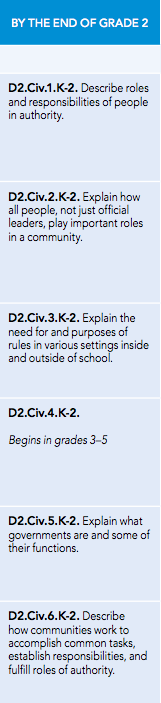
Relatively little is known about the lasting effects of civics at the lower grades–or even about what works best. Certainly, “civics” for younger children overlaps with character education, interpersonal skills, and personal behavior. It’s not all about laws, systems, and social issues. Discovering Justice takes a holistic approach. Still, even if we define “civics” narrowly, it is an appropriate topic for elementary students. The C3 (College, Career, and Citizenship) Framework identifies fairly specific civics content for grades k-2, shown at the right.

Kids are definitely able to learn these things. I cannot demonstrate that if they do, it will make a difference once they’re 30–especially if they get no reinforcement in between. But I’d be willing to bet that teaching these topics in elementary school is one component of an effective civic education. And the only way to find out is to develop, refine, improve, and test k-8 civics, which is the role that Discovering Justice has taken on.